Leadership, Communication, Handshakedness

l4

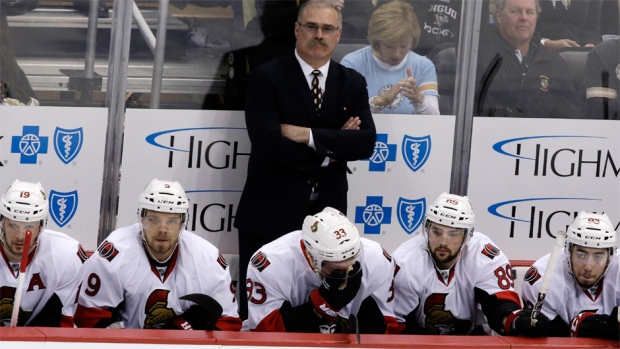
I was reading through some of Yost’s posts and found this recent one with quotes and analysis from and about Paul MacLean.

What strikes me about MacLean’s quotes here are 1) he really has no idea what anyone is talking about when they reference the changes he made in the way he communicates with his players, even though his general manager pointed to that communication as one of the primary issues behind the team’s poor performance and 2) not only can he not really change how he communicates if he’s not aware of how his communications have changed, but he views being disingenuous or not true to oneself (meaning, to change his approach at all) as a threat to the team’s performance: “When you’re trying to be something that you’re not, that’s never going to work.”

Let’s forget for a second that fans are left in an infuriating Catch 22-like moment where the GM thinks the best way to move forward is for the coach to change and the coach thinks the worst thing to do is to change at all. What I think is more important is the sense that the organization, or at least the media who have the opportunity to fixate on issues and ask questions of the organization, continue to fixate on more ephemeral, unsatisfying, cultural issues as the driver of the team’s poor play.

When Cory Clouston was head coach, the media and blogs jumped on Spezza’s offhand comments about poor communication and blew it up into the primary reason the team bottomed out. I’m seeing a lot of similarities between that year’s team and this one, in the sense that we’re once-again fixating on either a lack of leadership in the dressing room (whatever that means), which may result in shipping out the team’s most talented forward, or, again, on the coach’s need to be better at or do more communicating.

The point of these terms is that they’re stand-ins that scale conveniently in size according to how much information you have and need. In the absence of information about how a team intends to act next, or how much money they intend to spend on payroll, we’re forced, as fans, to take legitimate but possibly tiny issues and blow them all out of proportion. This pressure, in turn, must surely inform team marketing, which looks at the types of players fans prefer, the kind of merch they buy, etc. Is this how you end up with a team fixated on acquiring or failing to acquire Gary Roberts, possibly firing a GM over it? Is this is how you end up giving Chris Neil and Chris Phillips extensions despite every underlying number speaking to their inefficiency? I don’t know. But I do see a lot of Chris Neil jerseys at games, despite the fact that he’s a terrible hockey player.

What’s strange to me is that I haven’t seen many questions put to the organization about issues that are so thoroughly explained by the evidence as to be non-contentious. Why, for example, did their goaltending regress so badly? It might be the single biggest reason why a bubble team that allows a ton of shots went from the right side of the bubble to the wrong side. Was it injuries, or tactics like player usage and goaltending coaches? Whats the succession planning for the organization? Is it a goaltending thing, or should the underlying approach of being a high-event / shot producing team be re-thought? I don’t have the answers, but I’d prefer that conversation to the one about whether or not Spezza is leader-y enough.

Right now Ottawa is getting the worst of all worlds: placing repeated emphasis on leadership and communication and then failing to articulate what leadership means and putting their poor communication on clear display for all the world to see.

Put another way, and 600 words shorter: if communication is really such a problem that it sank our season, how bad is it that the general manager of this team said one thing about the coach’s abilities, and then the coach himself professed to have no idea what he was talking about?

Off Season Check-In: Is Everybody Ok? Not you Jason.

*Varada emerges from gigantic cocoon, dripping with amniotic fluids, gasping for air, and pulls iPod charger from the socket installed in the back of his skull. Inserts Kurig coffee pod into dispenser and waits* 

Hey there. Been a while.

There hasn’t been much to talk about in Sens-land lately, what with all of the exciting hockey being played by other teams and the Binghamton Senators bowing out of their first round series against the Wilkes-Barrie Penguins after their first three games went to OT. (Which: WHAT THE F.) But now, things are downright HEATING UP on the Sens beat. Which is to say we received confirmation that the team is doing what they’ve been rumoured to be doing for the last three months.

Which is, of course, trade Jason Spezza.

Now, let me say right up front that it’s impossible to say whether it would be a mistake to trade a player before you have any idea what you’re going to get for him. I’m tugging my collar and gulping at the thought of a player of Spezza’s caliber leaving town, but I’m going to stop complaining instantly if, like, Shea Weber is coming back our way or something. (Please note that this will never, ever happen. Please happen.)

But am I anxious? Hoo boy. Let’s review the facts:

  • In an off year, in which he was injury plagued (again) and played much of the year with one or a combination of a declining Milan Michalek, Mike Zibanejad playing out of his natural position, Colin Greening, or Chris Neil, he put up 66 points in 75 games. The instant he started playing with someone skilled, namely Ales Hemsky, they became one of the hottest lines in the NHL. Even Michalek’s numbers picked up.
  • He makes $4MM next year, which is unbelievable value for a guy who puts up 0.88 PPG playing with nobodies. (And is one point over exactly a PPG in his career.) Anybody you trade for is unlikely to provide similar value (albeit they might be under contract longer).
  • Players who are big on skill but lacking in their two-way game don’t seem to be much in vogue among GMs right now. Marian Gaborik was picked up at the deadline for Matt Frattin and a couple of conditional picks. Ales Hemsky cost Ottawa a 3rd and 5th round pick, and Edmonton had to retain half his salary to get even that. The situations aren’t exactly the same, but anyone hoping Ottawa is going to get Shea Weber in return (ahem) is probably going to be disappointed.

So there you have it. Jason Spezza, who you’ll be lucky to get a player, a prospect and a pick for, will be on his way out of town, along with Ales Hemsky (probably) and Milan Michalek (hopefully), leaving Ottawa without a second line.

So how do I feel about this? Well, Ottawa was five points out of a playoff spot after a belly flop of a season from Craig Anderson, after Chris Neil took more minor penalties than anyone in the league not named Zac Rinaldo, and after the team lost 14 times in overtime or a shootout. So I’m decidedly on the “status quo” side of things over the “major shake up” side. I don’t think it’s unreasonable to think that this team, as comprised, can get to the right side of the bubble. Now, if your goal is to win a cup, then it’s going to take a lot more than handing first-line-center duties to Kyle Turris to do it.

Just as Toronto re-signed Dion Phaneuf not because he was the best player available, but because they didn’t have anyone else lying around who could play 30 minutes a night (and hey, look…they’re trying to trade him already), Ottawa doesn’t have another player lying around who can score almost a point-per-game during a bum season.

Would retaining Spezza be the best thing to do from a resource management perspective? Probably not. But is the return more likely to make up those five points in the standings than winning a couple more shootout games, giving a few more games to Lehner, and telling Chris Neil to take a hike? I don’t think so.

Keep in mind also that because offensive-minded players express their value on the score sheet more explicitly, any defensive-minded player brought in in exchange for Spezza is likely to be seen as a bust by people who think grit translates directly into statistics. Dallas was vilified for trading James Neal for Goligoski, who’s been bedrock for them.

Given the apparent lack of interest around the league in signing skilled players, I think it would be far better for the team to look at picking up some of those guys at a bargain, if they can, than to try and grit their way to success.

Alas, I think we’re probably on our way to another of our trademarked “If Only We Had Gary Roberts” moments. When you go to Capgeek’s Armchair GM page and take a look at what many Ottawa fans want, it’s the same old story of hard work v. skill – as if the two are mutually exclusive. (One guy actually wants Zenon Konopka and Steve Ott on this team…as second line players.) When times are tough, you throw the skilled guys overboard for not single-handedly carrying the team. But I maintain that trying to assemble a team that just works harder than everyone else is unlikely to give you an appreciable edge. Everybody works hard. This is the NHL. It’s having those skilled players under control at a reasonable price so you can get more skilled guys who complement them that’ll do it.

At the very least, the trade of Jason Spezza will be entertaining and interesting, but Ottawa has clearly entered their Throwing Spaghetti Against the Wall phase of the rebuild-on-the-fly. How else do you explain shipping out a 12 year veteran of your team who scores the way Spezza scores and only makes $4MM a year? By every conceivable, reasonable metric–except the ones old-school hockey GMs use, all touchy-feeley qualifiers and staring into chicken guts to predict the future–it doesn’t make a whole lot of sense.

Unless we get Shea Weber.

The Not-So-Great Fix: Returning the Ottawa Senators to the Playoffs

940-senators-bench

Ottawa was eliminated from playoff contention this week, finally putting 2014’s frustrating, puzzling version of the team out of its misery. Though it’s been a foregone conclusion for a while now: they haven’t had a better than 40% chance of the playoffs since late November, in the middle of what we now understand to be a precipitous drop in fortune from above 60% probability to below 20% in December. The team never recovered from that.

Looking back, we’ll all find different points in the season where it went wrong. Multiple losses to the likes of Edmonton and Calgary; one of the several afternoon game defeats; maybe one of the many blowouts.

It will be a long off season for Ottawa, full of questions and without even the requisite amateur draft scouting to tide us over due to Ottawa’s lack of a first round pick. In other words: there’s plenty of space and time for soul searching.

Assumption: The Ottawa Senators are a bubble team—young, with compelling pieces like Erik Karlsson, Mika Zibanejad, Robin Lehner, and Kyle Turris, but without the influx of blue chip prospects or new revenues that could spur them into contender territory.

If you assume you need 92 points to make the playoffs (your bubble), and you assume a bubble team has a standard deviation of about 10 points in the standings in either direction from the bubble (I haven’t done the math on this, but a 10 point deviation would determine whether a team is in or out of the playoffs, but would not put them among the top or bottom five teams in the league), then Ottawa, if its goal is not to take major step back, should strive to maintain its window of between 82 and 102 points in the standings.

Ottawa is on pace for about 85 points this season, which means they’re performing within the standard deviation of a bubble team. On the lower end of that deviation, to be sure, but not so drastically badly that you’d think there needs to be a major overhaul.

There’s no emergency here. No rebuild required. Consider that, as of this writing, the team has more OT/shootout losses than all but New Jersey and (weirdly) Chicago, and that they maintain one of the lowest payrolls in the league. They’re well within their normal state as a mediocre team that can still, occasionally, make the playoffs and hope to catch fire. I’m not saying this is the best way to win a Cup. (Or any way at all to.) But it is the best that a small market team with a poor owner (relatively speaking) can hope for.

So the question: how do the Ottawa Senators squeeze at least another seven points out of next season, become a 92 point team, and make the playoffs? Seven measly points. I don’t think it would take much.

They could stand pat and hope for a bounce-back year from Bobby Ryan and Craig Anderson, as well as some improvement from Jared Cowen and better luck in OT or the shootout. And that could be more than enough. But there are a few other key steps that could help them out along the way.

Problem #1: Too many penalties.

Ottawa takes more minor penalties than almost every other team in the league, and the chief offenders in that regard are Chris Neil and Zack Smith. That’s minor penalties – not the kind of “stick up for your teammate” stuff that agitator / enforcer apologists will use to justify their continued existence. While Clarke MacArthur and Eric Gryba also take far too many minor penalties, one could argue (especially in the case of MacArthur) that their possession numbers or stats bring far more to the table than this one aspect of their game detracts. Not so with Ottawa’s checking line.

Combine Neil and Smith’s propensity for penalty box thinking with Colin Greening’s drop from the productivity cliff and it means that every time Ottawa sends their third line over the boards, fans are biting their nails that they won’t either do something stupid and put the team down a man or simply lose the play in transition.

The Fix: Trade or buy out Chris Neil and possibly Zack Smith.

I’ve argued before that Neil is a bit of a deceptive player. He has the illusion of upside, since agitating third liners so rarely put up points and he can put up some small numbers. The impression is that if you have to have one of these guys anyway, why wouldn’t you have one who can also score you the odd goal? Add to that his supposed leadership and grit, the fact that he tends to punch his own teammates in the face during practice (a good thing…?), and that he stays behind in the offseason to train youngins, and Neil is a favorite for the character crowd.

And there’s nothing really wrong with that. I also tend to think that you need some character and identity in the locker room. I just also happen to think that 1) veteran, character, third liners are readily available on the free market, and 2) you can have your veteran, character guy on the team who doesn’t take this many penalties and still not give him key ice time. He won’t mind sitting more often than not; he’s a character guy, after all.

Clearly Murray is buying what Neil is selling – Neil has an assistant captaincy. Not only does management think Chris Neil is an effective hockey player, they think Neil should be in a position to teach other hockey players how to play. That, to me, is astounding.

I can be convinced that Ottawa absolutely must hang on to one of these guys, but it’s totally unclear to me why we need two. At least Zack Smith is the second best faceoff guy on the team. Agitators with the illusion of upside are so plentiful, in fact, that we have more than one on the same line here. If Murray can find another old school GM who wants grit and is blinded by Neil’s occasional goal to take his nearly $2MM a year salary off of his hands, I think he absolutely should.

It’s not clear to me that Ottawa can find a taker for an expensive third line winger who doesn’t score with any consistency, doesn’t really fight (necessitating the use of another roster spot on Matt Kassian), has terrible possession numbers, and takes far, FAR more penalties than he draws. And I don’t think Melnyk has the appetite to pay Neil to go away. But if I were the GM of the Ottawa Senators, I would start by asking who we’ve got in Binghamton who might benefit from Neil’s third line minutes.

Problem #2: Lack of defensive depth

Erik Karlsson is a world class defenseman, leading the NHL in scoring among defensemen a little over a year after having his Achilles heel pretty much sliced in half. His possession numbers are beastly; his playing time substantial. He’s even playing the penalty kill now, which he didn’t do much of in his Norris winning season. After him we’ve got…hmmm…*runs finger down depth chart until it falls off the page*

Marc Methot is a serviceable top four guy being asked to play with an All-Star. Chris Phillips is third-pairing and should have never been re-signed, playing against the weakest competition and looking bad while doing it. Cody Ceci is about eight years old, and we’ve all been impressed with him essentially in his capacity to not look awful. Patrick Wiercioch has been totally serviceable and hasn’t played nearly as much as he’s deserved, but he might also be a specialist who isn’t supposed to play big minutes night in and night out. (Also an interesting case study in why Ceci gets all kinds of credit and Wiercioch sits in the box while the underlying numbers seem to imply Wiercioch has been the better defenseman.) Eric Gryba’s pretty tall. Who else…whoooooooo elsssssseeeee……

The Fix: Stop assuming Jared Cowen is something until he proves he is that something.

Whether it’s supposed offers of eight-year deals, or repeated comments from management indicating that Cowen will only get “better and better,” this absolute boat-anchor on the back-end has been relied on to shoulder a substantial load of the team’s fortune. Understand that I’m not suggesting Cowen is totally at fault here—management, after being careful not to insert Cowen into the lineup too early in his career, has now basically pinned their entire season on him taking a step forward.

I’ve written about it on the blog before: why a team and a player would repeatedly assume someone is top four without mutually agreeing to a “prove it” contract, as is usually the practice, is beyond me. He’s been continuously injured, so we’ve never seen him play. But so certain were both Cowen and management of his ability to be a top four guy for years to come that they were fixated on the moment he became that player, as opposed to giving him a one year deal to confirm it.

I’m also not suggesting that we trade Jared Cowen, or just give up on him in general. But once the team comes to grip with the fact that until Jared Cowen plays quality top four minutes he isn’t a quality top four defenseman, then it puts them in a place where they realize they’ll have to shore up their back end, and quickly.

With Marc Methot’s deal coming up next year, the prospect system only offering replacement level guys (sorry, Mark Borowiecki fans, but I don’t see him playing more than about a dozen minutes a night), and the free agent market offering only slim pickings, it looks like it will be up to Murray to find another trade on the Foligno-for-Methot scale. Unfortunately, I don’t see any teams out there willing to trade a top four defensemen for one or more of Ottawa’s bottom six defensemen and/or Stephane Da Costa.

This is the biggest dilemma facing Murray, and there are no easy answers. He’ll have to give up something truly valuable to get a good defenseman. An alternative might be to give Patty Wiercioch, he of the very respectable possession numbers, a closer look.

Problem #3: The Core is Nothing to Fear

The core of this team is Jason Spezza, Chris Phillips, and Chris Neil. Now, Spezza is a premier offensive force who also happens to own terrible defensive numbers and be hurt about 30% of the time, so arguments for his value can go either way. Personally, I think you re-sign him for the same reason Toronto re-signed Dion Phaneuf: there just aren’t that many high end guys out there, and no one else on the team to take his minutes. You might not like his game, but you’ll like this team a whole lot less without someone like Jason Spezza available to it.

As for the other two guys, they’re both ineffective and well past their prime. That they’ve been here a long time has a whiff of the self-legitimizing to it. They’re both on deals for the next couple of years, and so I know this will never happen, but it may be time to pass the leadership torch on to the team’s young, ACTUAL core of players: Kyle Turris and Erik Karlsson.

Another factor in this has been the ice time distribution. MacLean has continuously given ice time to the defensively porous combination of Jason Spezza and Milan Michalek, usually at the expense of the MacArthur-Turris-Ryan combo, and too often it’s resulted in poor possession and the puck being pinned in Ottawa’s end. While the addition of a guy like Hemsky adds someone who can pull off a flashy move and put up points, he’s also defensively porous and is not as strong a driver of possession. You need those skill guys, but it’s not clear to me why they aren’t being deployed in a more strategic manner—receiving more favorable zone starts, against weaker competition, and on the power play. Maybe MacLean was trying to get all of his lines going. But trusting Ryan and Turris to shoulder more of the load might have been a preferable option.

Problem #4: the Goaltending

Not much to add here: Anderson had a down year, and yet MacLean went back to him again and again—sometimes both times in back-to-back games. Lehner hasn’t been lights out in Anderson’s place, but he also hasn’t had enough consecutive starts to get on a roll. When he was finally handed the reigns due to an Anderson injury, the team was already so far out of it, and allowing close to 40 shots a game, that Lehner couldn’t help but look rusty and over-burdened.

If Anderson’s three year deal was meant as a transition from him to Lehner, with Robby getting gradual increases to his starts, then next year should see Anderson taking on a mentor / backup role and Lehner finally given a chance to thrive.

Alternatively, Murray can travel back in time and not trade potential Vezina winner Ben Bishop for a player he would later give away on waivers.

——–

So, you see that these aren’t big changes. A tweak on the back end, removing the biggest drivers of minor penalties from the equation and giving their ice time to more responsible players, depending less on Jason Spezza to be the kind of player he clearly isn’t, handing more responsibility to the good players you already have on the roster, and, for the love of god, learn to score in the shootout. That should be more than enough to give Ottawa the seven points it needs to get back into the dance.

Roundtable of Death: Robby Bryan Edition

roundtable

The Question: HEY – what you think of Bobby Ryan’s first season as an Ottawa Senator? Is he worth the dubloons?

Varada

I think it’s tempting to look at Bobby Ryan as a small disappointment, but probably only in the somewhat arbitrary terms we’ve put forward all season: he’s supposed to be a 30 goal scorer, and he’s probably not going to score 30 goals this year. Since he’s been described that way over and over, to score 30 goals is, at this point, a huge part of his identity. This is of course totally ridiculous.

He’s third on the team in points, with a +10 rating as of this writing, behind only Karlsson and Spezza. He has a positive Corsi For, and hasn’t been too sheltered, starting about the same percentage of his zone starts in the defensive and neutral zones as he does in the offensive zone. He doesn’t face the easiest competition either; MacLean seems to be a fan of rolling his lines.

All of this makes him an effective top six forward, and a very good one in the context of this (not very good) team. So, yeah: he’s been fine. Whether or not he was worth giving up two potential regular NHLers and what’s looking more and more like a lottery pick is another thing entirely, but I think, based on Ottawa’s season last year, and the weak draft, you have to think it was a risk worth taking.

Of course, it’s all completely relative to his salary, which, at a $5.1MM cap hit, makes him a deal. You could argue that he’s not providing as much value for his cap hit as his comparables. There are some pretty amazing players in that bracket – Phil Kessel, Patrice Bergeron, Jamie Benn, Evander Kane, Jeff Carter – but also some stinkers – Martin Havlat, Stephen Weiss, and David Clarkson. Also, the only way those other players have cap hits so manageable is that many of them are signed to gigantic, era-spanning deals.

The point being that if Ottawa can convince a still-young Bobby Ryan to stay in town for at or around his current cap hit, and knowing that his ceiling is probably higher than it was this season, he’ll be well worth the dough. But if he’s looking to make north of, I don’t know…$7MM on a long term deal? Then it may not be wise to commit so much to him.

James

Yeah, I for one have been quite pleased with Bobby Ryan. It would be a stretch, in my opinion, to say that he came here and didn’t do what he was supposed to. Any disappointment in him is merely attached to the disappointment surrounding the entire team this year. They’re better than they played and we all know it and that’s why we’re all so depressed about it.

Ryan may fall a bit short of the 30 goal standard that was placed on him the second he was traded here (albeit it’s a pretty fair standard considering he’s still in his prime and given the number of times he’s reached 30) but I don’t see that sub-30 goal total as his “new normal.” It’s just like how I don’t think that because Ottawa wont make the playoffs this year that they’re going to miss the post-season routinely now. Weird year, weird year.

Side note: Funny how some things can change in a heartbeat in the NHL. Seems totally normal that the Tampa Bay Lightning and Colorado Avalanche sit comfortably high up in their respective conferences despite the Bolts finishing 3rd last and the Avs 2nd last in the entire league less than a calendar year ago. Short season? Nah, chalk it up to the Avs rebuild model of getting a number 1 pick, adding him to the team right away and putting a successful minor league coach at the helm (WORKED FOR EDMONTON EVERY YEAR!!!) or the Tampa model of trading a standout rookie forward for what was essentially a 3rd string goalie at the time, losing Stamkos to injury most of the year and trading away their captain Marty St. Louis. You know, “hockey moves” (See also: Varada’s Be a GM Mode: Tipz n’ Trixx article).
What was I talking about again? Right, your recent divorce…I mean Bobby Ryan’s recent engagement, I mean just Bobby Ryan sports stuff. Did he surpass expectations? No, but on the up side he’s more or less met them in my eyes. I would say Clarke MacArthur would get my surpassed expectations award and Cody Ceci a very unexpected surprise for the year. Bobby? Well, he was what I hoped he would be: A smart top line winger with a dangerous shot. Was he incredibly consistent? No, but again, I don’t think many players on the team can say that. Here’s an example of why I find it a bit hard to have a go at Ryan’s goal today: A couple of months ago he was on pace to score a career high in goals. Also of note, Craig Anderson was the best goalie in the league last year and this year has had trouble not letting in TWO fucking goals on the first ten shots.
Hey James?
Yea-huh?
Can you get to the goddamn point, please?
OH, sure! 
I think Bryan Murray traded a ton for a top line player and got one. His first year here was a really messy one for the team, unfortunately. The Senators, as a whole, blew a ton of opportunities to advance in the standings. Individually it’s fair to say he went for quite a cold stretch, he was also, in my view, misused by the coach at times. I think that has a lot to do with trying to ignite a losing team but I’m a bit concerned that there’s something about Ryan’s game that drives coaches bananas. In added twist, it’s also being hinted at that he’s been playing hurt. I think that taking off two weeks for the Olympics and still having to miss out on practice after speaks for itself.
I am very much looking forward to seeing how next year goes (AAAAAAAAAAAAAAAAAAAAADOI). I don’t think we really saw the Ottawa Senators this year and I don’t think we fully saw Bobby Ryan this year either. A little winning really makes a lot of shortcomings disappear. I don’t remember anyone complaining about how Dany Heatley was the slowest skater on the team when he was rolling or how Chris Neil takes a lot of bad penalties back when the team was winning a lot of games (though social media was not as much of a thing way back in the 1700’s). Tough season to out and out judge but if I had to, I’d say he was fine. Scored a lot of goals, found a line he gelled with, seems like a great teammate.
Would I re-sign him? In a heartbeat. We should let a 30 goal man walk after giving up so much for him? Not usually a benchmark for good contracts but look at Toronto: gave up just an absolute ton for Phil Kessel, it didn’t work out right away. Was I the only one wringing my hands thinking, “Thanks for giving powerful division rival Boston 2nd overall there, Burkie” but to their credit they saw what they had in Kessel and locked him up – for a lot of money. As a Sens fan I really wish they didn’t. Similarly, I hope Ottawa sees what they have in Ryan.
As for how much he wants, well that’s always tough. I’m just a fan *audible gasp* and as a fan I’m thinking, we’re basically a cap floor team; pay the good players. Stop giving the fucking Colin Greenings and Chris Neils multi-year, multi-million dollar deals to be 4th liners. [Editor’s note: at this point Varada stood up and started banging on the table.] I love a good Turris dream contract and all but I appreciate that they are rare. I’m not concerned about Bobby Ryan becoming a Stephen Weiss or David Clarkson so I say pay him like Jamie Benn or Jeff Carter. If he wants to stay pay him what he should get within the reason you’d expect from a good general manager. If he can’t wait to jump ship after one down year (downISH too, its not like they’re in last place! The team was seriously like two small winning streaks away from being totally in the mix) then I don’t know: two trade demands in a few years? Guy’s kind of a talented wuss then. I would personally really love to see a fresh start with a top six of:
MacArthur – Turris – Ryan
<exciting new toy or Hoffman> – Spezza – Hemsky

The Sens are exactly as good as we thought they’d be

Lively discussion on Twitter tonight about whether or not this is the lowest point in the Senators’ history since the bankruptcy. Or was it the year after the Finals appearance? Or was it the Heatley debacle? Or was it finishing 5th last in the league? All I could think was…”are you kidding me?”

The Sens are exactly as good as thought they’d be. Which is to say that nobody thought they were runaway contenders, and nobody thought they’d be awful. Everyone, outside of a few people referencing homemade metrics or taking the outside bet, thought they’d be a bubble team who might make some noise in the playoffs if they made the cut.

Well, we were right: they’re a bubble team. Last year they were a few points in, this year a few points out. They have 13 OT or shootout losses. If they were a little bit better in the shootout (which is to say not dreadful), or if a few of those shots on net in OT were an inch or two to the right or left, we’re not even having this conversation. It really is a game of inches. That I understand. What I struggle with is the tendency of those who spend time analyzing the team to draw drastic conclusions.

I’m all for looking at underlying problems, and the Sens have them in spades. They haven’t been a good possession team, a consistent team, a defensively responsible team, and the coaching is just getting weirder by the game. We don’t need to rehash all of that here. But it’s time to acknowledge that the standard deviation for our predictions is massive–what, about 12 points in the standings?–and the Sens are well within it. What has changed in the last two or three games that we didn’t already know in December or January? Ottawa hasn’t been in a playoff position in months. They’re a bubble team, through and through. We probably could have guessed this on day one when we looked at their salary structure. And, actually, looking back at those posts, we did guess that.

If you pick the Sens to be in the playoffs by about six points, you’ve tacitly accepted that they might be out of them by six. That doesn’t mean the system is broken.

All this to say: they’re exactly where we thought they’d be. So loosen up, fans. This isn’t “the worst season in fan memory.” This is just another season in the long and storied history of a mid-market team trying to catch lightning in a bottle.

NHL 14 Review, Part 2: Live the Life Mode

Untitled1

By SuperDigestive (AKA Steven) – @superdigestive

You may recall back when NHL 2014 came out we ran the first of a promised three-part review of the game. You can find that first part here. Here is the second part, which concentrates on the “Live the Life” mode, formerly “Be a Pro.” James may someday review the NHL 2004 remake, as promised, or at least spoil the plot to Super Mario 2, which no one has ever finished (that friend that said that they did is a LIAR).

NHL 14 Review, Part 2: Live the Life Mode

First Impressions:

Well déjà vu actually… you turn this thing on and (Varada won’t know this because he’s wise enough to only throw $70 at this thing every other year) it’s the same design as last year’s menu big dumb TV that loops advertisements for the game itself, as if you haven’t already bought the thing.  Not exactly the greatest endorsement for the progressive development of NHL 14.

Anyways, what were we talking about? Oh yeah, Live the Life mode for those who don’t know, this mode used to be called Be a Pro mode, and the basic objective is to become a player in the NHL. And you know, be good at it.

The Draft:

Probably the most life-like element of this game. Why? There’s 806 players that have played this season in the NHL zero of them dreamt of being drafted by Florida. Now I’m not a gamblin’ man, but a 3.3% (probably even less considering draft order and such) of being draft by your team-of-choice is not exactly as sure-fire as “allows bet on black”, which wins all the time (48.648648648% of the time). So, if you don’t want to explore the studio space while wearing one of those Buffalo Sabres’ third jerseys, (On Sale Now!) I suggest picking your team from the get-go.

My experience: I got drafted number two overall by the Toronto Maple Leafs, in which I promptly used the now “enlightened media outlet” in LTL mode by selecting the option memory now has named  “I know that I should be happy, but despite their playoff potential, I am deeply disillusioned by the idea of playing for the team that has once or twice stabbed my team in the heart” {paraphrased, but you’ll know the choice should you find yourself in the same rock and hard video game diorama scenario} and they traded me to Vancouver where I was automatically signed to a three-year deal. (Because that’s how hockey works?) What would Eric Lindros do?

Money Matters:

The issue I have with these single-perspective sports games is that money doesn’t matter in the slightest.  You could pay me a dollar or millions, there’s no difference.  You can’t buy anything.  And yet, money compared to the performance of a player is the grand narrative of the NHL.

In past iterations of this game your rookie season could include such honors as the Maurice Richard (because of your 120 points), Calder Memorial, Conn Smythe, the Stanley Cup, and when it comes to contract renewal, Ottawa and a cap shallow team such as the Rangers are the only two teams offering you contracts that resemble a three-year 1.15 million per year.  If the underwhelming visual development of the game’s menus and aesthetic is any indicator, there’s no sign of that changing in this life-like addition of the NHL.  Think for a moment about how much more interesting it would be if they added in a dynamic contract dialog.  For instance:

Congratulations on an incredible year. There is no debate that you were a key component to our success and we, as an organization would like you to continue your future successes in an Ottawa Senators jersey.  We know that if we do not engage in these talks respectfully, that a number of teams will be more than willing to pay market value for your talents.  There are however, a number of complications regarding the team’s finances.

Players without a contract:

Jason Spezza

Robin Lehner

Cap Space Available:

13.85 million

Options:

  1. Your contract takes priority.  Get market value, but you are now a franchise player and we will demand your commitment in years in exchange for our commitment in dollars.  We will deal with other contracts with what cap space we       have left.
  2.  We recognize your future value to this team, but your youth and inexperience, is the reason we must focus on resigning Jason Spezza.  Hopefully he will give us a “home town discount” so that we can offer a competitive bridge contract.  Your sacrifice will not go unnoticed.
  3. Something about signing youth above experience and secure you and Lehner
  4. Advise agent to prepare for free agency

Untitled2

The Media is the Message:

The additional factor of having your pro navigate the media in the form of pre and post game interviews and the occasional role playing game type scenario where your team want to celebrate a win, but you are under a strict curfew, is really what differentiates 2013’s Be A Pro mode from 2014’s Live the Life mode .  Whatever is a professional hockey player to do?  It’s been my experience that whenever a video game franchise tacks-on one of these RPG type elements, the results are of two possibilities. A)  Insanely unrealistic (you’re out to dinner and a young boy politely asks for your autograph.  You select yes. Result: you break your wrist in the process and will miss the playoffs?) B) So easy that it’s not worth adding to the game. (You won tonight – Why?  You select: It’s a team game and a team effort, so it’s a team win. Keyword: Team.  Result: Your team likes you 2% more) This game leans towards outcome B.

Now, I haven’t played enough to see any transparent benefits/drawbacks of your fans, teammates, management, family either support or villainizing your media presence, but spoiler alert: getting 100% approval across the board, doesn’t mean you won’t be sent down to the minors for a spell to make room for Vinny Propsal (trade robot does it again).  There is an obvious flaw with the role of the media in this game. Sports media exists to do two things; create a story that manufactures debate by over-reacting to simple comments or action.  Imagine if EA developed the media aspects of the game according to these principles? The game would be incredible. Chris Neil refuses to pass to you because you didn’t see the validity of his fight when want to team really needed was a goal.

There are the same irritating contributions for the in-game commentating where the announcer doesn’t know which team is on the power-play or which team scored to tie the game, but will point out the fact that your player is one hat-trick away from tying Wayne Gretzky and Mario Lemieux’s record for most hat-tricks scored in a season.

Untitled3

This Hockey Game is Starting to Look Like Fight Night Round 4:

I’ve got to pause for a second to talk about the new advanced fighting in the game.  Yeah, it’s more realistic, but it quickly becomes the most irritating feature when your line-mate (in most cases Cory Conacher R.I.Buffalo) decides to defend your team’s honor and you’ve got to sit there and watch that shit for like minutes.  I’ve already got to play 82 games a season in real time at least let me fight someone else simultaneously so that I can gain the simulation time back in penalty minutes.  Couldn’t they have stuck to developing the advanced skating physics that they started in NHL 13? I know people criticized the change in skating for being harder in every aspect of the game, but hockey is difficult because you wear tiny swords under your shoes and go faster than any other televised sport (sorry Jai alai) and maybe the best thing to is celebrate and develop the aspect of the sports video game that brings it closer to the real experience than taking the easy way out and added an ultimately drop-in-the-ocean element of the game (“This year sticks break!” Varada 10 years ago)

Where’s My J.P. Barry:

I’m not going to labor over this issue for long.  In fact, the idea of a graphic of a sweaty, greed-driven shaved ape whispering in my ear every time it’s time to negotiate a contract does not fill my imagination with joy and I’ve already submitted my idea on how to improve the weight of your player’s contract, but the fact that you have to sign on the first day of negotiations without seeing who else is going to be signed is nuts.  Let’s introduce a little hold out scenario just so you’re not forced to sign early and the next move is for the Senators to trade their entire core group of players to the Winnipeg Jets for tickets to the Snow Birds air show.

Money Ball:

If you, like me, feel cheated by the total lack of positive development in this franchise, then let’s talk value.  The current trade-in value of this game is $30 (This paragraph was written a while ago, but WTYKY consumer tip of the day: The value of this game will remain high until the final round of the playoffs, jump ship before then and you won’t have some oily goon offer you 75 cents for a trade in).  Here’s an idea on how to spend it.  If you’re going to miss playing virtual hockey do not despair.  You can get NHL13 used for $14.99.  It’s the exact same playing experience with the same level of frustration.  You don’t have to say it, I know what you’re thinking.  What about the improved fighting element of the game?  Well, with your remaining fifteen clams, you can buy a used copy of possibly the best fighting game ever made.  DEF JAM ICON.  You get to beat the shit out of Ludacris and Method Man is your best friend.  Suggested fighting style: Street-Kwon-Do.

What EA can learn from EA:

When this game was initially released Varada and I were talking about our disappointment in the lack of substantial development in the game and how globally hockey is a small market sport in comparison to say soccer (fütboll), so it goes without saying that the hockey wing of EA sports is not pushing the most units worldwide, which means less money for development.  On top of that, THERE IS NO COMPETITION in the hockey game market. EA sports could literally update the roster from year to year, introduce the latest in stick graphics and would still be light years better than the next closest rival, which I suppose would be NHL2K but a new version of that hasn’t seen the light of day in my neighborhood since 2009.

As it happens, the solution to the majority of concerns that I and Varada have raised have already been developed years ago in franchises like FIFA, which I am a huge fan of.

Game Face in Be A Pro:  For those who do not know.  Game Face is a feature that has been available in every other EA sports platform since at least 2011 (even football. Where you can barely see a face behind those face cage things on their helmets) where user log into EA sports online upload a frontal and profile image of your face, place a few nodes and presto! It maps your face.  You then download that face into your Be a Pro mode and your beautiful mug is right there in the game with surprising accuracy.  EA Sports, if you’re listening (I know you are) I dare to find a face in nature that remotely resembles the mutants that you use for preset face options and update your hair options at least once a decade on all your platforms. (See also Erik Karlsson, Patrick Kane, and God Damn David Beckham. Shit changes a bit)

International play (Topical Non?):  Let’s face it; NHL hockey is at a distinct disadvantage in comparison to FIFA soccer.  That being that there is only one prize to win in the NHL and once you win the Ford Windstar for All-Star MVP, the game loses a significant motivating factor to renew the 82 game commitment to a new season.  Even if EA Sports is too cheat to pay the IIHF (which it is and what the fuck are those subway ads for anyway?) at least make up some phony International Mega Bowl to encourage players to qualify and play for their respective countries.  I know that you have the option to play in international competition in Tournament Mode, but let’s take the next step and immerse it into Live the Life mode.

Performance and experience based player development:  There’s no fucking reason why scoring four hundred goals should improve my ability to knock out all bums Muhammad Ali style or every win faceoffs, but in fact this is the way that the game is setup. Individual successes are rewarded with points that therefore can be assigned to strengthen features of the players game.  I can tell you that I’ve never felt the need to use a saucer pass or a one-touch deke, but I can tell you that I am number one in the league in terms of potential ability to do so.  I know what you’re going to say “how could I possibly get good at, let’s say, fighting if you don’t have the skill to do so from the beginning?” Well with experience comes development.  Playing 50, 100 or 1000 games could give a general boost to your overall ability.  The immediate playing benefit would be promoting multi-dimensional facets to game playing, instead of simply scoring 6 goals per game.  There is another option for player development, which brings me to my next wish list item.

Skill based pre-game challenge activities:  Relating directly to the idea that player development should be evolve through achieving certain feats rather than assigning points to a skill set, pre-game challenges can give the player an opportunity to develop and practice skills without in-game consequences.

Internal budget: Varada mentioned this in his previous post that no team is created equal money-wise (paraphrasing) and there is no reason why it should be any different in the video game.  It’s one of the most contributing factors in the success of any sports franchise.  FIFA lesson to learn?  Have a realistic budget based on market size of the team and as the GM’s responsibility, choose how to adequately ice a competitive team, while also using funds to upgrade and develop facilities to promote new revenue (Example: expanding capacity in the arena etc.)

Four minute halves or reduced game schedule: Athletes get paid millions of dollars a year to play 82 real-time 60 minute games a year; I pay EA Sports to have fun.  If you can reduce the period length in GM mode, please let us do so in Live the Life mode.  Maybe the answer is to acknowledge that the NHL season is at least 30 games toooooo long and have mercy on us by allowing a reduced schedule.

Going from a single player career into a GM mode:  It’s been in an option for a while in FIFA, so that when you get bored of playing in the single person perspective, you could smoothly transition into full team control.

Earning captaincy comes with input as to who stays and who goes:  Pretty self-explanatory

Media as a Weapon:  In past releases of the FIFA franchise you could use the media to call out an individual player or team.  The commentators remember players’ former teams and analyze the status of that relationship.  You know media stuff.

Why I keep playing this GD game:

Despite the infinite moaning over inaccurate media presence and still being able to score a 100+ goals in a season on the hardest level, (that’s right. I’m like 12-year-old-playing-video games, good) this game mode totally satisfies the part of my brain where my inner child meets my inner plebe at dawn and they tell each other a fart joke. I’ve heard goings on about why would you want to be only one player, basically watching the game half the time? Well, the answer is simple. The one player is you or your grotesque faced alter ego, but this mode allows you, in its more simplistic dimension, to be the hero or feed the puck constantly to a guy like Mika Zibanajad so he gets points and won’t be traded because you know the game doesn’t love him like you love him.  You can lay out Matt Cooke over and over again should you choose. (Wink)  Like I said, this is emotional. You gain a sense of agency while being a part of a universe that will not make sense on its best day.

Speaker’s Corner:

Since there are so many possible outcomes in a user’s single or multiple season experience, here’s your chance to vent, villainize or another ‘v’ word that means praise.  I’m especially interested in users playing in different roles or positions. Maybe I’ve been playing in the wrong position all this time.  Maybe being a stay-at-home defenseman is the thinking person’s experience for Live the Life mode.  If you were the brave soul who dared to play an entire season as a goalie, please chime in below.  Do so and I will award you with a picture of a beer.  Believe it or not, I think EA actually reads this stuff, so include development ideas and hopefully NHL15 will be more than a re-boxed version of NHL14.

The Defensive Dearth and Ottawa’s Future

It probably doesn’t come as any surprise at this point in the season to hear that Ottawa’s biggest weakness is its defence, or lack thereof. 28th in the league in shots allowed per game—only last-place Buffalo and made-a-deal-with-the-devil Toronto are worse. 28th in the league in goals allowed per game—only Edmonton and the Islanders are worse. They have decent, or at least average possession metrics. (Possibly as a result of slowly working Karlsson to death.) But when they’re outshot, they’re outshot badly. And when they get outshot badly, they can’t keep the puck out of their net.

It becomes truly worrisome when one considers there’s really no relief in sight. Ottawa’s best defensive prospect, Cody Ceci, is already up with the club. He’s acclimatized well, though is still a couple of years away from the team knowing what it has on its hands. Even when he maxes it, he’s thought to be more of an offensive defenseman.

Look at this depth chart from Hockey’s Future (number rating is self-explanatory; letter rating is probability of them having success, which I take to mean applicability of their skillset to the NHL game. I don’t really know how it’s determined, though it seems conservative enough):

1. Cody Ceci Pro 7.0 C
2. Mark Borowiecki Pro 6.5 B
3. Fredrik Claesson Pro 6.5 C
4. Troy Rutkowski Pro 6.5 C
5. Mikael Wikstrand Europe 6.5 C
6. Michael Sdao Pro 6.5 D
7. Chris Wideman Pro 6.5 D
8. Ben Blood Pro 6.5 D
9. Tim Boyle NCAA 6.5 D
10. Ben Harpur CHL 6.0 D


Troy Rutkowski is our fourth best defensive prospect! Ugh.

Beyond Mark Borowiecki, who’s demonstrated that he can play replacement level minutes, and some promising output from Mikael Wikstrand, there’s nobody that projects as a top four defenceman, and certainly nobody who projects as a top four shutdown defenceman.

The UFA market doesn’t look much better (courtesy of Capgeek):

Player

Pos

Team

Age

Cap Hit

Expiry

Boyle, Dan »

D

SJS

37

$6,666,667

2014 (UFA)

Timonen, Kimmo »

D

PHI

38

$6,000,000

2014 (UFA)

Markov, Andrei »

D

MTL

35

$5,750,000

2014 (UFA)

Pitkanen, Joni »

D

CAR

30

$4,500,000

2014 (UFA)

Zidlicky, Marek »

D

NJD

37

$4,000,000

2014 (UFA)

Meszaros, Andrej »

D

BOS

28

$4,000,000

2014 (UFA)

Quincey, Kyle »

D

DET

28

$3,775,000

2014 (UFA)

Salo, Sami »

D

TBL

39

$3,750,000

2014 (UFA)

Orpik, Brooks »

D

PIT

33

$3,750,000

2014 (UFA)

Mitchell, Willie »

D

LAK

36

$3,500,000

2014 (UFA)

Schultz, Nick »

D

CLB

31

$3,500,000

2014 (UFA)


Yeah, I stopped at Nick Schultz. I considered stopping further down the list at Douglas Murray, but I think you get the point. Even if there was anyone desirable on that list, Ottawa would be easily outbid by Philadelphia, who are basically a bunch of nihilists bent on crashing the market system at this point.

Chris Phillips—he of the fresh new contract—is clearly in decline. Marc Methot is only 28, but hasn’t had a great season, and could be on the verge of his own decline. Wiercioch doesn’t seem to have earned the trust of his coach, spending every other game in the press box, even if he earned a contract at $2MM per from Bryan Murray. And to make matters worse, without a first round pick this year, Ottawa misses out on the chance to draft a defenceman in the top ten. (Assuming they continue to perform at their current output.)

Bryan Murray has put all of his chips on Jared Cowen developing into a top four defenceman. It may have been a reasonable enough bet; drafted top ten, big guy, you know the drill. And it’s the sort of gamble small market teams have to make to get players at good value—trust your projections, get them under contract, and pray. But if Cowen doesn’t round into form, and Ceci takes a step back, Murray is going to need to find a solution elsewhere.

After all: we only have five seasons left of Karlsson’s prime after this year. I suppose it could be worse. Imagine if Karlsson had turned out to be an Anton Babchuk-like offensive specialist instead of the tiny beast we know and love. Where would Ottawa be in the standings today?

So where does that leave Ottawa? It does have a few decent if not outstanding NHL-caliber forwards it can dangle as trade bait, including captain Jason Spezza. Its prospects on the front end are also respectable, with players like Mark Stone, Matt Puempel, and Mike Hoffman at what might be the peak of his trade value.

Who could Ottawa target? There are a number of small fish like Dimitri Kulikov, or pending free agent Tom Gilbert, but this is depth at best. Christian Ehrhoff’s name has been bandied about, though the 175 years left remaining on his contract may be an issue. We can fantasize about getting Shea Weber from the offensively starved Nashville Predators for Jason Spezza, but I don’t see two captains with no trade clauses waiving to swap mid-level teams and go play in a system that doesn’t suit either of their skillsets. You might see a transaction on the Foligno-for-Methot level, but the truth is that there just aren’t many options out there for a team without blue chippers, without their first round pick, without money, and without being an appealing contender in an appealing market.

…which is to say that, in the short term, it’s Cowen or bust. Let’s hope that in the next couple of drafts Murray concentrates on the blueline.

We Are What We Are

phillips-chris091015cp

Having two related Murrays in GM roles is a convenient way to contrast approaches to building an NHL team. While we’ll never know the degree to which Tim Murray was involved in the decision making in Ottawa, what we do know is that in 2010-2011, when Ottawa finished 5th last in the league, they declined to sell off a number of their veterans—Chris Phillips, Daniel Alfredsson, Jason Spezza, and the newly acquired Craig Anderson—and go full rebuild. Instead, they traded Mike Fisher for a late 1st round pick, Chris Kelly for a second, and salary dumped Jarkko Ruutu and Alexei Kovalev for late picks. By the end of the 2011 draft, their rebuild was entirely comprised of the sixth overall pick, and two late first rounders.

In a lot of ways, this was totally defensible. Ottawa had almost as many points separating them from dead last as they did from a playoff spot. They weren’t a catastrophe; they were just one of many mediocre teams in this league. Ottawa settled for their meager picks, the emergence of Erik Karlsson as a stud defenceman, and the notion that once you make the playoffs, anything can happen. Ottawa looked at their future and decided to be a bubble team sooner than a contender later. Buffalo, in the same situation, could have re-signed Miller, kept those veterans who wanted to stay, drafted 1st overall this season and hoped for the best. Tim Murray took the other option. He set the house on fire.

And Ottawa’s choice may just reflect the reality of a mid-sized market team without a Pegula to stand on. (Sorry.) Eugene Melnyk surely had no appetite for four or five years of basement finishes and terrible financial returns in the name of a complete rebuild. Bryan Murray, in the twilight of his career, would surely rather go for it than be the Overseer of Rebuild: Phase One. All of this is fine. You do the best with the cards you’re dealt.

But here we are, just three years later, and the returns of the mini-rebuild are pretty much exhausted. Zibanejad is a good player with lots of room to grow, though not someone you build around. Noesen and Silfverberg are gone in the Bobby Ryan trade. Matt Puempel is in the minors, shaping up nicely as a complementary scorer. Ottawa now looks to several mid- to lower-tier prospects, like Mike Hoffman, while preaching the importance of the pipeline. Cody Ceci and Curtis Lazar are promising, but nobody is winning championships on their backs. Ottawa’s status as a middle-of-the-pack team is secure.

Contrast this with Buffalo, where everything not tied down is out the door for draft picks. Tim Murray not only has quality picks, but also quantity. I think he gets to make a sour face at the podium 12 times in the first two rounds over the next two drafts. This is in addition to Buffalo already selecting twice in the first round last season, and already having excellent young players like Grigorenko to build around. You could see a scary Buffalo team in a few years…

…or maybe you won’t. Ask Oilers or Islanders fans how that goes. Rebuilds are not a sure thing, and a few years is a long time to wait to find out. As a fan of hockey, I wouldn’t be particularly interested in soul-crushing awfulness for that long. And make no mistake that it’s going to be a painful few years in Buffalo.

But the point is that, even though a rebuild is not a sure thing, it’s a shot: an opportunity that comes along maybe once every decade. Rare is the opportunity where ownership, the fans, and management are aligned in their willingness to be terrible in the service of eventual greatness. When Ottawa had their chance, they didn’t take it. Even this year, given the opportunity to trade Chris Phillips – an old, soft, poor-possession third pairing defenseman – Bryan Murray decided to re-up for two more years. It’s just sort of sinking in for me…Ottawa is comfortable with being mediocre.

So we are what we are: a bubble team at best, who hopes for lightning in a bottle come playoff time, and who are at least another 3-4 years from the next opportunity to rebuild. We may bother a higher seed and occasionally go to the second round. We’ll bring in decent prospects like Lazar to replace the players we lose to free agency or ineffectiveness, but we won’t have these players at the same time, and we won’t have blue-chippers. I think the best we can hope for is to compete for a cup in…what, 2022, five years after the rebuild we launch in three years, if we decide to go for it then?

This isn’t a criticism of management, understand. Ottawa doesn’t have the money or the patience for a rebuild. And I saw a good comment on Twitter about how Ottawa still has a lot of flexibility and interesting opportunities in the offseason this year. (And, Jah-bless, we still have Karlsson.) But it’s about managing expectations. I, for one, feel much more comfortable heading into every season hoping for a low playoff seed at best and just enjoying hockey for what it is. What other choice do we have?

Concacher Waived in Preamble to Bizarro Trade Deadline

Ottawa Senators Official NHL Headshots

Sometimes I think I won’t ever understand the NHL.

Cory Conacher is a young, cheap player who had a very promising rookie season just last year. He was promising enough that Ottawa would give up a goaltender who dominated in the AHL and looked very, very good in NHL spot duty. He was promising enough that people took Yzerman to town for being fleeced in that same trade. And now he’s gone. For nothing.

Granted, Conacher’s numbers aren’t great this season — playing top line minutes and with great talent, he’s on pace to be less than a 30 point player, and he has only 4 goals. And, this is likely just a preamble to another deal, a move to make room for incoming additions.

But I can’t help but ask…how can a team not get at least a late round pick for a player who was so highly valued, and so recently? He still has decent possession numbers, and possibly the intangibles to make a difference. (He seems to get under the Habs’ skin every time.) Is he really worth less than, say, Matt Hendricks?

What successful organizations call “secession planning” ED NOTE: what writers called “succession planning”

Ottawa may or may not make prudent, measured moves on or before the trade deadline on Wednesday – only time will tell. But one thing is for sure: Bryan Murray sure as hell has no motivation to be either prudent or measured. Not totally unlike a banana republic dictator, the last challenge to Bryan Murray’s rule – his nephew, Tim – has been removed. Conditions have been created wherein Murray has no obligation to look out for the next generation. After all,the next generation now works for Pegula’s Sabres.

Look at how carefully Robin Lehner’s development was managed. It was important to not only give him an established starter under whom to study, but when the organization traded for Ben Bishop, they also gave Lehner competition. The job was not automatically his to inherit.

The principle, to some degree, applies here. How do you keep a GM from pushing in all of the organization’s chips and going for it, even if the team has only, say, a 20% chance of making the playoffs? Having an heir apparent on the team is useful, because that person can be a voice for restraint. Even better if that voice belongs to family. Bryan wouldn’t screw over Tim for one last shot at a Cup before he retires, would he?

But now, to whom is Murray accountable? On the last contract if his career, with a stockpile of prospects at his disposal, and a Stanley Cup conspicuously missing from his resume, the elder Murray may be compelled to mortgage the future for one last shot.

Is that even a mistake? I’m of two minds. On one hand, with the prices commanded at the deadline, the odds that Ottawa will come out net positive on any transaction is incredibly slim. Also, I’m not convinced a Chris Stewart or Matt Moulson turns a mediocre team into a contender.

…while on the other hand, I think Ottawa’s real chance to become a contender was back during the great sell-off. While Ottawa did well to draft three times in the first round, the fact that veterans like Phillips, Neil, Anderson, and Spezza stuck around means they didn’t get to do what Tim Murray is doing now in Buffalo: bring in a generation of top tier players to develop together. Having missed that chance, then what the hell: why not trade a scoring specialist prospect like Matt Puempel, who may never make the NHL, for a rental? Swing for the fences.

Whatever the case, Bryan Murray is king in Ottawa now. The only challenge to his rule has been exiled (not the right word,considering the billions Tim has to play with in Buffalo…) and even if Bryan sets the franchise on fire, he’s a year or two removed from transitioning to an advisory role. Secession planning has been thrown to the winds; let’s hope Bryan Murray isn’t set on going out in a blaze of glory.