
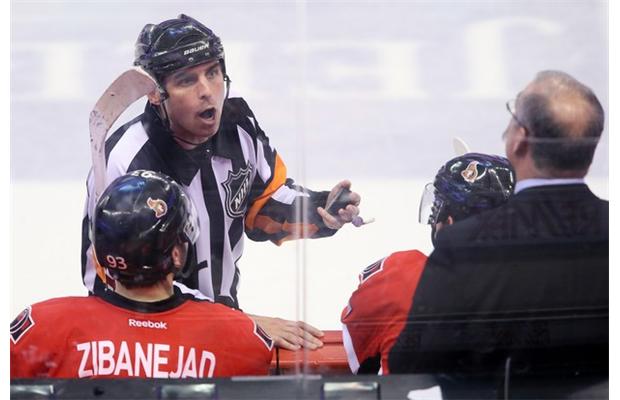
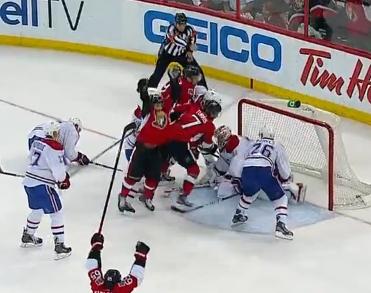
I’m not usually one to point fingers at the officials at any given time in a playoff series. The game is chaotic, and the officiating reflects a dynamic environment–which is a polite way of saying that the officiating is usually pretty terrible for everyone. Until the time the league gets its head out of its ass and seriously considers implementing a coach’s challenge or tells officials they are empowered and encouraged to review more than just goals, we’re going to end up with missed penalties or a flagrantly disproportionate number of calls. Ottawa’s been the beneficiary before, including Zibanejad’s borderline kicked-in goal against Montreal in the first round. That could have gone either way.
Generally, I accept this. It’s as if at random times during the game they release a live panther onto the ice, and it could maul anyone. Penalties are handed out with frustratingly opaque logic. Trying to fix it is tantamount to trying to fix a fundamental randomness in the universe. I’d rather buckle up and enjoy the ride, hoping that my favorite team comes out on top.
Up until now, I have also accepted some truth to the notion that the more penalized team is more penalized because they’re usually the less skilled / slower team and thus are more likely to find themselves resorting to clutching and grabbing, interference, or roughing in order to level the playing field. After the first round win in Montreal, it must have been especially clear that Ottawa’s game against skilled teams is to play on the edge. Ottawa is living firmly in that grey zone, the place where teams with generational skill and league max salaries don’t have to go.
Last night I thought to myself that Ottawa’s game plan has become exceedingly clear to both the Pens and the officials. The Pens have the skill to just wait everything out; they might lose the odd game, but they don’t need to get creative to win a series. Their veterans are being patient, and Cooke is going about his business. It’s almost as if they’re already thinking about Boston. Meanwhile, Ottawa has to get its hands dirty to have a chance in this series, and the officials know it. We’re getting sun burnt by their spotlight right now. But is that really an excuse?
Ottawa is the most penalized team in the 2013 playoffs, having found themselves shorthanded 40 times in just nine games, or 4.44 per game. Last year’s most penalized team in the playoffs was the New Jersey Devils, with 82 penalties in 24 games. That’s 3.42 penalties per game, a full penalty less. In 2010-2011 it was Vancouver with 3.96 per game. Philadelphia was the most penalized the two years before that, but they weren’t even close. I had to go all the way back to 2007-2008 to find another team as penalized as Ottawa this year–Detroit had 98 in 22, or 4.45 penalties per game that year. Before that was Anaheim, with a staggering 5.76 per game. There are other teams with slightly higher penalties-per-game averages (Nashville in 2006-2007), but their early exits couldn’t be blamed on penalties (Nashville had a 93.3% PK that year and lost in the first round in five.)
(note: for this I’m looking at “times shorthanded” on nhl.com, not necessarily total penalty minutes.)
What does this mean? Well, surprisingly, far from the most penalized teams being the worst / most overmatched, in recent years the most penalized teams have gone the furthest or won it all. New Jersey, Vancouver and Philly made the Finals. Detroit and Anaheim won the Cup. This seems to imply that being very penalized in the playoffs doesn’t necessarily lead to an unfair loss, or that these teams were so good that they could overcome the excessive burden of being on the PK so much.
For Ottawa, maybe this means we can’t blame penalties for our losses, either because they don’t impact the game that much or because we’re legitimately not as good as the contending teams of years past, who could take those penalties in stride.
You could point to penalties last night, but they don’t tell the whole story. In what amounts to a must-win game, on home ice, with all of the momentum on their side, Ottawa takes a minor penalty 1:12 in. This was blatant interference by Sergei Gonchar, one of the team’s key veterans, who found himself out of position and took the body on James Neal rather than give him a lane to the net. Far from that being Gonchar’s biggest sin in a game where he finished -4, Michalek actually scored shorthanded on the ensuing PK. Gonchar’s lack of toughness was a much bigger problem, and was particularly evident on Dupuis’ shorthanded goal, when Gonchar had him in front of the net and Dupuis’ easily got his shot away anyway. I don’t know if Gonchar was trying to avoid a penalty, but if so, that fear burnt him and the team.
Later, players like Smith, Greening, Zibanejad and Neil, whose games involve at least an element of physical toughness and agitation, could be seen obviously pulling back, not taking the body, trying to play the Penguins at their own game. At this point they have no idea if playing tough means going back to the penalty box. And instead of being unafraid of that and sticking to their game plan, Ottawa has been thoroughly thrown off; if Ottawa has any hope of getting back in this series, they need to get back to their I-don’t-give-a-shit attitude. If it means taking a penalty, then so be it.
The officials didn’t give this game to the Pens–Ottawa was up 2-1 and gave the Pens a breakaway one minute into the second period, then Anderson coughed up a brutal rebound 40 seconds later, and just like that, Ottawa is in the hole again. They never recovered. Tellingly, the Senators didn’t receive a penalty in the second period; when they had to tie it up, the officials let them play. Ottawa is getting killed in this series because the bottom has fallen out on their unreal goaltending; their Norris trophy defenceman is clearly not 100%; they’re playing against a team with $13MM more salary than them, with generational talent; and in what amounts to the most important game of their season–and possibly Alfie’s last ever in Ottawa–they didn’t show up.





 Welcome To Your Karlsson Years