A Hockey State of the Union

(Content warning: discussion of mental illness, addiction, substance abuse, suicide, harassment, assault, sexual assault, sexism, discrimination, Patrick Kane, Mike Ribeiro, Slava Voynov in post and links)

On the eve of a new NHL season, here are some things I’m thinking about with regards to the Senators and the league as a whole in a two-part feature. Some serious, some not, this is where I’m at with the game right now. You can read Part One here. Part Two features thoughts on Ottawa’s opposition, the NHL, and hockey more broadly.

1. Is Mike Babcock’s lucky McGill tie (the source of all his power) still lucky now that he’s traded Detroit’s (and McGill’s) red for Toronto blue?

2. Is Ottawa’s dormant rivalry with Buffalo about to heat up? The two teams have met on several occasions in the playoffs, usually play close games, and have had some infamous dust ups in the past. Add to that the Tim Murray and ex-Senators connections and things could get interesting. Evander Kane, Ryan O’Reilly, Jack Eichel, and Sam Reinhart certainly make them watchable and potentially explosive in terms of offense and with Ottawa’s defensive issues, this could get interesting.

3. Ottawa’s hottest rivalry continues to be with the Montreal Canadiens. After another close playoff series with fresh controversies, is another early round match-up in store? I hope so. From the Ottawa perspective, it’s a much more enjoyable rivalry than some of the rivalries we’ve had in the past.

4. Aside from breaking Mark Stone’s wrist, there’s a lot to like about P.K. Subban on and off the ice. His absolutely massive donation to a children’s hospital in Montreal this month might be the best reason. He’s long been aware, and talked about the economic realities facing children who want to play hockey and has made donations to back that up. Now he’s taking care of kids off the ice too. That’s leadership.

5. I try not to make a habit of betting on players to duplicate career years. That’s not to say they can’t follow up the best year of their career with another good effort, it’s just that it’s unlikely they reach the same heights. Carey Price had a season for the ages, winning basically everything you can during the regular season. And it was well deserved. The problem for the Habs is they relied on every moment of his season to finish where they did. What happens if he’s just good and not Hart-worthy?

6. Interesting division crease battles in Toronto and Detroit. Both teams have new coaches and goalies like James Reimer and Jimmy Howard get a clean slate. In a division with Ben Bishop, Carey Prince, Tuukka Rask, and Roberto Luongo, I’ll take any goalie controversies I can get in division.

7. The crease battle I’m most looking forward to is in Dallas. The Stars are locking up more than $10M this season (and for the two seasons after that) in two goalies Kari Lehtonen and Antti Niemi who are both over 30 and have consistency questions attached to their game. Should be fun.

8. Having traded Evander Kane, who will Winnipeg media blame for the inevitable slumps all teams go through this season?

9. Wayne Gretzky’s cowardice. No, I’m not talking about his recent political endorsement. After endorsing Patrick Brown for the leadership of the Ontario PC party this winter, it’s not really surprising that he endorsed Prime Minister Stephen Harper’s re-election bid last week. It wasn’t lost on people that Gretzky was endorsing a PM he had never lived under and who had disenfranchised Gretzky and over a million other expats in time for the upcoming election. Gretzky’s entitled to say want he wants and endorse whichever politician he feels like. However, he could not have sounded more out of touch on Friday when he called Harper an “unreal prime minister”.

10. No, I’m not talking about that. I’m talking about the fact that a man so concerned about leadership that he’d endorse two men who illustrate their lack respect for women in their respective parties’ platforms; I’m talking about a man who spent most of his pro career as a captain in the NHL; I’m talking about Gretzky’s lack of leadership when it comes to his former team. Gretzky is still influential in hockey circles and he’s not attached to another organization at the moment. Nothing is stopping him from saying how poorly the Kings handled Slava Voynov’s domestic violence arrest and conviction. But then we didn’t hear a peep out of him when Drew Doughty was under investigation for sexual assault a few years ago. Nothing is stopping him from reaching out to former teammate and current Kings President of Business Ops Luc Robitaille. You want to start endorsing leaders with damaging policies to run the province and country I live in, fine, but the spotlight will then be turned on what you’re not saying.

11. This raises the question of what should be expected from team ambassadors, those still playing and those long retired. Rocky Wirtz has been celebrated by the community for changing the culture in Chicago, reconnecting with the team’s legends and bringing them back into the fold. The problem is some players should never be elevated to such heights. That Bobby Hull continues to be held up as a face of the organization is problematic. That he has a statue outside the United Center is problematic. That his Cup win and 600 goals for Chicago are more important than multiple instances of domestic violence speaks to the true values of the organization. Nostalgia and selling merchandise are not more important than the safety of women. Lots of people will suggest that people like Hull deserves second (and third and fourth) chances and my question would be: when did a second chance become synonymous with the exact same opportunities as if nothing happened? When did a second chance start to mean continue as if nothing happened and never acknowledge that wrong?

12. A collective “we’re not tone deaf” from teams under fire. During Patrick Kane’s ill-conceived press conference last week, Chicago insisted it’s not a “tone deaf organization”. But actions like playing “I Fought the Law” during a pre-season game at the United Center or the Nashville Predators anointing Mike Ribeiro with an “A” for pre-season games was never going to be missed by fans online and across the league.

13. I agree with John McDonough that these organizations are “anything but tone deaf”. These actions aren’t accidental, they’re deliberate and designed to put the players’ needs, and to a greater extent, the organization’s goals, ahead of all other concerns. Do you think Chicago was unaware as an organization that putting Kane in front of the media to read a poorly phrased statement and thank people for their questions would communicate to their fans an assumption of Kane’s innocence? Do you think management was unaware that fans would see the organization fully behind the player, allowing Kane to use its name and clout to proclaim his innocence, and cause fans to make an assumption that he isn’t guilty? Of course they did. For a player and team alleging they wanted to respect the legal process, there sure was a lot of influencing going on. David Poile in Nashville has to be happy that there’s less scrutiny on the Ribeiro re-signing now, enough that the organization felt comfortable rewarding the veteran with some leadership points in pre-season. It’s a literal marking by the organization that Ribeiro has come full circle, is someone younger teammates can emulate. Silly or not, it is another thing fans can point to and say that Ribeiro has nothing to be sorry about at all. Teams endorse players who still have use to the organization in part because many fans will go along with it.

14. The Kings are trying to change; Pierre LeBrun has told us many times. I’m unwilling to reward the Kings for their efforts thus far and I will remain ever skeptical that this is anything but a PR move. Titled “Conduct Awareness Training Initiatives,” without concrete language and descriptions of what the program entails, it’s hard to say if it’s a step in the right direction. There are reasons to worry it’s nothing more than a “don’t get caught” lecture based on the name and Lombardi’s fixation on drug-related arrests of two former players gives this “watch who you get drunk/high with” feel. Still, the Kings have partnered with a local violence prevention centre Peace Over Violence. I don’t know enough about Peace Over Violence to properly assess the organization, but partnering with a local violence prevention group that knows the community and the problem far greater than Dean Lombardi or the Kings do is the first correct step the organization has taken in a long time.

15. There’s every indication Dean Lombardi and the rest of the Kings organization still don’t get it. Conflating drug offenses, especially drug use that is quite possibly the result of injuries suffered during play, with assault is troubling on a number of levels. It lessens the seriousness of Voynov’s assault and distracts attention from how women are treated in the NHL – as partners and fans. Lombardi’s public consternation at the Mike Richards case in particular seems that the biggest crime committed by any King in 2014-15 in Lombardi’s eyes was being betrayed by a player he loved. A lot of his response to these charges frames the issues around how they’ve impacted Dean and that’s so far beyond the point that I question Lombardi’s continued role in righting these wrongs.

16. The NHL recently implemented new security measured league-wide. I’ve written about my concerns with these changes before and don’t want to rehash those points except to say the league’s refusal to act against DV/SA and respect female fans illustrates those security measures aren’t about safety if there was still any doubt. The NHL does not care about the safety of women. With the NHL insisting they don’t need to develop league-wide policy to prevent and address violence against women (they do), teams need to develop their own policies. The right policy will provide a clear framework for possible discipline, but it might actually prevent such incidents from occurring because it starts a conversation that changes minds and behaviours. Teams need to implement this at every level of their organization (minor league affiliates) and apply it to the office side of things too. That’s a level of commitment beyond PR. You need to step up here, Ottawa.

17. The Kings don’t have the right policy because the right policy is completely transparent. The NHL and its teams hate transparency; salary terms are often not released, injury details are hidden. At every step this league tries to control information and that’s a problem. By not providing more information than is absolutely necessary, it allows teams and the league to bend and ignore the rules to suit their needs. If this is really about concrete action and centring victims, SA/DV policy needs to be developed and implemented in consultation with third party experts who are not subject to team restrictions, policy, and oversight. They need to hand over the reins.

18. It’s part of NHL culture to victim blame and this needs to change. I’ve written about this before, but it deserves restating. It happens in game when players are injured. If a player is hit hard from behind, talking heads will squawk that he turned at the last second and put himself in a vulnerable position. If a player suffers a concussion, he’s told to keep his head up. It’s a lot easier to blame a player who’s suffered an injury than take a step back and really examine the way the game’s played and officiated, and the culture it creates. Is it any wonder NHL fans feel so comfortable victim blaming when attention turns to off ice issues? This is how we do things in this sport and it needs to stop.

19. The league’s collective failure on these issues is alienating, discouraging, and wearing on female fans. Women are simply tired of the league reinforcing how little they value them. It’s not about special treatment, it’s about the respect people of all genders deserve when attending a game and participating in hockey fandom. This is hurting our game.

20. Early chatter about next September’s World Cup of Hockey. I have issues with the NHL’s involvement in the Olympics but in general, international hockey is fun and we need more of it. Gary Bettman and the NHL love to bill these events as growing the game. My question is: why can’t we also have a Women’s World Cup of Hockey in addition to a Men’s World Cup of Hockey? European countries will invest more in women’s hockey if there’s more marquee events to participate in and a Canada-USA final just helps build excitement about hockey generally. With the NWHL joining the CWHL this season the interest in women’s hockey is growing. The NHL hasn’t been a big supporter of women’s hockey in general and the CWHL/NWHL in particular. For whatever reason growing the women’s game doesn’t make financial sense to the NHL. It’s yet another mistake and another sign of disrespect.

21. Former NHLer Todd Ewan died from a self-inflicted gunshot wound on the weekend. Another suicide and it’s not being talked about enough. Say what you want about the recently retired Dan Carcillo, but his desire to help players transition to post-playing life is a good thing. It’s easy to feel not the least bit sympathetic for athletes who have trouble with retirement. After all, they knew it was coming, got to stop working a lot earlier than most people, and made a lot of money. This is of course true but doesn’t change the fact that we are consistently seeing cases of athletes who have trouble transitioning and what they need is empathy, support, and some solutions. Injuries, especially head injuries, and mental illness make this move harder. Best of luck to Carcillo, because this cycle of violence and anguish needs to end too.

22. The consequences of being an enforcer, of being a tough player, of fighting in hockey have been talked about a lot. But I wonder if we’ve missed another motivation in some of the cases. Head trauma obviously is of great importance here and I’m no expert on CTE or related traumas. But I know what it feels like to feel unloved and unliked, to be depressed. I know that so often it feels like no one can see you when you feel like that. I’ve played on teams and felt invisible to my teammates. I can see how a concrete action like standing up for the star player makes it impossible for your teammates to ignore you, forces them to see you. Gives you a concrete sense of your worth and their affection for you with all the fist bumps and high fives you receive. I can see how being hit or punched would give you something to center your pain on, or even just let you feel something again. I can see how that role would appeal to people with pre-existing mental illness. What I’m saying is we need better resources for mental illness in the minors and in junior hockey as well as the NHL. We need to talk about how signs of anxiety and depression manifest in sports and we need to watch out for them and reach out to players. We need to be vigilant. We need to provide support. We need to do better.

23. This is a liminal moment for my fandom. I don’t think I’m alone in that. The competing forces are seen in the competing forces of this piece. A new season is near and on the one side there’s jokes, concerns about my team, and questions about where the Sens fit when stacked against the competition. These are logical, acceptable, and typical things to be concerned about. It’s what fans are supposed to be preoccupied by. But then there’s the building storm, of disrespect and discrimination, of violence and sexual assault. It feels like this is going to get a whole lot worse before it gets better. But I can’t give up something I love right now and I won’t be made to go away or stop talking about it. There are many in the hockey community with a stronger resolve. This league with eventually, grudgingly, angrily submit and change.

A Senators State of the Union

On the eve of a new NHL season, here are some things I’m thinking about with regards to the Senators and the league as a whole in a two-part feature. Some serious, some not, this is where I’m at with the game right now. Part One features thoughts exclusively about the Senators.

1. I don’t like everything Eugene Melnyk does but there’s no question he’s an owner who’s a fan first. Here’s hoping he’s well enough to make the trip to the CTC for opening night.

2. This is Erik Karlsson’s year. Which sounds like a strange thing to say about a defenseman entering his age 25 season with two Norris trophies to his name, but here we are. We’re two and a half years on from his devastating Achilles injury and Marc Methot will be ready opening night. Before his run in with Matt Cooke in 2013, Karlsson was an early season Hart candidate. Think that’s the territory we’re about to enter again. It’s rarified air – enjoy it.

3. Veteran Erik Karlsson. There was some pouting when Karlsson was named captain before the start of last season but the decision was the right one at the time. Now suddenly he’s entering his seventh season in the league and is one of the longest-serving Senators. Sens fans spend a lot of time thinking about veteran presence on the team with the departures of Daniel Alfredsson, Jason Spezza, and the situations with Chris Phillips and Chris Neil that we forget there are other veterans to fill the void.

4. Mesmerizing skill is often mistaken as effortless and skill players are often maligned for not working hard enough. I’m reminded of this when Karlsson is occasionally criticized as lazy. For the record I don’t expect the effort we saw from him in OT Monday night’s preseason game during the regular season. But sometimes I think we forget his incredibly speedy recovery from his Achilles injury and the commitment to rehab that must have taken.

5. It’s never been clearer that we have the best Dave Cameron.

6. I don’t spend a lot of time watching junior hockey for a variety of reasons (that it’s not always available in HD is a large part of that) and I generally don’t salivate over prospects. So it’s safe to say unless the Sens have a lottery pick, I don’t have concrete footing to make a knowledgeable assessment of the team’s picks. However, the past month has gotten me quite excited to watch Thomas Chabut grow and mature.

7. Sens fans often look at the organization’s glut of replacement level NHL defenders and NHL-ready blueliners as a negative thing. Mark Borowiecki, Jared Cowen, and Chris Phillips aren’t providing anything special at the NHL level and are blocking the way of potential NHL candidates like Chris Wideman, Mikael Wikstrand, and Fredrik Claesson. The trio represent a variety of skill sets and Wideman and Wikstrand appear to have the inside track, not the least because they possess different skills (read: puck moving) than the trio currently filling out Ottawa’s bottom pairing. However, this depth also insulates the team from making decisions that aren’t in their long term interest. Thomas Chabut has dazzled since hearing his name called in the first round in June. While his skating and offensive instincts are most noticeable, he looked great with Erik Karlsson in Ottawa’s pre-season opener. However, Ottawa’s depth means it’s likely a couple years before he’s seriously got a chance at cracking the Senators’ blueline. That’s not a bad thing at all. On the contrary, the list of defenseman Ottawa has rushed to the NHL recently includes Cody Ceci and Jared Cowen, illustrating that it doesn’t always work out.

8. While he’s played in the NHL before, Mike Kostka doesn’t feel like a likely call-up in case of an injury. Lots of factors working against him, but I can’t imagine the organization wouldn’t prefer to insert Wideman, Wikstrand, Claesson or even Ben Harper first. Kostka’s there to bolster the ranks in Bingo and that’s fine. Insulating younger players at the AHL level is ok too.

9. Curtis Lazar gave an interview during the intermission of Monday night’s game and revealed his rooming with several Sens teammates this year, among them Chris Wideman. The defenseman had the inside track at landing the seventh spot on defense this season, his living arrangements seem to cement that assumption.

10. Whose health is more important for Ottawa’s success in 2015-16, Marc Methot or Craig Anderson? It’s easy to say Andy, after all, he’s frequently found himself on the shelf during his time in Ottawa and with the goalie situation clearer than it’s been in a long time, Anderson has the confidence of his coach and needs to roll with it. On top of that, there are still reasonable questions about what kind of backup goalie Andrew Hammond will be. Anderson’s game was one of the few highlights of Ottawa’s play under Paul MacLean last year and papered over the play of a porous defense. However, with Methot in the lineup, the Sens were a much improved team. It’s becoming increasingly more apparent that he’s the best partner for Erik Karlsson on the team and helps Ottawa pick up its play at both ends of the ice.

11. It’s no secret the Canadian dollar has taken a hit and it’s predicted to slide further. What that means for the Sens is a roster that currently costs almost $83M Canadian. Had he stayed in Ottawa, David Legwand’s a $4M CDN expenditure and along with Eric Gryba and Robin Lehner, Bryan Murray was able to shed just over $6M USD this summer, or about $8.4M CDN. That’s not nothing. It’s one of several, sneaky quiet good moves from the offseason.

12. I’m not the biggest fan of Mark Borowiecki’s game, but I’m interested to see what his game looks like away from Eric Gryba, who I found to be more problematic on the third pairing last year. Though his partner is most likely going to be Jared Cowen so I might miss more than Gryba’s beard.

13. Lost in the trendy Tim Murray is a Genius wave is that he overpaid for Robin Lehner. It’s not that a veteran like Legwand won’t be able to mentor young players like Jack Eichel and the Sabres certainly won’t miss the money they’re eating with the addition. It’s just that there were goalies, young, promising goalies, to spare as GMs met for the NHL draft and somehow Tim Murray gave up a first round pick and took a salary dump for a goalie I can’t imagine other organizations were willing to give up any more than a second round pick for. Add to it the fact that Murray the Elder insisted on the salary dump and the return package probably should have been less appealing. Murray the Younger’s familiarity with the Senators may have worked against him in case and prevented him from exploring other options. Lehner may develop into an elite goalie and this has a good chance to be a good trade for Buffalo, but it doesn’t change the fact that they probably could have given up less to acquire the player they wanted.

14. What’s a realistic point total for Kyle Turris in 2015-16? 70 is a big number in the low scoring NHL, but it’s just six more points than he had in 2014-15, when he didn’t really catch fire until the streak. A full season playing with Mark Stone at even strength and on the power play as well as a healthy season from Clarke MacArthur and it’s not out of the realm of possibility that he hits 70+. I don’t think Turris has more goals in him, I think he’s a 20-25 goal range kind of player, but I could see chipping in a handful more assists with a maturing Stone on his wing.

15. Mike Hoffman still feels like the best answer to the question “the Senator most likely to”. Score 30. Spend more time in the bottom six than top six. Get left off the power play. Have great chemistry with Mika Zibanejad. Have contract issues. Be traded mid-season.

16. The New Deals. Lots has been written about how Bobby Ryan, with his new contract which will see him make $7.25M per season and his declining point totals, needs to step this season. Fair enough. But he’s not the only Sens veteran starting a lucrative new deal. Clarke MacArthur, who had a somewhat disappointing 2014-15 that was marred by a concussion late in the year, might be feeling the heat too. He’s on the wrong side of 30 (it happens to the best of us) and while his dear isn’t as big as Ryan’s, but the $4.65M AAV is a step up from the value deal he signed with the Senators in 2013.

Merit Badges and Hockey Media

(Content warning: post and links discuss harassment, assault, sexual assault, rape, racism, sexism, and homophobia)

On the last Sunday in August, with an otherwise unremarkable slate of MLB games, Jake Arrieta threw a no-hitter and Jessica Mendoza was the analyst breaking down the action in the Sunday Night Baseball booth. Mendoza replaced former pro Curt Schilling, whose recent ill-informed twitter rant against Muslims resulted in his suspension for the remainder of the 2015 season.

That Mendoza is female and has no professional experience is groundbreaking. That we continue to evaluate what makes good play-by-play callers, analysts, and panel members based on how bloody their sock was when they forced a seventh and deciding game, if they won a championship at the highest level, or how funny their post-game interviews were, is not. It’s the same system that also erases Mendoza’s considerable playing credentials (softball gold in Athens in 2004 and silver in Beijing in 2008). It’s gatekeeping, pure and simple, and when it comes to NHL coverage, it’s designed to keep women, people of colour, and LGBTQ folks out and to erase the intersection of these identities in sports.

The elevation of the former player-turned-analyst (the variations of this include former coaches and general managers) in hockey media is tired and damaging. The blogging community and advanced stats movement has done much to discredit the worst aspects of this kind of analysis. But as the stats movement gained acceptance, many who rose to prominence replicated some of the worst aspects of the eye-test crowd.

Many of us believe we live in a meritocracy. That some combination of hard work and talent leads to success. That there are no barriers to what you can achieve if you want something bad enough. That more of these success stories happen to involve white, straight, cis men is mere coincidence for many of us. We believe this in part because we see this narrative playing out in hockey. We’re constantly reminded of can’t miss, generational talents like Wayne Gretzky, Sidney Crosby, and Connor McDavid or late round picks who worked hard to overcome some deficiency in their game, body type, or personality to succeed at the pro level. Less time is spent considering the inequalities in the system. What we talk about in more hushed tones is how economics – the price of minor hockey, equipment, and travel – culls the list before other factors enter into the equation. We celebrate advancements in the women’s game and the successes of programs like Title IX but overlook that female athletes – at every level – have less access to elite coaching, facilities, and medical care.

That the fans watching NHL hockey see generational talent on the ice and extrapolate and apply the same level of excellence to the analysts and panelists who explain, examine, and evaluate the game is equally problematic. There are barriers preventing many from accessing the game. Some of those barriers are in the booth and in the studio. The discriminatory ways some men who are paid to cover hockey act creates accessibility barriers for many who want to love the game.

Many fans persist in believing that those who are paid to talk and write about the games we watch are the most qualified to do so is verging on willful ignorance.

There is a place for former players, coaches, and GMs in sports analysis. Having played and worked in the industry they can provide unique insight into the mental strain of a losing streak or the ins and outs of the trade deadline. They can speak from experience on a variety of topics and some of the best analysts in the game have impressive NHL credentials. TSN’s Ray Ferraro provides among the best combination of an anecdotal player’s perspective with knowledge of current analytical trends. He also had over 400 goals in the NHL. There are others. But these broadcasts lack balance. How much of this perspective do we need? Regional and national broadcasts are full of former NHLers playing the role of analysts. Stars and scrubs, Hall-of-Famers and journeymen, All-Stars and healthy scratches, what matters is that these men once made it to the NHL.

It is a closed club, taking care of its members.

We rely so heavily on the former pro type precisely because of who it leaves out; hockey is still the whitest of the major North American sports and professional success remains elusive for women. The most prominent female voice on NHL broadcasts is Cassie Campbell-Pascall’s. For those watching in Canada, she is likely the only woman you will see and chances are it won’t be in the booth for a marquee matchup nor will it be at one of several intermission desks chalked full of former player analysts. While she saw limited duty in those roles for the CBC, she works as a reporter before games and during the intermission for Sportsnet. And yet on any given night when she’s on the broadcast, she’s the most accomplished former hockey player on screen. Sportsnet stars Glenn Healy and Nick Kypreos had long careers and won a Stanley Cup together with the Rangers in 1994 as the backup goalie and bit player respectively. P. J. Stock was a journeyman NHLer who played 235 games at the NHL level over seven seasons. Kelly Hrudy had a productive, if average, 15-year career in the league. This should not be read as a disparagement of these playing careers; on the contrary, making the NHL proves these men were among the very best male hockey players in the world at the time.

Rather, that when it is a question of hiring men to be on air talent, the parameters are malleable, the qualifications varied.

On the other hand, Campbell-Pascall’s playing résumé lacks only professional experience. She is, quite simply, one of the most decorated athletes in international hockey. She is the owner of 7 world championship medals, including 6 straight golds (1994 to 2004), in addition to 3 Olympic medals. She is the only player, male or female, since the 1998 Winter Olympics (when NHL players first played and women were first allowed to compete in the sport at the Olympic level) to captain her team to two straight Olympic gold medals. No other player has won two golds as captain let alone consecutively. Simply put, she has a playing record no other woman can match.

This is the standard that has been set for female former players who want a whiff of this type of post-playing career.

It will be at least another six years before we find out if another woman meets this criteria and should she achieve this legendary status, she’d still have to meet traditional standards of feminine beauty and female sexuality. While there is some variety in the masculinity presented on NHL pregame and intermission panels it’s still limiting and restrictive. These gendered restrictions are magnified for women. The varied way women present is not represented in sports media and those deemed too masculine never have a chance. There are lots of reasons past women’s hockey greats never got a shot on NHL or international broadcasts not the least of which is not everyone wants to make the move to broadcasting once they’re done playing. But some former players are erased because they’re black, or too masculine, or a lesbian.

Success continues to be defined by male achievement.

Success in hockey is further defined by white, straight, cis male achievement. That this is the norm is unquestioned. That those definitions will change to suit the needs of the hockey establishment is predictable. We ask why TSN, NBCSN, and Sportsnet don’t have more women as panelists, analysts, and play-by-play announcers and the responses usually revolve around issues of qualification. What we don’t ask enough is what qualifies men to be on these programs. What we don’t ask enough is why these networks don’t invest more time, training, and money in female broadcast talent. What we don’t ask enough is why we let these networks off the hook. Rogers winning the national NHL contract in Canada was an opportunity to employ more diverse on-air talent but it wasn’t taken. Too many of us gave them a pass, believing that after a few seasons of having the national contract women would just sort of magically appear, as if Sportsnet hasn’t had years to cultivate and promote female talent.

Mainstream broadcasters are failing fans. It’s problematic to have so many white, male, former pros on broadcasts because it creates a situation where there’s a lack of diversity: of opinion, perspective, and experience. Representation matters. Seeing women in the game and as part of hockey broadcasts helps create space for female fans and roles for women in hockey. It makes a difference.

The blogosphere created an opportunity to shake up the longstanding conventions of hockey media. Networks like Yahoo and SB Nation provided platforms for a plethora of new voices and the analytics movement coincided with this rise to prominence. But hockey blogging on mainstream sites such as Yahoo, SB Nation, and Bloguin operates from the perspective of white, straight, cis men. That’s not to say that there aren’t talented writers offering diverse perspectives at those sites just that those perspectives are not appreciated, supported, or cultivated across those networks and by those networks. In terms of diversity, the promise of the blogosphere has yet to be realized.

Blogs and analytics promised accessibility and knowledge. The two factors that are supposed to level the playing field. Advances in statistical analysis were supposed to make up for not having 40 years of experience watching the game. Ideally, anyone who reads advanced stats primers and with time, moves on to more intermediate pieces, should be able to participate in this new conversation. There has been a lot of good. Our collective understanding of hockey has been improved, expanded, and enriched because of the groundbreaking and thoughtful work of bloggers and stats folks. We have numbers to point to that indicate all third liners are not created equal. We’ve got graphs that illustrate that the title defensive defensemen is a bit euphemistic and that Marc Methot looks pretty good on his own merit. Fans and those in the game alike are understanding the game in different ways and have new language to talk about hockey.

These are all good things.

Yet I worry that the conversation about analytics in sports generally, and in hockey specifically, is the latest appeal to male authority. That the way we talk about advanced stats in particular is the most recent way of enforcing male regulation over the dominate dialogues in sports. In our search to wrestle control of dominant hockey narratives from establishment higher authorities like the Cherry-Healy-Milbury talking heads, we’ve found a new truth and installed another patriarchal order. We have new hockey experts and some use their knowledge to dismiss and control as effectively as mainstream hockey media uses their connections to enforce certain conventions. As if searching for the one “right way” to talk about hockey isn’t in itself an appeal to male authority. We think the stats movement is so new, so fresh, and so different that we don’t question enough whose voices it has given prominence to.

There are important voices in the stats community whose excellence extends beyond their ease with spreadsheets. Good men and women who will discuss, debate, and reflect on the issues facing the game beyond the numbers. But there are others, so many others, who never discuss issues of racism, sexism, homophobia, and transphobia in the game, online, and in our hockey media. There are valid reasons for deferring, there are valid reasons for staying quiet. But too often this silence is reflective of something else. You don’t have to look hard to find stats authorities mocking people on hockey twitter for being “upset” but never addressing sexism in hockey. You can probably think of more than a few examples of prominent stats men who belittle and insult women online, disregard valid critique, and participate in the erasure of the work done by female stats bloggers and female hockey bloggers more generally. Some are deliberately inaccessible in their writing and think the most pressing issue in hockey is that their work isn’t universally accepted and appreciated.

Because so many believe we live in a meritocracy we have elevated many new voices because they possess superior, analytical minds. We have new authorities.

But in too many ways, the underlying framework remains the same. It’s easier for many fans to see and identify discrimination when an abrasive, physical, former player type says something offensive like Curt Schilling or Don Cherry. It’s much harder for us as fans to admit that stats bloggers, whose work we admire, sometimes say the same things. That their entry into the conversations about the game is intellectual and not anecdotal further shields paid stats bloggers from legitimate criticism about failings on issues of equality. Because they should know better we expect that they actually do. Advanced stats are just like any other power structure and we need to look at who controls the narrative.

The analytics movement is failing where the talking heads failed before. There is still a refusal to talk about the most difficult issues in the game, a preference to keep mainstream topics about the on ice product. The problem is when the analytics movement gained the official seal of approval, when bloggers started to be hired by NHL teams, newspapers, and media outlets, expectations were raised.

I expect hockey media (traditional media as well as paid bloggers) to not shy away from issues of violence, racism, sexism, homophobia, transphobia, sexual assault, mental illness, substance abuse, as much as I expect them to tweet every detail about ongoing labour negotiations and shot suppression rates. Both are part of the game. Both are part of your job.

But too often those in positions of authority obfuscate when a difficult and complicated issue such as sexual assault or domestic violence comes up. It’s the “Patrick Kane situation,” the “Voynov circumstances,” and the “Varlamov incident”. Change starts with using clear and precise language.

They got away with it for a long time. Players and media alike.

Many fans in the silent, and not so silent, majority agree with paid hockey media’s take, with paid hockey media’s cowardice: hockey is supposed to be an escape and we should just talk about the game.

Two incidents in the past two days highlight both the problem and potential ways forward in hockey media. On Wednesday ESPN/TSN insider Pierre LeBrun wrote about how the Los Angeles Kings handled Slava Voynov’s assault conviction and two drug possession cases during the 2014-15 season. Except he didn’t. He started with this instead: “The NHL is not accustomed to headlines involving arrests and court dates.

That’s normally for other sports leagues.”

In reality, the NHL is quite adept at handling headlines involving arrests and court dates. The league has always been able to bury this type of controversy. After the initial breaking news, the NHL keeps assault and rape out of its popular talking points thanks to accomplices in hockey media like LeBrun. Insiders need access to management and players, and staying quiet about the criminal behaviour of NHLers keeps the cliché post-game quotes and trade rumours coming. The NHL Media Tour went this week in preparation for the upcoming season and it took several minutes for anyone among the assembled media to ask Commissioner Gary Bettman about the biggest story of the offseason: Patrick Kane’s rape investigation. LeBrun and his colleagues are more than happy to promote the NHL as the last bastion of good guys in professional sports. When talking about how LA’s “tight-knit” community rallied from these “distractions”, LeBrun deferred to Drew Doughty, neglecting to mention the defensemen’s own prior rape investigation. Doughty’s distortion of the Kings organization was in keeping with the tone established by LeBrun: “Because we are such a good organization and do have a very good image, it’s unfortunate”.

What’s unfortunate was how deliberately deceptive LeBrun was. What’s unfortunate is how full of shit Doughty was.

What’s unfortunate is how many examples we have of this behaviour. Beat reporters obscuring the truth, players falling back on their “team first” training. We get more examples every week. Just ask Jonathan Toews and Duncan Keith.

What’s truly unfortunate is how the real victim, not Slava Voynov, not Dean Lombardi, and certainly not the Los Angeles Kings, continues to be an afterthought, so frequently erased.

It is a closed club, taking care of its members.

Yesterday, noted numbers guy Rob Vollman tweeted about a piece he’d written for ESPN where he asked a “panel of prominent hockey numbers guys to rate this year’s summer signings”. And he meant “guys” literally: of the 28 prominent hockey minds surveyed, all were men. To Vollman’s credit, when asked why he didn’t included any of the numerous female stats bloggers in the community he addressed the issue immediately and admitted he asked only one and should have done more to address the gender imbalance. This is a good start but must be followed with concrete action.

Paid hockey media can continue to close its eyes and cover its ears but writing about and discussing issues of discrimination in hockey is only going to increase. The voices demanding necessary change are not going away, but are gradually swelling and your mute button will only work for so long.

A familiar refrain from men in positions of power in the mainstream media or at prominent blogging sites is a variation of “there aren’t a lot/any good writers who are …” or an exasperation at where to find writers who aren’t white, male, straight, and cis. For those making such statements success continues to be defined by male achievement and male standards. There are many terrific female hockey bloggers, one needs to look no further than the collection of talent behind the soon-to-launch The Victory Press, a site for excellent writing on women’s sports. There are skilled writers of colour covering hockey as well as tremendously capable LGBTQ bloggers. If you’re a site manager, editor, or prominent hockey voice and can’t find diverse voices you claim to seek, you’re part of the problem.

The problem is you.

Maybe your site is poorly moderated. Maybe your decision makers are sexist, racist, homophobic, or transphobic on twitter. Perhaps you post insensitive or offensive editorials, with little thought and no follow up on why your work is problematic. Maybe you’re a stats writer who’s worked hard and achieved mainstream success and is now more interested in maintaining the status quo then listening to the legitimate criticisms of the biases inherent in your work. There is a tendency to separate issues of representation from issues of discrimination or outright abuse. But the lack of women, people of colour, LGBTQ folks, and their intersecting identities in mainstream hockey media helps perpetuate discrimination in the game.

If you want to have a diverse site or diverse contacts you must be actively involved in and committed to creating inclusive environments. Women, PoC, and LGBTQ folks are tired of being left hanging by those with more power in the hockey community. Who wants to write for an editor that won’t have your back when an important piece draws the ire of those who want to keep online hockey spaces the stronghold of white masculinity? Who wants to visit a site that posts offensive material and exploits female labour? Not me.

The stats community still occasionally spars with the more traditional eye-test crowd. But both are oblivious to their similarities. Far too many in each group are working to keep hockey media a white, straight, cis male preserve.

Posted in Uncategorized | 1 Reply

10 Other Things the Ottawa Senators Should Bring Back

Yesterday word leaked from our friends at the Ottawa Sun that Martin Havlat, off-injured, 30-something sniper, might be offered a PTO with the club. He began his career to much fanfare with the Senators and Havlat still seems to have a few eggs in the “he was my favourite player” basket judging by twitter reaction. It’s unlikely Havlat sticks and unlikely he has much to offer based on his last couple of seasons but it’s a no risk move that has the potential to benefit the team. With that in mind, here are ten things the Sens should consider bringing back, some of the serious variety:

Bodycheck magazine. Revel in the full 90s glory. Hard to pick a favourite cover, but I’m going with Steve Duchesne wearing sunglasses and holding a surf board.

The pizza promo. Who doesn’t want a slice of tasty Pizza Pizza? Should not be used as an excuse to get rid of the last minute burger promo.

Win and you’re in. Think Andrew Hammond, with the 20-1-2 record, has the upper hand here.

Rihanna.

Sens Mile. Make it season long. Force Ottawa to have much needed debate about tempting fate and municipal overreaching.

Eric Gryba’s beard. I miss it so much.

Old jerseys. This one, not this one.

Daniel Alfredsson.

Trading away a second round pick at the deadline.

And of course, this guy.

Masked: A Visual History of Ottawa Senators Goaltending

(Content warning: racism, rape related to discussion of Ray Emery masks)

As hockey fans debate the latest symbol of NHL uniformity – the Adidas jersey deal and the renewed possibility of ads appearing on sweaters – I’ve been thinking of one of the most enduring symbols of player individuality: the (painted) goalie mask. Beginning with a few small, marker lines – meant to represent a stitch – drawn on Gerry Cheevers’ simple, white mask in jest, it became the most iconic of all goalies masks. As someone who played in the NHL in an era when some goalies still didn’t wear masks, it also became a statement about player safety.

As more and more goalies had their masks painted by hand and then airbrush, and as the protective gear evolved from face-hugging fiberglass, to helmet-cage combos, and finally to fiberglass/carbon fiber-cage combos, a rich tradition of mask painting emerged.

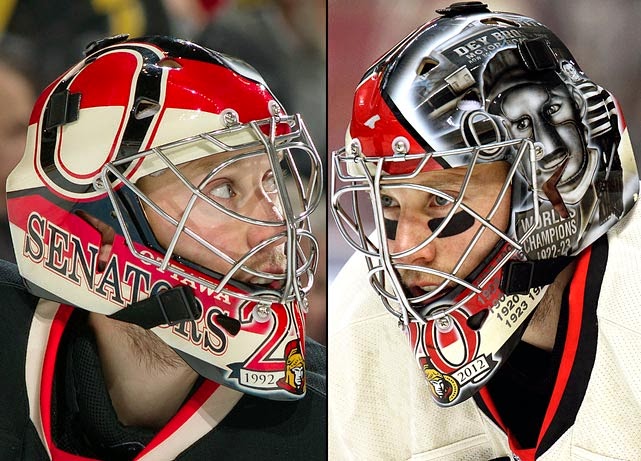
While mask artwork has been evaluated on its relative merits, I think there’s something to be gained from exploring the goalie mask history of a team’s netminders. What follows is a visual chronicle of Ottawa Senators goaltending (players who have played 20 or more games in a Sens uniform), but it also creates a type of visual Sens history.

Early Years: 1992-1996

Looking back at the buckets Peter Sidorkiewicz and Darrin Madeley started with in Ottawa’s inaugural season and you’d be forgiven for thinking Ottawa played its first games a decade before, in the 1980s. The retro Cooper helmet-cage combos, black for Madeley, white for Sidorkiewicz, started appearing in the 1970s and were popularized by Soviet goalie Vladislav Tretiak. Synonymous with the high-scoring, less than stellar goaltending of the 70s and 80s, they were the perfect choice for goalies who would replicate those bloated GAA totals from earlier eras.

petersidorkiewicz

While Madeley played most of his games with the Sens the following season, Daniel Berthiaume was relied on to back up the All-Star (yes) Sidorkiewicz. Berthiaume’s contribution to the Senators’ mask history was a DIY (at least I hope it was) effort. Painted all black, it featured a small logo decal on each side on the top of the mask. The whole effort probably cost less than $4 at the dollar store.

berthiaume

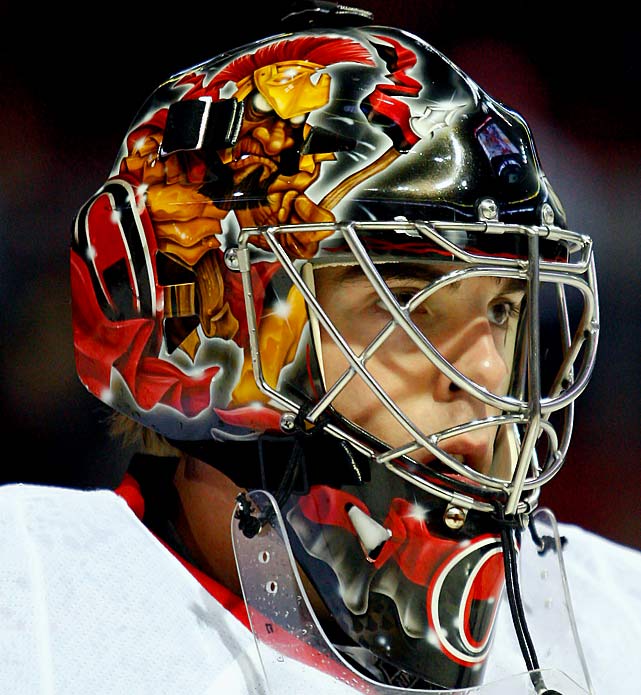
Of note from the first season is Sidorkiewicz’s early adoption of the centurion theme. Like the main Senators logo, Sidorkiewicz’s mask featured a stylized Imperial Gallic helmet. Painted to appear he was wearing a Roman centurion mask it set in motion both a very specific aesthetic look as well as the mask-within-a-mask tradition other Sens goalies would wear in the future.

PeterSidorkiewiczOttawa

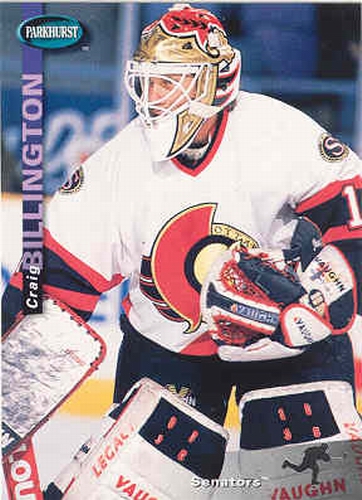
The 1993-94 pairing shows continuity with the inaugural season, in players (Madeley) and looks (Craig Billington). Billington wore an early variation of the centurion mask-within-a-mask. Like Sidorkiewicz, Billington’s mask featured the black fringe (seriously, what are those three black wings coming out of the red crest on the 2D logo supposed to be? A cape? Fringe?), from the main logo and a prominent laurel motif.

billingtonos90

Another Madeley mask might be the most interesting from this early period in that its stylized linear design seems more suited to the 70s and 80s and a different team. Except for using the appropriate colours, it doesn’t reference the team and reminds me of the lid Felix Potvin sported around the same time with the Leafs. It makes it look like Madeley wanted to join the Calgary Flames, which was probably preferable to playing goal for the Sens in 1993-94.

5078-340Fr

The following (shortened) season, Don Beaupre joined the fold and was between the pipes for most games. He was already the owner of a truly iconic mask from his time with the Washington Capitals, the team Ottawa acquired him from. Featuring a stars and stripes design along the jaw line and cheek/ear covering, the top of Beaupre’s Washington mask featured a graphic rendering of the U.S. Capitol Building. He applied the same thematic template to his Senators mask, creating the first truly iconic cage in Senators history. The top of his mask featured a gold, graphic rendering of the Parliament Buildings, the first Sens reference to the buildings/Peace Tower since the wordmark logo from Terrace’s expansion pitch, some five years previous. The Parliament Buildings/Peace Tower motif would be used by several Sens goalies, including the recent, never worn (thankfully because he was not good) Alex Auld heritage mask. While the expansion bid wordmark logo featured the Peace Tower with a Canadian flag, the Beaupre mask introduced the maple leaf to Ottawa’s visual repertoire. In fact, the Peace Tower/Maple Leaf alternate logo that featured as a shoulder patch from 2000-2007 and is still in use as a decal on Ottawa’s home and away helmets, owes as much to the iconic designed introduced by Beaupre (and taken up by Damian Rhodes) as it does the original wordmark logo.

donbeaupre

Perhaps it’s fitting that this bad, early period should end with Mike Bales. Not only was he quiet poor in net, his mask ushered in a particularly terrible design theme: the cartoon, full-size Roman soldier. While’s Bales’ graphic is more realistic than later incarnations, it features a soldier riding a rearing horse that just makes me think of this guy.

Bales

Golden Age: 1996-2007

Damian Rhodes joined the Senators for the 1995-96 season, but he came into his own with the club as the team made its initial playoff pushes in the late 1990s. Rhodes’ mask built on the aesthetic design of Beaupre’s but with slight modifications. The maple leaf background is more prominent and stylized; the leaf has veins and curves. The reference to the city is streamlined, with only the Peace Tower as the central focus above the cage. Along with Beaupre’s mask, the Peace Tower and maple leaf design featured on Rhodes’ mask was the look for Sens goalies as the team became respectable.

6a2926a18ea8896c9eca08d7a2acdccf

A counterpoint to Rhodes’ design was Ron Tugnutt’s look in the late 1990s. This is the most generic mask in Sens history. Its generic quality reminds me of this. Curtis Joseph wore it. But Tugnutt loved the “team colour splat” design. His mask is a great example of how the move toward airbrush paint jobs generated a bunch of designs in the 90s that shouldn’t have been allowed to see the light of day.

0e4d53ef788e6e8f800f3e083e2889d8

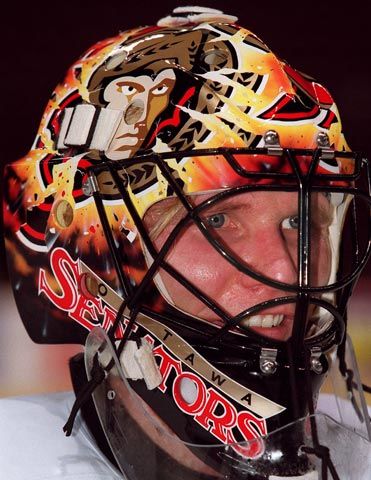
When the Sens shuffled goalies at the 1999 draft (Rhodes out, Patrick Lalime in), the reward for Ottawa fans was one of the best masks in team history. Lalime’s iconic Marvin the Martian mask was similar to the early Sidorkiewicz and Billington cages, with the top featuring a centurion mask. But Lalime modified that tradition and the result was terrific. His mask differed in that Marvin’s enraged eyes were popping out from under the centurion helmet. The original cartoon, developed in 1948 by Chuck Jones, was appropriately dressed as a centurion (with a pair of Chuck Taylor’s), based on the depictions of the Roman God of War, Mars, from antiquity. Lalime’s mask changed Marvin’s colours slightly to fit better with Sens colours and gave him goalie equipment. Unlike many Looney Tunes villains, Marvin the Martian was “clever and competent” as well as “incredibly destructive and legitimately dangerous”. Trying to destroy the world with his Illudium Q-36 Explosive Space Modulator, inevitably he was foiled by Bugs Bunny. So a perfect metaphor for a goalie who was unbeatable against the Flyers in the playoffs but was constantly thwarted by the Leafs.

year11week08

That brings us to Jani Hurme. This mask could not be more 90s, which means it was already outdated by the time he busted it out in the early 2000s. Another airbrush, graphic disaster, Hurme’s mask featured a fractured and splintering Senagoth logo (the first time that logo appeared on a mask in this series), and is quite clearly a reference to the ongoing financial woes and general instability of then-owner Rod Brydon. That or Hurme’s save percentage.

1302128951030_ORIGINAL

Martin Prusek is up next and there are things that need to be said about his mask. Important things. For starters, wearing the helmet-cage combo in the early 2000s was more than a little eclectic. Still, there were guys at that time who could pull it off, and Prusek wasn’t one of them. The cage and helmet didn’t seem to fit properly, and the helmet seemed to pop up on his head. Basically, he made Tommy Söderström look like the height of fashion. He doubled-down on bold choices by picking a Roman motif not utilized by anyone else in franchise history: the Colosseum. Aesthetically, the Colosseum might work on a mask but Prusek took the decidedly unaesthetic approach. I can’t be sure, but it seems like the thinking was: “my head is round, so is the Colosseum. I will wear this building like a crown around my head”. Sure. Now it’s possible it was some sort of comparison of arenas: of gladiatorial games and hockey games. But if Martin Prusek had posted a .911 save percentage in ancient Rome, he would have stayed in the provinces and never made it to the big show in Rome.

prusek

After another playoff loss to the Leafs and an NHL lockout, two new goalies emerged. Dominik Hasek was a living legend when he joined the Senators and his Cooper helmet-cage was his standard look (the Sens seem to have a disproportionate number of goalies who went this route). Hasek started painting his helmets while in Detroit and continued the practice in Ottawa. His final days with the team have been dissected before, but not enough time has been spent discussing his subtle work for Ottawa Tourism. Until he left for the 2006 Winter Olympics, Hasek worked tirelessly to promote Ottawa as a sunny, warm, weather destination by featuring a sunburnt, centurion on his mask. You’re welcome, Kanata.

PHILADELPHIA - DECEMBER 22:  Goaltender Dominik Hasek #39 of the Ottawa Senators in action against the Philadelphia Flyers during the NHL game at the Wachovia Center on December 22, 2005 in Philadelphia, Pennsylvania.  The Flyers defeated the Senators 4-3.  (Photo by Len Redkoles/Getty Images) *** Local Caption *** Dominik Hasek

PHILADELPHIA – DECEMBER 22: Goaltender Dominik Hasek #39 of the Ottawa Senators in action against the Philadelphia Flyers during the NHL game at the Wachovia Center on December 22, 2005 in Philadelphia, Pennsylvania. The Flyers defeated the Senators 4-3. (Photo by Len Redkoles/Getty Images) *** Local Caption *** Dominik Hasek

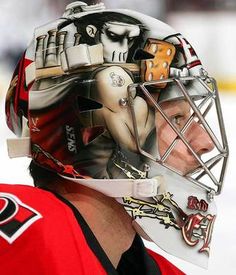
Ray Emery’s masks are possibly the most talked about in Sens history. Nominally related to the team, they generally feature a team wordmark or small logo but focus primarily on Emery’s love of boxing. I think that’s a great thing actually. From the beginning, goalie masks have been an assertion of individuality. When Gerry Cheevers began the painted mask tradition it was also an assertion of individuality. Some of the most iconic masks in NHL history (Cheevers, Gary Bromley, Gilles Gratton, Curtis Joseph, Curtis Sanford, and Gary Simmons) had little to do with the teams they played for. Some designs, like Ed Belfour’s Eagle design from his time in Chicago or Patrick Lalime’s Marvin the Martian design from his time in Ottawa, become so associated with the goalie that he adapts it to fit the colours and style of successive new teams. However, in 15 years of Sens goalies, Emery was the first to have an individualized mask whose primary focus wasn’t a centurion or city-related imagery and without significant references to team iconography. Even Lalime’s mask was a play on the centurion theme. Emery’s cages were a needed burst of individuality and the fighter theme translated well to hockey.

OTT-Emery-Front

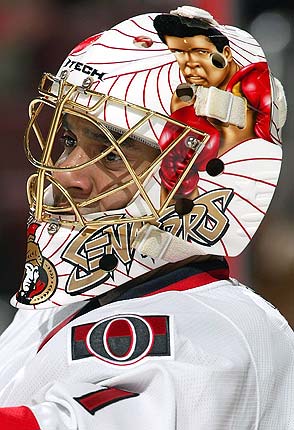
Emery also had the most controversial mask in team history. While some goalies shop out the bulk of the design and thematic work to the artists who paint the masks, it’s fair to say Emery was more involved in the process than most. In 2006 he debuted a mask featuring former heavyweight champion Mike Tyson. Emery wore the controversial mask for just one game before Sens management stepped in. After a meeting with John Muckler, Emery retired the mask. There were several instances of the Sens objecting to Emery’s behaviour and Stacy L. Lorenz and Rod Murray’s article “The Dennis Rodman of Hockey: Ray Emery and the Policing of Blackness in the Great White North” in Commodified and Criminalized: New Racism and African Americans in Contemporary Sports elaborates on the racial overtones of management’s objections. Where I disagree with Lorenz and Murray is the argument that the Senators only acted because Emery is black and used the fact that other organizations allowed goalies to wear masks objectifying women (most notably John Grahame in Tampa Bay) as proof. The Sens can’t stop goalies in other organization for having masks with objectionable material. While Emery’s race may very well have been a contributing factor to Muckler’s objection (the authors make a convincing case it was a factor in other clashes between the goalie and management), so too was public outcry. Simply put, having a mask celebrating a boxer who is also a convicted rapist is deeply problematic given the issues we still face in hockey culture and is deeply offensive to many survivors who watch the game.

06-ray-emery-ottawa-senators-mask-294nm-030209

Contemporary Period: 2007 to present

Martin Gerber entered the fold after the 2005-06 season. I guess it’s telling that it’s really hard to remember the mask he wore during his first season in Ottawa. Brought in to start, he ended up backing up Emery during the season the Sens when to the Final. He started the 07-08 season trying to reclaim his starting job and wore a black mask while awaiting a paint job on his primarily cage. The black mask endeared him to Sens fans and earned him the nickname “Darth Gerber”. Gerber even proved he got the joke, when he unveiled a Darth Vader mask to start the 2008-09 season. Sens fans didn’t see much of the mask as Gerber’s poor play led to him losing his starting gig to veteran Alex Auld and newcomer Brian Elliott and he was eventually placed on waivers.

RbPZsu7

Alex Auld’s masks were boring and derivative which is more charitable than I can be about his play. Auld’s look featured the mask-within-a-mask centurion helmet that made its first appearance in the inaugural season. Ugh.

alex-auld

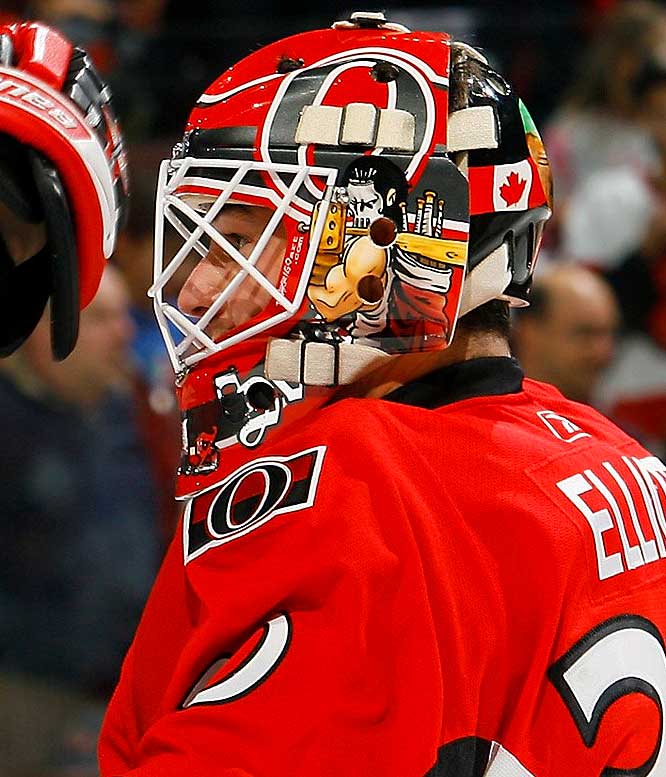
Elliott had two main masks while playing for Ottawa, a white one and a red one, both featuring the cartoon character Casey Jones from the Teenage Mutant Ninja Turtles universe.

6243d292c00c81640f1671abafb89847

Elliott’s red version stands out because he adopted the Heritage O secondary logo which had been featured as a shoulder patch on the home and away jerseys up to that point. A number of factors contributed to the Heritage O logo gaining in popularity among Sens fans and while Elliott’s mask is not at the top of that list, it helped push the O from afterthought to the attention of fans.

brian-elliot

It would be easy to forget Pascal Leclaire and the most memorable thing about his mask was when he wasn’t wearing it on the bench, took a puck to the head and suffered a broken cheekbone, part of a string of injuries which sadly cut his career short. His injury history was legendary but his mask was not. Leclaire’s mask was one of those centurion caricatures that’s silly and thematically boring. Like Elliott, Leclaire also adopted the Heritage O logo as part of the design of his mask.

ottawa-pascal-leclaire

Sorting out the final days of the Elliott-Leclaire tandem resulted in the Sens using six goalies in 2010-2011 season and the only one to see significant playing time in addition to that duo was Craig Anderson. Anderson’s Sens masks have all been a variation of masks worn in Colorado and Florida. The left side of the mask features a Rat Fink-inspired centurion driving a corvette, the right a Sens logo and team wordmark. A maple leaf/leaves have also been a feature of his Ottawa masks.

140410152807-ottawa-senators-craig-anderson-single-image-cut

His heritage masks strongly link the current team with the original Ottawa Senators, a link that’s been suggested since the expansion franchise was awarded, and has been rejuvenated over the last four years with the heritage jerseys.

140410152803-ottawa-senators-craig-anderson2-single-image-cut

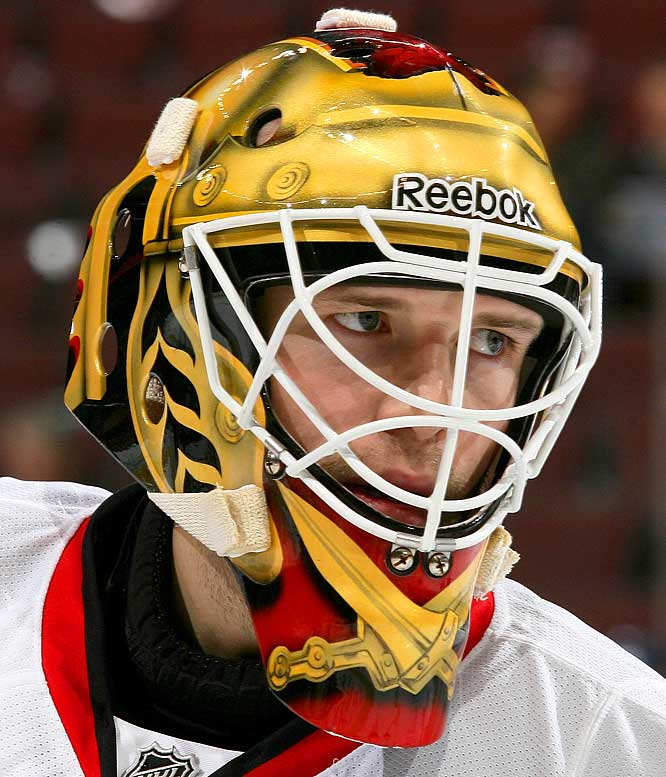
Robin Lehner’s mask looks like the face covering you’d wear to slay your enemies while driving through Valhalla on a motorcycle, blood running down your face.

140410152811-ottawa-senators-robin-lehner-single-image-cut

Ben Bishop wasn’t in Ottawa for very long, but long enough to become part of the fan base’s revisionist history and to personalize a mask. It’s an unremarkable black and white design but is notable for including the alternate side profile logo that’s an update of the original 2D logo. While ostensibly part of the team’s visual landscape since 2007, it’s rarely if ever used but appears on Bishop’s mask.

hi-res-7156292_crop_north

Finally, we come to Andrew Hammond’s Hamburglar mask. Along with Lalime’s mask, it’s the most iconic in team history. Featuring Alfred E. Newman in the Hamburglar’s costume, it’s noticeable, fun, and different. It also shows how a mask can help create a fan favourite. No doubt the strong play of Hammond during the streak was the most significant factor to him being embraced by the fan base. However, the mask and nickname led to burger tossing, much burger eating, and general revelry.

andrew-hammond-nhl-buffalo-sabres-ottawa-senators-850x560

At its most basic level, painted goalie masks are an expression of a goalie’s individuality. But they’re also an extension of team identity and can push, however subtly, boundaries of iconography, marketing, and codes of behaviour. A mask can be as forgettable as the player wearing it or help foster affection for the guy standing between the pipes. A mask can chart the visual and aesthetic history of a franchise and connect fans to that chronicle. A mask protects, creating an additional boundary between goalie and opposition. But it also connects fan to goalie, because the paint shows something of the person behind the cage.

Posted in Uncategorized | 1 Reply

Whose Masculinity is this Anyway? Identity, Violence, and the Real Crisis in Hockey

(Content warning: post and links discuss harassment, assault, sexual assault, rape, racism, sexism, and homophobia)

Yesterday was both a blemish on major North American sports and an utterly predictable series of events. Within the span of about an hour Thursday morning, the Tampa Bay Buccaneers launched “an embarrassingly sexist” program aimed at helping female fans understand the complexity of football with tips about fashion and play clocks. The official Vanderbilt Football twitter account tweeted an offensive and ill-conceived promo for its program claiming, “We are RELENTLESS, TOUGH, AND INTELLIGENT, and WE DON’T NEED YOUR PERMISSION”. The sexual assault overtones are clear; they are made worse when the program’s recent history with sexual violence is known. At about the same time word broke of Chicago superstar Patrick Kane’s involvement in a rape investigation in New York.

There was appropriate concern and pushback against these developments online as well as predictable, disappointing, and harmful support for Kane and dismissal of the Bucs’ and Vanderbilt’s actions. Those content to bury their heads further in the sand sang the familiar and flawed refrain of “this is society’s problem”.

Conventions, rules, and pedagogy in sport did not develop in a vacuum. Rather, sporting traditions have always grown out of the values of and challenges faced by the cultures creating and codifying sports like football or hockey. Hockey is like the internet in that it reflects, not exists separately from, our culture. Consequently, it is the flimsiest of defenses that suggests “hockey doesn’t have a problem with violence against women, society does!”
No.

That’s incorrect.

Violence in sport is socially constructed.

Both hockey and the society which created it, and maintains the sport’s practices, have a serious problem with violence against women. To suggest otherwise is to blatantly ignore the reality that we are presented with on an almost daily basis.
As fans we have a tendency to want to limit the scope of hockey’s domestic violence and sexual assault problem. So we try to limit the discussion to player actions we deem criminal and ignore the everyday sexism we see in the game, in the way teams treat female fans and employees, and jokes on social media that fall flat. We eviscerate the Los Angeles Kings and Dean Lombardi for being terrible, which they are, and we take the Nashville Predators to task for being appalling, which they are, and we’ll add Chicago to the list now, but we will refuse to see this as a league-wide problem. We’ll ignore that it permeates various levels of the game and is endemic to the sport. It makes it easier to keep watching and talking hockey if every team, and by extension, fans, aren’t complicit. It makes it easier to root for your team when you only object to rape culture and violence against women when it’s a player from a rival team in the crosshairs. The team I cheer for is complicit and so is the team you cheer for. No team has a moral high ground here.

We’ll continue to take our cues from the commissioner who says hockey doesn’t need a comprehensive strategy for addressing and dealing with violence against women; that most in the sport are good guys who would never participate in such violent actions. We’ll cross our fingers and believe it, even with all the mounting evidence to the contrary.

Somewhat lost in the shuffle yesterday was another Canadian sports league taking action. The CFL released a comprehensive and victim-centred violence against women policy. Created in partnership with the Ending Violence Association of Canada the program doesn’t relegate victims to the sidelines which happens frequently in other leagues. It’s not perfect but it also illustrates that pro leagues can lead on this issue and change the cultures of their sports if they just make an effort. The more proactive a league is, the harder it becomes for its fans to deny the realities we keep seeing in the games we love.

There are many who want to stop these incidents. But the culture won’t change just by throwing the book at Slava Voynov, Mike Ribeiro, or Patrick Kane. The culture won’t change if we continue to refuse to centre the victim in discussions of violence and rape. The culture won’t change if we don’t take sports media to task for writing bullshit, reputation repairing pieces. So far, sports fans, and hockey fans in particular, have been unwilling to examine their own complicity in the culture of the game which permits such treatment of women. Further, we are collectively unwilling to look at the ways in which hockey itself promotes and relies on a masculinity rooted in rape culture.

Earlier this spring comedian Amy Schumer’s sketch “Football Night Lights” made waves and was widely celebrated not just for its stance on rape culture in sports but for clearly articulating the fictional community’s complicity in that culture and how football itself speaks the language of rape. The coach, played by Josh Charles, tells his team football isn’t about rape; rather that “It’s about violently dominating anyone that stands between you and what you want! You gotta get yourself into the mindset that you are gods, and you are entitled to this!” The message is clear: victory on the field requires both physical prowess and domination; players must force the opposition into submission. In this landscape, women are treated as trophies, the spoils of victory, and subject to a similar domination.

Yet there’s been a failure to apply what’s articulated in “Football Night Lights” to hockey. Hockey players are encouraged to play hard, dominate in the corners, and beat their opponents into submission. In hockey, players and teams are frequently reward for using violence during the course of a game. Typically mocked as simple sports clichés, we hear the language of domination from players, coaches, and analysts as well as read it in newspapers and blogs. We don’t bat an eye when this language crosses over into more explicitly sexual language. How often have you heard Jim Hughson or Gord Miller talk about penetration when describing a player like Kyle Turris or Henrik Sedin enter the opposing zone? Objections to this word and similar phrases in hockey are usually met with dismissal; “this is hockey,” the refrain goes, not sex or rape (the distinction between the two remains murky to many). To paraphrase Pitch Perfect, a zone entry is not a good enough reason to use the word penetrate. As hockey fans we’re aware of how suggestive the language of the game can be, but rather than question what’s at stake when using sexual language to describe a sporting event, we treat it as a joke and use hashtags like #hockeyporn to keep the laughs going. But we rarely reflect on the homophobic nature of the humour or how it naturalizes the pairing of violence and sex.

We talk about hockey this way and use such sexual language because of the type of masculinity we celebrate in the game. Hockey praises a masculinity that is still based on conservative notions of toughness and dependent on strength and aggression. The game’s ubiquity and popularity in Canada means it’s the dominant expression of masculinity in this country. It’s typified by people like Nick Kypreos and current players like Chris Neil, and celebrated by personalities like Don Cherry. Steeped in whiteness, it uses subtle, racially-motivated language to police behaviour and maintain the status quo. Players like Evander Kane, P.K. Subban, and Josh Ho Sang are considered controversial because they have “personality,” confidence,” and are “outspoken”; coded language highlighting how uncomfortable hockey’s traditional, white masculinity is with difference.

Hockey has a code which also maintains and rewards this kind of conventional tough masculinity. Hitting and fighting are acceptable performances of aggressive masculinity (despite the physical dangers and the fact that fighting is always penalized) while more benign transgressions, like diving (which generally injuries no one), are treated as stains on the game. Those who dive are described in feminized language as soft and delicate. European players are often described this way in contrast to the proper masculinity of celebrated Canadian boys who play the game the “right” way. I’ve always found the consternation surrounding diving in sports like hockey and soccer to be over the top, but that it’s characterized so vehemently as duplicitous is important. Cross-checking is cheating, hitting from behind is cheating, and sucker punching a player is cheating, yet diving, more than any other infraction in hockey, causes the toughness crowd to lose their composure. It’s because diving is seen as lying, cheating, and fraudulent and those who dive are feminized. Think about that. Think about the language used and the response from hockey fans when players embellish or are perceived as faking an injury to gain an advantage like a power play.

It can’t be surprising then, that the majority response to women who have been raped or physically abused by hockey players is to disbelieve and discredit victims, to slander and shame women. It’s the same language.

I’ve been thinking about my masculinity a lot lately. It’s a component of my trans identity and I can’t dismiss it simply because of the numerous examples of toxic masculinity around me. Yet I’m a product of a patriarchal society and I can see how a masculinity based in toughness is appealing. Following convention when it comes to identity can provide someone like me with security and safety and that’s desperately needed for trans lives. But for me, the cost of inclusion is simply too high, namely increased complicity in the toxic masculinity and rape culture of sports like hockey.

One of the things you become acutely aware of if you’re trans is how much of gender is performance. The same is true of masculinity. We often evaluate masculinity in terms of crisis and fragility. The emergence of organized and codified sports like hockey at the end of the 19th and start of the 20th centuries are sometimes discussed as a response to the feminization of men in the late Victorian period. Similarly, we talk about the fragility of modern masculinity in the face of the erosion of traditional gender roles and the loss of breadwinner status and therefore embrace contemporary examples of tough, aggressive masculinity, like hockey, football, and MMA. But the real crisis is not masculine identity but the violence against women which continues to plague the North American sports landscape.

I don’t see the panicked actions of a fragile identity. I see a deliberate digging in. It’s a limiting mindset for men and sidelines all who don’t fit this particular expression of identity. What I see in the masculinity typified by hockey, in its players and many of its supporters, is dangerous. It is a concerted effort to maintain the hierarchical power they have always enjoyed and abused. It extends to the stands and bars and pubs where fans watch this performance of tough, aggressive masculinity. It continues off ice for players and team personnel.

That women continue to bear the brunt of this assertion of power remains tragically predictable.

10 Years Later: Hossa for Heatley

This month marks the 10th anniversary of the Hossa-Heatley trade. While Yashin for Chara and the pick the Sens used to draft Jason Spezza will remain the greatest trade in team history, Hossa-Heatley is perhaps the most important, franchise defining move and subject to considerable revisionist history by Sens fans.

It’s not that people weren’t excited about the trade at the time, far from it. While a vocal minority panned the move, Heatley was young and exciting and certainly a big ticket winger on the same level as Hossa. Hossa was beloved in the capital, fans chanted his name after every goal. He was one of the team’s most exciting players and a big contributor during the 2003 playoff run to the Eastern Conference Finals. But the P.R. machine got to work quickly; conventional xenophobia emerged in reaction to the move – Hossa was a soft European who couldn’t handle the tough play of the NHL playoffs while Heatley was a gritty Canadian kid. It was easy to paint Hossa as greedy, the stereotype of the mercenary European player still fresh in the minds of Sens fans after several rounds of contract disputes with former captain Alexei Yashin.

Heatley didn’t exactly fit the gritty Canadian player mould either. He scored more from the hash marks than the crease, and came with his own considerable baggage. He had asked for a trade out of Atlanta earlier in the summer, troubled by his responsibility for an accident in September 2003, in which Heatley drove too fast, crashed his car, and his passenger and teammate Dan Snyder died as a result. But just as quickly as Hossa was painted as greedy, Heatley’s past was glossed over by many Sens fans. He was Ottawa’s first true Canadian star. Spezza would quickly join Heatley, but didn’t have a breakout season until paired with the winger, and Wade Redden, who would have his best season statistically in 2005-06, was overshadowed by Zdeno Chara. Ottawa’s best, Yashin, Alfredsson, and Hossa, were all Europeans who had strained and difficult contract disputes with the organization in the past. Players negotiating with the tools available to them has for a long time been characterized as greed by fans and media alike. If playing the game right means measuring a player’s toughness on the ice, then playing for the love of the game and eschewing monetary concerns is how to play it right off the ice in conventional Canadian hockey mythology. In contrast to Yashin, Alfie, and Hossa, Heatley had starred for Canada at the previous three World Championships as well as the World Cup in 2004 while recovering from serious knee and eye injuries. There was the prospect of cheering a Senator wearing the red maple leaf for Canada at the Olympics in 2006 with his arrival. He was also under contract for three more seasons. He was different in key ways that generated excitement and allowed fans to quickly move on from a summer of debating the merits of Hossa and the dollars he deserved.

Looking back, the money can’t be overlooked.

Hossa was frequently credited with being not only a great two-way player at the time of the deal, but Ottawa’s best player period. One of the top wingers in the league at the time, he matched the play of upper end comparables like Jarome Iginla and Vincent Lecavalier. The eventual deal the Sens and Hossa agreed to (3 years, $18 million) before reaching arbitration was fair in terms of his ability and what he was worth, but would prove difficult to accommodate in the new, salary cap world.

With the Senators hovering around the $31 million mark in salary and the newly instituted cap set at $39 million, Ottawa was right up against the upper limit with the Hossa deal. Had the case been decided in arbitration, the award could have been even higher and the team risked losing him as a UFA 12 months later. It wasn’t a salary considered in isolation either. Then Senators GM John Muckler had an eye on the following summer when star defensemen Wade Redden and Zdeno Chara could both walk as UFAs and winger Martin Havlat would need a new deal. The situation might have been even trickier had Sens captain Daniel Alfredsson not signed a 5-year deal after the 2003-04 season. Signed before the 2004-05 lockout, it was subject to a 25% rollback when play finally resumed the following season. After a lucrative $7.5 million signing bonus, Alfie was set to make just $4.66 million in 2005-06. Had Alfie signed another short term deal in 2004, he might have been deemed expendable in the post-lockout world as the Sens struggled to get both star wingers under contract. Had the Sens kept Hossa after signing him to that three year deal ten years ago, Alfie, signed long term and to an affordable deal for a star player, might have been appealing trade bait.

While the salary cap put teams on equal footing in terms of spending, it disproportionately affected good teams with young talent coming out of RFA years and moving toward UFA status. Teams like the Senators. Not only did the lockout wipe out a year of contracts for players like Hossa, it wiped out a year of RFA status, a year of team control. It was hard to plan long term with the looming lockout. While the league was pushing hard for a salary cap, what it would be set at was unknown and salary rollback wasn’t guaranteed. Further complicating the matter for the Sens was the team’s recent bankruptcy. Financial trouble had hounded the team since its early days and became acute in the years leading up to 2003. During the last few years of Rod Brydon’s ownership, the Sens often stuck to short term deals, affording the team financial flexibility in times of ownership and CBA instability. Simply put, it’s hard to lock up your young stars to affordable or near affordable deals when you can’t afford to pay them in the first place.

This trade has received a lot of retroactive criticism, but I wonder if it would be seen as a good bit of business, perhaps even prudent, if it was a move Bryan Murray had made this summer. I wonder how the move would be viewed today had it been made in the climate of analytics and a decade into the salary-cap era. At that point in their careers Hossa and Heatley were pretty close in terms of point production, but Hossa would have likely come out on top of the Corsi battle. Still, Heatley’s projected production at the time, in combination with the fact that Heatley’s cap hit was $1.5 million less than Hossa’s each season through the course of Hossa’s deal (which is the same amount the Sens saved on Hossa’s deal in real dollars each season by trading for Heatley), and some might conclude that Heatley might have been the better value in the restrictive early years of the cap system.

What pushes the deal over the top in the short term is that in addition to trading sniper-for-sniper, the Sens were able to offload Greg de Vries. The veteran defenseman was coming off a down year and was due to make $2.28 million in 2005-06 and was under contract until 2007. While that might not seem like a lot now, he was making more than every Senator not named Hossa, Alfredsson, Redden, Chara, or Havlat. In other words, he was making a lot for a defensive defenseman who failed to impress as a deadline pickup in 2003-04. With Hossa and de Vries in the lineup, it’s likely depth contributors like Chris Kelly and Christoph Schubert, as well as rookie standout Andrej Meszaros, would have been stuck in the AHL due to budget constraints/de Vries’ spot in the lineup. It’s always going to be difficult to give up a player of Hossa’s calibre, but to bring back a younger player with similar point production and strengthen your depth all while shedding salary isn’t a bad way to get out of bind.

If it’s hard to remember where the Sens were at in August 2005, those first two seasons with Heatley in the lineup seem equally distant. For all the longing for Hossa you hear now, things were considerably quieter when Heatley notched points in his first 22 games as a Senator (besting Hossa’s previous franchise mark by nine games), on the way to back-to-back 50 goal seasons and a trip to the Stanley Cup Final. While Hossa put up similar numbers in Atlanta, it’s not like the Senators missed out on a terrific trade return when he was shipped to Pittsburgh at the trade deadline in 2008. It’s possible Hossa wouldn’t have jumped around so much if his faith in the negotiating process hadn’t been shaken by the Senators, but it’s also clear he wanted to win a Cup. After falling short with Pittsburgh in 2008, he signed a lucrative one year deal in Detroit that didn’t work out and led to a mammoth 12 year/$63.3 million deal with Chicago in 2009. The Hossa everyone regrets missing out on is the elder statesman Hawks version, with three Cups to his name and part of a modern NHL dynasty. That’s fair, he’s been a big part of Chicago’s golden age. What it illustrates the most though is Hossa’s legacy in the NHL is defined by his time Chicago now, his Ottawa years more footnote than main story.

It was always going to be tough to sign and retain that early-to-mid 2000s core in Ottawa. A perfect storm of bankruptcy, maturing talent, and a new (and by today’s standards, restrictive) salary cap, was always going to leave at least a few players on the outside looking in. That Heatley didn’t have the longevity of Hossa is clear. That the Senators gave up the best player in the deal is also clear. What might have been a win in the short term has been a loss long term. But keeping Hossa would have also altered the story as well and the results likely wouldn’t have been the fairy tale ending he’s enjoying in Chicago.

August Long Weekend Kanata Staycation: Lunch at Big Rig

The August long weekend is upon us, Sens fans, and while many of you will sit for hours in traffic on the way to the cottage, camping, or some a rain-soaked music festival that has final grasped the fact that cultural appropriation is unacceptable, @lukeperisty and I decided to check out early on Friday afternoon for a staycation in sunny Kanata.

After taking in some of the most notable sights and landmarks of eastern Ontario, including the biggest development of the summer, we navigated through the typical congestion of Ikea bound homeowners and inadequate parking in the Big Rig lot. We were seated quickly at Big Rig, which suited us just fine as hard-hitting reporting is hungry work.

Big Rig 2

Luke made a selection off the summer drink menu, trying out the raspberry ale. The colour reminded me of a punch I’d find in this book. That’s not a bad thing, I really love punch. The author had a cola beverage. Nothing to report, it was a cola beverage.

Waiting for our food, our thoughts turned to Chef Chris. We’re all too familiar with his exploits on the ice and his family’s interest in nutrition, but what about his skills in the kitchen?

Luke played it safe with a classic grilled cheese and tomato pairing, sampling the somewhat pejoratively titled “Grown Up Grilled Cheese and Tomato Bisque”. It looked appealing, tasty, and slightly decadent but its presentation was lacking. Chef Chris wisely avoided the conventional grill marks that so many hockey fans gravitate toward, but missed an obvious use for this product. As for the bisque, it was obviously meant for Coach Cameron, sitting two booths away; its hypnotic cream swirl had my fellow blogger suggesting a Big Rig-Boro duo could be more than a buddy cop flick and might actually be a shutdown third pairing this season.

Big Rig 1

Where this sandwich was on point was the cheese. Grown up grilled cheese sandwiches don’t rely on kid-pleasing American cheddar. They make a statement. And when Chef Chris is at the helm, the statement its making is this: it’s Chris Phillips’ house and you’re just a guest. Smoked cheddar, Havarti (known as “Grandma Cheese” in my house – don’t ask), Swiss, and gorgonzola. That’s four, FOUR, 4 cheeses. On point, Chef Chris, on point.

I entered Big Rig planning on ordering a burger, something with a subtle tie into the man himself, like the “# 4 Burger,” the “Big Rig Chop Chop Burger,” or the best named item on the menu, the “Fort Mac Daddy”. Afterall, Burgers: It’s What they Do!

Big Rig 5

But as I walked to our booth, I saw a family of four eating a pizza, served on a pedestal and realized I deserve more pedestal food. Now, I’m gonna level with you: sometimes you go out for pizza and you think, “that was really good, but there wasn’t enough meat”. But this place is called Big Rig, it’s going to have a signature meat pizza. It’s called Quattro Carne.

Quattro.

Four. FOUR. 4!!!!!!

Bacon, sausage, salami, pepperoni. That’s four meats. On point again, Chef Chris, on point.

Big Rig 3

You know presentation matters with this dish because it’s served on a pedestal. However, this pizza committed the biggest pizza sin in my opinion: placing the sliced, cured meats directly on top of the tomato sauce, then layering with cheese, and finally topping with bacon and sausage. It’s not that pepperoni and salami specifically shouldn’t go under the cheese, it’s just that I don’t trust pizza with toppings under cheese. This might sound ridiculous. This might seem a tad bizarre.

Let me explain.

When we were kids, my mom would make delicious pizza dough most Friday nights. The three pizzas would be divided into one for my parents, one for my younger sisters, and one for me and my older sister. One time when my older sister was about 11 and I was about nine, my sister was taking her turn dressing our pizza. Now, we would divide our pizza in half, her half would have mushrooms (one of three foods I refuse to eat) and mine would have green olives (which she doesn’t like). This particular time and in true evil sibling form, she put a mushroom under every pepperoni on my side of the pizza, then finished it off with a light dusting of mozzarella. When I bit in and was properly revolted, she laughingly revealed her duplicity, much to the delight of #DadL who also could not stop laughing.

Chef Chris’ “Quattro Carne” pizza was not a repeat of the infamous “Mushroom Surprise Pizza”. It was simply fucking good. It was probably the mounds of cheese. Definitely all the meat. It was good. Eat it.

As we waited for our bills, the classic rock soundtrack of 70s hits fit perfectly. The Eagles reminded us that we could never leave and it became stunningly apparent that the Sens have a better branding and design team than Chef Chris:

Big Rig 4

Underappreciated Sens

The arbitration period of the summer is typically the low point of the hockey year. So little is going on that fans spend hours debating the merits of a player asking more than his employer on his next deal as if this was not an utterly predictable exchange and tactic. But it does shine a light on what is deemed valuable within the current mood of the NHL and who is assigned value.

Ottawa has had its fair share of heroes; players who have put up big points, scored crucial goals, or strung together remarkable victories. These players get a lot of ink, but what about the underrated and underappreciated? The guys who aren’t subject to round after round of Senators Revisionist History by bored fans on brutally hot summer nights. Who are the most underappreciated Senators?

Shawn McEachern

McEachern was part of the best Sens era in team history but gets overshadowed by offensive players like Alexei Yashin, Daniel Alfredsson, and Marian Hossa. Yet in his six years in Ottawa, McEachern twice finished second in team scoring to Yashin and finished third on another occasion. There was a period of a few seasons where Alfredsson had horrible injury luck and the Yashin saga was playing out when McEachern was the reliable veteran who could be counted on for top-six offensive production in the dead puck era. Two 30+ goal seasons as well as a season with 29 goals, Shawn wasn’t depth scoring, he provided key production, yet has been all but forgotten in the decade+ since his trade to the Thrashers.

Jason York and Igor Kravchuk

Neither were key contributors or flashy players. What they were is what we now crave: reliable blueline depth. Good for 25-35 points a season and generally more than 22 minutes/game, York was in Ottawa for five seasons and Kravchuk for three and a half. They didn’t take a lot of penalties, they didn’t hurt their team. They were just quietly steady. They were the kind of blueline depth that fans now crave but the type of players that are easy to forget when they’re in the lineup.

Antoine Vermette and Chris Kelly

These two go together because my memory of one seems to always include the other. Young players during Ottawa’s golden age, Kelly and Vermette came up as inexperienced, inexpensive, depth players, the type good teams need to cultivate to stay good. They spent most of their time on the third line and killing penalties, where they were not only an effective shutdown force, but a force for good with a knack for chipping in shorthanded goals (8 between them in 06-07 alone). Trapped behind Spezza and Fisher, Vermette was too good for the third line but couldn’t break into the top six. Still, he had seasons of 19, 21, and 24 goals for the Senators, but never received the attention of the surprisingly comparable Fisher. Chris Kelly is remembered more as a useful, but limited, defensive specialist. However, he always hit double-digits in goals, and twice notched 15 as a Senator. That’s awesome production from a third line player, especially one who is so versatile defensively – the original Erik Condra if you will, but with twice the goals.

Nick Foligno

Foligno was another young player who the Sens moved in his mid-20s like Vermette. During his first couple of seasons with the big club, the Senators were still under the illusion they were an elite team. As Foligno continued to develop, he played on some truly crap Sens incarnations yet seemed to have trouble sticking in the top-six and often played a third line role under Cory Clouston (Q. how much did that guy fuck with things?) Yet Foligno kept contributing and his last season as a Senator was his best (15 goals, 47 points). His penchant for taking ill-advised penalties seems more an anomaly instead of habit in retrospect, but one which contributed to him being traded. He’s not the biggest guy in the league, but he’s a physical player who’s comfortable setting up in front of the net. Essentially, he’s the player Bryan Murray envisioned when signing the Colin Greening contract. Even his goalie hugs, which have become the stuff of legend in Columbus, were underrated in Ottawa.

Chris Phillips

It might seem odd to see Phillips on this list. A Senator since 1964, Phillips was key in choosing a new Canadian flag. But he also gets lost in the shuffle somewhat, as Ottawa’s blueline has traditionally been pretty strong. Behind Redden and Chara on the depth chart for the prime of his career, his pairing with Volchenkov was given its due, but his-hard hitting partner was the more celebrated of the duo. Since Erik Karlsson’s emergence, a litany of defensemen (Kuba, Gonchar, and Methot) have all been more vital to the Sens success. That Phillips was not one of the team’s two best defensemen for much of his career shouldn’t diminish the fact that he was a valuable one for the bulk of his years in the NHL and deserves the corresponding appreciation. His rapid decline post-35 is being weighted too much right now. His last days in the capital have surely been his worst, but like Bryan Mulroney or George W. Bush who also left at their lowest, there’s nowhere for Phillips to go but up.

Watching from the Stands

(Content warning: anxiety, harassment, assault, sexual assault, racism, sexism, homophobia, transphobia).

Earlier this week I wrote about what sports fandom means to me during transition. It was an introductory post on a new site and I hadn’t intended on writing a series on mediating being a sports fan and transition. But I went to a ball game on Tuesday night and had to go through all the typical trials of that experience. On Wednesday, I wrote about how difficult it is to make it from your house to your seat when attending a game if you’re not cisgender. I’ll return to writing more about the Sens soon, but before I do, I want to pick up where I left off in Wednesday’s post and talk about what it’s like to watch a game live when you’re not cis.

Most sports maintain, enforce, and rely on the traditional gender binary.

Certain sports like hockey, which generates and enshrines toxic masculinity as its core value, are particularly invested in keeping this status quo. To attend a sporting event when you do not fit the traditional definitions of femininity and masculinity is to take a risk that threatens your safety. If something does happen to you during the course of the game, very few people your back.

Sports crowds have documented issues with racism, homophobia, and sexism. Often stadiums and arenas are only partially accessible if you live with a disability. Trans people exist at the intersection of these issues and their gender identity.

Chances are you’ve thought a lot about the location of your seat if you’re trans and the view of the playing field wasn’t top of the list. Maybe you’re most comfortable if you only have to sit beside the person you’ve come with, so you’ve chosen an aisle seat. Maybe it’s easiest for you to get through the game if you don’t have to look at other fans so you chose a seat against a railing or a column. Maybe you chose to sit in the last row of your section or against a wall so all the action, including other fans, remains in front of you. Perhaps you want to be close to an exit in case things go south. If you’re MTF, FTM, agender, or non-binary and you use a mobility aid you have even less options for controlling your surroundings. Some sporting events, such as the Pan Am Games and university competitions, have unassigned bleacher seating. Many people, including trans people and people dealing with mental illness, show up early to secure seating which makes navigating public space and a crowd more manageable. Before you ask someone to move over so you can get the seat you want, consider that many people chose where they sit deliberately. Being a good ally means being aware that not every disability is visible and privileges you enjoy are not always shared by others. The same goes for swapping seats at a sparsely attended baseball game and while using transit to and from the game. Be aware.

Trans people face so much discrimination just by sitting in their seat. There are numerous announcements during the course of the game, often starting with the anthem. Sometimes these announcements ask fans to stand or give their attention to something happening in the crowd or at ice level. Facilities that are actively inclusive begin these announcements with “fans” instead of “ladies and gentlemen”. “Ladies and gentlemen” is a common expression and is seen as polite. It might not seem like a big deal to you if you’re cis, but if you’re not, it can feel like an erasure of your identity and serves to underscore the fact that you are not welcome.

Just sitting in your seat might lead to problems with other fans and stadium employees. Fans passing by to get to their seats or to the stairs say “sir,” “ma’am,” “miss,” or any of the multiple gendered descriptors we use every day without much thought. A worker climbing the steps selling water, pop, and cotton candy genders you incorrectly. You exist outside of cisnormativity but get called a lady when buying 50/50 tickets. I worked as a cashier for a number of years and employees who interact with customers are often taught to ask “may I help you ma’am?” and “is there anything I can do for you, sir?” Many people see this as a sign of courteous service, but simply asking “may I help you?” without gendered terminology is a lot more inclusive.

Even simple game day rituals can contribute to misgendering. You identify as trans feminine but sometimes pass as male so you think twice about buying that beer and not because it’s going to set you back $10. When you are gendered a certain way by others and then partake in activities typically associated with that gender (like passing as male and buying a beer at a hockey game), the likelihood the person serving you the beer is going to call you “man,” “dude,” “bro,” or “buddy” increases dramatically. That gendering doesn’t end there. If you’re ordering a beer you’re most likely going to hold it, and, unlike in beer commercials, you’re actually going to drink it. Some people read that beer as a signifier of maleness. This can be useful if passing as a certain gender is important to you, but it might also contribute to continued misgendering by the fan who wants to slip by you to head to the concourse or the person beside you who wants to high five after a goal.

Misgendering happens. It’s a regular part of life for people who aren’t cis. If you misgendered someone, apologize and move on. Don’t make it about you because it’s not about you. For some trans people, misgendering is a normal part of life that isn’t upsetting unless in extreme situations. For others, it’s deeply distressing. There is infinite variety in gender identity, and the trans experience is one that differs from person to person. If someone misgenders you and they see it upsets you, sometimes that person keeps doing it with the purpose of upsetting you. That’s happened to me at games. Consistently misgendering someone isn’t an accident or mistake. Consistently misgendering someone is offensive, abusive, and compromises the safety of the person being misgendered.

Sometimes sitting in your seat is a threatening experience if you’re trans. A rink is a gendered space: traditional masculinity is on display in the form of the players on the ice and the toughness of the game; traditional femininity takes place on the margins. Ice clearing crews are formed primarily of, or exclusively of, women filtered through the heteronormativity of the male gaze. It’s a situation that makes a lot of cisgender people feel uncomfortable and fosters an environment hostile to all but those who meet this narrow definition of masculinity. Consequently, it’s common to use gendered language and insults to abuse the opposition or in some cases, the home team. These insults, spoken casually around you in the stands or abusively hurled, yelled for all to hear, are sometimes racist, misogynistic, homophobic, and transphobic. This behaviour can be encouraged by alcohol but it’s the product of a society that actively hates women and those who don’t conform and a game which encourages players, and by extension fans, to “man up”.

Someone beside you insults you. A person four rows down and eight seats over is yelling homophobic insults at the opposition. Cis people don’t always have the option of saying something to a fan who is being offensive. If you’re alone or in a small group impacts whether you say something. If you’ve brought you’re kids to the game, you might not feel comfortable confronting the group of dude bros sitting in front of you making offensive remarks. Whether you’re a man or a woman or a person of colour impacts you’re ability to say something. If you have anxiety or another mental illness does too. The same holds true of sexual orientation. Trans people have to make these considerations as well. But we have additional barriers when confronting discrimination in game.

Sometimes our voices out us.

If you’re non-binary, sometimes the sound of your voice leads to you being misgendered. If you’re trans, speaking can out you. Listeners might make assumptions about which gender you were assigned at birth. Say you’re a 27-year-old trans man who’s started T. Your voice is likely changing, getting deeper, and yeah, might even be cracking. Some trans people go through puberty for a second time as an adult and it raises several issues that can prevent someone from speaking out. That’s not to say that those who do not fit traditional gender binaries don’t speak out against discrimination, many do and they should be listened to. It’s just that there are barriers for many of us when it comes to speaking to say nothing of the barriers cisgendered people deliberately put up when it comes to listening to trans people.

There are lots of valid reasons why people don’t say anything about the abusive and discriminatory language that’s common at sporting events. But consistently, cis people fail to pick up the transphobic overtones of this environment. This oversight jeopardizes the safety of all trans people.

It gives bigots an invitation to insult, harass, and assault us.

In plain sight.

There’s a sort of paradoxical nature to my fandom experience. I’ve been accepted by many in the Sens online community. I’ve met some truly wonderful people and gained some cherished friends. But my in-game experience is quite different. There isn’t a noticeable show of support, there’s just silence. There are valid reasons not everyone can speak out, as I’ve mentioned above. But I wonder if some part of that silence is a different sort of acceptance. That hearing, seeing, and experiencing hatred is viewed as a problematic, but natural, part of the game. That those doing the hating, by virtue of always having been there, have become somehow fixed, like a ubiquitous, bigoted foam finger.

When I’ve talked about the harassment I’ve experience, people respond with things like “where do you live?” “who are these people?” “didn’t anyone say anything?” and “how did this happen?” as if this sort of thing doesn’t happen all the time in front of them. I’ve been to games where people around me openly debated my gender. Whether done in a mocking tone or with genuine interest, this sort of behaviour is incredibly offensive and frankly, none of your business. Men and women have used transphobic insults against me for nothing more than trying to watch a beautiful Erik Karlsson rush. A man told me I had “nice titties” as he flicked my nipples with his fingers and called me “bro”. Think it makes things better by challenging these assumptions or objecting to this transphobia? It doesn’t. It makes it worse. When your body isn’t read as meeting cis standards, you are often considered suspect. For objecting to insults I’ve been called a sexual predator.

Cisgendered men and women have contributed to this discrimination. However, most of the abuse I’ve received has come from cis men. There are cis men who have been among my biggest allies when attending games, who consider my needs and offer support in a variety of ways. However, there are also cis men who are invested in actively maintaining the toxic masculinity that empowers them. Toxic masculinity gives them the faulty impression the public space of the arena is their birthright and must remain aggressively male, aggressively white, aggressively straight, and aggressively cis.

When cis men with this view speak nostalgically about what it used to be like to go to a game I get uncomfortable. Some fans just want to cheer loudly and ensure their team has the best home ice advantage. Cool, that’s not what makes me uncomfortable. I’m uncomfortable because often this type of nostalgia is coded. When English soccer fans yearn for the days of terrace culture and when North American fans want to replicate the rowdy, raucous atmosphere of European stadiums, what many of them aren’t saying is those space are desirable because of who was kept out. Hostile to women and people of colour, these spaces were celebrations of a certain type of maleness and as a result, also homophobic and transphobic.

Sports teams and arena management groups do little to curb the discriminatory behaviour still present in our stadiums. Little changes can make these spaces safer for everyone. Something as simple as posting signage with team/arena discrimination policy, clearly outlining that all types of discrimination, including transphobia, are prohibited helps non-binary people know there’s a chance their concerns will be heard. It’s common for teams or the companies running sports facilities to save money by cutting down on the number of ushers working at any given game. Not every section has stadium personnel, not every area is monitored. If an usher is present, not only can they intervene on their own when they see or hear objectionable conduct, but they also provide an easily identifiable source for help. Further, many trans people have a distrust for security and law enforcement personnel. Ushers can act as intermediaries between fan and security. But they can only do this if they receive training on issues of disability, race, sexism, homophobia, and transphobia. Assuming your employees have the resources available to address the insectionality of fan conflict, is not a sound policy. Greater diversity among ushers and security personnel can aid in establishing this type of institutional knowledge as well as improve the approachability of your game day staff for women, people of colour, and LGBTQ folks.

Assuming every fan can access stadium personnel when needed is also problematic. There are numerous valid reasons why someone is unable to physically go and seek out this kind of help. For trans people sometimes getting help means being on the receiving end of more discrimination. Making official complaints to stadium personnel or police can be problematic for trans people if you have to give your name. Lots of people are transphobic and many don’t hide it because it’s still socially acceptable to hate people who are not cis. Some of those transphobic people work in rinks: at the concessions stands, as part of the cleaning crew, as ushers, ticket scanners, and security, to say nothing of the management of the organization itself. When people hate you, they don’t see you worthy of help and they don’t care about the abuse you’re suffering. In recent years, some teams have set up a system allowing fans to use texts to report abusive behaviour and lodge complaints. Making this sort of accessible system available enhances the safety of not just trans people but all fans.

Transphobia doesn’t exist in a vacuum. To eliminate it we must actively work to eliminate racism, homophobia, and sexism from these venues as well instead of accepting discrimination, bigotry, and hatred as the cost of going to the game.

Whatever happens on the ice or field, leaving usually has additional hurdles if you’re not cisgendered. While it is customary to leave a Blue Jays game in the seventh inning or a Sens game with five minutes left in the third period, the crush of fans trying to exit their row and down staircases, on their way to the concourse after the final whistle blows, is hard if you’re dealing with mental illness. The close proximity means some bumping between fans, which is anxiety-producing for some people. But some see this as an opportunity to grope, press and otherwise take advantage of the crowd to harass and assault other people. Those who exist outside of the intersection of cis, straight manhood are often the victims.

For trans people this time can be really stressful and hard. It’s not just that the ride to the rink and the experience of the game has been mentally draining, it’s that the mental preparation that is required before you even leave for the game compounds things. You’re just tired and drained. You’re less likely to be able to come up with quick, alternate plans if things start to go south. You might be rushing to catch a bus and trying to not worry about what happens if you miss it.

Some of my worst interactions with other fans have been on the way out of the rink. It’s hard to ignore the impact alcohol has on this part of the game day experience. Many fans are at least a few drinks in, some have been overserved for most of the night. What might have just been insults in the first period can easily turn to physical abuse when it’s time to leave.

Once in Detroit I was harassed by two shitbags. They were on my radar from the moment they took their seats. If you’re fortunate you don’t have to scan the crowd around you looking for people who might cause you problems. If you’re trans, you don’t have that luxury. These particular shitbags made several sexually explicit comments about women and started drinking during warm up. During the first intermission they noticed me as I was walking back to my seat. I was familiar with the way they stared at me because I’ve seen that look a thousand times. It’s the look of cis people realizing there’s something different about me. During the next two periods they looked across the aisle at me at regular intervals. But it wasn’t until the end of the game that things got really dangerous. They followed me down the stairs of the section. On the concourse one walked behind me bumping into me, the other to my right, pushing me and knocking me off stride. There had been a promotion that night; cardboard signs reading “Go Wings Go” were given out. The shitbag beside me held his right in front of my face so I couldn’t see where I was going. The shitbag behind me was bouncing his sign off the back of my neck, cutting me with the edge of the cardboard. The whole time they were saying transphobic things to me and threatening me. I wasn’t alone and we were surrounded by other people. It was in plain sight.

It’s not like things like this don’t happen at my home rink. This sort of stuff can happen anywhere. The last time I went to a Sens game in Ottawa it was a pretty good experience as far as these things go for me. The Sens won in overtime and fans went home happy. I rushed to catch my shuttle bus and was able to get there before anyone else and grab a set at the front. Four drunk shitbags got on the bus and suddenly I had a problem. I had made a mental note of them when they got on the bus at the start of the night, but now they were drunk and we were alone. I was sitting looking out the window and one of them punched me in the back of the head. They laughed and fist bumped and called me “pussy” and transphobic slurs. Then they took their seats like nothing happened. The bus finished loading and we started for downtown. We cheered for the same team.

I am not ashamed to say I cried for most of the trip back downtown. The only shame in that situation should be felt by the people who see difference and can only acknowledge it with violence.

That was the last time I went to a Sens game. I don’t know when I’ll be back.