Welcome to Your Karlsson Year’s Epic First Round Preview Which May Never Happen

I wrote this yesterday, before Boston’s 3-1 win over a lethargic Senators squad, with the intention of posting it when playoff seeding was finalized. But now, with the real possibility that the Senators will face the Rangers if they lose in regulation to New Jersey and Washington wins their remaining game, I figured I should probably just post this thing so it’s not all for naught. I’ll write another 1700 words about the Rangers if need be. So here you have our Epic First Round Preview Which May Never Happen:

And lo’, did our Lord and Savior Bryan Murray in his 187th year look upon what he had built and think: this is Good, or at the very least I expect us to be competitive and anything can happen in the playoffs and so on. For the Ottawa Senators were returned to the land of milk and honey, that place where it is rumored that each home date produces an additional million dollars in ticket revenue to say nothing of merchandise sales, and where people are compelled to descend upon James Street Feed Company so that they may drink beer from dirty taps and sup on a feast of deep fried somethings that do make one’s stomach churn mightily. And we did think back to the days of Cory Clouston and did weep at our foolishness. And we did laugh at the Toronto Maple Leafs and their fan base, who are cursed and rightly so, for they have not, nor will they, know such joy as playoff hockey.

But hark, the Beast that is before us is a strong and shitty one. Built for playoff hockey, armed with a defenceman that Ottawa spurned in favor of Wade Redden, and stacked from top to bottom with professional agitators, Murray knoweth this is probably the worst matchup for Ottawa. Hell, it’s bad for anyone. Even the better-ranked New York Rangers would be preferable. Our faith will be tested. But if we manage to stay awake on the bus ride out to Kanata we’ll give it our all and with laser pointers in hand will aim into the eyes of the Beast (Editor’s note: don’t actually do that.) and anyway we’ll be drunk.

Offense

Ottawa and Boston are ranked about as comparably as can be in goals-per-game, with Boston ranked third in the league at 3.18 and Ottawa fourth at an even 3. Boston’s 5-on-5 goals are a bit better at 1.32, which is again third in the league, compared to Ottawa’s 1.06, which is 10th. Boston’s powerplay is ranked 14th at 17.3% compared to Ottawa’s ninth at 18.5%–and that, ladies and gentlemen, is just about the only category you will find in which Ottawa has a statistical advantage over Boston. Boston is also ranked third in the league in shots per game, at 32.3 to Ottawa’s 31.3, good for ninth. Finally, Boston is the best team in the league in faceoff percentage. (Damn you Bergeron.) Ottawa is 15th.

Which is to say that we’d better hope Ottawa’s recent struggles on the powerplay are temporary. Boston outmatches Ottawa in every regard at even strength, and their G/G averages are only close because Ottawa spent so much of the early season dominating with the man advantage. Milan Michalek’s otherworldly shooting percentage, which tumbled in the back half of the season, needs to pick up. Karlsson needs to heat up again and rack up assists, to say nothing of starting to score goals again. And the depth scoring—Greening, Smith, Condra, Neil, Foligno—need to get back to where they were early on, scoring timely if not frequent goals. But more than anything, so much more than anything that it needs to be stated again, the friggin’ powerplay needs to start clicking. If they go 0-for-9 or something, they’re a turkey dinner.

Boston will be missing Nathan Horton to injury, lost Michael Ryder to free agency and Mark Recchi to retirement. Otherwise they’ll have their scary forward depth at full power. Faceoff invincibility is assured by Patrice Bergeron and it flows from there with grit and skill throughout. Lucic and Krejci are representative of the team’s all-around two-way play and go-to-the-net-itude. Pest Marchand is prepped to make Gonchar make that baby-with-gas face he makes, and sophomore Stanley Cup-ring-having Tyler Seguin (FUCK, TORONTO, WHAT THE HELL) will return to see if he can occasionally score a hat trick. Players like Benoit Pouliot and Chris Kelly extend the skill and two-way excellence all the way down.

Ottawa will not be missing anyone other than Peter Regin, who’s been hurt since 1978, and potentially Bobby Butler, who will probably be scratched. They will also hope that Boston forgets that Jason Spezza, he of the point-per-game play, is in the game.

Defense

Obviously Tim Thomas and the Bruins have had Ottawa’s number all year. Thomas is 4-1 against Ottawa this season with a .932SV% and 2.41 GAA. He’s also a ridiculous 23-9-2 all time against the Sens, with a .937SV% and 1.98 GAA. Thomas has done nothing but consistently stonewall the Senators, so we’re obviously all hoping he tweaks his groin and Ottawa ends up facing Marty Turco instead.

In Ottawa’s end, the team has lived and died, and will continue to do so, with Craig Anderson. Though the team has some options with exciting young players in Robin Lehner (who earned the team’s only win against Boston with a shutout this season) and Ben Bishop, Anderson is the team’s starter. He, along with the team’s powerplay, will remain the biggest influence on this entire series. Will he be the Anderson who faces 40+ shots and steals the game? Or will he be the Anderson who allows a goal from center ice or gets all mopey-faced when he wanders out of his net and bobbles the puck? I think he can be a game-changer, not just someone who “gives the team a chance to win.” But he’ll have to outduel the reigning Vezina and Conn Smythe winner. Just keep Don Brennan away from him.

Team defense doesn’t look nearly so even handed as offense. Boston is sixth in the league with a 2.44 goals-per-game, and to find Ottawa you need to look waaaaaaaay down to 25th and their 2.86. Boston is also 11th in shots allowed per game at 29.6 and Ottawa is second worst in the entire league at 32.1. Perhaps surprisingly, Boston and Ottawa share similar penalty kills at 83.2% (11th) and 81.9% (15th) respectively. Also interestingly, Boston has the fewest overtime losses in the league with four compared with Ottawa’s 13th place 10 OT losses. Not sure how much can be read into this, but it being the playoffs you know there will probably be some overtime played, and Boston has a tendency to get it done in the extra frame.

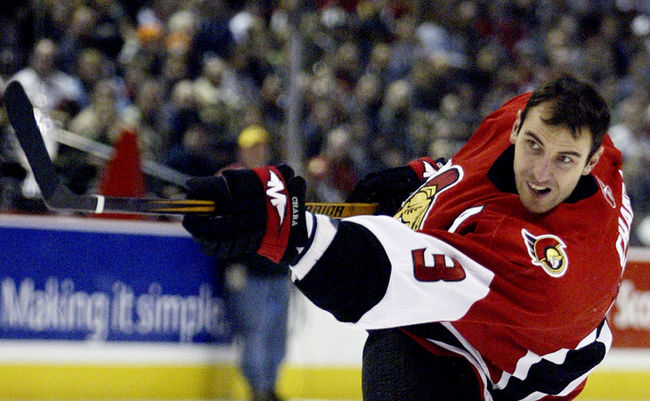
Boston may be missing the recently re-signed Johnny Boychuk, who is more important to that team than a lot of people realize, which is I guess is the scenario in preparation for which they picked up defensive depth in Greg Zanon. They also have this guy Zdeno Chara playing 30+ minutes a night, who is apparently pretty good, and Dennis Seidenberg, who is one of the league’s best shot-blockers. Ottawa will have to try and exploit their speed against a team that at times can look like a wall.

Some other interesting (depressing) statistics: Boston is first in the league in winning percentage when scoring the first goal at .853%, and first in the league in winning when leading after one period at a mind-bending 91.7%. (Ottawa is 17th and 20th respectively). The second best team (Philly) is at only 86.7%. It’s not even close.  Oh, and get this: Boston has won 100% of the games in which they were leading after two periods. Ugh. This team locks down like a motherfucker. Ottawa needs to get on the board early, and first. The cardiac kid routine isn’t going to work here.

The Senators’ defense is founded on Murray’s quasi-famous (in Ottawa at least) proclamation that the “other team should block our shots for a change,” which is why he let Anton Volchenkov go and signed the ghost of gnarly wizard Sergei Gonchar, who according to Wikipedia used to be one of the best puck moving defencemen in the league! Pretty cool. Erik Karlsson is running this shit at this point, dragging along his scrappy doghouse of veterans, giving Filip Kuba a good enough +/- to get him another contract and probably painting Chris Phillips’ house.

It’s sort of absurd to think that Ottawa’s chances in this series against the Boston Fucking Bruins will rest on the shoulders of a 180lb offensive defenseman, but it looks like that’s the case. He seems to feed on confidence, and he didn’t look out of place two seasons ago playing against Pittsburg. Here’s hoping that he saunters into this series against the defending champs with enough swagger to carry the fragile egos and puppy dog faces of veterans Chris Phillips and Sergei Gonchar, and surprises the Boston faithful. Let’s also hope Chara doesn’t Phaneuf-hitting-Da Costa the kid in the neutral zone and accidentally kill him on national television.

Baconater

I don’t want to sound like the series is a foregone conclusion: Ottawa’s been surprising teams all season long, though they’ve come down to earth a bit in recent weeks and months. At the very least this will be an enormous advantage for Ottawa’s rookies, an experience for them to build on and an important step to establishing a winning culture in Ottawa’s dressing room.

With the Bruins’ propensity for edgy play, Ottawa might benefit from a few penalty calls, and their ability to steal this series will be dependent almost entirely on Anderson’s play and whether they can score on Tim Thomas on the powerplay. Other than that it’s all one game at a time. If they can get that split in Boston and then come home, then they’re off to the races. This is clearly a case of trying to out-score the opposition. They can’t clamp down and play tight playoff hockey—they’ll have to run-and-gun it and hope someone in our colors is still alive on the other side. If they try to beat the Bruins at their own game, which is to say spend the first period having Chris Neil take a run at Marchand and Matt Carkner overcompensating for the Bruins’ toughness, then the Sens will probably spend most of the game in the penalty box. Ottawa needs to play smart, not take the bait, and more than anything get shots on net. The rest will be up to Craig Anderson.

No pressure, dude.

HOMEEEERRR!!! IM NOT ACTUALLY COLONEL KLINKHAMMER!!!

We know that next year’s roster will likely include Mika Zibanejad, Jakob Silfverberg, and possibly more of Ottawa’s many prospects, not to mention lost souls Bobby Butler, Stephane Da Costa and Nikita Filatov, who are scouring the bottom of the ocean looking for their game. So we’ve got a few UFAs to consider. (I’m not looking at RFAs like Nick Foligno or Peter Regin, because I assume they’ll all be back.) What better time than an exciting ramp up to the playoffs to look beyond said playoffs and consider the dry logistics of contract negotiation?

Jesse Winchester – After an injury shortened season, Winchester may end up the victim of incoming depth, particularly with the emergence of Jim O’Brien as a reliable 3/4 centerman and Peter Regin’s ability to switch to wing. I’d think he has to be worth the close-to-league minimum salary he’ll earn though, especially given how easily he draws into the lineup, his play on the penalty kill, and how strong he is along the boards. True NHLers who also happen to be cheap and will accept short contracts are valuable. If you have to sit him in the press box because of excess depth, that’s a problem most GMs would love to have. RE-SIGN HIM.

Zenon Konopka – When Zenon joined the Senators as his fifth NHL club in seven seasons, I was one of I imagine few people to be quite happy with it. Cheap, good face-off man, good in the room (we hear) and consistently leads the NHL is fighting majors, I was convinced that if you’re going to insist on having a player like that on your roster it may as well be him. 55 NHL games later and I’m not so sure. One consequence of Konopka fighting so much is that it seems to have little effect on the game itself. He fights as a matter of professional obligation, and it rarely seems in response to anything happening in game. It’s not accurate to say that he’s policing . I’ve become desensitized to Konopka’s presence. Worse, he’s prone to taking terrible penalties at bad times. CUT HIM LOOSE.

Colonel Klinkhammer – The Curious Case of Dr. Bob Klinkhammer, currently enjoying his longest stint in the NHL and not exactly lighting it up despite an opportunity to play extended periods with Alfredsson and Turris. 14 games in and he’s still looking for that first NHL goal. You’ve got to think that his natural spot on the team will be absorbed by Silfverberg or Zibanejad. At only 25 there’s plenty of potential here, but unless he’s willing to accept a two-way contract and spend time in Binghamton I just don’t see him returning to Ottawa. THROW THAT SKELETON OUT A HELICOPTER.

Filip Kuba – This is the biggest question facing Murray in the offseason other than how many zeros to add to Erik Karlsson’s contract. Kuba’s posting the best +/- of his career, and playing 20+ minutes a night. He’s a legitimate top four defenseman, and take a look at how few of those will be available July 1st. Barring some impossible run at Ryan Suter, Dennis Wideman, or maybe Johnny Oduya, this team isn’t going to replace those minutes internally. Or it could sign Jeff Finger. On the other hand, at 35 this is probably Kuba’s last professional contract, and I can’t blame him for insisting on three to four years at an average of $2MM-$3MM. That’s overpayment for Ottawa, but I’d still make the argument that it should happen. Cowen is still young, playing 20 minutes one night and 12 the next. There isn’t much defensive depth coming up, unless you think Eric Gryba is better than a bottom pairing D. Gonchar and Phillips will be a year older and less likely to shoulder the load. And he plays well with Karlsson. I think you’ve gotta PIAY THE MIAN HEESE MIONEE.

Matt Gilroy – Gilroy’s a tough nut to crack. He’s getting plenty of ice time, but in a system as wide-open as Ottawa’s you’ve got to think that a puck moving defenceman could do better than one assist in 13 games and a -2, especially considering that he had 17 in 53 and was a plus player with the terrible Lightning. He’s had his chances, and has famously blown a few open net shots. His CORSI is anemic. At this point you’ve got to think that he’s already scoping out potential destinations. MAKE HIM WATCH THE SANDRA BULLOCK VEHICLE ‘THE NET’ AND THEN DON’T RE-SIGN HIM.

Matt Carkner – I may be in the minority in thinking that Matt Carkner represents a fairly valuable type of player: cheap enough to occasionally sit without major consequence, willing to take a short deal, can play as a 6-7 defenseman in the NHL, and fights. Defensive depth is the name of the game, and if the acquisition of Matt Gilroy has showed us anything, a player good enough that you barely notice him is worth something. He may seem expendable, but he’s a low-risk player. Murray may let him walk only because he deserves a chance to sign longer term somewhere else, but if he’ll take something resembling his current deal, then UPGRADE HIS KITCHEN.

Alex Auld – Who? I think Auld got a raw deal this year, never being put in a position to succeed, but he’s obviously expendable with Ben Bishop towering over his shoulder and asking Auld “are you going to eat that?” Plus if Auld sticks around any longer Robin Lehner will cut the brake lines in his car. With so many teams desperate for goaltending, he’ll find work. RELEASE THE HOUNDS.

Sens clinch to make dream season official

Well, there it is: no late season collapse robbing us of our newfound feeling of entitlement to playoff hockey, just another afternoon domination of the perpetually rebuilding Islanders. The Senators clinch a playoff spot to top off what has been a long and thoroughly fucking awesome season of Senators hockey.

A few thoughts:

1) Turris: I’ve been as vocal as anyone from the day Rundblad was traded to Phoenix that I didn’t like the trade. I’ve maintained that Rundblad could have been the centerpiece of some larger, better trade, and moreover, was nowhere near his full trade value when sent packing. But it’s games like today’s that make a man admit when he looks wrong. And Turris made me look wroooooooong today. The casual way he delayed on that first goal was a delicious marinara sauce. I can admit it. He looks great.

2) The Islanders: you know, I’ve also kind of felt for a while that the Islanders, while of course a bit of a joke for all of the obvious reasons, were running a really solid rebuild. They’ve drafted and developed their prospects patiently. They’ve locked up their core players. They have great prospects coming up. They should be active in the offseason, possibly trading for veteran contracts from teams who’ve bottomed out. (If I was Garth Snow, I’d be the first one to call Montreal’s new GM, Pierre McGuire.) They’re probably moving to Brooklyn, which is an awesome place. I truly do believe that there will come a season, and pretty soon, when the Islanders will be the team-du-jour to get behind.

But you know, there are times when you’re watching the New York Islanders, with Al Fucking Montoya in net, and JOHN FUCKING GRAHAME backing him up, and you just have to think that the Islanders will be hopeless forever. Is there any franchise other than the Islanders that you could picture having a goaltending tandem of Montoya and Grahame? What a bunch of maroons.

3) First round match ups: I’m sure there’s going to be about a million articles about first round match ups for you folks in the next few days and weeks, but I’m getting some early worrying done about facing Boston. Florida is obviously everyone’s favorite dance partner, and I’d rather face the New York Rangers any day of the week. Needless to say, now that we’ve clinched I’ll be cheering Washington on a bit to take over that 7th seed.

4) Earlier today I saw an old woman fall down some stairs outside a church: don’t worry, she was okay, but she’ll have a real goose egg over her right eye. I told her it’ll look really badass. She didn’t agree.

5) You know who I’m kind of sick of? Chris Neil: I mean, I get it. A tough guy who can chip in some goals is worthwhile, and the way he drew that penalty shows that he can be a useful pest rather than one of those ‘remnants of the way the game used to be played’ pests. But during games like this, when you’re missing two top six forwards and he’s a key veteran who you expect to step up, you can really see the limit of his abilities. I like him because he’s a Senator, but I can imagine being a fan of another team and detesting Neil.

6) What’s your favorite Sens playoff goal? Mine is Dean McAmmond’s shorthanded goal on Brodeur during the 2007 Cup Run. I can’t find a clip of it, but this McAmmond to Saprykin goal was also pretty sweet.

Eugene Melnyk Accepts Honorary Degree from Chicago School of Economics

I’ll say this for the Euge: he never leaves us wanting for something to write about.

This latest interview (excerpts from a larger Citizen interview entitled “Senators poised for financial turnaround”) sees everyone’s favorite pharmaceutical magnate provide some revealing insight into his expectations for the season before the Sens went and surprised everyone. That in itself is worth the short read. It’s satisfying the way most behind-the-scenes documentaries tend to be.

But of course, given the title, the interview also allows Melnyk to revisit some of his favorite tropes about the economic sustainability of franchise ownership. Frankly, I can’t blame him for hammering this notion into the ground – that the Senators are constantly on flimsy financial ground, that they once needed to make it to the second round of the playoffs just to break even, and so on – because part of his responsibility as an owner is to maximize team support. But to see the hockey media in this town trot out these ideas again and again without any rigor or interrogation is starting to rankle.

I’ve written on this blog before about the cognitive dissonance between the assumption that the league is structured to make profit for its franchises and Melnyk’s statements that it is not. He maintains that Ottawa, as a mid-sized market who spent to the cap, couldn’t make it work financially. There’s not much beyond that quote that we know for sure.

We do know that Ottawa is right around the league average in ticket prices and in the top ten in attendance. The profits it receives due to television revenues and sales of merchandise are not public, but I’m making an assumption that as a Canadian market they are, at the very least, average. We know that merchandise sales outside of arena stores are shared around the league. So my confusion remains: if an average club making average revenue can’t break even without consistently being among the best eight teams in the league in terms of performance, how does the NHL even stay in business? Every year NHL revenues are increasing, profit is way up, and yet billionaire owners continue to cry poor about the state of the affairs.

Let’s look at some choice quotes:

On what making the playoffs means from a business perspective: Up until this year, we had to make two rounds of playoffs just to break even. Now we are doing well enough that we break even, pretty much, just finishing off the season and everything else kind of gets bonused out. We still have some hangovers from previous contracts that we’re still obligated to fulfill, at least in payment, but once those are all cleaned up in the next couple of years, things can all come together where the business of hockey actually pays. The cheques start going, hopefully, the other way.

Nothing new here, really. The basic assumption is that this club barely ekes out a living after salaries and hockey related expenses. He says this every time there’s about to be a ticket drive, either for seasons or playoff tickets. What Melnyk doesn’t clarify – and what the Citizen of course doesn’t bother to ask – is how much money Melnyk receives as a byproduct of franchise ownership but that is not hockey related – his overall net profit, in other words. One of the reasons clubs like Phoenix and Atlanta have had so much trouble making money is not only that people don’t go or watch the games on TV. It’s also that the owners don’t or didn’t own the building. If hockey teams eat up a large chunk of operating expenses, that leaves all other events – concerts, family events, whatever – as almost pure profit. Phoenix, on the other hand, pays rent. When you factor in television, merchandise, and tax breaks, it’s hard to believe that Melnyk doesn’t make any profit whatsoever from owning the Ottawa Senators. Forbes noted in 2010 that the club was carrying about $130MM worth of debt, which it’s financing, though I’m assuming this was debt taken on to purchase the team and will return to Melnyk when he sells. I’d still like clarification of if this ‘break-even’ point is actually the point at which hockey revenue, i.e. ticket sales, equals hockey expenses. Because otherwise the whole league is a house of cards.

Finally, not sure if he’s referring to the approximately $2.5MM worth of buy-outs Ottawa is carrying from Emery, Cheechoo and Alfredsson (from when Alfie’s contract was renewed), which are coming off the books this year, or Heatley’s bonus, which was already paid out. Curious that he says, “once those are cleaned up in the next couple of years,” which maybe implies a player currently under contract, but I can’t imagine who that would be. (Gonchar?) In any case, I love that he refers to them as hangovers.

On the Ontario government considering removing a business tax break on sports tickets: It did (take him by surprise), and I think it was very foolish to even attempt something like that, you know because at this point, that would have kind of pushed us over the edge. Forget about deep pockets, it has to survive on its own. And the one way, if you’re going to continue having a franchise within a city, especially what I call a mid-market city like Ottawa, is to be able to be smart in everything you do. And the stupidest thing you could do is something like try to do a tax grab of some sort…

I’m not sure what to say here except that as a person who works in health care in Ontario, who sees what the government’s budget and debt look like and knowing we’re all going to have to tighten our belts due to austerity measures, calling this “stupid” and a “tax grab” is a bit insensitive. It’s certainly tone deaf to the tenor of the political discussion today and the popular notion that everyone should have to give back. You have doctors offering to pay more income tax, and this billionaire sports franchise owner wants to talk about survival? Classy, Euge. Really classy.

As James says, it’s easy to have a soft spot for Euge because he saved the team from bankruptcy (real bankruptcy, under a pre-cap, pre-revenue-sharing ownership without assets). But sometimes he says something that reminds you that he’s a billionaire pharmaceuticals owner. Rexall is doing the same shit in Edmonton by forcing the taxpayers to pay for a new arena. These guys didn’t become rich by accident, and during these moments there’s not much more to say than “go fuck yourself.”

On the economic contribution of the team, versus the cost of the tax credit: If you look at the math of what we contributed (around the All-Star Game), it’s a $150 million we contributed. You look at the world juniors, the other events, the two drafts we brought, the All-Star Game that we brought the (Bell Capital Cup) that we have every year. What the Sens foundation does…

No idea what he’s talking about here. Either he means “contributed” in terms of tax revenue, or in stimulus to the local economy. I assume the latter, given he’s referencing events in Ottawa, but this is where he’s starting to contradict himself. Should we support him as an owner because the team is barely surviving, or because of some half-baked trickle-down theory about how professional sports spurs local economies? (A theory debunked about fifteen ways from Sunday.

It’s a fair argument. I just think if we’re going to “look at the math,” then by all means: let’s look at the math. What are the total revenues, not just direct revenues, as a result of franchise and arena ownership? How much does Melnyk stand to make when he sells the franchise?

On fan initiatives planned for the playoffs: First things first, I don’t want to jinx it, James. We want to get into the playoffs. If we’re in the playoffs and we need fans to come out for those last three games, and scream and make our players believe they are playing at home, we’ve got to start with that. We get sold out anyways. We need them to come out and cheer them on. If we do, yeah, it’s the same thing all over again. It’s playoff fever. Luckily, I was fortunate enough, and you were too, that ’07 playoff fever was rampant and we got to Round 4 and nobody’s ever seen anything like it. Jeez, we were so close, and it’s going to be the same thing all over. I’m sure that Cyril has planned a whole slew of party events, events for kids and things that are going to get this city rocking again (mentions he will be in town Saturday for a skate for underprivileged children).

This I’m including not only because Melnyk affirms that, yes, this team gets “sold out anyway,” (which, again, if you’re a Canadian team selling out every game, how are you struggling?), but also because I want to be fair. It’s such a likeable quote. Ultimately the Senators are a huge part of the community. I grew up in Ottawa, and the ’07 Cup run was one of the proudest moments for the community that I can remember. Melnyk’s right that we’d never seen anything like it. It’s a reminder of just why we care about sports so much: they are, in the end, declarations of our affinity for one another as members of a shared community, be that community a regional entity or a clumsily arranged group of yahoos clustered around a brand, a likeable Swedish guy, and a cartoon gladiator.

Interviews like this remind us that sports may render all of us community members equal. It’s just that some of us are more equal than others.

Home ice ain’t home ice at all / What we can learn about Bishop from Turris

A couple of unrelated things percolating in the brain pan after watching the Senators lose 1-0 to New Jersey last night. First is Ottawa’s absolutely pathetic home record, now 19-15-4 compared to 18-12-6 on the road.

This stretch was supposed to be Ottawa’s chance to catch some rest after that Florida road trip, rack up some points, even challenge for the division. Fewer games, most of them on home ice, and against plenty of mediocre teams was an ideal opportunity to lock up a playoff spot. Instead we’ve seen six points out of a possible 12, with Ottawa facing down the (somehow) always-challenging Canadiens, the seemingly unbeatable Penguins, the Jets on the road in the toughest building in the league, and then almost a week off for other teams to catch up before playing on the road in Philly.

Suddenly, the Senators are in a dogfight just to stay alive. Only four points up on eighth in the conference and the Sens’ inability to win games at home has dug them a small hole.

Of course, given what we’ve learned about this year’s Ottawa Senators, they’ll probably waltz right into Philly and win it 4-1. They’ve made a season out of taking games they had no business winning only to promptly lose to the Islanders or Leafs at home. Why on earth the team is so lacklustre at Scotiabank Place is hard to know, though I think it goes back to expectations.

The Senators can win away games with all of the pressure on their opponent, who is “supposed” to win, because the situation lends itself to their fast and loose style of play. Last night’s game, where the team executed sound breakouts and passes, got pucks on net, but then they simply couldn’t get their sticks on the rebound or keep pressure in front of the net. It seemed like a case of gripping the stick a little too tightly. As the game went on, even the most elementary powerplay execution – which they must be practicing non-stop these days – looked completely lost, with passes back to the point sailing all the way back to Bishop to corral. Suddenly, those few simple passes they were pulling off at even strength were flying all over the place with a man advantage.

Maybe the problem with home ice is the same problem that plagues the powerplay – when this team is supposed to have the advantage, it has a brain fart. When it feels fewer expectations, it will surprise you.

You could also see it with all the whining to the refs last night. Karlsson’s arms raised in disbelief, even the usually-Zen Alfredsson looking back for the call. The refs made some weird decisions last night, granted, but when the team is blaming everything else on the ice you can tell they’re hoping something, anything, comes along and resolves their play for them.

Basically I’ve been building all of this up so I could recommend that the team have a pizza party. Relax, guys.

Everyone’s feeling mighty good about Ben Bishop these days. He’s playing lights out, and Bryan Murray must be basking in the accolades. Bishop’s been so impressive he even broke Sports Illustrated’s quasi-moratorium on hockey coverage long enough to be called the best deadline acquisition of the year. (Better than Paul Gaustad for a 1st? Better than…the other…trades that happened?)

I can’t help but think about Turris when he first came over from Phoenix. Those early games were used as all of the evidence we needed that Ottawa won the trade. Now, I’ve long maintained that Murray payed WAY too much for a risky second line center, and even when Turris was looking very serviceable I wasn’t thrilled with the deal. My attitude hasn’t changed, but I’m thinking there’s something we can learn about the early days of a trade.

Even a skeptic like me will admit that Turris came over looking energized. He had something to prove, was enjoying the ice time, or liked playing in a full building for a change. Whatever it was, he didn’t look out of place, developing chemistry with Alfredsson and putting up 13 points in his first 16 games. In the weeks that followed, however, he’s been ice cold. He has six points in his last 25 games.

If Turris doesn’t work out, the team hasn’t bet so much bet on him that they can’t turn it around. He’s an RFA on a very affordable deal. But if David Rundblad becomes even half the player Erik Karlsson is, it’s going to look like a mighty silly deal a year or two from now. It will look like Ottawa traded a high-end puck moving defenseman because they weren’t patient enough with him during a rebuild, when the only luxury you’ve got is patience. I won’t even talk about the draft pick, knowing that half the readership think draft picks are worthless and the other half think they’re the most valuable thing in the world.

So what’s this got to do with Ben Bishop? Well, he’s also a player with some NHL experience, albeit not as much. His organization deemed him expendable. He came to Ottawa with something to prove, energized, whatever. And just like with Turris, we’re prepared to call the trade a win and move on. It’s almost as if, just maybe, we should expect a peak in performance in the early days of a trade.

Now, I do agree with Elliott Friedman’s point that if Ottawa chooses to trade either Bishop or Lehner in the future they’ll get more than their 2nd rounder back for him. And it’s not like Ottawa threw in, say, Mika Zibanejad to get him or anything. I just think this whole “picks to win games now” thing is sort of short sighted. I don’t want to win a few games in March. (Though it would be nice.) I want to see Murray build a contender.

All of this to say that I’m reserving judgement for when Bishop’s played a few more games. He’s working out in the short term, and maybe that’s enough. I’m obviously not in the room with the scouts, and maybe they’re looking at the board and saying “we don’t like anyone in the second round anyway.” But the discussion of whether or not these trades that Murray is pulling off are worth it should never be “in the short term” discussions.

Why the Toronto Maple Leafs are Bordering on Greek Tragedy

CORRECTION: Ron Wilson was hired by Cliff Fletcher, not Brian Burke. Thanks to reader Kartik Subramani for the correction.

In his book The Game, Ken Dryen wrote: “As players, they have been in the hands of their owner, and in the hands of the owner’s general manager, his scouts and coaches. Depending on them to draft the right players, to make the right trades, to give them a chance to do what they were good enough to do, and they have been badly let down. The tragedy is that what they had has been squandered and is now gone, with so little to show for it.” 

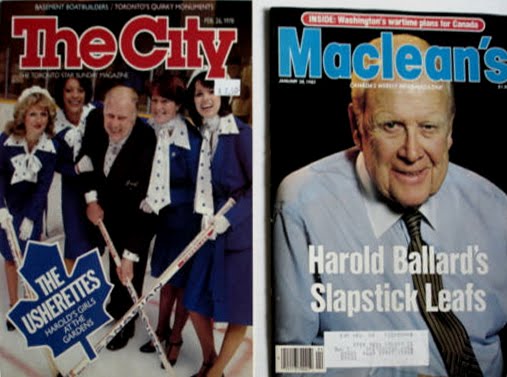
In this, Dryden was speaking about the 1979 Toronto Maple Leafs, playing in the shadow of owner Harold Ballard’s blinkered micromanagement. Key players were traded for middling returns. Prospect development was unheard of. Yes men abounded. The Leafs, located then and forevermore at the Center of the Hockey Universe, were subject to the whims of a tyrannical egotism that sucked air from the lungs of the franchise. Dryden suggests that this was particularly heartbreaking to see in 1979, contrasted with the fast-fading glories of the 1967 Stanley Cup winning team.

Over the 33 years since, this identity has hardened. That The Maple Leafs are losers is only more evidence of their status as underdog whose struggle is a nobler struggle: that of the blue collar worker against the capricious and unfair nature of the sport, i.e. the world. The team has been awful forever, but that awfulness has taken on a kind of perseverance in the face of utter pointlessness. All forms of team development swim against the current of this romantic undertow.

What strikes me most about Dryden’s description is his equation of wasted talents with “tragedy.” Dryden’s book, still a lonely, existential examination in contrast to the often saccharine standard that can be long-form hockey writing, lamented what could only be described as the injustice of seeing something so fiercely meaningful debased by incompetence and greed. Sittler and MacDonald wasted away on those mediocre teams, shades of the men they might have been in Montreal, Chicago, or Boston. Dryden lends pathos to those men, admitting that if hockey can be a lonely game while you play for a dynasty, then it is an unimaginable curse when played with a team that is not only underperforming, but culturally stagnant.

There are similarities between this Ballardian intractability and the current General Manager of the Toronto Maple Leafs, Brian Burke, who finds his team on the cusp of missing the playoffs for an incredible seventh straight season and 45 years from their last championship. Put a more diplomatic way, the differences between Ballard and Burke are differences of degrees. Both men adhere to binding principles that override all objective measures of hockey development. Both men cast themselves as defenders of the hockey faith against the inevitable dilution of the sport’s essence. And both men are responsible for some terrible hockey teams.

Their similarities tell us something about the central identity of a storied club that is paradoxically harmful to that club’s ability to win hockey games. It also says something valuable about the long, cold look in the mirror that the Toronto Maple Leafs must take before they can return to contention, and just how fundamental, even philosophical that overhaul must be. It’s no longer a matter of getting a high draft pick (though that would help). The Toronto Maple Leafs need to stop worshipping the romantic notion of the Toronto Maple Leafs.

It’s time for the Maple Leafs to allow humility into their lives.

In a salary capped league, where the notion of ‘parity’ abounds, there are plenty of mediocre clubs. What denigrates the Toronto Maple Leafs’ situation from merely unfortunate to the stuff of Greek tragedy is how intertwined their history has become with that sense of lost opportunity. A rebuild is a very difficult thing to embrace, particularly in a hockey market as rabid as Toronto’s. Ownership must be convinced to swallow the loss of revenue (which, in Toronto’s case, will never be an actual ‘loss’ so much as ‘lower profit than what’s possible’). The media needs to be convinced of the process so they don’t sour the fan base with their editorials, ubiquitous coverage and speculation. And finally, the fan base needs to be on board so as to not damage the brand too badly.

Prior to Brian Burke’s arrival, Toronto’s ownership and management had taken these difficult steps. General Manager John Ferguson Jr. was dismissed, and an interim General Manager—respected, old-school personality Cliff Fletcher, the “Silver Fox”—was appointed, with particular emphasis placed on the word ‘interim.’ Fletcher would be empowered to make the hard decisions, but didn’t have to worry about being liked. He knew his way to the exit already. He could be the bad guy.

In those early years of the rebuild, Fletcher sold off what veterans he could (largely hampered by No Trade clauses, the most famous of which belonged to Mats Sundin), bought out a few, traded up in the draft to pick promising defenseman Luke Schenn in the top-five, and traded for top line center Mikhail Grabovski (recently re-signed by Burke). In his short time as Toronto’s GM, Fletcher laid the foundation for a future team that was never to emerge. The rebuild would be difficult, but the hardest of those first steps had been taken. Most importantly, the Maple Leafs and their management began to look at their roster through a cold, utilitarian lens rather than with the blue-and-white colored glasses.

In 2008 Brian Burke came to the Toronto Maple Leafs from the Anaheim Ducks with all of the respect afforded an unstoppable force. While managing the Vancouver Canucks Burke had displayed an undeniable will, moving mountains to draft twin Swedes Henrik and Daniel Sedin side-by-side in the first round. (An act having about it certain masterpiece qualities in the art form of General Managing.) Burke convinced Hall of Fame defenseman Scott Neidermayer to join his brother Rob in Anaheim, where Scott made up one half of an unstoppable top defensive pairing with Chris Pronger that helped the Ducks to win the Cup in 2007. Burke demonstrated again and again that if inheriting a team whose fundamental building blocks were in place, he could do what was necessary to get them over the hump.

In Toronto, he would sign the most lucrative contract in the league for a General Manager. Fletcher was given a role as an advisor in the organization. And with his arrival, Burke once again gave the franchise an identity of inescapable gravity. The Toronto Maple Leafs as we had always known them—defiant, romantic, never compromising—were back. For better or worse.

In his almost five years since assuming the General Manager position, Burke has done everything in his power to resist the notion of a traditional rebuild, as if the sole missing factor in the equation for success is for the team to understand what Burke understands. It’s this fact, and the cyclical history it implies, that makes the Maple Leafs’ situation particularly tragic.

Burke appointed his good friend Ron Wilson as coach, Burke only recently assented to firing his good friend, the Fletcher-appointed Ron Wilson, despite the team having only one winning (non-playoff) season in four years. Wilson was replaced with Burke’s other good friend, ex-Anaheim coach Randy Carlyle. In the middle of another lost season (albeit at a time when the Leafs still clung to a playoff spot), Burke awarded Wilson a one-year contract, admitting it was less about security than danger pay in the event that he might have to fire Wilson. At no point did the awful results of the previous seasons seem to factor in.

In his first year with the team, with the Leafs floundering and the playoffs out of reach, Burke picked up veteran goalie Martin Gerber on waivers. Gerber, his career on the line and with something to prove, led the team from what would have been a draft lottery pick to seventh last overall, where they drafted promising but second-tier Nazem Kadri.

Most controversially, Burke obtained the talented but unpopular scorer Phil Kessel from division rival Boston Bruins for a king’s ransom of two first round picks and a second round pick—less than he would have been required to pay if he had used an Offer Sheet, a tactic which Burke objects to on moral grounds—in a move that spurns the cheap Entry Level Contracts on which rebuilders thrive. Burke promptly signed the winger to a deal paying him over $5MM a season. The Maple Leafs finished second and ninth last in the league in the next two years to hand Boston—the defending champions no less—two foundational players in Tyler Seguin and Dougie Hamilton.

Burke has traded and overpaid for players like Dion Phaneuf and Colby Armstrong, known for playing with an edge but far from their prime. In many of his transactions Burke has been saved from disaster only by the missteps of the GMs with whom he was dealing, those few other lost souls like Calgary’s now-dismissed Daryl Sutter, beleaguered too by his own inability to adapt to the game.

As the language of the game has changed to capture diminishing margins of advantage—CORSI, Fenwick, QualComp—Burke has remained steadfast. Appearing with tie draped, untied around his neck, he isn’t embarrassed to express himself in terms like “truculence.” He calls a press conference to lament the diminished role of the enforcer in a game that he perceives to have lost its sense of honor. This is the man, after all, who challenged a ex-Oilers GM Kevin Lowe to a fistfight in a rented barn, and then later spoke about it as frankly as one would any natural path to conflict resolution.

Burke has announced in turn, and with characteristic publicity, his position on a number of ‘vital’ issues: front-loaded contracts, offer sheets, roster freezes before trade deadlines, how “the rats are taking over” the sport, and most persistently how Toronto should never build through the draft. Ever more puzzling, the practices to which he takes umbrage are not only enshrined in the Collective Bargaining Agreement, but embodied by a league-wide shift in the game. In this, Brian Burke’s principles automatically place his club at a disadvantage. And as during the Ballard years, Burke’s inflexibility provides more fuel for the “us-against-the-world” fire, solidifying the team’s conviction that it need only will itself to victory in a world where will is quantified and tallied on other team’s scouting reports.

On these and many other issues Burke is cast as the only good man in an immoral, dehumanized league. Like his closest comparable, Don Cherry (with whom he only naturally began to spar in the media recently), Burke’ authenticity makes him likeable. It validates what for many of us is our sense that the sport, so full of complexities and occasional crushing disappointments, was indeed better before, in some halcyon past, where all we remember, conveniently, are the victories.

I’m certainly not above liking Brian Burke. I don’t doubt the sincerity of his morals, or that they can be employed for enormous good. His stance on gay rights in hockey is not only admirable but essential, and an example to the rest of the sports leagues. But when it comes to building hockey teams, his morals just happen to be misplaced. Burke’s stance on gay rights demonstrates that he’s capable of change, of questioning his principles and changing his mind, doing what’s right for the greater good. Those no reason why he can’t do the same during the far less loaded discussion of whether or not the team should retain draft picks or fire an ineffective coach. 

The Leafs are already wildly profitable, a 79.5% stake in them having recently sold for an insane $1.32 billion, a number so big that it took two rival behemoth telecoms carriers partnering up to buy it. But a winning team in Toronto would not only be good for Toronto, and for Canada, but the league and the sport all over the world. Were Toronto to find itself in the playoffs and actually winning a game, the city would be exactly the place you would want to be. Interest begets interest.

Toronto is so far beyond the notion of “not buying tickets to send a message” that the decisions made in board rooms and managers’ offices take on the qualities of royal decrees. Their decisions take place in a vacuum without ramifications, where intense privilege allows those with power to humor abstract principles for diminishing returns.

The unique tragedy of the Toronto Maple Leafs is not that they are a mediocre team. They are not, like Columbus, Long Island, or Edmonton, in a perpetual state of rebuild, needing only to refine their development of top prospects and pair it with smart contracts given to key veterans. Watching the Leafs’ frequent pre-game ceremonies, which are arduously long and self-congratulatory, it becomes apparent that the Toronto Maple Leafs are on an island of their own making, adhering to values all their own, winning their own game but no one else’s. They are in purgatory.

On my desire to piss all over everything

These are exciting times for our Ottawa Senators: in a playoff spot despite spending less money on player salaries than my friends’ ball hockey team does on t-shirts. Jason Spezza and Erik Karlsson legitimate contenders for league MVP. A brash young net minder ready to win some games and run for mayor, though not necessarily in that order. What’s more, Ottawa has more prospects projected to be top six players than they’ve had, well, pretty much ever.

Here’s the thing: 1) a rebuild that delivers a solid window of contention requires more than one great draft, because most draft picks never work out, and 2) there are fates worse than being a truly terrible team. Just ask the Toronto Maple Leafs.

The danger with prospects is that before they ever make it to the NHL we have a tendency to look at them exclusively through the lens of their potential. What’s their upside? Their absolute ceiling? Somewhere in there the most likely scenario for their development is lost. In the rush of enthusiasm, players and, I think, management, would rather put all their chips on black and fantasize about the big win.

Mika Zibanejad projects as a really great top six player. By that I mean a 20 goal scorer with a solid two-way game and some edge. He has upside, sure, but he slots in best as a complimentary player. In other words, Jason Spezza he’s not.

Ditto for Stefan Noesen. Murray clearly saw something in this kid that others didn’t, as he used a mid-to-late round first on him when he was projected to go in the second round. And he’s having a really nice season with the Plymouth Whalers. But again, he’s a Mike Fisher type. We’ll love him, but he’s not single-handedly winning us any games.

Matt Puempel is a different type of player, a pure scorer, but he’s had terrible concussion problems while playing for the Pete’s. He’s either going to score a lot of goals in the NHL or never make it there.

Then there are your prospects who project as third liners, like Jakob Silfverberg and Andre Petersson. You need guys like this, but we’re talking Nick Foligno types who will spend their time in Ottawa on the edge of top six duty.

Finally, you have your one dimensional players. Mark Stone has proven he can dominate lesser leagues but I’m skeptical can transition a power forward game to the NHL while lacking skating and size. I think Nikita Filatov plays on the moon these days.

Don’t get me wrong: together, these are the types of players that make up the heart and soul of a team, and I’m thrilled to have them. They constitute the kind of depth Ottawa’s lacked forever. But they aren’t cornerstones to build a championship around. With Ottawa unable to attract top end free agent talent, or rightly disinterested in going after the Brad Richards style contracts, you’re left with something of a nightmare scenario: a team forever on the bubble, hoping to sneak into the playoffs and go on a run, and years from being able to launch another rebuild.

This becomes especially easy to imagine when you see Spezza and Michalek exiting their peak years, Alfredsson retired, Phillips in the third year of his puzzling contract, and so on.

A rebuild is something that comes along once in a decade or so, and you have to get it right if you want to win a cup. We’ve got a team worthy of our support as fans, who are fun to watch and completely likeable. But I fear that Ottawa didn’t move themselves any closer to the ultimate goal of winning a cup.

I’ll be as excited as the next guy when this team lines up for puck drop in game one of the playoffs this year. I listened to a Leafs podcast the other day and you should hear them talk about their team about to miss the seventh straight year of playoffs. At this point they’d probably give up five first round picks just to experience some playoff hockey, even if they get swept. It’s a good time to be a Sens fan. But I can’t help but think that last year’s sell-off didn’t go far enough, or didn’t extend to this year, and we cashed it all in for one Butch Cassidy and the Sundance Kid moment in the first round of the playoffs. (The Bolivian Army will be played by the Boston Bruins.)

It’s hard to think this way when the team is so much fun to watch. Let me put it another way: if in the depths of last year, when the team didn’t win a game in February, if I had asked you if you would prefer a prospect like Nail Yakupov or a free pass to the first round to roll the dice with this lineup against whoever you met, what would you say?

Robin Lehner is just what Ottawa needs: crazy

Just read an interesting article about Robin Lehner wherein questions about his attitude and maturity were raised, and couldn’t help but think that it said more about Ottawa and the types of players it prefers than anything about the 21 year old netminder.

James has raised an interesting point in the past: when you look at effective goaltenders, they do seem to be a little bit unconventional (to put it diplomatically) and certainly intensely competitive. Some of the best goaltenders in the league are plagued by off-ice issues from substance abuse to public spats with management and the fanbase to alienation of teammates. Patrick Roy, Ed Belfour, Dominik Hasek, Tim Thomas even Miikka Kiprusoff – some of the league’s best seem like some of the hardest to engage with in a civilized dialogue. Ilya Bryzgalov, Ken Dryden and Jonas Hiller seem at least quirky and unconventional. It’s as if goaltenders stand in direct contradiction to the bland cliches to which we’ve becomed accustomed in post-game interviews. And this bears out when you remember that Ottawa’s best goaltending came from Ray Emery.

The point being that maybe there’s a direct relationship between an unconventional personality and being very good at standing in front of 85mph slapshots. It’s not a constant; it’s just not always a bad thing. Maybe it’s why we see so many goaltenders simply isolated from media rather than banished to another league, and why we have different expectations of goaltenders than we do of forwards.

What I suspect is that Ottawa likes its players a bit vanilla. Even though it’s one of the biggest teams in the league, and features players like Chris Neil and Zenon Konoptka (who is tied for the league lead in fighting majors) I couldn’t imagine Ottawa taking on players like, say, Steve Ott or Brendan Morrow. Opinionated, cocky, confident: Dallas has an entirely different culture in their dressing room than Ottawa. And I wonder how much of that has to do with the media and the fans.

Which is why I’m wary of our boilerplate tendencies to insist that a goaltender’s weirdness is a kink in his game to be ironed out. When Robin Lehner publicly disagrees with being sent down to the AHL, when he says he’s going to “hunt” Craig Anderson, even when he Tweets “;)”, questions arise about a supposed sense of entitlement.

My question is: how on earth are these things considered detrimental to a goalie’s game? There is a universal rule in sports that so long as you keep winning you can basically be an awful person and everyone will look the other way. But beyond that: what’s wrong with having a cog in the team’s machine that is skewed a little sideways, especially at such a game-changing position? We have our soft-spoken nice guy representatives in Alfie, Spezza, Phillips, Gonchar, Kuba, and a handful of young guys who are enthusiastic but well-versed in the necessity to say absolutely nothing in interviews. Ottawa needs a little bit of color.

We all thought it was awesome when Emery was smiling like a madman during that Buffalo brawl (during which plenty of Sens players stood around a did nothing), and we exiled him for the same tendencies only months later. He seemed to tap into that same well of resolve when he went through an extremely arduous hip procedure and made an improbable return to the NHL. What keeps him from seeming like an easy guy is what keeps him in the game.

Let’s hope we continue to see Lehner’s intensity (Lehntensity?) as an advantage rather than something that needs to be wrung from his personality. The goalie graveyard is littered with nice guys. Ottawa isn’t taking anyone by surprise anymore; on the first day of the playoffs they’re going to meet an absolutely determined higher seed who has studied and practiced for the sole intention of destroying the Senators in as few games as possible. There are going to be games where we’ll need a cocky, entitled, player to put the team on his back and will them to victory.

Did Anyone Think We’d Be Having Legit Discussion About Awards Back In October?

Photo Courtesy of Hopes & Dreams

Pete Mused: 

Okay, so there is a ton of buzz right now about Karlsson’s worthiness or unworthiness for the Norris trophy. Basically there’s two sides of this debate, the ravenous, passionate fan-based perspective and the stern serious, established hockey journalist perspective. Seems like there’s no middle ground with this one. Not sure why it’s so devisive? I think it’s because he’s just so young and cute and God don’t you just want to cradle him sometimes? Wait are we still talking about Varada’s new kitten?

Here’s my take. Karlsson absolutely deserves this award and the only reason the media won’t give it to him is the complete absence of an objective stat that adquately convey’s his contribution. Seriously, people claim he’s only a power play specialist but Filip Kuba has more power play goals while Campbell and Suter are close in PP points. He’s a defensive liability yet he leads the league in takeaways. He isn’t responsible in his own end yet he leads a resurgent team in ice time. Don’t blame him if the talking heads don’t have an all encompassing stat to crystallize the concept of defensive hockey. It’s not his adorable little fault you big jerks!

Also Jason Spezza’s tires are getting pumped for a Hart nom, plausible?


James chanced to Imagineer:

I like my Erik Karlsson Norris discussion like I like my mainstream Ottawa Senators coverage. Largely dismissed and underdog as shit.
As a fan, I like all eyez on other teams. SO FAR SO GOOD BTW!

BREAKING: Brian Burke just realized he forgot to TiVO Pawn Stars last night. Updates to follow!

Anyway, as I was saying, it’s all good, keep the attention on our rivals diarrheaing all over themselves. Up until recently, a lot of the coverage outside of the Sensphere of Ottawa’s surprising season has been more about streaks, holes in the lineup, how they will cool down eventually, more than how they are just #winning (too soon?) but that’s fine. I am happy being a fan of a team that a lot of people gloss over that has snuck itself into 5th in the East (with a lot of games in hand but still).
The same sentiment goes for all the fronting on Erik Karlsson’s season. Though I will admit I was very surprised to read in a recent Greg Wyshynski article that EK was actually the favorite to win the Norris in a USA Today hockey writers poll. That said, I’ve been reading  a number of pieces about why Our Special Little Guy should NOT be considered for the Norris trophy (including 90% of said Wyshynski article). The reasons people are giving are by no means crazy and to tell you the truth, I’m fine with all of it. It is very win-win, he loses the Sens save a little bit of money on his pending contract if he wins the Sens have a a 21 year old that just won the frigging Norris on their team! What did that rap man Noteworthy B.F.G. say in his song, “Big Monies, No Problems”? If you ask me my personal thoughts on whether he has earned his way into a nomination, I say without question he has. Here are my admittedly biased reasons why:

On pace for over a point per game
Playing 25+ mins per game (team leading)
With a +15 rating (2nd highest on team)
Over 20 points ahead of next highest scoring defenseman.
In top ten in ALL NHL scoring (only D man in the top 73 btw)
21 years of age (biggest reason, for me)
Plays for Ottawa Senators. (second biggest reason)

Like YES I GET IT, ERIK KARLSSON IS NOT NIKLAS “ALL THINGS TO ALL MEN AND MAYBE TO ONE LUCKY GAL” LIDSTROM…but I tip the scale in EK’s favor a little bit because of his age, the team he plays for compared to the others in the discussion – I love me my Senators but EK does not have the Ovechkin, Semin and Backstrom guys to feed passes to like Green did, not to mention his ever growing plus rating, the massive point differential he holds and just his general all around improvement over last year’s -30 performance.
Will these points (no pun intended) win him the trophy? Mmmm probably not, I could see it going to Lidstrom, the Meryl Streep of Norris trophy winning and like Streep, deservedly so. But like the impressiveness of Lidstrom’s age, it’s Karlsson’s 21 years that really blows my mind. On pace for over 80 points in only his second FULL NHL season. Wow. Does he kill penalties as much as Shea Weber? No, but does Shea Weber have 51 assists? Different defensemen…different dietary needs! Anyway, it’s a special season he’s having. I’m too in awe of it and I watch almost every single game he plays (especially if that delightful Denis Potvin is involved!). I’m too close to him to make a proper call…so….?…Celebrate the moments of our lives?

As for Spezza for Hart talk…Jeez, this is a new one…I haven’t given much thought to this. From my perspective, the touchstone moment was during what shall be known as The Season Of Turds (2010-2011) when Spezza went down with an injury and missed the entire month of February. Ottawa won just one motherfucking game with Spezza out of the line up.  He returned a man possessed. He started tearing it UP and hasn’t really slowed down since. It’s become more clear this year that as Spezza goes, so the team goes. When he doesn’t put up points the team basically doesn’t win. Good thing he scores all the frigging time. Now, that’s a valuable player. It’s a question of how that value stacks up league wide.
Haters, who allegedly gon’ hate, said that Spezza would flounder without his former wingman Heatley but losing Dirtbag Dany could prove to be the best thing to happen to Spezza as a player. He has worked hard to round out his game and has become heir apparent to the Sens captaincy when Daniel Alfredsson retires in 2024.
Now, back to the whole, Spezza: good, Hart: ? thing. Well, if there was a Hart trophy for each teaaaam…yeah he’s a lock. There aint one of those, save for Your Draglam Salt: Ottawa’s Best And Saltiest Salt Hardest Working Sen Award, so when the discussion gets league wide it’s pretty tricky. With Gino Malkin’s Mario Lemieux-like rushes and leading the Pens in this non-Crosby paradigm, I think he is the current favorite. There is also a ton of hype around Claude Giroulx. Hype that extends down to the United States, which is both important when it comes to voting and something Spezza doesn’t get to enjoy. Finally, there is the question of whether the voters will be hypnotized by the gaudy number of goals Steven Stamkos of the Lightening, who stiiiiiink, is bound to put up (currently projected at over 60, YIKES!). Actually, now that I think on it, if he can continue his strong play into April Spezza’s for sure in the discussion. Can any of you beauty readers think of some other players who could be considered ahead of Spezza or should we just break into the hockey hall of fame now, steal the trophy, burn “WTYKY LUVZ U” into his lawn, leave the trophy on his front step, ring the doorbell and then hide in the bushes until the police arrive?

Trade Deadline Summary: T’was just a shart

Brian Lee for Matt Gilroy. Clearly Ottawa is now a Cup contender. They were also considering a deal for a bale of hay, which would have been more mobile than Matt Carkner.

And so ended the definition of anticlimactic programming, as TSN’s entire synergistic strategy – to become about hockey at all times – exploded in their face. Using their “DAN-DAN-DAN / DAN-DAN-DAN!” sound effect every time there was a trade was adorable, especially when the trades were THIS BAD. I think Bob MacKenzie was playing Jet Pack Joyride on his Blackberry.

Most surprising of course were the teams that really, really should have done something, or at least more, and who sat pat. I’m not talking about the contenders, though I am surprised that Philadelphia didn’t do something else, if only because they feel a compulsion to constantly trade and sign players. I’m talking mostly about Edmonton, Minnesota, Montreal, Carolina. I can understand Columbus not trading Rick Nash, because they absolutely must get that trade right. But why on earth, say, Buffalo wouldn’t take whatever the hell they could for their army of pending UFAs is totally beyond me. Maybe after Nashville gave up a first for Paul freaking Gaustad they started asking for too much. That’s like Ottawa getting a first round pick for Chris Neil.

Anyway, I mostly like that Ottawa didn’t do much, though again, without those delicious second round picks – the perfect trade deadline resource – what were they going to do anyway? Turris is Ottawa’s big mid-season acquisition, and it’s mostly worked out. Ben Bishop is here now too, so Ottawa got taller I guess.