Is Ottawa a Cap Team?

Every year, strategically timed when season tickets  go on sale, Eugene Melnyk makes a radio or television appearance in which he says something about how this team needs to go to the second round of the playoffs just to break even, or is a small market team that could relocate unless all of the chips fall just right. I’ve taken up a lot of time on this blog talking about all of the revenue Melnyk doesn’t count in his estimates–non-hockey events at the arena he owns because he owns the team, as well as merchandising and television revenues–and I won’t belabor it again here. I am willing to accept, however, that Ottawa is not Philadelphia or New York. We won’t, nor should we, seek to spend to the cap simply because we can, or as a matter of competitive principle. With the team in rebuild mode, it hasn’t made much sense to throw money at veterans.

This year is different, though. A unique confluence of events has conspired to a point where it only makes sense for Ottawa to spend to the cap, if only for a season or two.

  • The team is already competitive, having made the playoffs in their last two seasons and winning a round this year, and has over $22 million in cap space with no key players to sign outside of Alfredsson, Condra, and Wiercioch. The latter two players won’t cost the team much more than their expiring deals. Let’s say that drops them to $16 million in cap space–that’s plenty enough to sign a marquee top six forward (or two) and a top four defenseman.
  • The big money powers in the East–Boston, Pittsburgh, Philadelphia, New York–will all be shedding players rather than adding them in order to lock up their core members and become cap compliant.
  • Great young players like Zibanejad, Turris, and Silfverberg are in, or are about to enter, their primes.
  • The team will likely get one more year of Daniel Alfredsson.
  • It’s the last year of Bryan Murray’s deal.
  • You have to think that the extra round of playoffs, even if it was only a couple of extra home games in a 5 game loss to the Pens, means the team saw a bump in team revenues. After all, Ottawa ran with the fifth lowest payroll all season long. [Sidenote: how does player insurance work? With Spezza and Karlsson injured, I know they get paid, but does that come out of Melnyk’s pocket or the insurance company’s? If the latter, Ottawa had the lowest payroll in the entire league, while still being top ten in attendance, and enjoying the additional playoff revenue. All of this after a totally unnecessary lockout.]

If there was ever a season to go for it, it’s now. There’s the cause, the will, and the means.

It reminds me of the Blue Jays’ situation, which can obviously serve as a cautionary tale as much as anything: with the powers in their division scaling back on salary to come into compliance with MLB’s luxury tax rules (sorry if I’m messing up the terminology…baseball, amiright?), and with the good young players to complement veterans, Alex Anthopoulos brought in over $200 million in new salary. Now, it hasn’t exactly worked out for the Jays, and with hockey being even more chaotic than baseball, signing a couple of UFAs won’t be all it takes to stack up in a league with this kind of parity. But the conditions have never been so perfect for a spending spree. The takeaway from the Jays’ spending hasn’t been success, but enthusiasm. Remember what it was like during that round one win against Montreal? Imagine going into this season as a presumptive favorite for the Cup.

So open up the wallet, Melnyk. This is no time to tout small market economics. We paid the price with two lockouts to get the cap, and it’s been a long six years since our trip to the Finals. Recognize an opportunity when it’s staring you in the face and go for it.
Patty Wiercioch, Ottawa’s offensive defenseman question, and the UFA market

120227_GrantClitsome

Last season, I made a bit of a stink over letting Filip Kuba walk. I’m not a huge fan of Kuba, and didn’t think for a moment that Ottawa should have matched the two year, $8MM contract Kuba eventually received from Florida. But his exit raised larger questions about consistency and reliability on the Ottawa blueline. Guys who can play 20 minutes a night don’t come along every day, and Kuba, while not flashy, was something of a proven commodity. We knew he complemented Karlsson well enough. It made sense to me to try and re-sign him.

Thankfully, the acquisition of Marc Methot made the debate a bit of a moot point. Methot not only stepped into Kuba’s shoes, he played tough minutes, and quite well, with and without Karlsson. Thank god that worked out, because Ottawa gave up a good young top six forward in Foligno to get Methot. Also thank god the loss of Kuba was further mitigated when Sergei Gonchar ate up minutes and carried the offensive torch for Karlsson while he recovered from a severed achilles tendon.

But Ottawa has entered another off-season allowing another veteran to walk to a team who opted to give out another expensive two year deal. Murray has to wonder where the cavalry is coming from this time. It’s those depth, second line guys who populate your system, and allow coaches to give their elite players space.

Karlsson will still play 30 minutes a night, if healthy. (Or even if he isn’t, as it’s suspected he was still recovering in the playoffs. It certainly looked like it at times.) But unless Murray turns to the free agent market, or gives up another prime asset in a trade, it seems like he’ll be leaning on Patrick Wiercioch to develop.

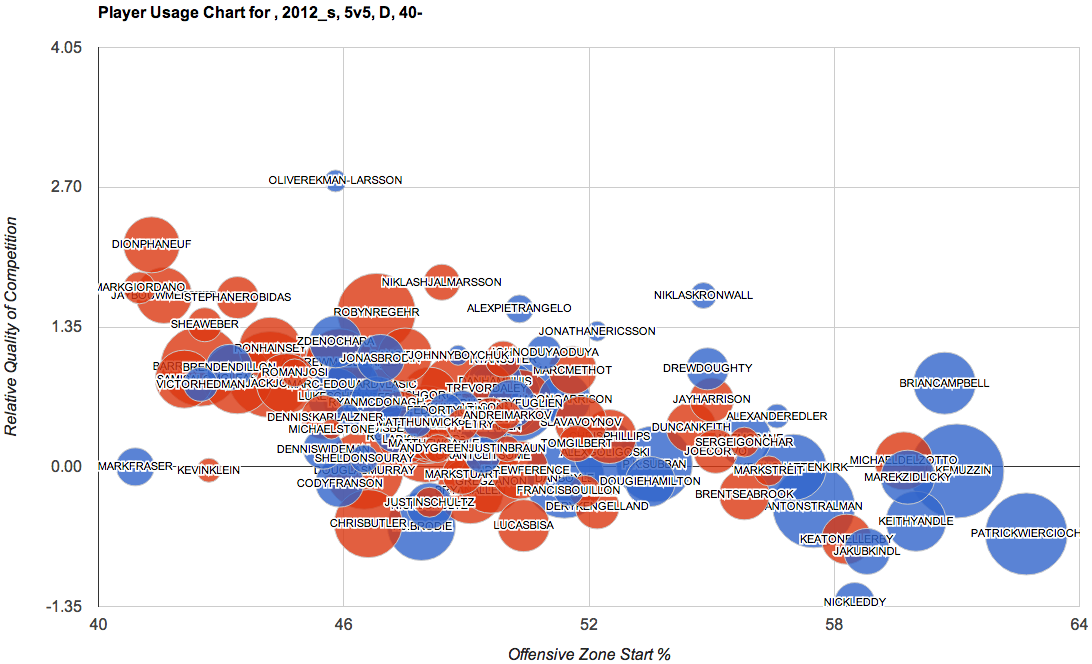
On the surface, Wiercioch had a strong season last year. 19 points and 5 goals in 42 games officially qualifies you as an offensive defenseman in my books. But this chart (which I saw in this Score blog post about Dion Phaneuf) caught my eye:

defencemen-usage-chart

This is 5v5 usage for defensemen over 40 games this season, and check out that big blue dot in the lower right hand corner. Wiercioch received more offensive zone starts, and against weaker competition, than almost every other defenseman in the entire league. He was effective in that position (as evidenced by the size of that blue dot–he drove possession in that role), but what this chart demonstrates is that he isn’t going to be the kind of minute-eating, all-around guy that Gonchar and Kuba were. He’s a weapon to be used extremely selectively. It’s also why, despite his numbers, Wiercioch found himself scratched at times for players like Eric Gryba. Gryba won’t get you the points, but you can lean on him when the game suddenly shifts and you find yourself pinned in your own end.

The point being that while Wiercioch is good at what he does, and you want that kind of player at your disposal (it’s why Anton Babchuck keeps finding work), it’s not likely that in one season he’ll morph into the kind of defenseman Ottawa needs–a reliable second pairing player who is responsible defensively, can play quality minutes, and can also drive possession.

The solution might be a full season of Jared Cowen, though he lost a year of development and looked lost against Pittsburgh. (Not to draw conclusions from that about Cowen; the Pens are a good team.) But a quick glance at the UFA market for offensive defencemen shows it’s better than I thought.

There are higher profile guys like Tomas Kaberle, Ryan Whitney, or Ian White available, but none of them have had particularly good seasons of late, are clearly in decline, and will cost. A guy like Zidlicky or Scuderi can put up minutes, but will cost you a pretty penny. (Or 400 million pennies a year.) Which brings us to Grant Clitsome.

Clitsom put up decent numbers and possession metrics on a weak Winnipeg team playing about 16 minutes a night last season. He was on pace for about a 8-24-32 stat line if it had been a full season, which would have been a career high by far, and he was a +10 on a team that was bottom five in goals against. His shooting percentage (7.1%) wasn’t particularly out of line with his career average (6.5%).  And he was affordable, playing out a two year, $2.5MM contract. At 28, he has a year or two left of prime output if you assume defensemen develop on a longer timeline than forwards.

Even if some regression is to be expected (it was a contract year), Clitsome is the kind of player I think Murray is hoping Wiercioch will develop into–a player who can put up points and play in both ends of the rink. If you only look at offensive zone starts, though, where Clitsome had a 49.4% to Wiercioch’s 62.7%, Patty has a long way to go.

Next season is going to be interesting. Improving on making the playoffs and winning a round by hoping Karlsson will continue to be a wizard and injured players will stay healthy seems naive. Hoping that the addition of another scoring winger will be enough, especially if we lose Alfredsson, also seems naive. It’s going to be those hidden gems that allow the Senators to keep taking the rest of the league by surprise.

Trade Targets 2013

271032-superstar-ice-hockey-dos-screenshot-trading-players-ega-s
James took a look at free agents a couple of weeks ago. Another option for Bryan Murray heading into the draft is trading for the scoring, top six forward the team so desperately needs.

I took a look through Capgeek, and here’s a list of forwards that I think Ottawa could trade for who are 1) low cost in terms of salary (relatively speaking) / high reward, 2) could be traded for without parting with an insane, Rick Nash-style package of prospects and picks, 3) mostly don’t have NMC/NTCs in their contract, and 4) are often playing for teams who will need to shed salary to get under the cap. In some cases their cap hit is larger than their actual salary. And there’re question marks next to nearly all of them.

What does Ottawa have to give up? Well, in addition to the 17th overall pick in this year’s draft, they also have three former 1st round picks in Noesen, Puempel and Ceci who have yet to play in the NHL. There are quality prospects (though not blue chippers) in Da Costa, Hoffman, Pageau, and Prince. And there are two NHLers in Silfverberg and Zibanejad, who you have to think are only on the table for an absolutely killer deal.


David Booth

– I liked Booth when he was in Florida…though so did everyone, which is why Mike Gillis traded for him and why he’s now stuck with an injury prone scoring forward who hasn’t been that effective. Booth has two years left on his contract, and if he’s healthy he’d make a good complementary winger for Spezza. He’s also a left winger, which is a spot where Ottawa can be weak.

Ryan Malone

– Another left winger on a team with sky-high salaries, though he’d have to waive his NTC to come to Ottawa. Malone has a $4.5MM cap hit, but his salary in both of his final two years is $2.5MM. Seems like he could fit into MacLean’s two-way hockey mantra.

Joe Pavelski

– I was surprised to see that Pavelski didn’t have a NTC/NMC, and at $4MM with only one year left on his contract, he’d be pursued heavily if he’s indeed on the block. I don’t see him being worth a bidding war (look at what San Jose got for Ryan Clowe), but it’s worth kicking the tires. He is a centerman, which Ottawa doesn’t need as badly, though as the6thsens guys pointed out recently, our depth at center isn’t as good as we sometimes insist it is.

Devin Setoguchi

– Minnie is spending a ton of money on a mediocre lineup, and Setoguchi only has one year left on his deal. At $3MM, and not much required to get him, he might be worth the risk–though his game seems to have degraded badly over the past two seasons. He’s 26.

Dustin Brown

– This would be an absolute coup, and Ottawa would need to pay through the nose to get him. Brown played a diminished role in this year’s playoffs, often relegated to the third line on a deep team, and he only has one year left on his contract. It’s probably not worth paying a king’s ransom (wah-wah) for one year of Brown before he tests the UFA market, but he instantly makes the team better, and is a great young leader on a team of young, character players. I’d love to have him in a Sens uniform.

Derick Brassard

– He’s a centerman which, again, Ottawa doesn’t need as badly, but he seems to fit the mold of a Bryan Murray trade: good pedigree (drafted 6th overall), stuttering development, connections to Columbus. He only has one year left on his deal, but he’s an RFA after that, so Ottawa retains control. He’s right in that age wheelhouse too, at 25.

Ales Hemsky

– Hoo boy, this one is probably contentious. Most people seem to think that Hemsky sucks. Most in the analytics community seem to think he…sucks less. Personally, I think he makes a lot of money in a market that is thoroughly sick of losing. He’s a focal point for a terrible team. He makes $5.5MM this year, which is a bit hefty, but could probably be got for a pick or mid-tier prospect unless one of those desperate big market teams gets involved and fucks everything up like they usually do.

Scottie Upshall

– I liked Upshall when he was in Philly, and sort of hoped that Ottawa would throw him an offer before Dale Tallon went nuts that one year and signed every mediocre free agent on the market. Upshall is borderline top six, and so might not be worth the risk, and he’s got two years at $3.5MM left. Which, again, was pretty stupid, Dale. But if he can reclaim his spark-plug scorer acumen, giving up a late pick for a salary dump might seem brilliant.

Mike Cammalleri

– Is Calgary rebuilding? I guess so, but it’s hard to say with Feaster and that ownership group. Camm has one year left at a whopping $6MM, but would look awesome next to Spezza. You’d probably have to get into a bidding war with somebody. There is the benefit of knowing that Calgary probably isn’t going to wait until the trade deadline to trade him; everyone knows that that team is going to suck this year. They should unload at the draft if they can.

Chris Stewart

– I wish…St. Louis will probably re-sign him–he’s an RFA without a new deal–but Stewart is just the kind of power forward Ottawa would love to have line up in their top six. St. Louis also needs to re-sign Pietrangelo and Shattenkirk, so they’re kind of screwed. They might be willing to part with a complementary, big forward, especially since he had a down year playing in Hitchcock’s defensive system. Alongside Dustin Brown, this would probably be my #1 player to see in a Sens uniform.

Radim Vrbata

– He’s pretty much the only scoring threat in Phoenix’s lineup, and he has a NTC and a great relationship with his team. But, as always, ownership issues in Phoenix make this a possibility. Would they trade him now and get something in return rather than watch him walk next year, as he only has one year left on his deal? He’s older (32), but would be a decent replacement for Alfie if the captain retires.

Blake Wheeler

– Like Stewart, Wheeler is an RFA in need of a deal. If they can’t get something done in Winnipeg, could they trade him? Would Ottawa want to put themselves in a situation where they give up assets in advance of a contract negotiation, removing all leverage? (cough cough Flyers cough.)

Bryan Little

– Another centerman, another RFA without a deal, and another player who is probably not worth the package required to get him. But might be worth a second look if negotiations don’t go Winnipeg’s way.

Alex Burmistrov

– This one is pretty intriguing, as Ottawa has been linked to Burmistrov in the past. Apparently there’s a good deal of interest there, and Winnipeg is less than enamored with the 21 year old centerman (10 points in 44 games will do that). He’s an RFA with pedigree, having been drafted 8th overall. This has ‘Kyle Turris’ written all over it.

The Wacky East and Chaos Theory

tumblr_lxx7x4gfGL1qill7p

I find that from every occurrence in hockey, analysts will draw one of two universalizing and entirely contradictory conclusions: either that the game is the predictable outcome of systems with a liberal sprinkling of occasionally small sample sizes to spice things up, or that the game is complete chaos and basically we know nothing.

The Stanley Cup playoffs exemplify these principles; either a team goes on a hot streak and defies expectations, or one of the league’s few elite teams goes all the way. Everything is deliberate and careful, or the Hockey Gods bless the Chosen Ones. In either scenario, the analysts (I’m including myself here) are able to point to the result and nod knowingly. We knew something like that would happen.

The Kings are the perfect example. Last year absolutely nobody was picking them to win the Cup. Everyone knew they were good, sure; maybe everything would align, just as it did, but I don’t think they were being talked about the way people talk about the Penguins. They won it all, and now they’re included among those elite teams. Chaos turns into a sense of structure. Only the truly deserving ever win, and we know that, because when we win we retroactively talk about why they’re truly deserving.

But now, the East is turning everything on its head again. Ottawa handily defeats Montreal because Montreal is an overachieving team that didn’t have the mental fortitude or team system for playoff hockey. Then Ottawa is handily defeated by the Penguins because the Penguins are a class above in talent. Now the Penguins are being destroyed by Boston, and the analysts are struggling to understand why. I saw some picking the Pens to sweep Boston. The narrative thread of fish being eaten by bigger fish is fraying.

So what does this matter to Senators fans? Well, as we all know by now, expectations are everything. Back when the Senators were dominating the regular season, anything short of a conference final was considered a disappointment. Players were traded and coaches fired after extremely successful seasons ended without a Cup. (Al Vignault nods silently and John Tortarella nods then throws a desk chair through a window.) These past couple of years, just being invited to the dance has been enough. But now there’s an expectation: is Ottawa on a linear path to greatness? Are they ready to elevate their game yet again, to go from “bubble playoff team” to “elite contender”? Is it ridiculous to even presume that these things happen so predictably? Next year we could see Ottawa with none of the injuries finish second last overall, for all we know.

We should watch the Pens-Bruins series closely this year. A team that is probably as stacked as any I’ve ever seen is being handled, and easily. It’s as if two careful, intentional systems were placed across from one another and produced only chaos. It’s fascinating, and it’s hard to know what we can learn from that series, except that even under the best of circumstances–two generational talents, incredible scorers up and down the line-up, a deep defense, veterans everywhere–we’re all subject to the cruel randomness of this weird, wacky sport.

Say Goodbye and God Bless to the Latendresse

Not "goodbye...just....so lo-- ...actually goodbye seems pretty accurate.

Not “Goodbye”…just….so lo– …actually goodbye seems pretty accurate.

Well, it has been a miniature whirl of wind hasn’t it?

A mere 27 regular season games and 3 (!!) post season appearances into it and the William The Tenderness experiment has come to an end.
For a guy I made repeated jokes about being the heir apparent to the Alex Kovalev 50% Off Jersey at Sports Experts Award before the season even started (a prediction that has now sadly come true) I thought this would end better than it did. Gui and I got off to a bad start when six games into the season the injury plagued winger went down with …I think it was diagnosed as The Bends at one point but I actually ended up liking him more than I expected as the season rolled on.
That said, once playoff time rolled around things got ugly. The optics of getting benched for not showing enough passion against the team that rushed you and subsequently booted you, the city who’s media tore you to shreds and made you a scapegoat is truly a rough way to close out the season here in the nation’s capital (hi haters). Considering he is a player who lives on the absolute margins of a team’s top six, for some reason there is always a surprising amount to unpack with Latendresse. It’s pretty hard to believe he only just turned 26. I came across an RDS message board while searching for an image of Gui and read an article and comments (blech) from October 2009 that you’d swear were written yesterday. Always a lightening rod, let’s have a brief chat with undertones of sensual espionage about this…(Ugh, weird, sorry… THANKS FOR READING!)

What I Liked About Willy

I think it would be completely bratty to say Latendresse made zero contribution to the team this year. In a season where injuries decimated the team to the point that ERIC GRYBA WAS FILLING IN FOR ERIK KARLSSON the experience and skill that Latendresse brought to the team during some dark days was not lost on me. Critics will forever (fairly) point to the lack of speed that Latendresse possesses. It was especially noticeable with already sluggish skater having missed the past two seasons. That wasn’t the end of the world necessarily though, Ottawa has had some very slow scoring wingers in the past. Dani Heatley was positively tortoise-like but made the most of it by always getting into the mid-high slot. Jonathan Cheechoo, well, certainly looked like a guy who had suffered multiple sports hernias and was a shell of his former self. I would say that Gui was no Heatley but wasn’t quite that Cheechooesque shell either. To his credit he was trying to forge an identity as that immovable object in front of the goal. He also still had his hand skills. As we saw, Gui could compensate for his lack of skating at times by providing beautiful passes to faster players as he did with memorable set ups to Neal and Turris goals. He could also be that guy that I’ve been hoping Colin Greening would evolve into for a couple seasons now by “scoring” some absolute trash bag goals off of his butt shot by far better players like Daniel Alfredsson. Lastly, on top of the size and weight he did have the ability to capitalize on scraaaaaaaamble situations down low evidenced here by what I think was one of the best Senators goals of the entire season:

I’m gunna miss that 73-93-33 line a bit (buuut not as much as I’m looking forward to the possibility of more of that 89-93-33 line). He was far from perfect and again I think he’s a player on the margins of the top six, but his 6 goals in 27 games (2 more than the far more skilled Michalek put up in 23 games) were much needed on a team that was in the toilet in terms of Goals For.

What I Whatever the Opposite of Liked Is About Willy

Look, I get that not every player is going to be Scott Stevens out there but I did come to appreciate the knock on his game that he’s as the Germans would say, “Not the most intense dude.” There is a lack of urgency to his play that when combined with his slow foot speed makes for a very frustrating player to watch. The talent is there but he just can’t make himself a big factor on a consistent basis. This was especially noticeable given that there are very few slow players on this skating based, hard back checking team. I mean shit, even Chris Neil has pretty decent wheels. Much like Matt Kassian, who gets far less ice time, Latendresse does not fit Paul MacLean’s system of a 200 foot game.  Colin Greening can potentially play a similar game but can skate like the wind…also Greening is in tremendous physical condition…which is…a subject I’m trying politely to avoid.
Most importantly, the thing that you just can’t ignore is that Latendresse was benched for a bunch of the series against Montreal DESPITE SCORING A GOAL! Damn. I’ll get into it more in a bit but that is just awful looking. I said going into the series that his performance against Montreal would be the pivotal point of his comeback. Well, a lengthy benching through two rounds of playoffs (in some cases Matt Kassian the only player on the team slower than him drawing in) is a spectacular failure indeed. He could have/should have been a bull against a small, injury depleted Habs squad. He wasn’t.

Legacy

Well, for starters is 73 the worst number in Sens history? Those sale jerseys at Sports Experts had it rough to begin with but man that number looks dumb. Especially considering the font on the home and away jerseys butchers most numerical configurations.
I think Latendresse will in large be a guy who will not be remembered fondly in terms of his play and his signing will be looked upon as a mistake a la Pascal Leclaire but to me it’s not that simple. He was unspectacular, sure, but I think he helped get the team through a very rough patch. When he came back from his neck injury he was a guy who could actually play a top six role at a time where the team was basically half AHL call ups. I think it would be unfair to say he was a passenger this season. He scored a couple of timely goals that helped Ottawa ultimately make the post season. I just wish he’d have played better once they did.
His singing was far from a mistake too. It was as if Murray was hedging his bets more than taking a gamble on signing Gui. With such a young squad with so many injury prone stars (Spezz, Milo) and a 40 year old captain, he provided MacLean with that extra guy in case. That’s pretty much what he was. On a bonus laden contract at only 1 year, with several rookies showing they can indeed hang at the NHL level the Senators are in a position to say “Thanks for your service and good luck in future whatevers” to Guillaume and fill his roster spot with someone else.

Futur Proche

It would appear that Latendresse’s career path is very uncertain at this point. Again, it’s hard to believe that he is only 26 years old. When you take into account that Bryan Murray is Monsieur Reclamation I wonder if any GM would be willing to pick up his scraps. They sure passed on the Cheechoos and LeClaires of recent memory.
Much like how Peter Regin’s agent has it in tough cold calling teams for tryouts this fall, “How many goals did my client score last season? Well, umm, let me ask you THIS: did you see the first round of the playoffs in 2010? Let me tell ya…” Latendresse will similarly be pretty hard pressed to have a team take a flyer on him. Despite having two 25+ goal seasons under his belt, he does have a significant injury history, speed issues, conditioning issues and motivation issues working against him. Cons appear to outweigh the pros at this point. I don’t know if he’s cut out for the speed and lateral game of the KHL and he’s probably not going to settle for the AHL; a league he skipped entirely in his development.
Prediction: Let me be the first to introduce you to the newest panelist on the popular RDS show L’antichambre 

Can we really blame officiating for Ottawa’s meltdown?

8008833

I’m not usually one to point fingers at the officials at any given time in a playoff series. The game is chaotic, and the officiating reflects a dynamic environment–which is a polite way of saying that the officiating is usually pretty terrible for everyone. Until the time the league gets its head out of its ass and seriously considers implementing a coach’s challenge or tells officials they are empowered and encouraged to review more than just goals, we’re going to end up with missed penalties or a flagrantly disproportionate number of calls. Ottawa’s been the beneficiary before, including Zibanejad’s borderline kicked-in goal against Montreal in the first round. That could have gone either way.

Generally, I accept this. It’s as if at random times during the game they release a live panther onto the ice, and it could maul anyone. Penalties are handed out with frustratingly opaque logic. Trying to fix it is tantamount to trying to fix a fundamental randomness in the universe. I’d rather buckle up and enjoy the ride, hoping that my favorite team comes out on top.

Up until now, I have also accepted some truth to the notion that the more penalized team is more penalized because they’re usually the less skilled / slower team and thus are more likely to find themselves resorting to clutching and grabbing, interference, or roughing in order to level the playing field. After the first round win in Montreal, it must have been especially clear that Ottawa’s game against skilled teams is to play on the edge. Ottawa is living firmly in that grey zone, the place where teams with generational skill and league max salaries don’t have to go.

Last night I thought to myself that Ottawa’s game plan has become exceedingly clear to both the Pens and the officials. The Pens have the skill to just wait everything out; they might lose the odd game, but they don’t need to get creative to win a series. Their veterans are being patient, and Cooke is going about his business. It’s almost as if they’re already thinking about Boston. Meanwhile, Ottawa has to get its hands dirty to have a chance in this series, and the officials know it. We’re getting sun burnt by their spotlight right now. But is that really an excuse?

Ottawa is the most penalized team in the 2013 playoffs, having found themselves shorthanded 40 times in just nine games, or 4.44 per game. Last year’s most penalized team in the playoffs was the New Jersey Devils, with 82 penalties in 24 games. That’s 3.42 penalties per game, a full penalty less. In 2010-2011 it was Vancouver with 3.96 per game. Philadelphia was the most penalized the two years before that, but they weren’t even close. I had to go all the way back to 2007-2008 to find another team as penalized as Ottawa this year–Detroit had 98 in 22, or 4.45 penalties per game that year. Before that was Anaheim, with a staggering 5.76 per game. There are other teams with slightly higher penalties-per-game averages (Nashville in 2006-2007), but their early exits couldn’t be blamed on penalties (Nashville had a 93.3% PK that year and lost in the first round in five.)

(note: for this I’m looking at “times shorthanded” on nhl.com, not necessarily total penalty minutes.)

What does this mean? Well, surprisingly, far from the most penalized teams being the worst / most overmatched, in recent years the most penalized teams have gone the furthest or won it all. New Jersey, Vancouver and Philly made the Finals. Detroit and Anaheim won the Cup. This seems to imply that being very penalized in the playoffs doesn’t necessarily lead to an unfair loss, or that these teams were so good that they could overcome the excessive burden of being on the PK so much.

For Ottawa, maybe this means we can’t blame penalties for our losses, either because they don’t impact the game that much or because we’re legitimately not as good as the contending teams of years past, who could take those penalties in stride.

You could point to penalties last night, but they don’t tell the whole story. In what amounts to a must-win game, on home ice, with all of the momentum on their side, Ottawa takes a minor penalty 1:12 in. This was blatant interference by Sergei Gonchar, one of the team’s key veterans, who found himself out of position and took the body on James Neal rather than give him a lane to the net. Far from that being Gonchar’s biggest sin in a game where he finished -4, Michalek actually scored shorthanded on the ensuing PK. Gonchar’s lack of toughness was a much bigger problem, and was particularly evident on Dupuis’ shorthanded goal, when Gonchar had him in front of the net and Dupuis’ easily got his shot away anyway. I don’t know if Gonchar was trying to avoid a penalty, but if so, that fear burnt him and the team.

Later, players like Smith, Greening, Zibanejad and Neil, whose games involve at least an element of physical toughness and agitation, could be seen obviously pulling back, not taking the body, trying to play the Penguins at their own game. At this point they have no idea if playing tough means going back to the penalty box. And instead of being unafraid of that and sticking to their game plan, Ottawa has been thoroughly thrown off; if Ottawa has any hope of getting back in this series, they need to get back to their I-don’t-give-a-shit attitude. If it means taking a penalty, then so be it.

The officials didn’t give this game to the Pens–Ottawa was up 2-1 and gave the Pens a breakaway one minute into the second period, then Anderson coughed up a brutal rebound 40 seconds later, and just like that, Ottawa is in the hole again. They never recovered. Tellingly, the Senators didn’t receive a penalty in the second period; when they had to tie it up, the officials let them play. Ottawa is getting killed in this series because the bottom has fallen out on their unreal goaltending; their Norris trophy defenceman is clearly not 100%; they’re playing against a team with $13MM more salary than them, with generational talent; and in what amounts to the most important game of their season–and possibly Alfie’s last ever in Ottawa–they didn’t show up.

“Hi. Haters”: Embracing our Role as the Team Everyone is Actively Rooting Against

For those of us who have been watching the Ottawa Senators play for years, you can sense something different in the air. There’s a greater sense of pride over this team, and it’s not just the unexpected playoff appearances, the emergence of a superstar defenseman, or the affable identity Paul MacLean has brought to the team. It’s the fact that for maybe the first time ever, we don’t give a damn what other markets think of us.

Go back to the early to mid-2000s: Ottawa had a veritable All-Star team, replete with two Norris-worthy defencemen, scoring leaders all over the lineup, and solid if unspectacular goaltending. Jacques Martin coached what had been a league-wide joke to regular season credibility. And every year in the playoffs Ottawa ran headlong into a team that was, supposedly, less skilled, and were manhandled. There was a sense back then that this wasn’t just bad puck luck–Ottawa’s stars were off their game.

How did that happen? Well, playing what amounts to all road games thanks to your barn being filled with Toronto fans and media with Leaf-colored glasses might contribute some small bit. But more to the point, it was that Ottawa was trying to win at a large market game. We could beat up on lesser teams when the games didn’t matter, but when the eyes of the country turned to us we were shrinking violets. We didn’t just want to beat the Leafs–we wanted to be loved by Leafs fans.

What we didn’t realize back then, and seem to realize now, is that even if Ottawa won back-to-back-to-back-to-back Cups, we’ll never have the respect or the credibility enjoyed by large markets. You didn’t think they could hate you now, did you? But they hate you.

The larger numbers in those markets feed revenue; that revenue feeds media. That media feeds the perception of credibility. The desire to be liked leads to everyone and their brother following the cool kids’ team. That’s how you end up with newspaper stories like this one: the gutsy, hard-working, underdog Senators, the sole remaining Canadian team in the playoffs after big budget busts like Toronto and Montreal and Vancouver choke hard, don’t even get a little bit of love. They get a reminder that they will never, ever be seen as credible in the eyes of the large markets. (Never mind that the article simultaneously acknowledges that Toronto is seen as smug while smugly deriding it’s smaller cousin by saying the city–that’s right, not the team, but the city itself–is a city envied by nobody.)

That’s why the #pesky moniker means so much. The subtext here isn’t that we’re annoying (though we are, thanks). It’s that we acknowledge that Ottawa isn’t the romantic choice for generations of people whose fathers grew up following one of the original six franchises. I’d wager there are more people in Toronto, Montreal and Vancouver rooting for the Pens in this series. And you know what? It’s time we embrace that. We shouldn’t want it any other way.

It’s time for Ottawa to fully embrace, and feed off of, its status as a hated franchise. It’s not just the sort of team Leafs fans, and possible Sabres fans, can hate–we want all of the league’s hate. We can take it. We’ll feed off of it. It’ll make the victories that much sweeter.

As these Sens have shown, it doesn’t matter if we’re down a goal and down a man with less than a minute to go–they’ll eat your hate.

Weekend Grab Bag

So, this is a thing I found on the internet.

So, this is a thing I found on the internet.

I’ve got to post something just because I’ve had a post about being empathetic to Leafs fans on the front page for like a week and I’m over it. (Okay, one last word on it: if you haven’t read Tyler Dellow’s amazing post on the probability of seeing a game like that again, go do that now.)

MacLean for Jack!

Unsurprisingly, Piddy Macaroon got his second consecutive Jack Adams award nomination today. I think we can all agree it’s well-deserved, considering the combination of low payroll and injuries he had to deal with. But one has to wonder at what point the expectations game catches up with him.

As we all know, the Jack Adams is awarded to either the coach who is perceived to have done the most with the least, or the coach who wins so handily in this parity-filled league that the team’s success just has to be his doing, right? In the battle of the paupers, MacLean and Boudreau go head to head–as if neither of them have anything to work with. All MacLean had was Vezina caliber goaltending and Boudreau had relative unknowns like Ryan Getzlaf and Corey Perry and Bobby Ryan.

This angle is a bit of a joke. If it’s expectations we’re talking about, why not Capuano for getting the Islanders into the dance, or Todd Richards for having Columbus playing competitively all season long? Or even Hitchcock again? He has a good team, but that’s one of the lowest payrolls in the league and Blues were a regular season powerhouse yet again.

In any case, it’s probably going to be hard for the jury (or whatever ramshackle assembly of arena workers and carnies they have vote on this thing) to ignore Chicago’s record-setting start to the season. I mean, good is good, but the record books sort of elevate a person’s case beyond reproach.

And hey: Michel Therrien wasn’t nominated! Yeah, fuck that guy!

Oh yeah, the playoffs

Sigh…the Pens are pretty good. Didn’t like much of what I saw from the Sens this week, but they had their chances. It’s going to be a really fine line all series long. Ottawa has to play with grit and toughness, getting right up in the Pens’ wheelhouse. But at the same time, if you give a team like that power plays, they’re going to eat you alive. I don’t know how you do it. I don’t see Ottawa getting this team off their game through peskiness, given all the veterans they have in their lineup. Which brings us back to that old mainstay…Help us, Craig Anderson. You’re our only hope.

Playoff predictions

Anyone watch that LA – San Jose game last night? Obviously I’m hoping the Senators win two or three Cups this year, but if it’s not them, LA has the look of a team who could repeat. Just fantastic depth on that team, and their system is relentless. Perfect combination of hard work and skill-based puck possession. You can see how it pretty much wouldn’t work at all without Doughty (so glad we’ve got one of those on our team), but beyond him, I can’t think of a more serviceable and intimidating group of tough defensive defensemen than Regehr, Scuderi, and Mitchell. None of them has to be The Guy, but together it’s just a wall. Get past them, and you get Jonathan Quick. And, as the Sharks learned last night, even if you get up on them by a couple of goals, they have the kind of tenacious and skilled players in Brown, Kopitar, Carter, Richards, and Stoll that they can absolutely claw back. I’m also still blown away that a GM as incompetent as Sutter could be such a good coach. The Kings are the complete package.

Something about empathy, I think

So yeah, I watched that Boston-Toronto game last night. A lot of people did. Not just hockey fans, but people I know who never watch hockey. My mother called me during that third period, right after Bergeron’s tying goal, to ask why this was such a big deal. Apparently, even with her limited access to social media, her computer was blowing up. I had text messages from people I haven’t spoken to in months. I spent about three hours just reading Twitter. Last night was an event. It doesn’t matter where your allegiances lie. Sometimes you just have to recognize when something is important to a lot of people.

And this was an event not just because of the already much-bandied fact that no team had ever come back from a three goal deficit in the third period in the history of the playoffs. To me the takeaway is that I sometimes forget that that team is not a team like our team. Our team, like most teams, is tied to our city, is tied to local pride, is tied to community, and is tied to our desire to distinguish ourselves from that team. But that team…they’re about people’s fathers, you know? Other than maybe a few of the other original six teams, they’re different. Not special. Not better. But different.

As I read Twitter last night, I saw the sort of stunned reaction as events unfolded turn to something resembling empathy. Can you imagine if that happened to us? How would that feel? About twenty minutes later that empathy transformed, predictably, into gleeful schadenfreude, then, weirdly, into blame: Toronto fans deserve this, somehow. Because some dude made a shitty sign; because they’re mean to us at our home games; because they cheered for Anaheim in the Final; because they’re everywhere.

I don’t know–maybe they do deserve this. But I’m reading the various blogs and recaps this morning and I don’t feel like rubbing it in. This is a team that missed the playoffs for eight years, were killed over the Kessel trade, and now, when they finally make the playoffs, raise hopes to insane levels only to open the door to the most crushing, excruciating letdown any sports fan could ever feel. Maybe that’s just sports, and we should dog pile on because, yeah, they’d probably do the same to us.

But I have to admit: it might have been fun to see something resembling success in the biggest hockey market in the world.

Ottawa is my team, and Toronto is always going to be Enemy Number One, at least until we actually beat them in the playoffs and exorcise those demons a little bit. But this morning I’m feeling a bit of empathy here. They played a good series. A gutsy series. They won two games in a row to force a game seven against Boston, and then dominated in Boston for 45 minutes against a team that has owned the entire division’s ass all season long, including ours. There will be plenty of time to shove the meltdown in their fans’ faces later. But for now, at least, I want to say: good series, guys. You’ll bounce back.

Saluting the Fallen: Montreal Canadiens

Maybe it’s just that I threw out my back and have spent the last couple of days in bed watching Game of Thrones and hockey, but the two things are starting to conflate in my head and I feel the need to spend a few minutes making a pompous salute to these Habs that Ottawa dispatched last night.

PK Subban

His hissy fits and alpha-male demonstrations became more a distraction by game three, but seeing what Subban can do, I can appreciate the difficulty of balancing the detrimental effects of that ego with how inextricably that ego is tied to performance. Subban gets pumped up, and he largely backs it up with Norris-worthy offensive play. The two things are dependent, really. But combined with other volatile personalities, like Michel Therrien, you can see the mixture becoming counterproductive. One gets the feeling that the burgeoning rivalry between these two clubs will center around the young defenceman. I’m looking forward to the teams’ next meeting, if only to see what he’ll do. It’ll either be a brilliant performance, or his head will explode.

Michel Therrien

If there’s anyone whose stock dropped during this series, it must be Therrien, who was not only outmaneuvered on the ice by Paul MacLean, but became a distraction to his team and a rallying cry for the opposition. He epitomized the characterization of the Habs as over-sensitive, entitled, and unprepared for the physicality of playoff hockey. The problem with the whole “they have no class or respect” tactic–if it was indeed a tactic to get his team fired up–is that you can only really play that card once, maybe twice. After that you’re just making excuses.

I said earlier in the year that the Canadiens wouldn’t be as bad as last year–how could they be with Markov back full time, another year’s development for their young players, a host of veterans, and an all-start goalie? Therrien deserves some credit, but I think his Jack Adams credentials were overstated, and in this series he showed himself the lesser between he and MacLean. Maybe Therrien is best thought of as a coach who gets a team back on track after years of underperformance, only to be replaced when the team is ready to get over the hump.

Brendan Gallagher

What a pitbull this kid is. Obnoxious, sure; a borderline player, full of greasy goals and provocation, definitely. Basically, he’d look great as a member of the 2012-2013 Senators.

Carey Price

He deserved better than this series. Price looked like a man on an island most nights. I  think he’s a quality player, possibly a top five goaltender in the league, but he was hung out to dry by his team on some of those goals. Imagine what he could do behind an even stodgier defensive system, without the injuries on the backend, and without the distractions of the Montreal market. He’d look great in Anaheim.

All them others

Even with the injuries, Montreal looked like a team with enough depth on paper to have better luck than they did. Bourque and Galchenyuk looked good, as did the players mentioned above, but looking at the box score to yesterday’s game I’m surprised to see that Michael Ryder actually played. I didn’t even notice him. (You have to wonder if Bergevin is rethinking that Cole trade about now.) I’ve often thought that Plekanec was an underrated top centerman, but he was largely invisible this series. That defensive corp was good at moving the puck and establishing a presence in the Ottawa zone, but couldn’t compete with Ottawa’s physical play. This group underperformed at a time of year when motivation should never be a problem.

Ultimately, the pundits will look at their division crown and pick them to finish much higher next year, and Montreal has an intriguing mixture of veterans and good young players that you’ll see them compete. In a seven game series, it doesn’t take much to tip it one way or another, and Montreal was outplayed, had bad luck, and got down early. These things happen; they’ll be back.