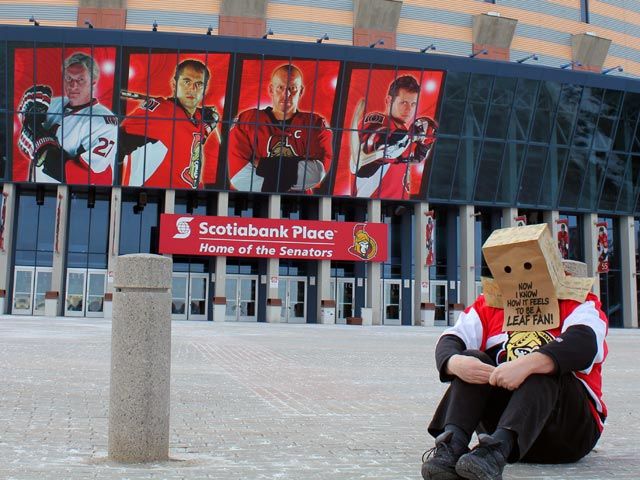
A note on whether or not the Ottawa Senators actually stink. (No they do not.)

Last night’s loss to Tampa Bay was a gut punch. Ottawa loses a close game, and every team that Ottawa is chasing wins theirs. In one night the Sens’ playoff probability drops from about 25% to 15%. Moreover, the feeling that this team takes one step back for every step forward weighs down the whole #fearless experience. The feeling of futility is settling in. But as is usually the case, the real story of the game lies just below the box score.

Ottawa outshot Tampa 34-22 and dominated possession 5v5 60.3%-39.7%. It was a one goal game right up until the last few minutes, and at one point, with the score tied, Bishop absolutely robbed Bobby Ryan. If he doesn’t maybe the whole narrative changes. A team with excellent goaltending stole a couple of close ones away from the team who should, by all rights, have won.

In fact, if you look at the Senators’ last 10 games—of which they’ve lost seven—they’ve controlled possession in seven of those games. In four of those games—also all losses—they’ve been north of 60% when 5v5, which, in a league this good, you can consider absolute domination in possession terms. In that same time they’ve allowed fewer than 30 shots on net at even strength eight times, and 20 or fewer shots at even strength five times.

The Senators, at even strength, are a good team. Or at least they have been lately. When Patrick Wiercioch said post-game that the team has been “finding ways to lose,” he’s not kidding.

So why are they losing so much? We don’t have to go far to find areas of legitimate concern. Their PK is terrible, currently rated 23rd in the league, and is absolutely giving the game away in places. This couldn’t be worse when you also consider Ottawa leads the league in times shorthanded. Their goaltending could also stand to make one or two more timely saves, which is a kind way of saying that Craig Anderson has been brutal this season. But my key takeaway here is that if this team stays out of the box even a little bit more, some of these losses turn to wins.

RELATED NOTE: Chris Neil’s penalties per 60 minutes of play this season is 2.9, which is 2nd in the league among players with 20 or more games played behind the also-useless Zac Rinaldo. This is almost a career high for Neil. (He took 3.1 penalties a game per 60 back in 2007-2008.) His penalties drawn? 0.4! That’s a career low.

For an agitator who doesn’t really do much to drive possession or put up points, that’s stunningly ineffective. For a team that is so pressed for cash that in order to call up Mike Hoffman they also need to send down effective fourth liner Derek Grant, Neil’s $1.9MM salary (for two more seasons after this…sigh) is a boat anchor.

I think the book is out on Chris Neil; the refs aren’t biting anymore. More importantly, I don’t know how you scratch young players for not playing responsibly in their own zone, and then not only give Chris Neil a free pass, but also the assistant captaincy. It can’t do much for your credibility.

Anyway…sometimes it’s helpful to just curse the hockey gods and move on. Toronto was massively outshot last night and eked out another win in OT, clinging to the edge of a regression cliff by their fingernails and the grace of good goaltending. Ottawa, at least over their last 10 games, is the reverse story. Their fundamentals are starting to come into alignment, but bad luck and discipline are doing them in.

To be a 92 point team they need to go 30-17-2 over the rest of the season. They have a big game against Toronto on Saturday—the battle of teams with opposite luck and possession. (I’m still looking for somebody to do an analysis of Ottawa’s record during Hockey Night in Canada broadcasts. I’m going to go out on a limb and suggest it’s really very terrible.) And knowing the hockey god’s cruel sense of humour, it could go absolutely anywhere. But if there are two things that you can bet on, they’re that Chris Neil will take a penalty, and on the ensuing penalty kill, Ottawa will probably get scored on.

Taking a look at the new Rogers broadcast deal

This is an Ottawa Senators fan blog, so we usually stay away from league-wide business developments (unless it’s a lockout and there’s nothing else to write about). But this seems too important to me, and that it will affect Ottawa, along with every other market in the league.

If you haven’t read about it, here’s the story: The NHL and Rogers reached a 12-year broadcast deal worth $5.2 billion that gives Rogers, under their Sportsnet suite of channels, exclusive national rights to all NHL broadcasts, across all platforms. Rogers will sublicense out some Saturday night games to CBC so they can continue their iconic Hockey Night in Canada broadcasts.

My initial gut reaction is that TSN has set the standard for hockey broadcasting in Canada, and it’s a shame to see them rewarded for all their hard work by being frozen out of the hockey picture altogether. I would argue that hockey is the commodity it is in Canada, in part, because of TSN’s effective campaigns to amp up and market international tournaments, league-wide events like trade deadline day and the free agent ‘frenzy,’ and just the general excellent of their broadcasts. Sportsnet’s quality, in my mind, has been lower.

And more importantly, without competition from TSN, it’s hard to see how Sportsnet has any incentive to improve their product now. CBC has always seemed like the fuddy duddy of the bunch, running embarrassing sketches with Don Cherry dressed as the Phantom of the Opera and giving airtime to brute personalities over respected analysts (Elliotte Friedman being the exception), so they probably won’t be the ones driving Sportsnet to new heights. If anything, the low quality broadcasts of Sportsnet will stagnate over time as Rogers tries to control costs and maximize profit on this massive, up-front investment. (In fact, they pay $150 million up front in the deal.)

While this sucks for TSN, and the consumer, I think the bigger story is the consolidation of media services under one umbrella. Rogers now owns a massive chunk of the television and telecom infrastructure and contracts in Canada, is part owner of the Leafs, and has exclusive broadcast rights for hockey. Those who follow media and telecom in Canada will tell you that when the distributors of content also own the content, that’s usually bad news for consumers, who end up paying more for less choice.

I can see the appeal for the league and, frankly, the short term appeal for a poor team like Ottawa. They get a massive infusion of cash to be shared among the league’s teams (hopefully Melnyk doesn’t have to sell any more of his prize horses now), and they partner with a provider who is ideally situated to deliver their content across an array of devices. People are increasingly watching media wherever they are, on tablets and phones as well as televisions. Rogers is in the position to provide those services. Bell, who owns TSN, must have made a less compelling case. Really, the writing should have been on the wall as soon as Rogers became part owner of the Leafs (along with Bell) that market consolidation was coming, and we’d all have to sign lifetime deals with either Rogers or Bell to keep watching hockey. This is good for the league, even if that doesn’t necessarily mean it’s good for the fans. Make no mistake, this is unprecedented centralization in the Canadian market, and less competition has always meant higher prices and less choice.

I’m hoping that Rogers proves me wrong, but then I’ve been an off-and-on Rogers customer for years – purely because of lack of choice – and they’ve let me down countless times before. We could see more specialty channels requiring additional payments to watch games in your market; additional charges for access across devices; obligations to sign contracts to gain access to the content you want; and a whole lot more Leafs.

I won’t turn this into a blog complaining about the telcos because we’ll be here all day, but Canada has tried to diversify its media and telecom landscape for decades – and it just got that much smaller. I’ll miss TSN, but more than that, I’ll miss a stable of quality broadcasters driving each other to deliver better quality broadcasts, more original content, and better access.

A Prescription for the Next 58 Games

1302138248157_ORIGINAL

I think it goes without saying that this year’s version of the Ottawa Senators is an infuriatingly inconsistent mess. As of today, their playoff probability sits a smidge over 25%. With absolutely everyone in their conference outside of Florida and Buffalo capable of playing at least .500 hockey, Ottawa needs to go 31-21-6 to have even odds of making the post-season. Bryan Murray is faced with some tough decisions. With that in mind, and knowing that he reads this blog religiously, I’ve come up with a plan to fix the Ottawa Senators.

1: Accept your situation

The Ottawa Senators can’t be fixed. Thanks for reading!

Seriously though, this season is just about in the bucket. While it’s possible that they can play at a better than .500 rate for large stretches of the season, they’ll need to play that way consistently, and have Montreal, Detroit, and/or Tampa falter significantly. It’s possible, given that Detroit has looked inconsistent (and almost missed the playoffs last year), Tampa is missing Stamkos and is due for some regression as they’re eighth in the league in PDO (luck), and Montreal is ninth in that regard and barely a bubble team. Ottawa’s own PDO is average (almost exactly 1000, or 15th in the league), so it’s possible that they could take a run. But we should recognize and acknowledge how tough of a spot we’re in at the moment, and set a date at which it’s time to make the painful but necessary moves for the future.

Having said that…

2: Don’t read too much into a lost season

There will be plenty of people who don’t watch a whole lot of Senators hockey but who are expected to produce thousands and thousands of words about the league. They will survey the standings, look at the lineup, and make a pronouncement about the state and direction of the franchise that is largely disconnected from reality. None will use trend analysis, or even drill down to individual players. For example, I don’t know how many non-Sens writers I currently see attributing the team’s poor start to losing Alfredsson (currently hurt) and Gonchar (currently terrible). These same people picked Ottawa to finish dead last the year after they finished fifth last, and who picked Ottawa to be a dark horse contender this year. Don’t trust polemics. This team needs minor adjustments at best. There’s a big difference between accepting a lost season and blowing it up.

3: Hand leadership over to the young core

Taking the As from Phillips and Neil doesn’t have to be a disgrace. It can be a symbolic gesture about the future and direction of this team. Ottawa is filled with players on very affordable deals. For a poor team like Ottawa, it needs to have these guys outperforming their contracts. Having your team living and dying for the crest, which is what happened for most of last year, is the only way to get value and performance out of this motley crew. Karlsson is an obvious candidate, given he’s on the ice for half the damn game anyway. Handing the other A over to a young player you hope will start to play better, like Colin Greening, is a cheap and easy thing to do, and not much of a stretch given his character role. The team can be anything the young players want it to be, but they need to lead to make it so.

In any case, it can’t be much worse than having take-way-more-penalties-than-I-draw / lord-of-the-offside Chris Neil as your role model. What, is Neil going to stop playing the way he plays if you take away his A? If he did, what would he have left to offer?

4: There’s not as much dead weight as you think

Outside of Milan Michalek, who isn’t playing anywhere close to the value of his $6MM base salary, or Chris Neil, who is just annoying, most of the players are on affordable deals, or their shortcomings are more than made up for in other areas. (Spezza is a -8, but almost a point-per-game player, yet again.) While the temptation might be there to make a deal, I’d hesitate to part with anyone like Cowen, Phillips, Greening, or Concacher, who have shown flashes of what they can do, and the financial risk of keeping them is low. This team’s survival is based entirely on achieving value. To that end, I’d much rather have Chris Phillips on an even cheaper deal than he’s on now than the 2nd round pick in a weak draft that we could get for him at the deadline.

5: Figure out your own barn

Ottawa’s home record is especially bad at 4-6-2, and could be due for an uptick. Ottawa plays 11 of its 16 December games at home. If Ottawa is not at least a game or two over .500 by Christmas, it should seriously consider building for next year. If there’s going to be a turnaround, it has to take place in the intimidating and spectacular farmer’s fields of Kanata.

When you think about it, so much of the Senators’ problems are tied up in their play at Canadian Tire Centre. They play terribly, ticket sales slow, management can’t put money into the roster…I know it doesn’t happen quite so quickly, but winning a couple of those friggin’ afternoon games would go a long way towards selling hope to the fans. Also: when given the opportunity to play the Edmonton Oilers at home, those are two points you have to take.

6a: Build a compelling case for 2015’s free agents

If Ottawa bombs out this year, even without its first round pick, it’s not the end of the world. They’ll bring back a young core of Karlsson, Turris, Zibanejad, Lehner, and Cowen, and their star players are around for another year. The year after that, however, has apocalyptic potential—full rebuild potential. We could lose Spezza, Ryan, MacArthur, Methot, and Anderson. Say what you will about their performance this year, but there aren’t many teams who can lose three top six forwards, a top four defenseman, and a veteran starting goaltender and not take a big step back. We don’t have the depth on the farm to replace those guys, and they aren’t in the free agent pool.

To get these guys re-signed means communicating early and often that whatever struggles the team is encountering now are temporary, and when next year rolls around the team will be ready to make changes, spend money on free agents, and be aggressive when it comes to winning. If I have one takeaway from watching a lot of terrible Senators hockey this year, it’s that this team would be even less fun to watch without Bobby Ryan.

6b: Or, actually, a little bit of extended rebuilding wouldn’t be all that bad either

This is what I would imagine to be an unpopular alternative to re-signing all of our best players and magically getting good again. We could accept our young core as the future, let all or most of our stars walk, pick up another potential superstar in the draft, and try to re-open the window of contention in 2016. Karlsson is signed through 2019 (sucker), Zibanejad is starting to come into his own at only 20 years old and will be firmly in his prime by then, and Lehner is the real deal. Add to that a Connor McDavid (a guy can dream, can’t he?) and some key free agent signings, and perhaps Ottawa is in a better spot than it would be in its current incarnation as a bubble team that hopes to go on a streak in the playoffs.

7: Decide what kind of team this is supposed to be

And I don’t mean “hard working” or “pesky.” Yes, you should try to score goals when you’re down late in the game. Yes, you should outwork your opponents. This is a strategy adhered to by every single team in the NHL (except maybe Florida). But is this the up tempo puck possession team we’ve all been conditioned to think it is? If so, why is our only other puck moving defensemen outside of Karlsson the unstoppable Wiercioch / Corvo ensemble? For the former  there is no evidence of being a capable top four defender, and the latter is a seventh defenseman making less than a million per. On the other hand, if this is a defensively staunch team, as the numbers implied last year, then why were they so heavily outshot and having to depend on Craig Anderson’s career season?

Ottawa has a lot of well-rounded utility guys in the lineup, but they aren’t particularly good at any one aspect of the game. You don’t have to be one or the other, but it helps to know where on the spectrum of risk and playing style you fall.

8: Whatever you decide to do, let the fans in on it

Uncertainty breeds fatigue. It’s not the team’s fault that there are several media outlets and about 2000 blogs covering every move the Sens make in breathless fashion, but it certainly gets exhausting to read about the daily ins and outs of a mediocre hockey club. What gets people on board is a vision for the future. Are we going for it in 2014? Are we continuing our rebuild? Is the team broke or what, and if it is, what are the plans to remedy that? When Bryan Murray retires I imagine there’ll be plenty of speculation about the direction of the franchise, and this can be a healthy discussion.

More than anything, I think that people like to follow a good story. Years of being a bubble team doesn’t have any sense of forward momentum, of progress. Give us something to look forward to.

Fourteen consecutive games (Ed note: if by consecutive you mean not in a row)

That’s how many games in a row Ottawa has given up the first goal. (Ed note: I got this stat from TSN’s game notes, but they scored first against the Panthers a few games ago. If I’ve learned anything from Rob Ford, you apologize and move on without actually changing anything, no matter how big the mistake.)

Let that sink in. Remind yourself that they’ve only played 21 games in the season, which means almost 70% of the time Ottawa will allow the first goal. That in itself is pretty disparaging, and also makes for less than entertaining hockey. But doing it 14 times in a row is…wow. Just wow. It’s almost an accomplishment. You’d have to try to do that. You’d think a shot would accidentally go in first at some point.

And for it to not really be the fault of goaltending is what makes this problem particularly infuriating. The team’s penalty kill will be good…until it isn’t anymore. (It’s down to 20th in the league after a short stint of being the best.) Their goaltending will be good overall…but the team will still be scored on in the first couple minutes of a game. The team will dominate the cycle…and then dump the puck back into their own end. Their defensive coverage will go from keyed in to completely out-of-synch in the course of a single shift. It’s absolutely dumbfounding to watch.

I’m not calling for the coach or GM’s head or anything, but you have to think this is either a system problem, or that Murray simply hasn’t given MacLean the horses to run an up-tempo puck possession team. Wiercioch and Cowen clearly haven’t worked out as planned. Karlsson can’t do it all. The team is just constantly pinned in their own end.

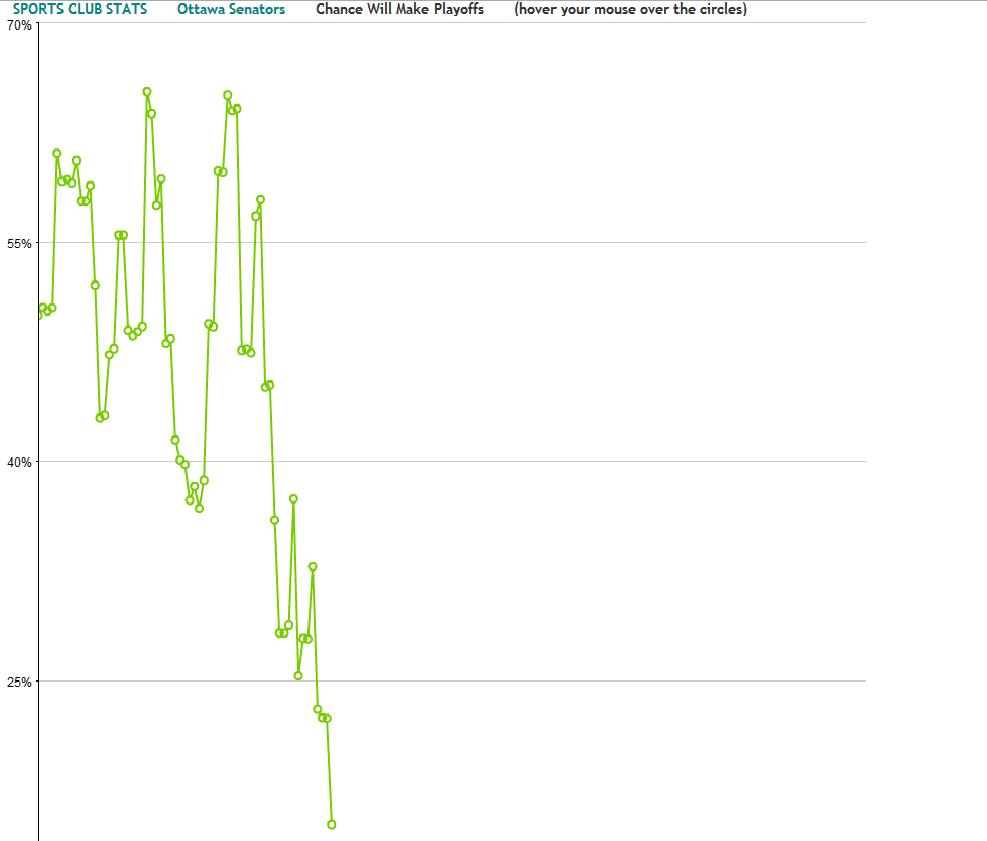
In any case, the team’s playoff probability went from about 60% two games ago, thanks in part to Montreal and Detroit also struggling, to 35% now. These things turn around quickly, but as James said in his last JDP: Ottawa is going to want these losses at home to Columbus and Edmonton back in the spring when they’re four points out of a wild card spot and have to play the Blackhawks and the Penguins.

We’re only a quarter of the way into the season, and I feel as if Murray has a move to shake this team up pending, but as has been mentioned on plenty of other blogs, the team is getting above average goaltending and has a good shooting percentage. If either of those stats regress even a little bit, this isn’t going to be a team trying to keep its head above water. It will be a team trying to stay out of the bottom five in a year when it doesn’t even have its first round pick. It’s already 10th last in the league.

It’s not as if Murray doesn’t have a few choices. Michalek and Phillips are on expiring deals (though the latter has a NMC until Jan. 1, after which he can pick 10 teams to which he cannot be traded). Conacher has been disappointing, though if he was traded now it would be selling pretty low on a player who at this time last year was being talked about as a dark horse Calder candidate. And of course we keep hearing about Anderson being on the block, though I can’t imagine anyone giving up what the Sens need for an underperforming goaltender at a time when there are still free agent goalies sitting around playing NHL 14.

All of this to say that the team is damned lucky to be sitting at 8-9-4 through this point of the year. They’re a short winning streak and a moribund Montreal stretch away from being back in the picture. But there’s something really disturbing about that 14 game streak. It says everything you need to know about this year’s Ottawa Senators. If last year they were pesky, this year they’ve become very, very accommodating.

Weekend Grab Bag: “Do we sort of suck? No. Maybe. I don’t know” edition

So, this is a thing I found on the internet.

So, this is a thing I found on the internet.

On Spezza

Jason Spezza has, and will always be, a divisive figure on this team, for reasons both fair and unfair. As I said during our inaugural Scotchcast, he’s a creative player who seems to pass to where another player with similar anticipation would have been, rather to where the players who he’s on a line with actually are. As a result, when his plans go awry, they seem to do so in spectacular fashion. I mean, I get it: it’s frustrating for a team that spends as little time in the attacking zone as Ottawa does to have its highly skilled, highly paid captain then whip the puck to an empty spot on the ice, effectively clearing it for the opposition.

That’s why this team went out and got Bobby Ryan, a player who excels at finding the open ice, at anticipating his playmaker, and at getting a shot off in small spaces. He seemed like a perfect compliment to Spezza. Instead, we’ve learned that Ryan can make plays too, and fits almost perfectly on a line with MacArthur and Turris, two well-rounded players who drive the possession game and make smart, simple plays consistently. Spezza and Ryan look lost together, perhaps because it’s not clear who’s driving the boat. The M-T-R line knows that you’re trying to find Ryan for the shot, and both of Ryan’s linemates are smart enough to read the situation and flow with it.

As a result, Spezza is looking a little bit lost out there. MacLean is cycling through line mates, but it’s tough to find a compliment for a free-wheeling playmaker who prefers the low-percentage, counterintuitive strategy to the traditional playbook. Michalek is invisible at times, neither able to receive nor get off a pass, and Spezza’s right side has been a motley amalgam of Neil, Greening, and Zibanejad. At this point I’m starting to wonder if Zack Smith deserves a shot on Spezza’s wing, and even I have to admit that’s a pretty stupid idea.

I’m not sure what the solution is. Ottawa’s offensive prospects aren’t really anywhere near ready (though one imagines Puempel getting his shot alongside Spezza in 2016-2017). It’s still far too early to target anyone on the trade market, not that Ottawa has the money to take on new salary anyway. And Spezza’s numbers are fantastic to start the season, though that’s buoyed by a few offensive outbursts rather than consistent production.

It’s not that I’m at all concerned, and I definitely don’t share the hate-on that some seem to have for Spezza. A few atonal improve-jazz moments are more than worth it for a point-a-game center making less than market value. (Don’t even act like Spezza wouldn’t make $8MM+ if on the free market now.) But I remember the good old days of Spezza with weapons on his wing. There were games when he looked unstoppable. He must also think about playing with an in-their-prime Alfie and Heatley when he looks over and sees Chris Neil charging the goaltender while holding his stick upside-down. As good as he is, we’re not getting the best out of Jason Spezza.

On puck movers and Weircioch

Ottawa’s transition game looked rough again against Montreal, especially in the first. Outside of Karlsson, who’s already playing about 30 minutes a night, there just isn’t anyone back there who knows how to do anything with the puck to start the rush. Cowen made a cross-ice pass in front of his own net that clearly surprised Karlsson, and which Montreal’s strong forecheck promptly turned into a chance to score. Phillips and Methot are far better at muscling someone off the puck than getting the puck to their forwards. And Gryba and Borowiecki are replacement-level AHL call-ups. That leaves the struggling Cowen, who the team has to hope is going to get his head out of his ass soon, and Wiercioch, who has a hell of a pass but who played the most sheltered minutes in the NHL last year, and who is a player more the mould of Anton Babchuck. He can play the point on the powerplay, and he can start in the offensive zone, but MacLean clearly doesn’t have any faith in Patty in the d-zone.

It’s a pretty big gap in Ottawa’s strategy, and it has a domino effect. The defense backs up and concedes all kinds of space knowing they don’t have the stick work or wheels to strip the puck away, and hoping to block a shot or stop the rush in their own end. The forwards have to carry the puck most of the way up the ice, with only MacArthur showing any success because of his reliance on simple and effective chip-and-chase plays along the boards and his excellent speed. Karlsson ends up playing more minutes than maybe he should, which results in him making mistakes. The goaltenders end up facing more shots. It goes on and on. Next thing you know, this team is outshot 2-1.

The inclination has been that Ottawa needs someone who can stop the bleeding because of how many shots the team is allowing. Personally, I think they’re allowing so many shots not because they don’t have their share of solid or all-around defensive players, but because their transition game stinks. And for that, they need to look at where the transition game starts. They need someone who can make a first pass to save his life. Even more than finding a linemate for Spezza, this team needs to find a defenseman who can move the puck. None of Phillips, Gryba, Borowiecki, Methot, or Cowen seem capable of doing that at the moment.

When do the fire sales begin?

You’ve got to feel for Panthers fans (the unicorns of the NHL): they’re about to bottom out again. They’ve already got their last several top five picks in the lineup, and they seem to be stagnating anyway. Huberdeau might be for real, but Gudbranson and Markstrom look like their souls have been crushed. Barkov is young, but already learning how little it matters to succeed in a market like Florida. Bjugstad looks frustrated. The whole team looks thwarted.

Their second-tier prospects are transitioning in, but their veterans have tuned out. (Remember that Brian Campbell and Ed Jovanovski are somehow on this team.) After finally parting with Stephen Weiss, and many years earlier with their prominent pick Nathan Horton, you have to wonder if they’re stuck in a perpetual mediocre machine. But as pointed out on several blogs, most of the teams in the league are within a couple million dollars of the cap. There just aren’t any trading partners out there in a season where the cap has come down.

Having said that, is anyone else surprised by the repeated mentions of Edmonton being a team ready to blow up its core? Hall, Eberle and Nugent-Hopkins are already on or approaching their second deals, eating up tons of money and cap space on a team that still has to deal with goaltending and defense. I’m genuinely surprised that they’re this bad, though. With the addition of Ference and a change-up on the team’s bottom six, I thought they were ready to at least be a bubble team. Instead, we’re all talking about who among Edmonton’s elite young players is going to be the next Tyler Seguin. Could this be an opportunity for Ottawa?

Vanek for Moulson, and good old fashioned money puck

vanekasgjersey

As I’m sure you’ve heard, a couple of days ago the Islanders traded Matt Moulson, a 1st round pick this year, and a 2nd round pick next year for Thomas Vanek.

Everything about this trade is fascinating to me, from the assumptions made by the teams involved to the way the media is writing about it. I feel like this could be one of the most straightforward examples I’ve ever seen of one general manager exploiting the superficial perceptions of another to receive a higher trade return.

Let’s start with Moulson:

                                  GP    G    A  Pts 
NHL Totals                        334  126  109  235

Moulson has a career point-per-game average of 0.70 with three 30+ goal seasons, or a .37 goals-per-game. (He was on course for a fourth 30 goal season in the lockout shortened year.) His career Relative Corsi is a respectable 6.06, and that’s including his first two pretty terrible seasons in LA. If you look only at his Islanders years, his Relative Corsi is 7.1. He’s never been a negative possession player in his time on the island.

In other words, Moulson hasn’t just been good; he’s been consistently good. In Ottawa we talk about Bobby Ryan being a four-time 30 goal scorer as if that’s the new benchmark for superstars, and it will entitle him to $8MM+ when his new contract is due. Moulson, on the other hand, is making just over $3MM a year for the same kind of production. He provides some of the best value in the NHL.

Now Vanek:

                                   GP    G    A  Pts 
 NHL Totals                        598  254  243  497

First thing to mention is that Vanek has 3.2 more seasons of experience than Moulson. So, there is the seniority factor here. He sports a marginally higher 0.83 points-per-game average, and a marginally higher goals-per-game average of 0.42. His career Relative Corsi is 7.2, or almost exactly the same as Islanders Years Moulson.

In other words, the two players are so similar in production and possession as to almost be shadows of each other. Vanek, however, has had a couple of 40 goal seasons, and is paid about $7.2MM a year–or about two-and-a-half times what Moulson is making.

The key difference between the two players seems to be the perception of their potential. Shortly after the trade, I saw something on Puck Daddy to the effect of Vanek being the kind of player who is capable of “carrying a team on his back for weeks on end,” whatever that means. I’m not sure what the criteria is for team carrying, or why Moulson doesn’t meet those criteria, especially considering that Moulson has produced on an Islanders team that has consistently had one of the lowest payrolls in the league, while some of Vanek’s best years came when the Sabres were making the conference finals, racking up 100 point regular seasons, and when teammates Chris Drury and Daniel Briere were in their prime.

My point is that it’s not at all clear to me why Vanek is spoken about as if he’s an elite player, a star, a ‘special’ contributor, and Moulson is not. It’s certainly assumed that Vanek’s ceiling is higher than Moulson’s, and that other, mitigating factors have kept him from reaching that ceiling more consistently. In the right conditions–say, with a star centerman like John Tavares–he’ll flourish. (The same has been said about Rick Nash’s time in Columbus, though playing on a better Rangers team certainly hasn’t propelled Nash to stratospheric production.) Moulson, to put it diplomatically, is assumed to already be playing at his ceiling, or even outperforming his ‘natural state’ as a player.

This, maybe even more than this season’s Toronto Maple Leafs, who consistently get outshot and still win games, is a case study for advanced stats and the assumptions of general managers.

For both players we have a large enough sample size to theorize about what is reasonable to expect from them. Moulson, when given first line minutes and linemates like Tavares, can be a 30 goal scorer. That’s a proven commodity, and one, as we’ve seen in Ottawa, that teams will pay handsomely for. A player who can produce like that on a very cheap deal is the best of all worlds, the holy grail, the type of player you should constantly be seeking out in a cap- and fund-constrained league. And the Islanders just gave that guy away on the assumption that Vanek can return to 40+ goal form, or maybe even reach new heights. And I’m not sure how likely that is, considering his last 40 goal season was in 2008-2009.

And then there’s the draft picks. Next year’s 2nd rounder isn’t anything to get excited about. Assuming a 2nd round pick needs two to four years of development before you even know what you have, then whoever the Islanders draft there isn’t going to fit into their plans to contend in the next few years. The 1st rounder, on the other hand, represents significant risk. They’re banking on it being a mid- to late-round pick, in which case the player selected may still be a few years out. But those players are valuable assets nonetheless, and you can ask Chicago how valuable having a pipeline is when you want to extend your window as a contender.

I agree with the principle that the Islanders have plenty of prospects, and the time to upgrade is now. But as I’ve written on this blog about Ottawa time and again, you only really get one or two shots at a big upgrade when you’re at the apex of your rebuild. It takes a lot in terms of picks and prospects to get an established NHLer, and the Islanders just used some of those resources on a player who is only marginally better than the roster player they gave up. I’m not even really getting into the fact that the Islanders don’t need offsense, they need goaltending and defense.

If absolutely everything goes right for the Islanders–Vanek gels with Tavares, works in their system, and escalates his output–it’s not really reasonable to expect much more than Moulson’s ‘natural state’ output of 30 goals. Let’s say he’s able to break that magical 40 goal threshold that separates the superstars and special players like Vanek from the rest of the pack. Vanek has about $6MM left outstanding on his salary to Moulson’s $2.6MM. Will those extra ten goals have been worth $3.4MM, a first rounder which could land anywhere, and a 2nd rounder?

This trade really is dumbfounding. Even if you factor in intangibles which we’re not privy to–Vanek’s extra NHL experience, the fact that he was (for a very, very short time) a co-captain (with Steve Ott, fer Chrissake), and whatever other concerns the Islanders might have had about Moulson, it’s hard to understand what the Islanders are seeing in Vanek that’s worth the price of the upgrade. If you’d asked me whether I’d do Moulson for Vanek straight up, I’d have to really think about it because of the money involved and the fact that I know Moulson can produce for my team.

What’s even more confusing is the way this trade is being written about on blogs and in the media. The main issue, I’m told, is that there’s no guarantee the Islanders can re-sign Vanek. Where’s the emoticon for facepalming? Why on earth would a poor team like the Islanders want to pay Vanek what he can get on the open market when they should be looking for more guys like Moulson?

In fact, if the Islanders are very lucky, maybe they can re-sign Moulson in the offseason. After all, after his two goal night in his first game for Buffalo, he’s now on pace for a 53 goal season.

Could an early season trade for defense perk the Sens up?

It’s probably not all that contentious a point, as we reach the 10% mark of the season, to say that the Senators are a defensive dud. Not a catastrophe, but far from impressive. 18th in goals against per game. 17th in goal differential. Dead last in shots allowed per game, though there were a couple of 50 shot games to skew the totals. They’re 21st in the league in winning percentage when being outshot, and 26th when trailing after one period–which seems like almost always.

All of which is a real shame, because the team is chugging along offensively: 8th in shots per game, 16th in goals. Their PDO is a paltry 20th, which means they have some room for luck with their shooting percentage. If they keep doing what they’re doing, the pucks will start to go in. But on the back-end it’s a whole other story.

Jared Cowen’s possession stats are abysmal, as are Patrick Wiercioch’s. Chris Phillips fares much better, but is being asked to do too much in the absence of an actual second pairing. Fair to say that Ottawa could use some reinforcements.

With the Islanders trading for Tomas Vanek last night, I can’t help but ask if an early season trade might shake the team up a bit.

Of course they aren’t helped along by the fact that they have neither their first round pick nor any sort of money to spend, and it’s way too early for even the basement dwellers to signal defeat by selling off assets. Also, it’s way more cost effective and strategic to give some ice time to a Mark Borowiecki type than to give up assets for costly veterans. But if Ottawa were to target a defenseman, who might they go after?

I looked at players on expiring contracts who are playing for underperforming teams, and this is what I came up with:

Kimmo Timonen – PHI – Cap hit: $6MM

Hard to imagine Philly actually giving up a defenseman as opposed to targeting one, even one playing as poorly and as injured as Timonen is right now. But he’s formerly a stud defenseman who, at 38, you imagine has at least enough in the tank and his share of experience to share top four minutes, even if he’ll never be the 20-minute-a-night solution he once was.

Andrej Meszaros – PHI – Cap hit: $4MM

It might be interesting to see Mesz back in an Ottawa uniform, although it can’t be helped along that he’s playing terribly and his actual salary is $5.5MM. His Relative Corsi actually isn’t all that bad. Philly apparently wants to part with him badly; could Ottawa have him for peanuts as part of a salary dump? Maybe if Philly retained a portion of his salary?

Marek Zidlicky – NJ – Cap hit: $4MM

Another veteran who could probably be had for cheap, Zidlicky’s been around for what feels like forever.

Nick Shultz – EDM – Cap hit: $3.5MM

If you’ve read any of Tyler Dellow’s stuff about Nick Shultz, you’re yelling at me to run as far and as fast as I can from this player. Never mind.

Dan Girardi – NYR – Cap hit: $3.325MM

Ah, now this is interesting. I don’t think anyone expected the Rangers to be so far out of it at this point in the season. Girardi is young (29), has played decent second pairing minutes for the Rangers, and he isn’t so integral to their plans that he couldn’t be part of an early season trade to shake things up for a team that wants to contend right away.

Stephane Robidas – DAL – Cap hit: $3.3MM

Somewhat underrated defenceman, perhaps due to the market he plays in, but Robidas used to put up solid minutes for Dallas. Also aging, and probably on his way out from a Dallas team that has some young options on the back end, it might be time for a change of scenery. Dallas is looking like they’re heading for another mediocre finish in a tough division.

Nikita Nikitin – CBJ – Cap hit: $2.150MM

This would sort of be swinging for the fences, as you have to assume that Columbus wants to keep this effective, 27 year old player in their plans, and they aren’t far enough out of it to be sellers just yet. Ottawa would have to give up serious resources to make this happen.

—————————————

Beyond this cutoff you have players on teams that are either currently in a playoff spot, or guys who you can’t picture playing top four minutes.

So there you have it. It goes without saying that a lot of these guys aren’t going to turn the team into a contender all on their own. But as a decent stopgap to try and stop the bleeding, they might just do the trick.

WTYKY Scotchcast Episode One: The Scotchening

Scotchcast

Here it is. Long promised, never before delivered. Two hours of James and I talking about the Sens’ early season performance; when to panic; Sens we like and Sens we don’t; and questions from you, the WTYKY readers.

This is our first go at this, so go easy. But any suggestions or comments are welcome, either through the Contact Us link above, or on our Twitter – @wtyky.

Why do so many Ottawa fans feel disconnected from the live game experience?

9224689415_59b54e644d_z

Trying to build a little bit on my earlier post about ticket prices, I’ve been thinking about the experience of going to a Senators game and where the value lies.

The WTYKY team went to the home opener last night, and I think it was a pretty typical Sens hockey experience. Not a bad seat in the house; competitive team put on a show, making up for some nail-biting defensive lapses by making legendary Marty Brodeur look awful; great facilities; good times all around. And one of the weirdest, dumbest commutes I’ve experienced in pro sports.

I don’t want to write a post that is only complaining about how long it takes to get to the game. It’s not that long a drive. It’s not a big deal. 40 minutes on the bus is a small price to pay for being able to see your affordable, competitive team whenever you like. But I think there’s something to the idea that Ottawa games are quieter, less raucous atmospheres than what other cities have going, and it has to do with how the arena is a bit of an afterthought. I’ve been to games in a few NHL arenas. Chicago, Toronto, Montreal. And, honestly, it took me as long to commute to those arenas–usually located in those cities’ business districts–as it takes to bus out to Kanata. But what those places have in common is the arena is on the regular public transit grid, meaning that you can go out early.

An NHL arena is a pretty special place, and teams know how to create atmosphere. You feel like you’re becoming a small part of your team’s history when you walk through those doors. A lot of thought is put into making the arena the sort of place where you’ll walk around, check out the memorabilia, maybe shop for some team gear, maybe grab dinner before the game. All the while, the anticipation for the game builds. The game I went to at the ACC a couple of years ago was completely bananas, even though Toronto was out of the playoffs at that time, and they were playing a St. Louis team that was also out of the playoffs. When Toronto won in a shootout, the place exploded.

The problem with Sens games is that it’s not physically possible to hang out at the arena unless you drive. We did our part: after a quick after-work beer, we were at the bus stop, waiting for the game shuttle, at 6 for a game that started at 7:30. The bus didn’t arrive for 30 minutes, and when it did, it was too full to pick us up and drove past. We arrived at about 7:25, just in time for the anthems, with no time for get beer or food, let alone walk around and experience all of the aesthetic touches that the Sens’ marketing team have put in place.

When the game ends, you have about 30 minutes to get on the shuttle back to downtown otherwise it’s gone without you. What this translates into is a very workmanlike experience. Get there; drink as many beers as you can in two periods; get home. It’s such a shame, because yesterday was the home opener and there were all kinds of events and booths set up which we had no choice but to hurry past on the way to our seats.

I’ve talked to friends in other cities who will make fun of Ottawa fans for not going to their good team’s cheap games because of the commute, but I really think there’s something to this. Ottawa has trouble establishing the same sense of prestige and history that other franchises possess, and it’s because the arena is basically inaccessible by public transportation for anything other than just the game. This is to say nothing about being on a bus that is driving through dark farmer’s fields instead of into the center of a buzzing urban center.

I know there’s nothing that can be done about the location of the arena, but I think there has to be something for those super-fans – the ones who have been looking forward to the game for weeks and want to make an event of it – to get out there earlier.

A few other notes from the game:

  • A guy on the bus home said something to the effect of Spezza’s empty netter being “such a Spezza goal.” I know following Alfredsson as captain is a tough thing for any player to do, but man does Spezz get a rough ride. He’s a creative player, which means that his mistakes, when they happen, are a lot more glaring than your typical north-south grinder / character player’s are going to be. I suppose there’s a valid point in here somewhere – you don’t want the ultra-skilled guy to be teaching your young players, since most of them won’t be able to pull off what he’s doing anyway. You want someone who teaches the fundamentals. But all the same, a lot of Ottawa fans assume there isn’t much to his game. Team Canada must feel the same way, not even offering him a try-out. Anyway: he only scored a hat trick the game before, so I guess you’re right that his next three point night, and his 8 points in 6 games, is a total fluke, bus guy.
  • Why the hell is Ottawa playing Chris Phillips out there on the power play? It’s awful to see. At one point Maclean sent a powerplay out of Phillips, Gryba, Smith, Neil and Greening. Must have been sending his skilled guys a message. Obviously that PP was hot garbage.
  • Re-watch Karlsson’s slick pass to Smith on the third goal. Spezza breaches the zone and waits, not passing to a wide open Smith so he can instead dish to a streaking Karlsson, who then draws four Devils to him before sending it to Smith for a back door goal. It was a thing of beauty, but what started it all? Jaromir Jagr, following Karlsson in his own end, gives up once Karlsson gets skating and peels off on a change, leaving Karlsson completely open to skate into the Devils’ zone unimpeded. I don’t envy Peter De Boer having to have that conversation with living legend Jagr, who will probably be gone at the deadline. Lazy, lazy play.
  • If you’re a fan of watching penalty kills, man are you getting your money’s worth out of the Sens.
  • Clearly some opening night bugs on display throughout the game. Lots of penalty announcements happening a minute after taken, and musical miscues. For all the ink spilled on Ottawa having new in-arena entertainment, it all seemed pretty standard, and off-kilter at that.. (“Don’t cheer too loud, you’ll break the Noise-o Meter!”)
  • The Sens have a really family friendly atmosphere going. This is not a compliment. Let’s work some of the Nickelodeon dance music out of the routine, fellas. It can’t be very intimidating for the opponents to know they’ll be playing The Wiggles.