Because hockey is hockey, but Star Trek TNG is Star Trek TNG

One tragic byproduct of this whole lockout—other than people losing their jobs and stuff—is that our web sphere (that’s a thing) has lost some serious momentum. James is killing it over on Twitter as usual (just over –>), but I don’t have anything to write about except some whiny articles about how I don’t like hockey anymore and how billionaires have billions of aires. I miss being enthusiastic, childlike, idiotic about unimportant entertainment.

So, as a new ongoing feature, I’d like to write about Star Trek: The Next Generation, which was just added to Canadian Netflix, as I watch all 177 episodes in order.

Now, for our American readers, you need to know first that Netflix in Canada stinks. It doesn’t have anything. While in Amurh-ica you have access to hours of quality programming (read: Golden Girls), in Canada Netflix is mostly state-sponsored shows about the joys and mishaps of agricultural life and also some SeaQuest 2032 (R.I.P. Jonanthan Brandis, King of Tiger Beat). For some reason, content rights have to be negotiated fiefdom-by-fiefdom. But Star Trek TNG was just added, and though I shudder (with pleasure) when I see the words “177 episodes” displayed, I only watched the first four episodes this week.

Episode One: Encounter at Far Point

 UntitledThe new series starts out ballsy by following the statement “To boldly go where no one has gone before” with an episode that basically asks “is all this exploring stuff even a good thing to be doing?” Within a few minutes of taking over the ship, Picard and company are confronted by Q, a near-omnipotent creature who appears in the guise of the various phases of human expansion and colonialism. Q then proceeds to put them on trial for the crimes of humanity. You could have ended the entire series right here, with Picard admitting that exploring for exploring’s sake is sort of dangerous and meddling and stupid, that the human race is a virus, and then the screen could go black and giant middle finger could appear. This might be the series’ most meta, first-year-lit student moment. It’s either awesome or stupid, depending on how you look at it.

We also get to see a version of Picard that is irresponsible and dickish. He hates children; he risks an emergency saucer separation at warp 9.8; he makes Riker re-dock the ship manually for no reason; and he’s kind of brattish when standing up to Q, causing the god-like being to repeatedly injure his crew. Kind of awesome, again, for the debut episode to be like, “You want more Kirk? Guess what: Captain Kirk was an asshole. He lost a crew member every single episode. He was a terrible captain.” Then they find a planet where a human is mercilessly abusing a giant space jelly fish, basically admitting that humanity isn’t that much better in the future than it is now.

Oh, also: Shit is dark. Someone actually gets shot with a machine gun in this episode. I think this might be the darkest episode until the one where Tasha Yar has to fight someone with a spikey glove in a cage of death. You know the one. I think it’s an episode or two from now.

Counselor Troi is clearly intended to be this show’s Jonathan Brandis.

Episode Two: The Naked Now

 Untitled2Okay, this is incredible: in only their SECOND EVER EPISODE a space virus makes everyone act drunk and screw each other. That’s not an exaggeration. The Enterprise stumbles across a ship where the crew immediately demands HOT MEN and then proceeds to blow themselves out of an airlock. I’ve been drunk before, even stupidly so, but I’ve raaaaaaarely wanted to kill myself and everyone around me because of it. I can’t speak for my friend Tom, Who Lights Camp Fires with Gasoline. He might be space virus drunk. Also, someone showers in their clothes. That’s just crazy.

There’s a weirdly puritanical subtext to this whole thing, sort of like Reefer Madness. Do you want to get drunk kids? Just know that if you do, you might kill everyone.

So, the Enterprise crew, including, somehow, Data, get infected with this thing, and everybody, including Data but excepting Jordie (Geordie?), gets laid. Wesley Crusher, being a boy, has no interest in being laid, but uses his boy genius to steal the ship. A meteorite is hurtling towards the ship (the odds of a relatively small rock in space arcing toward a relatively small ship, thermodynamically speaking, are astronomically tiny, but whatevs) and Riker, having less than a minute to live, decides to narrate something in his space journal about the situation. Also, the most advanced ship in the history of the race stops working if you take out a bunch of giant microchips.

Untitled3

Episode Three: Code of Honor

untitled4Otherwise known as the most racist episode of Star Trek TNG ever, the crew visits a planet of Africans and makes a series of condescending remarks about how they, the largely white crew, used to be just like them, the Africans. Meaning materialistic, venal, and sexist. Surprisingly, Worf–from the race of Klingons that usually stand in for anachronistic and vaguely ethnic stereotypes–doesn’t even get a line to speak. Seems to reaffirm that you only need as many Others as you need antagonists for your space operas. Anyway, Tasha Yar fights another woman to the death in a laser cage, and everyone moves on to other, hopefully less racist episodes.

We also discover why Star Trek TNG took so long to get to Canadian Netflix: at one point Data calls French an outdated language. Racists AND monologuist. Not exactly the franchise’s brightest moment.

Episode Four: The Last Outpost 
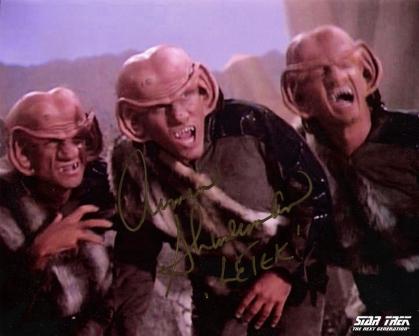
untitled5Ferengis (sp?) shut down the Enterprise, making them totally vulnerable. Picard uses the opportunity to tell Data about the history of human flags. The bad guys stole a T-9 Energy Converter from Gamma Tari 4. This is relevant.


Shortly after I’m pretty sure Picard says “merde.” Jordie says, “Come back fighting, woo wee!” then gives a thumbs up. Brilliant.

For the rest of the episode everyone is pretty much useless at their jobs and the ship barely works. Picard seems completely insane, and Riker looks at him like he knows it. Data gets his fingers stuck. The future is a terrible place full of imbeciles.
Should, and can, Bettman go?

With this first glitter of optimism we’ve received in weeks—generated, perhaps tellingly, by meetings where the NHL Commissioner and NHLPA head were both absent—I’ve found myself thinking about the prospect of seeing hockey this year. Up until today I’d just about given up on that notion. Goes to show how even the cynical like me can be bent by a mildly positive though largely ambiguous headline.

It also speaks to how little we fans may expect from either side in terms of PR, and how little we received. I’ve never felt like either side was invested in the feelings of the fans, except to the degree they could manipulate fan sentiment as leverage in their negotiations. Such is the magnifying effect of the 24 hour news cycle. What is a group of rich people fighting over how much richer one side gets to be than the other turns into the same group of rich people biting the hand that feeds them. Given how badly this thing has been cocked up, I can’t help but think some kind of overture has to be made to the fans to get them back on side; I’ve never heard people sound as cynical as they have these past two months.

Which makes the following question both a bit compelling and also completely ludicrous: is the best thing the league can do to make amends with the fans to axe Bettman?

It would be succumbing to an unfair stereotype—Bettman answers to the owners, after all. But consider that 1) Bettman is a convenient stand-in for the greediness of the owners and the brokenness of this negotiation process; 2) There are many skilled, cut-throat former lawyers who could play the role of facilitator and administrator, and 3) maybe it’s healthy to have a little bit of turnover at the top, especially when your guy has been in his role for almost 20 years. This track record of lockouts is not synonymous with Bettman’s track record. For better or for worse, Bettman is the brand.

How many more years do you want this guy booed every time he steps up to a microphone, be it at the draft or handing out the Stanley Cup? This is supposed to be the face of ownership, the powerful mask of the league itself. Fair or not, Bettman’s as divisive a figure as you’ll find in professional sports, and after yet another lockout I can’t imagine there aren’t enough owners in that board room to do the ultimate shanking in blaming this whole fiasco on him. They could wash their hands of the whole situation and get back to the business of making money.

Unlikely to happen, of course, as Bettman has created the ultimate insiders’ club. And there’s nothing more appealing to the rich white man who has everything than membership in an exclusive club. He’s ingrained himself with the league’s identity. But we might be starting to see the beginning of a fan backlash that could be counteracted by the appearance, if certainly not the reality, of regime change.

Forbes list foregrounds the not-so-hidden benefits of franchise ownership

I was trying to find an image for this post, but figured you don’t want to see another photograph of Gary Bettman making a turgid face as he strains to offer another non-answer at a press scrum…

I don’t know what it says about me that Forbes puts out some of my favorite hockey analysis, but they’ve done it again with their annual report on the value of hockey franchises. In it, they illustrate that the media’s focus on the operational losses of franchise ownership–which are themselves specious claims for owners who also own their arenas–are nothing more than the short-term price one pays for what can be staggeringly lucrative mid-term investments.

We mortals are expected to get by on the sort of paltry returns available to people playing with mere hundreds or thousands of dollars. What Forbes’ list indicates is that if you can afford to sink $200MM into a franchise, you’ll probably get the kind of increases in overall value, year over year, that make losing $5MM a year in the short term more than palatable. (Presuming you’ve got it to lose after buying the thing, admittedly.)

I won’t focus on Toronto, where all sense and logic are destroyed in the void of abject homerism. Or on New York, where they have a license to print money. ($74MM in cool cash year-over-year, zero debt.) But Melnyk’s looking at a nice little $100MM return on his $120MM investment in the Sens about a decade ago. Double your value in 10 years? Anyone who even bothers to look at their RRSPs will tell you that’s a pretty good deal.

Ottawa’s operating income was probably slim to nothing – $14.5MM before taxes, etc. But between all of the undeclared revenues that are made possibly through owning a hockey team – non-hockey events at ScotiaBank Place, television revenues, merchandise – in addition to the return when Melnyk gets around to selling the team, even a small market team like Ottawa, presents an enviable investment.

Maybe more suprising is how much debt Ottawa is carrying. At 59% of value, Ottawa is eighth overall is debt load, among the likes of the Islanders, Panthers, Hurricanes and Stars. They’re worse off than Nashville and St. Louis. This seems strange since Melnyk’s had a decade to pay off that arena. This may speak to his financial woes at Biovail. He has a profitable franchise. He just isn’t paying down his principle fast enough to be able to enjoy it.

More surprising still is that despite all this debt he’s carrying, Melnyk doesn’t seem to be a hardliner in this lockout situation. Sitting right there with him, in 10th, are the Washington Capitals, and their owner Ted Leonsis has long been suspected of being a hawk in all of this. Though he’s got a few looooooong term deals, and he might be feeling buyer’s remorse, in many ways the Caps are better off than the Sens financially.

Over on Puck Daddy they’re talking about the gap between rich and poor teams, but I don’t know if that’s really the point. Teams, even the exceedingly poor ones, can claim to be losing money operationally, but the overall value of the franchises don’t go down at the rate that most franchises go up. Only three franchises went down in value last year – St. Louis, Columbus, and Carolina. Two remained neutral – Tampa and Phoenix. (That’s right, Phoenix did not lose overall sale value despite losing more money operationally than any other this season.) And everyone else experienced at least marginal growth. The middle of the pack franchises increased in value between 4% and 11%, which ain’t a bad return in one year for your $150MM-$300MM investment. Especially considering, you know, you get to own a hockey team on top of all that.

How the 2012 lockout affects the way I interact with hockey

It’s been a long, long time since I’ve written anything on this blog. In fact, the last post I wrote, on September 20th, was a petition vowing that if any games were cancelled that I wouldn’t watch any hockey for the rest of the season. Since that time I’ve had just about no desire to contemplate our situation as hockey fans, and no interest in covering the ongoing non-event that is this lockout.

The reaction to that petition was predictable and fair. Most seemed to appreciate the sentiment–that only by withholding our dollars can we actually communicate with owners and/or players–but admitted that they would eat hockey up if and when it returned. I’m missing hockey something fierce; I don’t begrudge anyone the opportunity to watch the Sens play again. But I thought it only right to follow up on whether or not my position has changed over the last month plus…

Nope. The owners have cynically positioned the fans, leveraging our passion for the sport in a fight to undermine player rights. They’ve irreparably set the sport back at least a year or two after what had been years of record growth and some of the best hockey in years. My sense is still one of deep resentment. If any other company or brand, selling me any other product, so fragrantly took me for granted in this way I would never go back to them.

Now, I’m not saying that I’m never going to watch hockey again. And I have to acknowledge that Melnyk doesn’t seem to be one of the hardliners among the ownership cadre driving this thing. But I simply can’t go back to the way things were and pretend that this level of greed is a normal and cyclical thing in the overall scheme of CBA negotiations.

So what were my plans for 2012-2013? Well, after a surprisingly competitive season last year, I planned to consume Ottawa Senators hockey to about the same degree as any fan who bothers to write about hockey on his own blog. Which is to say that I was going to watch every game at least on TV, attend between a half-dozen and dozen home games, go to as many playoff games as I can, buy some merch, and drink a shit-ton of $11 beers at Scotiabank Place. I don’t spend like a madman when it comes to hockey. But I’m part of the gristle that makes hockey profitable in this city. If I was a die-hard with season tickets and a version of every jersey, then peeling back a little doesn’t make that much difference; I’d still be spending like mad. Instead, I’m the kind of consumer who had built hockey into my routine. What any lockout demonstrates to the consumer like me is that I don’t need hockey in my life that badly.

When there are this many companies willing to bend over backward for my entertainment buck I can’t go back to hockey spending. I won’t be going to any home games if and when hockey is back, not even playoff games. I won’t buy any merch, like jerseys or t-shirts. (Not even that Ottawa Senators Dream Capture Kit.) I won’t spend any money on arena food or beer.

So, why would I punish our small market team? Well, I’m on record (here and here) thinking that Melnyk has a habit of stretching the truth when it comes to describing the challenges of breaking even. And I can’t ignore that Daniel Alfredsson is re-considering his plans to play another year, and that we’re losing a year of Erik Karlsson and Jason Spezza in their prime. Hockey, and Ottawa Senators hockey specifically, is damaged because of this lockout. If we never break out of this habit of flocking back to hockey because we’ve missed it so badly, then we’ll only have ourselves to blame when all of this happens again in 6-7 years.

Sign this petition to end the lockout

SIGN HERE

I submit to you a thesis: that the consumer of NHL hockey does not sit at the powerless nexus between billionaire owners and millionaire players in their fight to divide a $3.3 billion pie but, in fact, has agency.

That agency is his or her almighty dollar, the many billions of which these owners and players are fighting over, after all. And though we might feel powerless in this situation, the one decision that no person or corporation can take from us, no matter how influential they are, is the decision to leave our wallets in our back pockets.

Because let’s face it: we’re being taken for granted here. And it’s far more egregious than how Canadian hockey fans feel taken for granted when their dollars are used to subsidize expansion into non-traditional markets. There is a tacit assumption on the part of ownership that the fans will come back. There will be no fiscal penalty, relatively speaking, for taking away something that we love. We’ve come back before.

It’s tempting to take sides, particularly against the owners. Their bull-headed position is matched only by their willingness to fire staff or cut back their hours and pay, and the inevitability of even higher ticket prices should they succeed in maximizing their profit. Their arrogance seems all the more despicable for the very public way in which it’s dissected by a hockey starved sports media. But taking sides is nothing but semantics for any hockey consumer who doesn’t happen to have a pulpit from which to speak about labor issues. You can buy a ticket because you like the players, the owners, the ice girls, or the popcorn. But you only have one type of almighty dollar to spend and no matter why you spend it, that dollar ends up in the same place.

Which is why I propose not spending it. Somewhere in league offices there is probably an algorithm that demonstrates the degree to which the owners can risk good consumer relations against what they stand to gain in a labor dispute. And the only way to speak to them in their language is to demonstrate that their decision to deny hockey fans hockey has repercussions.

If the league comes back to play a truncated season, it will be tempting to watch. But how can I, after experiencing yet another lockout, send that signal to Bettman and the owners? Why would I rush out to buy another season ticket package or jersey? Why would I celebrate a team’s deep prospect pool, an unexpected playoff appearance, a gritty performance, or the glory of a championship? Why would I become reinvested when the owners are so quick to take it away?

Boycotting and staying away for a prolonged period of time—and, just as importantly, letting management know through a written letter campaign—is the only way to send a  message to this league that they can’t take hockey fans for granted.

That’s why I humbly propose the following pledge:

If a single game is lost from the 2012-2013 NHL season, I pledge not to watch any NHL hockey for the duration of said season if and when hockey returns. I will buy no tickets or merchandise for my home team or any other team. I will not watch NHL hockey or related shows on television. I will not listen to NHL hockey or related shows on the radio. I do this to send a message to NHL ownership that we, as consumers, demand respect. If you deny us this game that we so love, we will deny you our dollars.

SIGN HERE

ESPN Releases Ultimate Standings, acknowledges that Ottawa has a sports franchise

ESPN’s crack team of NHL analysts

It’s only natural that the hockey community’s perspective on ESPN’s amazing/contentious idea, their “Ultimate Standings,” would focus on the Leafs being dead last among all sports franchises. For even such a flawed methodology as one that basically asks a frustrated group of fans what they think, those results deserve a little bit of commentary. But there might also be a few things we can learn from what amounts to marketing data made public.

(Aside: what is with this trend? Pitchfork did something similar with their People’s List, which was treated around the internet as if it wasn’t just free market research. They even broke down all the demographics. Sports has always been a little bit more comfortable with its commercial nature, but indie music? It’s a weird contradiction to me to have so many indie fans happy to share their consumer habits in a public way.)

ESPN’s methodology is a combination of the standard—weighted averages across eight key categories, designed to smooth outliers and exemptions, economic analysis—and counterproductive—polling fans by phone and online. I say it’s counterproductive because if the goal is to collect reliable data and drop the extreme deviations, then you’d also need to account for the fact that sports fans tend to harbor hyperbolic attitudes towards their favorite and least favorite franchises. You can’t just ask sports fans for the objective truth. A real “Ultimate List” would measure fans actions over time, as opposed to opinions. (That’s an interesting discussion in itself: what counts? Just attendance at events and watching on TV, or blogging, and shopping, and Tweeting, etc.?) It’s not unusual for a sports fan to put one thing in extremely strong terms and do another thing altogether.

It’s also difficult to understand how a fan in one city might render judgment of another city’s “fan experience.” How would an Ottawa Senators fan answer the question of fan experience about the Leafs? I’ve been to a Leafs game and thought the atmosphere was amazing, especially considering they were already out of the playoffs and they were playing the Blues. Can I be trusted, as a rival fan, to say that in a poll? Even just looking at Title Track: “Championships already won or expected in the lifetime of current fans.” Pretty sure we know how Leafs fans feel about the latter part of that sentence, but they won quite a few Cups back when the sport was played in a tanning factory in Depression Era New England. How does a Leafs fan answer that question v. a Sens fan?

A good deal of the factors are economic—in other words, value for money—which is often tied directly to how poor the team is. The Coyotes are listed as the best NHL team on the strength of coaching, loyalty to players, and how cheap everything is. Depending on solid coaching, loyal players, and cheap tickets is just the sort of thing a team this close to folding has to do.

Therein is the contradiction for fans to consider when in the middle of CBA negotiation designed to increase the prosperity of teams. If the Toronto Maple Leafs, the most profitable team in the league, are the worst at delivering a good product at a good price, and the Coyotes, a total financial mess, are the best, is there an inverse relationship between a team’s profitability and fan enjoyment? Makes sense to me. You will derive more value buying products that are not in high demand. The OHL team in Ottawa, the 67s, delivers an amazing product for about $20 a pop. That’s much more value than the Senators, but we can’t pretend that the OHL is the NHL anymore than we can pretend that the Coyotes are as valuable to the league as the Leafs.

It calls into question the way the ratings are weighted. Title track is weighted much less than, say, coaching or affordability. But I can imagine quite a few Leafs fans who would think that all of the expensive tickets and years of poor coaching would be worth it if they could have that one, cathartic championship win. More importantly, I can think of a few Leafs fans who would spend all of their money on anything Leafs related if the Leafs won a cup. But it’s still a valid question: would you rather have a cheap and still reasonably fun hockey experience or a contender?

A lot of the NHL teams near the top of list are either teams that are forced to sell cheap tickets due to poor economic performance, or are in non-traditional hockey markets—Tampa Bay, New Jersey, Nashville, St. Louis. Some of the most profitable teams in hockey are near or at the bottom—the New York Rangers are in the middle at 63, the Canucks are 92, Montreal is 111, and of course Toronto is last at 122. I’m left to wonder, relying only on the results of ESPN’s flawed algorithm, if the fan who intersects with the game on very tangible levels—how much do tickets cost and does the team win?—will be better off without greater economic and performance parity. It seems to me that the better the team is in both of these categories, the more the fan is bled for their bucks.

It’s something to consider as players and league officials try to win the hearts and minds of fans during a lockout. Bettman has promised lower ticket prices before, and he probably learned enough of a lesson not to do that again. But when asked what they want out of this whole mess, fans may do well to remember that the owners have no intention of making their product more affordable if they get the kind of concessions they’re seeking from the players.

For Sens fans, Ottawa finds itself at a respectable 42. They do particularly well in fan relations (32), ownership (25 – which also includes community involvement, which Ottawa has a great history of. Glad to see it recognized here) and, interestingly, coaching and on-field leadership (21). You’ve got Jack Adams nominee Paul MacLean, and Alfredsson as one of the longest serving captains in the league, but last year they were rated 117 in that category. Quite an improvement for one year. Similarly, ownership improved by 25 spots and fan relations by 20 spots. The players’ ‘effort and likeability’ also improved an incredible 47 spots, which sounds about right considering the team doesn’t employ Alex Kovalev anymore.

I don’t know if the team’s community outreach was really that much better last season than the season before, but that’s fan perception for you: if a team outperforms dismal expectations, every single aspect of your team is perceived more favorably. It will be interesting to see where Ottawa figures on this list next year now that the Hockey News has picked them to be a playoff team. In the meantime, we’re left to wonder if the next six or seven year CBA will create a landscape in which owners will make much more profit and pass along their good fortune to us in the form of price hikes.

Paying for potential as a sub-cap team: the fan experience

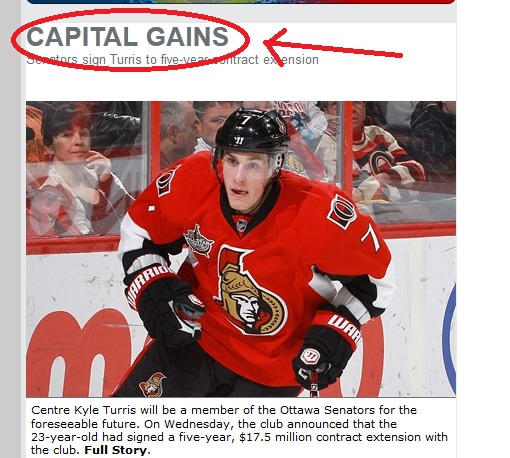
Plenty of interesting interpretations of Kyle Turris’ new deal out there. Maybe predictably, Sens blogs and fans think it’s a steal because the assumption is that he will progress towards the expectations of a third overall pick. If that happens, then the team bought some of Turris’ prime years at what might be a discounted rate. Others take a more measured (read: pessimistic) stance, assume Turris is getting a lot of money and term for not a lot of production, and wonder if Ottawa just threw $17.5MM at a nebulous concept.

Both of these perspectives are valid, of course, and both represent risk for the organization. If you lock him up ahead of time, you hope for value down the road at the risk of the player not reaching their projected performance. If you don’t, you sidestep the risk of an anchor contract, but at the risk that you may have to pay more if the player performs. What I find interesting in all of this is that fans would internalize these two scenarios equally.

I think I’ve said before on this blog that if the Sens are not spending to the cap–even a cap rolled back in the CBA negotiations–then I don’t particularly care if Eugene Melnyk is getting great value for his money. A goal is no more enjoyable if the player scoring it is being paid less for doing so. At least not for me. The only scenario in which I care if an owner is getting value for his money is one in which he intends to spend as much as he is allowed, and the value of his contracts will help the team compete against other cap spenders. But this team, so laden as it is with over-performing rookies, entry-level contracts, and players like Michalek, Karlsson, Alfredsson and Anderson over-delivering value on their contracts, then it I certainly can’t get motivated to anger if a player gets paid because management didn’t have the foresight to predict his performance. If Turris ends up being worth, say $5MM, why would I, as a fan, care that the team has to spend that?

When we talk about the fan experience of watching a hockey game, one factor–money–is abstract, and doesn’t really impact how entertaining the game is. The other–term–isn’t abstract because we watch these players for the years of their contract. It seems logical to me that we should have a greater investment in the quality of the product on the ice than in the owner getting value for his money. These things are related, of course, but less so when you have a team spending so little in any case.

What should terrify fans more is term. If this 23 year old incurs an injury or mental block or simply fails to perform without the motivation of needing a contract for five more years, then it affects me as a fan. Simply put, I’m stunned that this management was willing to give out a contract of that length after such a short audition. Erik Karlsson only got two more years than Turris.

Listen to Melnyk’s interviews and you don’t get the sense that this team is going through a temporary period of low-spending during a rebuild, to be followed, inevitably, by more spending to the cap. Something’s changed. Spending so much money only to have last year’s cheap-o team make the playoffs seems to have really gotten to Melnyk. Now, when he speaks about the team, he talks about it as if it inhabits a permanent state of small market spending, restraint, and patient prospect development. None of this is strange to me. What’s confusing is the attitude of fans (or at least those fans whose opinions I read online) who take some personal pride out of defending this billionaire’s cash. I’m not trying to troll here, Melnyk saved our team from bankruptcy after all. I’m trying to get at the tendency of armchair analysts like myself to look at every deal in terms of value for investment, even when the owner is openly saying he will spend less than he can on payroll and the league is in a bar room brawl over revenue sharing.

I like Turris (though I’ve been rough on the deal that brought him here), and he seems like a good depth player on a team that has a number of quality prospects coming up. And I hope that the team is seeing something in his off-season development that makes five years less of a risk than a one year, wait-and-see deal. But as of now, consider me perplexed.