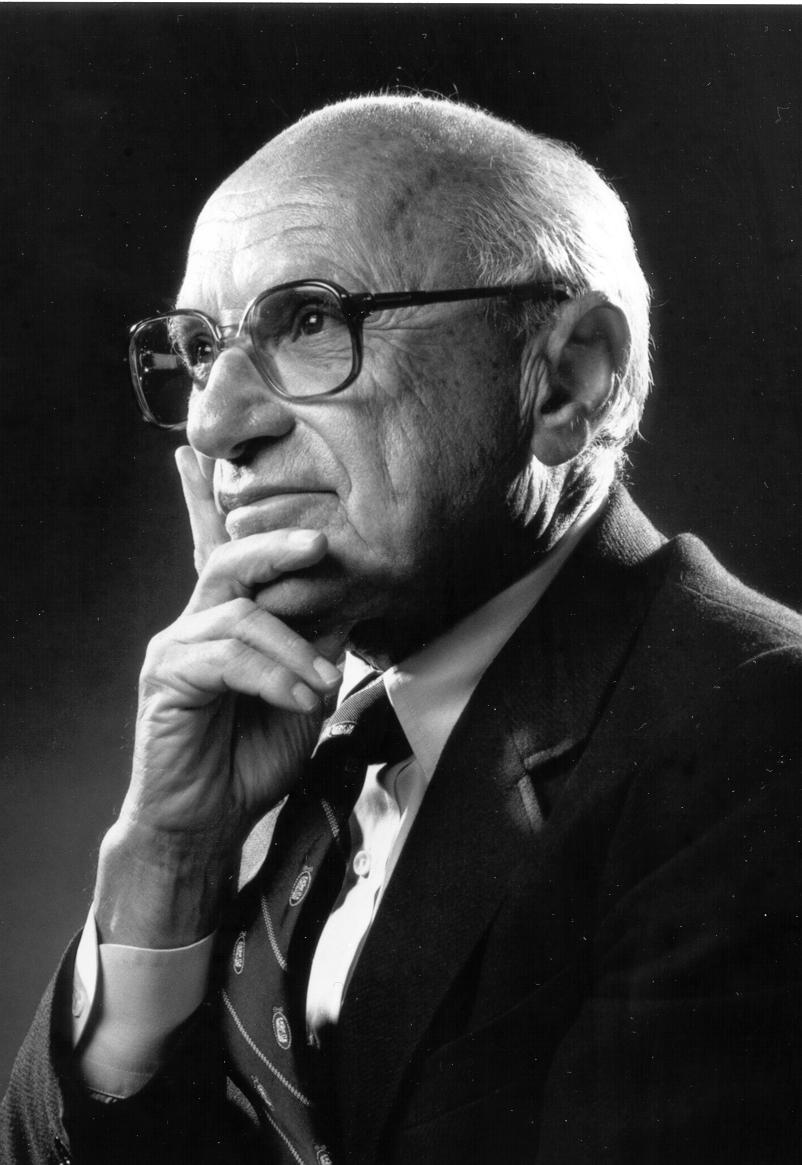
Eugene Melnyk Accepts Honorary Degree from Chicago School of Economics

I’ll say this for the Euge: he never leaves us wanting for something to write about.

This latest interview (excerpts from a larger Citizen interview entitled “Senators poised for financial turnaround”) sees everyone’s favorite pharmaceutical magnate provide some revealing insight into his expectations for the season before the Sens went and surprised everyone. That in itself is worth the short read. It’s satisfying the way most behind-the-scenes documentaries tend to be.

But of course, given the title, the interview also allows Melnyk to revisit some of his favorite tropes about the economic sustainability of franchise ownership. Frankly, I can’t blame him for hammering this notion into the ground – that the Senators are constantly on flimsy financial ground, that they once needed to make it to the second round of the playoffs just to break even, and so on – because part of his responsibility as an owner is to maximize team support. But to see the hockey media in this town trot out these ideas again and again without any rigor or interrogation is starting to rankle.

I’ve written on this blog before about the cognitive dissonance between the assumption that the league is structured to make profit for its franchises and Melnyk’s statements that it is not. He maintains that Ottawa, as a mid-sized market who spent to the cap, couldn’t make it work financially. There’s not much beyond that quote that we know for sure.

We do know that Ottawa is right around the league average in ticket prices and in the top ten in attendance. The profits it receives due to television revenues and sales of merchandise are not public, but I’m making an assumption that as a Canadian market they are, at the very least, average. We know that merchandise sales outside of arena stores are shared around the league. So my confusion remains: if an average club making average revenue can’t break even without consistently being among the best eight teams in the league in terms of performance, how does the NHL even stay in business? Every year NHL revenues are increasing, profit is way up, and yet billionaire owners continue to cry poor about the state of the affairs.

Let’s look at some choice quotes:

On what making the playoffs means from a business perspective: Up until this year, we had to make two rounds of playoffs just to break even. Now we are doing well enough that we break even, pretty much, just finishing off the season and everything else kind of gets bonused out. We still have some hangovers from previous contracts that we’re still obligated to fulfill, at least in payment, but once those are all cleaned up in the next couple of years, things can all come together where the business of hockey actually pays. The cheques start going, hopefully, the other way.

Nothing new here, really. The basic assumption is that this club barely ekes out a living after salaries and hockey related expenses. He says this every time there’s about to be a ticket drive, either for seasons or playoff tickets. What Melnyk doesn’t clarify – and what the Citizen of course doesn’t bother to ask – is how much money Melnyk receives as a byproduct of franchise ownership but that is not hockey related – his overall net profit, in other words. One of the reasons clubs like Phoenix and Atlanta have had so much trouble making money is not only that people don’t go or watch the games on TV. It’s also that the owners don’t or didn’t own the building. If hockey teams eat up a large chunk of operating expenses, that leaves all other events – concerts, family events, whatever – as almost pure profit. Phoenix, on the other hand, pays rent. When you factor in television, merchandise, and tax breaks, it’s hard to believe that Melnyk doesn’t make any profit whatsoever from owning the Ottawa Senators. Forbes noted in 2010 that the club was carrying about $130MM worth of debt, which it’s financing, though I’m assuming this was debt taken on to purchase the team and will return to Melnyk when he sells. I’d still like clarification of if this ‘break-even’ point is actually the point at which hockey revenue, i.e. ticket sales, equals hockey expenses. Because otherwise the whole league is a house of cards.

Finally, not sure if he’s referring to the approximately $2.5MM worth of buy-outs Ottawa is carrying from Emery, Cheechoo and Alfredsson (from when Alfie’s contract was renewed), which are coming off the books this year, or Heatley’s bonus, which was already paid out. Curious that he says, “once those are cleaned up in the next couple of years,” which maybe implies a player currently under contract, but I can’t imagine who that would be. (Gonchar?) In any case, I love that he refers to them as hangovers.

On the Ontario government considering removing a business tax break on sports tickets: It did (take him by surprise), and I think it was very foolish to even attempt something like that, you know because at this point, that would have kind of pushed us over the edge. Forget about deep pockets, it has to survive on its own. And the one way, if you’re going to continue having a franchise within a city, especially what I call a mid-market city like Ottawa, is to be able to be smart in everything you do. And the stupidest thing you could do is something like try to do a tax grab of some sort…

I’m not sure what to say here except that as a person who works in health care in Ontario, who sees what the government’s budget and debt look like and knowing we’re all going to have to tighten our belts due to austerity measures, calling this “stupid” and a “tax grab” is a bit insensitive. It’s certainly tone deaf to the tenor of the political discussion today and the popular notion that everyone should have to give back. You have doctors offering to pay more income tax, and this billionaire sports franchise owner wants to talk about survival? Classy, Euge. Really classy.

As James says, it’s easy to have a soft spot for Euge because he saved the team from bankruptcy (real bankruptcy, under a pre-cap, pre-revenue-sharing ownership without assets). But sometimes he says something that reminds you that he’s a billionaire pharmaceuticals owner. Rexall is doing the same shit in Edmonton by forcing the taxpayers to pay for a new arena. These guys didn’t become rich by accident, and during these moments there’s not much more to say than “go fuck yourself.”

On the economic contribution of the team, versus the cost of the tax credit: If you look at the math of what we contributed (around the All-Star Game), it’s a $150 million we contributed. You look at the world juniors, the other events, the two drafts we brought, the All-Star Game that we brought the (Bell Capital Cup) that we have every year. What the Sens foundation does…

No idea what he’s talking about here. Either he means “contributed” in terms of tax revenue, or in stimulus to the local economy. I assume the latter, given he’s referencing events in Ottawa, but this is where he’s starting to contradict himself. Should we support him as an owner because the team is barely surviving, or because of some half-baked trickle-down theory about how professional sports spurs local economies? (A theory debunked about fifteen ways from Sunday.

It’s a fair argument. I just think if we’re going to “look at the math,” then by all means: let’s look at the math. What are the total revenues, not just direct revenues, as a result of franchise and arena ownership? How much does Melnyk stand to make when he sells the franchise?

On fan initiatives planned for the playoffs: First things first, I don’t want to jinx it, James. We want to get into the playoffs. If we’re in the playoffs and we need fans to come out for those last three games, and scream and make our players believe they are playing at home, we’ve got to start with that. We get sold out anyways. We need them to come out and cheer them on. If we do, yeah, it’s the same thing all over again. It’s playoff fever. Luckily, I was fortunate enough, and you were too, that ’07 playoff fever was rampant and we got to Round 4 and nobody’s ever seen anything like it. Jeez, we were so close, and it’s going to be the same thing all over. I’m sure that Cyril has planned a whole slew of party events, events for kids and things that are going to get this city rocking again (mentions he will be in town Saturday for a skate for underprivileged children).

This I’m including not only because Melnyk affirms that, yes, this team gets “sold out anyway,” (which, again, if you’re a Canadian team selling out every game, how are you struggling?), but also because I want to be fair. It’s such a likeable quote. Ultimately the Senators are a huge part of the community. I grew up in Ottawa, and the ’07 Cup run was one of the proudest moments for the community that I can remember. Melnyk’s right that we’d never seen anything like it. It’s a reminder of just why we care about sports so much: they are, in the end, declarations of our affinity for one another as members of a shared community, be that community a regional entity or a clumsily arranged group of yahoos clustered around a brand, a likeable Swedish guy, and a cartoon gladiator.

Interviews like this remind us that sports may render all of us community members equal. It’s just that some of us are more equal than others.

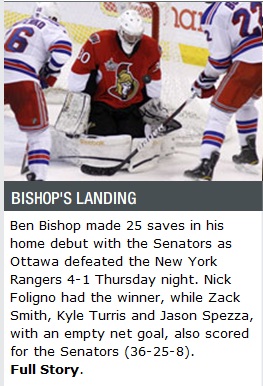
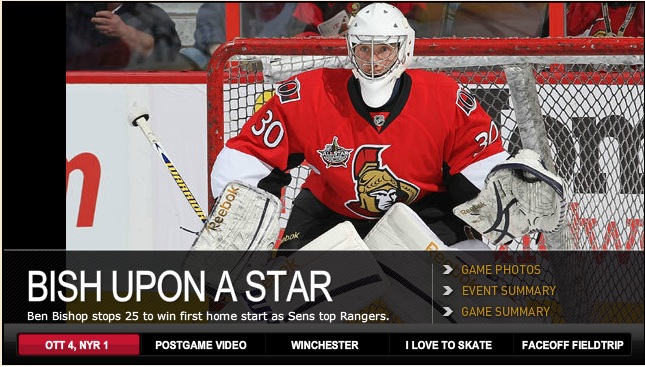
Home ice ain’t home ice at all / What we can learn about Bishop from Turris

A couple of unrelated things percolating in the brain pan after watching the Senators lose 1-0 to New Jersey last night. First is Ottawa’s absolutely pathetic home record, now 19-15-4 compared to 18-12-6 on the road.

This stretch was supposed to be Ottawa’s chance to catch some rest after that Florida road trip, rack up some points, even challenge for the division. Fewer games, most of them on home ice, and against plenty of mediocre teams was an ideal opportunity to lock up a playoff spot. Instead we’ve seen six points out of a possible 12, with Ottawa facing down the (somehow) always-challenging Canadiens, the seemingly unbeatable Penguins, the Jets on the road in the toughest building in the league, and then almost a week off for other teams to catch up before playing on the road in Philly.

Suddenly, the Senators are in a dogfight just to stay alive. Only four points up on eighth in the conference and the Sens’ inability to win games at home has dug them a small hole.

Of course, given what we’ve learned about this year’s Ottawa Senators, they’ll probably waltz right into Philly and win it 4-1. They’ve made a season out of taking games they had no business winning only to promptly lose to the Islanders or Leafs at home. Why on earth the team is so lacklustre at Scotiabank Place is hard to know, though I think it goes back to expectations.

The Senators can win away games with all of the pressure on their opponent, who is “supposed” to win, because the situation lends itself to their fast and loose style of play. Last night’s game, where the team executed sound breakouts and passes, got pucks on net, but then they simply couldn’t get their sticks on the rebound or keep pressure in front of the net. It seemed like a case of gripping the stick a little too tightly. As the game went on, even the most elementary powerplay execution – which they must be practicing non-stop these days – looked completely lost, with passes back to the point sailing all the way back to Bishop to corral. Suddenly, those few simple passes they were pulling off at even strength were flying all over the place with a man advantage.

Maybe the problem with home ice is the same problem that plagues the powerplay – when this team is supposed to have the advantage, it has a brain fart. When it feels fewer expectations, it will surprise you.

You could also see it with all the whining to the refs last night. Karlsson’s arms raised in disbelief, even the usually-Zen Alfredsson looking back for the call. The refs made some weird decisions last night, granted, but when the team is blaming everything else on the ice you can tell they’re hoping something, anything, comes along and resolves their play for them.

Basically I’ve been building all of this up so I could recommend that the team have a pizza party. Relax, guys.

Everyone’s feeling mighty good about Ben Bishop these days. He’s playing lights out, and Bryan Murray must be basking in the accolades. Bishop’s been so impressive he even broke Sports Illustrated’s quasi-moratorium on hockey coverage long enough to be called the best deadline acquisition of the year. (Better than Paul Gaustad for a 1st? Better than…the other…trades that happened?)

I can’t help but think about Turris when he first came over from Phoenix. Those early games were used as all of the evidence we needed that Ottawa won the trade. Now, I’ve long maintained that Murray payed WAY too much for a risky second line center, and even when Turris was looking very serviceable I wasn’t thrilled with the deal. My attitude hasn’t changed, but I’m thinking there’s something we can learn about the early days of a trade.

Even a skeptic like me will admit that Turris came over looking energized. He had something to prove, was enjoying the ice time, or liked playing in a full building for a change. Whatever it was, he didn’t look out of place, developing chemistry with Alfredsson and putting up 13 points in his first 16 games. In the weeks that followed, however, he’s been ice cold. He has six points in his last 25 games.

If Turris doesn’t work out, the team hasn’t bet so much bet on him that they can’t turn it around. He’s an RFA on a very affordable deal. But if David Rundblad becomes even half the player Erik Karlsson is, it’s going to look like a mighty silly deal a year or two from now. It will look like Ottawa traded a high-end puck moving defenseman because they weren’t patient enough with him during a rebuild, when the only luxury you’ve got is patience. I won’t even talk about the draft pick, knowing that half the readership think draft picks are worthless and the other half think they’re the most valuable thing in the world.

So what’s this got to do with Ben Bishop? Well, he’s also a player with some NHL experience, albeit not as much. His organization deemed him expendable. He came to Ottawa with something to prove, energized, whatever. And just like with Turris, we’re prepared to call the trade a win and move on. It’s almost as if, just maybe, we should expect a peak in performance in the early days of a trade.

Now, I do agree with Elliott Friedman’s point that if Ottawa chooses to trade either Bishop or Lehner in the future they’ll get more than their 2nd rounder back for him. And it’s not like Ottawa threw in, say, Mika Zibanejad to get him or anything. I just think this whole “picks to win games now” thing is sort of short sighted. I don’t want to win a few games in March. (Though it would be nice.) I want to see Murray build a contender.

All of this to say that I’m reserving judgement for when Bishop’s played a few more games. He’s working out in the short term, and maybe that’s enough. I’m obviously not in the room with the scouts, and maybe they’re looking at the board and saying “we don’t like anyone in the second round anyway.” But the discussion of whether or not these trades that Murray is pulling off are worth it should never be “in the short term” discussions.

ROUNDTABLE OF DEATH: On the Senator’s penchant for divisional shit-beddery

Varada

Question: why the hell does Ottawa have so much trouble with terrible division rivals? Losing to Buffalo, scraping out a win in back-to-back games against the Habs, and then losing to Toronto. Most of those games are on home ice. (Ottawa’s home record is 19-14-4, by the way, compared to 18-12-6 on the road.) Is it the fact that home games against Montreal and Toronto are basically also road games due to the atmosphere in the building? Are those teams actually not that bad? Where’s the beef?

James

WWWWWWWWWEEEEEEEEEEEELLLLLLLL,

Its a good question this. A pertinent one coming off a stinging loss to hated Toronto. Last game, or as i like to call it “Toronto fans biiiiiiiig special day” getting good and St. Patrick’s Day drunk and watching “their” team…
(Pointless sidebar: What’s that like leafs fans from Ottawa? Cheering for the team of another city that ostensibly hates the city you are both from and live in? I’ve always found it precious, “GOOOOO OTHER CITY!!! BOOO, I HATE MY CITY!!!” Isn’t that the main thing with our silly world of sports? Root root root for the home team? Look, I know it’s because your pappy loves the leafs and you two have stuff to work out and need this but you should have taken your disloyalty to your home to a much more successful place like Detroit…or…almost anywhere else, anyway, looks good on you!)
…play their rival slugging out their 3rd game in 4 nights. It was not one I expected Ottawa to win no matter who they were playing. I’m not making excuses. I’m just being realistic. Ottawa’s a good team but they’re far from elite. It was unlikely they’d win that game at home or on the road.

As for the “atmosphere” hooey people tend to bring up a lot, I hate that it happens but I dont really buy into it. These are professional athletes, when the game is being played I don’t think that the players of either team are effected by it all that much on the ice. That said, Alfie is routinely booed by Toronto fans and tends to play well against them so perhaps that’s motivating for him but by that same token, I dont know if chanting a goalie’s name mockingly really fucks him up. I have my doubts that athletes depend much on the energy of the building to win or lose. I could be wrong but my belief is that it’s mainly fatigue from travel, not sleeping in your own bed and occasionally time zone, probably going out and partying more at night and just generally being out of your routine (something hockey robots thrive on) that makes road games harder to win. But thats not what youre asking is it?
<Pause, takes off fake glasses dramtically>

What youre asking is why Ottawa seems to have trouble winning games where the travel might be minimal or non existent and against a division of familiar teams all of which but one sits above Ottawa in the standings and only tenuously at that! 

First, Boston, well, this team goes without saying. They are the defending champs and despite having Marty Turco and struggling lately are still a very, very serious team for anyone to beat. Tim Thomas is maybe the biggest Sens killer in the league and thinks that his country has gotten away from the ideals of a bunch of slave owners who lived over 4 centuries ago and would not have the slightlest clue how the world currently works. That’s the kind of crazy only a goalie like Robin Lehner can match. So..what was I saying? Oh yeah, fuck that guy on AND off the ice. Boston also plays a pretty boring system that really works effectively against the Sens. Good as they are, Ottawa plays the brewin’s (thats right) what feels like a dozen frigging times a year and really needs to pick up more than one W a season against them. Especially when you consider these two might start dancing in the playoffs regularly. 

Next, Montreal this one is an interesting emergence. Im not too panicked about this one as much as those last two games REALLY sucked to watch on a few levels, I cant really begrudge the boys for taking three of four points from a home and home. Though I think it’s fair that you bring it up as on paper they should have just pummeled the Habs both games. The teams play similar systems which I find typically makes their meetings a dog fight. Also, their goalie is way fucking better than any of ours. I dont want to seem like I’m gushing about him but look at Price’s numbers in comparison to their putrid place in the standings. I think without that guy they’d practically be the Blue Jackets. Price tends to play lights out against the Sens and it sucks for all of us.

Buffalo, yeh, Ottawa’s lost a couple to them recently…this is just the cosmic ballet of life. I really don’t find Ottawa has all that much trouble beating them overall as the Sabres continue to be bullshit. 😉

Finally, Toronto. I dont know. What is it with Toronto? With the exception of like what? 4 players on the team the Sens roster has nearly compleley turned over since their playoff days practically a decade ago. Toronto has seen a complete changing of the guard b/c Brian Burke has had to reboot the team like twice since taking over. It’s called, “killing it, bro.” So is there bad juju at work? If you believe in it I guess this would be the place for it. Cant blame the shitty schedule on the struggles they have had against them including last game where Ottawa nearly doubled the leafs in shots and even saw an own goal form one of their best players. WTMF.

For me, the answer to the Toronto question is the same one I have for a lot of perplexing losses Ottawa has suffered at the hands of lesser teams this season. It is that this team is hard working and really fun to watch but their performance in situations where a lot is on the line show they are still young as a group. I’ve noticed the boys seem to be able to do shit like roll into HP Pavilion and beat the Sharks, dummy the Caps on the road, basically own the Rangers all season but they arent expected to win those games. They play a loose but gritty game and maximize their run and gun style and creep creep on teams a lot. As soon as a game is a total “must-win” they can look like a shell of the team that can hold their own with the best. I dont think it’s that they arent getting up for big 4 point games against division rivals so much as maybe the team is not yet confident enough to play on their freewheeling style when big things are on the line.

Jah willing, when the Sens can smoosh the teams below them in the division on a consistent basis we will know that the rebuild is further along and we can start getting ready for some very, very exciting hockey. Right now its a bit early to panic too much as we are still in a phase where Ottawa’s strong season is an “unexpected pleasant surprise.”

Varada

Yeah, I also wonder about the atmosphere at games, and agree that it’s mostly a fan fixation. Unless we’re talking those playoff-mad atmospheres where it’s probably going to shock Kyle I Used to Play for the Coyotes Turris a little and either psyche him up or scare the shit out of him.
 
I think there’s also something to be said for the demographics at certain games. I’ve been to a million Sens games where even sitting in the third deck I’m next to a family of fourteen out for Lil’ Jimbo’s birthday party. It’s like a 67s game half the time. Then you go to a game against the Leafs (or at the ACC, which I’ve done a couple of times) and it’s all middle aged angry men with a shit ton of money, a nice suit, and a complex about how the central brand in their life has been awful for as long as they’ve been alive. For that reason and that reason alone I never go to see Leafs or Habs games at Scotiabank Place. Pay twice the ticket price to completely lose sight of the fact that it’s hockey? No thanks! I sort of think of the higher prices to those games as Idiot Tax – let the other fan bases subsidize our team.
 
Bruins have the Sens’ number, but then their record indicates that they have a lot of teams’ numbers. Against Toronto there’s always an excuse, but they are somewhat valid. This year it’s that Ottawa only plays Toronto on the second of back-to-back nights, which is surreal. Montreal just seems to find a way against Montreal, most recently a sudden supernatural ability to block shots. (Though part of me wonders if having Andrei Markov back in the lineup helps. Even if he isn’t scoring, you have to adjust your whole gameplan with him on the ice. I think the Habs’ season would have been a different story with him around this year. As would have been my fantasy team’s.)
 
Oh, I forgot to ask: what is with Ottawa’s complete inability to win games when featured on Hockey Night in Canada? It seems like they only lose embarassingly when it’s a Saturday night against the Leafs and the whole country is watching. I wish there was a record somewhere of Ottawa’s record during nationally televised games. I bet even if you removed all those early years when the team was record-breakingly bad, you’d still have a losing record.
 
I actually completely forgot about the Sabres. Which makes sense.

Totally agree about expectations and the team’s playing style. I’m hoping someone on the Senators’ brass recognizes this and the night before their first playoff game against the Bruins wanders into the dressing room all drunk, collar open, like “Issh the end of the world boyysssss. Drink up iffu gottem!” and the team just loosens up and is like, “You know, we play hockey for a living. How awesome is that? Have fun out there!” and then they accidentially win the series in six.

Introducing CBA Appreciation

At the termination of the 2011-2012 NHL season, the NHL and NHLPA will begin negotiations on a new Collective Bargaining Agreement. In an attempt to demonstrate some appreciation for the old CBA, which we have come to know and love since it was birthed in 2005, we’ll randomly take some passage from the 472 page document and paste it here without commentary or analysis.

Thank you, CBA. You made all of our dreams come true.

14.6 Spousal Airfare.

(a) A Player’s spouse (or Living Companion) and children will be entitled to a round-trip economy class flight between the city from which the Player was Assigned and the city to which he was Assigned, or

(b) In the alternative, and in the event the Player intends to relocate his family to the city to which he was Assigned, the Player’s spouse (or Living Companion) and children will be entitled to a round-trip economy class flight between the city from which the Player was Assigned and the city to which he was Assigned for the specific purpose of searching for suitable housing in the new Club’s city, and shall also be entitled to oneway economy class airfare for the purpose of actually relocating from the city from which he was Assigned to his new Club’s city.

Read the CBA here.

Why the Toronto Maple Leafs are Bordering on Greek Tragedy

CORRECTION: Ron Wilson was hired by Cliff Fletcher, not Brian Burke. Thanks to reader Kartik Subramani for the correction.

In his book The Game, Ken Dryen wrote: “As players, they have been in the hands of their owner, and in the hands of the owner’s general manager, his scouts and coaches. Depending on them to draft the right players, to make the right trades, to give them a chance to do what they were good enough to do, and they have been badly let down. The tragedy is that what they had has been squandered and is now gone, with so little to show for it.” 

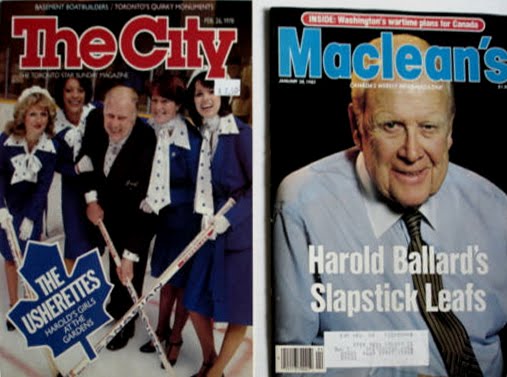
In this, Dryden was speaking about the 1979 Toronto Maple Leafs, playing in the shadow of owner Harold Ballard’s blinkered micromanagement. Key players were traded for middling returns. Prospect development was unheard of. Yes men abounded. The Leafs, located then and forevermore at the Center of the Hockey Universe, were subject to the whims of a tyrannical egotism that sucked air from the lungs of the franchise. Dryden suggests that this was particularly heartbreaking to see in 1979, contrasted with the fast-fading glories of the 1967 Stanley Cup winning team.

Over the 33 years since, this identity has hardened. That The Maple Leafs are losers is only more evidence of their status as underdog whose struggle is a nobler struggle: that of the blue collar worker against the capricious and unfair nature of the sport, i.e. the world. The team has been awful forever, but that awfulness has taken on a kind of perseverance in the face of utter pointlessness. All forms of team development swim against the current of this romantic undertow.

What strikes me most about Dryden’s description is his equation of wasted talents with “tragedy.” Dryden’s book, still a lonely, existential examination in contrast to the often saccharine standard that can be long-form hockey writing, lamented what could only be described as the injustice of seeing something so fiercely meaningful debased by incompetence and greed. Sittler and MacDonald wasted away on those mediocre teams, shades of the men they might have been in Montreal, Chicago, or Boston. Dryden lends pathos to those men, admitting that if hockey can be a lonely game while you play for a dynasty, then it is an unimaginable curse when played with a team that is not only underperforming, but culturally stagnant.

There are similarities between this Ballardian intractability and the current General Manager of the Toronto Maple Leafs, Brian Burke, who finds his team on the cusp of missing the playoffs for an incredible seventh straight season and 45 years from their last championship. Put a more diplomatic way, the differences between Ballard and Burke are differences of degrees. Both men adhere to binding principles that override all objective measures of hockey development. Both men cast themselves as defenders of the hockey faith against the inevitable dilution of the sport’s essence. And both men are responsible for some terrible hockey teams.

Their similarities tell us something about the central identity of a storied club that is paradoxically harmful to that club’s ability to win hockey games. It also says something valuable about the long, cold look in the mirror that the Toronto Maple Leafs must take before they can return to contention, and just how fundamental, even philosophical that overhaul must be. It’s no longer a matter of getting a high draft pick (though that would help). The Toronto Maple Leafs need to stop worshipping the romantic notion of the Toronto Maple Leafs.

It’s time for the Maple Leafs to allow humility into their lives.

In a salary capped league, where the notion of ‘parity’ abounds, there are plenty of mediocre clubs. What denigrates the Toronto Maple Leafs’ situation from merely unfortunate to the stuff of Greek tragedy is how intertwined their history has become with that sense of lost opportunity. A rebuild is a very difficult thing to embrace, particularly in a hockey market as rabid as Toronto’s. Ownership must be convinced to swallow the loss of revenue (which, in Toronto’s case, will never be an actual ‘loss’ so much as ‘lower profit than what’s possible’). The media needs to be convinced of the process so they don’t sour the fan base with their editorials, ubiquitous coverage and speculation. And finally, the fan base needs to be on board so as to not damage the brand too badly.

Prior to Brian Burke’s arrival, Toronto’s ownership and management had taken these difficult steps. General Manager John Ferguson Jr. was dismissed, and an interim General Manager—respected, old-school personality Cliff Fletcher, the “Silver Fox”—was appointed, with particular emphasis placed on the word ‘interim.’ Fletcher would be empowered to make the hard decisions, but didn’t have to worry about being liked. He knew his way to the exit already. He could be the bad guy.

In those early years of the rebuild, Fletcher sold off what veterans he could (largely hampered by No Trade clauses, the most famous of which belonged to Mats Sundin), bought out a few, traded up in the draft to pick promising defenseman Luke Schenn in the top-five, and traded for top line center Mikhail Grabovski (recently re-signed by Burke). In his short time as Toronto’s GM, Fletcher laid the foundation for a future team that was never to emerge. The rebuild would be difficult, but the hardest of those first steps had been taken. Most importantly, the Maple Leafs and their management began to look at their roster through a cold, utilitarian lens rather than with the blue-and-white colored glasses.

In 2008 Brian Burke came to the Toronto Maple Leafs from the Anaheim Ducks with all of the respect afforded an unstoppable force. While managing the Vancouver Canucks Burke had displayed an undeniable will, moving mountains to draft twin Swedes Henrik and Daniel Sedin side-by-side in the first round. (An act having about it certain masterpiece qualities in the art form of General Managing.) Burke convinced Hall of Fame defenseman Scott Neidermayer to join his brother Rob in Anaheim, where Scott made up one half of an unstoppable top defensive pairing with Chris Pronger that helped the Ducks to win the Cup in 2007. Burke demonstrated again and again that if inheriting a team whose fundamental building blocks were in place, he could do what was necessary to get them over the hump.

In Toronto, he would sign the most lucrative contract in the league for a General Manager. Fletcher was given a role as an advisor in the organization. And with his arrival, Burke once again gave the franchise an identity of inescapable gravity. The Toronto Maple Leafs as we had always known them—defiant, romantic, never compromising—were back. For better or worse.

In his almost five years since assuming the General Manager position, Burke has done everything in his power to resist the notion of a traditional rebuild, as if the sole missing factor in the equation for success is for the team to understand what Burke understands. It’s this fact, and the cyclical history it implies, that makes the Maple Leafs’ situation particularly tragic.

Burke appointed his good friend Ron Wilson as coach, Burke only recently assented to firing his good friend, the Fletcher-appointed Ron Wilson, despite the team having only one winning (non-playoff) season in four years. Wilson was replaced with Burke’s other good friend, ex-Anaheim coach Randy Carlyle. In the middle of another lost season (albeit at a time when the Leafs still clung to a playoff spot), Burke awarded Wilson a one-year contract, admitting it was less about security than danger pay in the event that he might have to fire Wilson. At no point did the awful results of the previous seasons seem to factor in.

In his first year with the team, with the Leafs floundering and the playoffs out of reach, Burke picked up veteran goalie Martin Gerber on waivers. Gerber, his career on the line and with something to prove, led the team from what would have been a draft lottery pick to seventh last overall, where they drafted promising but second-tier Nazem Kadri.

Most controversially, Burke obtained the talented but unpopular scorer Phil Kessel from division rival Boston Bruins for a king’s ransom of two first round picks and a second round pick—less than he would have been required to pay if he had used an Offer Sheet, a tactic which Burke objects to on moral grounds—in a move that spurns the cheap Entry Level Contracts on which rebuilders thrive. Burke promptly signed the winger to a deal paying him over $5MM a season. The Maple Leafs finished second and ninth last in the league in the next two years to hand Boston—the defending champions no less—two foundational players in Tyler Seguin and Dougie Hamilton.

Burke has traded and overpaid for players like Dion Phaneuf and Colby Armstrong, known for playing with an edge but far from their prime. In many of his transactions Burke has been saved from disaster only by the missteps of the GMs with whom he was dealing, those few other lost souls like Calgary’s now-dismissed Daryl Sutter, beleaguered too by his own inability to adapt to the game.

As the language of the game has changed to capture diminishing margins of advantage—CORSI, Fenwick, QualComp—Burke has remained steadfast. Appearing with tie draped, untied around his neck, he isn’t embarrassed to express himself in terms like “truculence.” He calls a press conference to lament the diminished role of the enforcer in a game that he perceives to have lost its sense of honor. This is the man, after all, who challenged a ex-Oilers GM Kevin Lowe to a fistfight in a rented barn, and then later spoke about it as frankly as one would any natural path to conflict resolution.

Burke has announced in turn, and with characteristic publicity, his position on a number of ‘vital’ issues: front-loaded contracts, offer sheets, roster freezes before trade deadlines, how “the rats are taking over” the sport, and most persistently how Toronto should never build through the draft. Ever more puzzling, the practices to which he takes umbrage are not only enshrined in the Collective Bargaining Agreement, but embodied by a league-wide shift in the game. In this, Brian Burke’s principles automatically place his club at a disadvantage. And as during the Ballard years, Burke’s inflexibility provides more fuel for the “us-against-the-world” fire, solidifying the team’s conviction that it need only will itself to victory in a world where will is quantified and tallied on other team’s scouting reports.

On these and many other issues Burke is cast as the only good man in an immoral, dehumanized league. Like his closest comparable, Don Cherry (with whom he only naturally began to spar in the media recently), Burke’ authenticity makes him likeable. It validates what for many of us is our sense that the sport, so full of complexities and occasional crushing disappointments, was indeed better before, in some halcyon past, where all we remember, conveniently, are the victories.

I’m certainly not above liking Brian Burke. I don’t doubt the sincerity of his morals, or that they can be employed for enormous good. His stance on gay rights in hockey is not only admirable but essential, and an example to the rest of the sports leagues. But when it comes to building hockey teams, his morals just happen to be misplaced. Burke’s stance on gay rights demonstrates that he’s capable of change, of questioning his principles and changing his mind, doing what’s right for the greater good. Those no reason why he can’t do the same during the far less loaded discussion of whether or not the team should retain draft picks or fire an ineffective coach. 

The Leafs are already wildly profitable, a 79.5% stake in them having recently sold for an insane $1.32 billion, a number so big that it took two rival behemoth telecoms carriers partnering up to buy it. But a winning team in Toronto would not only be good for Toronto, and for Canada, but the league and the sport all over the world. Were Toronto to find itself in the playoffs and actually winning a game, the city would be exactly the place you would want to be. Interest begets interest.

Toronto is so far beyond the notion of “not buying tickets to send a message” that the decisions made in board rooms and managers’ offices take on the qualities of royal decrees. Their decisions take place in a vacuum without ramifications, where intense privilege allows those with power to humor abstract principles for diminishing returns.

The unique tragedy of the Toronto Maple Leafs is not that they are a mediocre team. They are not, like Columbus, Long Island, or Edmonton, in a perpetual state of rebuild, needing only to refine their development of top prospects and pair it with smart contracts given to key veterans. Watching the Leafs’ frequent pre-game ceremonies, which are arduously long and self-congratulatory, it becomes apparent that the Toronto Maple Leafs are on an island of their own making, adhering to values all their own, winning their own game but no one else’s. They are in purgatory.

On my desire to piss all over everything

These are exciting times for our Ottawa Senators: in a playoff spot despite spending less money on player salaries than my friends’ ball hockey team does on t-shirts. Jason Spezza and Erik Karlsson legitimate contenders for league MVP. A brash young net minder ready to win some games and run for mayor, though not necessarily in that order. What’s more, Ottawa has more prospects projected to be top six players than they’ve had, well, pretty much ever.

Here’s the thing: 1) a rebuild that delivers a solid window of contention requires more than one great draft, because most draft picks never work out, and 2) there are fates worse than being a truly terrible team. Just ask the Toronto Maple Leafs.

The danger with prospects is that before they ever make it to the NHL we have a tendency to look at them exclusively through the lens of their potential. What’s their upside? Their absolute ceiling? Somewhere in there the most likely scenario for their development is lost. In the rush of enthusiasm, players and, I think, management, would rather put all their chips on black and fantasize about the big win.

Mika Zibanejad projects as a really great top six player. By that I mean a 20 goal scorer with a solid two-way game and some edge. He has upside, sure, but he slots in best as a complimentary player. In other words, Jason Spezza he’s not.

Ditto for Stefan Noesen. Murray clearly saw something in this kid that others didn’t, as he used a mid-to-late round first on him when he was projected to go in the second round. And he’s having a really nice season with the Plymouth Whalers. But again, he’s a Mike Fisher type. We’ll love him, but he’s not single-handedly winning us any games.

Matt Puempel is a different type of player, a pure scorer, but he’s had terrible concussion problems while playing for the Pete’s. He’s either going to score a lot of goals in the NHL or never make it there.

Then there are your prospects who project as third liners, like Jakob Silfverberg and Andre Petersson. You need guys like this, but we’re talking Nick Foligno types who will spend their time in Ottawa on the edge of top six duty.

Finally, you have your one dimensional players. Mark Stone has proven he can dominate lesser leagues but I’m skeptical can transition a power forward game to the NHL while lacking skating and size. I think Nikita Filatov plays on the moon these days.

Don’t get me wrong: together, these are the types of players that make up the heart and soul of a team, and I’m thrilled to have them. They constitute the kind of depth Ottawa’s lacked forever. But they aren’t cornerstones to build a championship around. With Ottawa unable to attract top end free agent talent, or rightly disinterested in going after the Brad Richards style contracts, you’re left with something of a nightmare scenario: a team forever on the bubble, hoping to sneak into the playoffs and go on a run, and years from being able to launch another rebuild.

This becomes especially easy to imagine when you see Spezza and Michalek exiting their peak years, Alfredsson retired, Phillips in the third year of his puzzling contract, and so on.

A rebuild is something that comes along once in a decade or so, and you have to get it right if you want to win a cup. We’ve got a team worthy of our support as fans, who are fun to watch and completely likeable. But I fear that Ottawa didn’t move themselves any closer to the ultimate goal of winning a cup.

I’ll be as excited as the next guy when this team lines up for puck drop in game one of the playoffs this year. I listened to a Leafs podcast the other day and you should hear them talk about their team about to miss the seventh straight year of playoffs. At this point they’d probably give up five first round picks just to experience some playoff hockey, even if they get swept. It’s a good time to be a Sens fan. But I can’t help but think that last year’s sell-off didn’t go far enough, or didn’t extend to this year, and we cashed it all in for one Butch Cassidy and the Sundance Kid moment in the first round of the playoffs. (The Bolivian Army will be played by the Boston Bruins.)

It’s hard to think this way when the team is so much fun to watch. Let me put it another way: if in the depths of last year, when the team didn’t win a game in February, if I had asked you if you would prefer a prospect like Nail Yakupov or a free pass to the first round to roll the dice with this lineup against whoever you met, what would you say?

Robin Lehner is just what Ottawa needs: crazy

Just read an interesting article about Robin Lehner wherein questions about his attitude and maturity were raised, and couldn’t help but think that it said more about Ottawa and the types of players it prefers than anything about the 21 year old netminder.

James has raised an interesting point in the past: when you look at effective goaltenders, they do seem to be a little bit unconventional (to put it diplomatically) and certainly intensely competitive. Some of the best goaltenders in the league are plagued by off-ice issues from substance abuse to public spats with management and the fanbase to alienation of teammates. Patrick Roy, Ed Belfour, Dominik Hasek, Tim Thomas even Miikka Kiprusoff – some of the league’s best seem like some of the hardest to engage with in a civilized dialogue. Ilya Bryzgalov, Ken Dryden and Jonas Hiller seem at least quirky and unconventional. It’s as if goaltenders stand in direct contradiction to the bland cliches to which we’ve becomed accustomed in post-game interviews. And this bears out when you remember that Ottawa’s best goaltending came from Ray Emery.

The point being that maybe there’s a direct relationship between an unconventional personality and being very good at standing in front of 85mph slapshots. It’s not a constant; it’s just not always a bad thing. Maybe it’s why we see so many goaltenders simply isolated from media rather than banished to another league, and why we have different expectations of goaltenders than we do of forwards.

What I suspect is that Ottawa likes its players a bit vanilla. Even though it’s one of the biggest teams in the league, and features players like Chris Neil and Zenon Konoptka (who is tied for the league lead in fighting majors) I couldn’t imagine Ottawa taking on players like, say, Steve Ott or Brendan Morrow. Opinionated, cocky, confident: Dallas has an entirely different culture in their dressing room than Ottawa. And I wonder how much of that has to do with the media and the fans.

Which is why I’m wary of our boilerplate tendencies to insist that a goaltender’s weirdness is a kink in his game to be ironed out. When Robin Lehner publicly disagrees with being sent down to the AHL, when he says he’s going to “hunt” Craig Anderson, even when he Tweets “;)”, questions arise about a supposed sense of entitlement.

My question is: how on earth are these things considered detrimental to a goalie’s game? There is a universal rule in sports that so long as you keep winning you can basically be an awful person and everyone will look the other way. But beyond that: what’s wrong with having a cog in the team’s machine that is skewed a little sideways, especially at such a game-changing position? We have our soft-spoken nice guy representatives in Alfie, Spezza, Phillips, Gonchar, Kuba, and a handful of young guys who are enthusiastic but well-versed in the necessity to say absolutely nothing in interviews. Ottawa needs a little bit of color.

We all thought it was awesome when Emery was smiling like a madman during that Buffalo brawl (during which plenty of Sens players stood around a did nothing), and we exiled him for the same tendencies only months later. He seemed to tap into that same well of resolve when he went through an extremely arduous hip procedure and made an improbable return to the NHL. What keeps him from seeming like an easy guy is what keeps him in the game.

Let’s hope we continue to see Lehner’s intensity (Lehntensity?) as an advantage rather than something that needs to be wrung from his personality. The goalie graveyard is littered with nice guys. Ottawa isn’t taking anyone by surprise anymore; on the first day of the playoffs they’re going to meet an absolutely determined higher seed who has studied and practiced for the sole intention of destroying the Senators in as few games as possible. There are going to be games where we’ll need a cocky, entitled, player to put the team on his back and will them to victory.