Jared Cowen: A Retrospective

Jared Cowen and I have had some fun over the years. Let’s take a look back.

——————————

——————————

——————————

——————————

——————————

——————————

——————————

——————————

——————————

——————————

——————————

——————————

——————————

——————————

——————————

——————————

——————————

——————————

Goodbye, Gentle Giant.

Your Model Sucks

20160125_151812

No Fancy Stats argument is actually about stats. A statistic is a number that (theoretically) represents reality, and you can’t argue about reality1. Mark Borowiecki has a 5-on-5 score-adjusted CF% of 44% this season. Can’t argue with that. Patrick Wiercioch has 3 points this season and Erik Karlsson’s got 51 points this season. Can’t argue with that.

Analytics arguments are actually (#ACTUALLY) dissecting what these numbers mean in terms of player evaluation and future performance. These are questions without easy answers2 and really more about one’s philosophy and biases than they are about actual mathematics. This is why participants in a #fancystats argument mostly end up sounding like 3rd year undergraduates trying to nail the 5% class participation mark. This isn’t math class, it’s philosophy class.3

All this to say I’m not here to talk about stats. I’m here to talk about models, which are like stats only worse. Let me explain…

Ed note: This post is about to get wild nerdy. I don’t know how to prevent this. Turns out one can’t talk about their personal philosophy of phenomenological modelling without sounding like a huge dork. So it goes.

In a perfect world, you would describe and make predictions about all physical phenomena by applying the prescribed laws. Physicists love doing this. Physicists write down some laws, solve some differential equations, and boom there’s General Relativity. Very few things ever work out this nicely. Most things worth studying contain too many moving parts to accommodate well-defined system behaviour. The real world is messy. This is where models come in.

A model takes inputs, does math to the inputs (to use the technical term), and then spits out an an output that looks hopefully looks like reality. A good model should help us make inferences about the relationship between Things. However, and this is very important to always bear in mind, just because a model looks like reality does not mean that it is necessarily a good stand-in for reality. This is the origin of the expression from the statistician George Box, “All models are wrong, some models are useful.

Which brings me back to the intentionally inflammatory title of this post: your model sucks. It does. It is in the very nature of modelling that a model is an imperfect representation of reality. Therefore, if a model is to be taken seriously, I believe that the ways in which it is imperfect must be both qualitatively and quantitatively stated (and if your default position is to say “It’s just because of variance”, I will personally wish for you to be haunted until the end of your days by the ghost of Ludwig Boltzmann.)

There is another philosophical question that must be answered, which is “What is this model for?”. Is it meant to be a descriptive model (and if so, why is it necessarily better than examining raw inputs?), or is it a predictive/evaluative model (and if so, just how predictive is it?). There’s a couple of models floating around out here, and it’s not always clear what supposed to be for.

Let’s look at the much-ballyhooed dCorsi. From Stephen Burtch’s post, “dCorsi represents the unexplained residual portion of Corsi results observed for a given skater in a given season.” which is to say it’s the difference between The Fancy Model and Reality. Even if dCorsi is repeatable (its year-over-year R-squared is about 0.15), all that would really mean is that the model is wrong in some consistent ways, which I would find worrying if it was my job to apply the model. I would rather just use dCorsi as a way to quantify the error bars on the model outputs. I think it’s difficult to properly use something like dCorsi as an evaluative tool when it is literally just an expression of what you don’t know.

Then there is this:

In general I feel like weird results such as this, where Brad Marchand has a Goals Above Replacement per 60 that is 50% higher than Patrick Kane, or where John Tavares and Jack Eichel have worse dCorsis than Zac Rinaldo really say much more about the model in question than they do about the player being modeled. It’s tough for me to read this post without coming away with the impression that the values from this Expected Goal model should have some big goddamn error bars on them. Merely posting something that basically says “Aaaaaaay, look how much better Brad Marchand is than Patrick Kane.” is slightly absurd because Brad Marchand is not a better hockey player than Patrick Kane. If anything, this tweet is best understood as an illustration of how much work on these types of models still need to be done4.

Not every deep truth about sports has to be couched in some sort of Gladwellian counter-intuition. Sometimes your model just sucks. I need to know why and by how much if I’m ever going to use it.

1. Ok just work with me on this one.

2. Don’t @ me.

3. Good example: Do secondary assists matter? Answer: it depends! Speaking of secondary assists, we here at Welcome to your Karlsson Years dot com would like to bestow the Lifetime Achievement Award in Petty Hating to Tyler Dellow for his 2012 piece (which sadly no longer exists on the internet) in which he examined every single one of Erik Karlsson’s assists in an attempt to de-legitimize EK’s point totals. You did it, boo! (You can read Travis Yost’s response here.)

4. I believe Zack Lowe’s amazing piece on the Toronto Raptors’ player tracking department is an excellent indication of how much more data (i.e. a ludicrous amount of data) modelers will need before useful models can be created for hockey. Until then, I’ll settle for some big ol’ error bars on this stuff.

Your Half-Assed Guide to Improving the Defense at Discount Prices

I went on a brief but fun Twitter rant yesterday after spending several minutes thinking about the state of Ottawa’s blue line in the context of the rest of the league. Only once I had finished screaming into the ether did I realize that I’d missed a prime opportunity to create content, and though I hate repeating myself, I don’t hate it as much as I enjoy listening to myself talk.

So in case you missed it, here’s some ideas about how to improve Ottawa’s defense at discount prices.

I will begin by stating the following facts:

1. Ottawa’s problems on the blue line are in no way unique. As much as we’ve been blessed with many “Are the Sens wasting Erik Karlsson’s prime?” pieces over the past months, there are other teams such as the New York Rangers and Edmonton Oilers who should be striving to improve their defense before their high-end talent loses their fastballs.

2. Even though there is no shortage of need, player movement is at an all-time low. The Rob Scuderi for Trevor Daley trade was nothing more than a replacement level player for a less-than-replacement level player. Similarly, Luke Schenn’s inclusion in the Vincent Lecavalier deal wasn’t the domino that needed to fall in order to really open up the trade market. Even as Seth Jones was traded hours after Schenn, the asking price on that deal was prohibitively high. If you didn’t have a highly skilled and slightly disgruntled star forward kicking around, that deal was never going to come off. In short, it is a seller’s market.

3. It isn’t easy to improve your defense. Everyone would do it if it were easy.

4. Ottawa really only needs a 3-4 defenseman who is solid, and reasonably priced. Of course, those types of players are really rare and valuable so good luck trying get one away from any other team.

Since Ottawa’s never going to be able to get a Hamonic or a De Haan or a Shattenkirk (Ed note: gotta hear both sides) or a Hjalmarsson or a Tanev or a Boychuk or An Established 2nd Pairing Player without paying a prohibitively high price, I suggest they do what they did when they acquired Marc Methot: trade for a player who is currently being used in a 3rd pairing role who may be able to be used in a 2nd pairing role. “Exploiting market inefficiencies” has hardly been considered a revolutionary strategy ever since that Moneyball movie got made, but in this case it may really be the only way for Ottawa to make something meaningful happen without selling the farm.

In order to find players who might fit this criteria, I went on war-on-ice.com and sorted players with more than 300 minutes played this season by their relative Corsi% (Relative Corsi % is a player’s on-ice Corsi % subtracted from their team’s Corsi %. It is a measure of how much better a player’s possession numbers are than the rest of the player’s team.) and looked for players whose time-on-ice per game indicated that they are currently being used in a 3rd pairing role.

For your consideration:

Eric Gelinas

Do you like Patrick Wiercioch? Well allow me to introduce you to New Jersey’s Patrick Wiercioch! Despite his apparently excellent possession numbers, Gelinas has seen his ice time reduced every season since his rookie season and has found himself a healthy scratch of late. (Is his being a healthy scratch related to his 96.6% PDO? I’ll let you decide!) A former 2nd round draft pick, the 6-4, 210 pound Gelinas does not lack for physical tools, but is considered weak in his own end and HOLY SHIT THIS GUY IS LITERALLY PATRICK WIERCIOCH. Just when you think it couldn’t get any more lit, you find out that Gelinas is from Vanier and oh my god I need to take a moment to fan myself.

Ok, I’ve  actually changed my mind on this one. Let’s put a pin in this and decide what to do with Actual Patrick Wiercioch before trying to acquire Another Patrick Wiercioch.

Jakub Kindl

Ottawa may not even have to make a trade to acquire Kindl as his name is already being used in the same sentence as “waivers” on some corners of the internet. Kindl’s possession numbers have been consistently good for the past several seasons, but he has found his GF% tank this season. Is this related to his 98.8% PDO? I’ll let you decide!

Kindl is owed $2.5MM this year and $3.0MM next year, so his contract likely could not be absorbed by the Senators without there being some sort of money-in-money-out trade. If only there were some obvious candidate for such a thing…

Brandon Davidson

The problem with Brandon Davidson is that it might be too late to get him for cheap; Edmonton may already know he’s good. Davidson’s been getting more 1st and 2nd pairing time than 3rd pairing time of late which makes sense as finding a good defenseman on the Oilers is a discovery analogous to finding water on Mars. That said, it’s not like we don’t know that Peter Chiarelli is prone to dumb trades. My proposal? Yakupov and Davidson for Cody Ceci. Call me, Peter!

The Wisdom

The good thing about these players is that they are young and on cheap contracts (a thing Ottawa likes). In addition, Davidson and Gelinas will be RFAs at the conclusion of their contracts. Positives abound.

I would never advocate making a trade merely because The Corsis said so, but if Ottawa was going to scout some players to try to find some value, these guys would be where I’d start.

F**k Cancer (and Some Other Things While We’re At It)

Everything that’s happened with respect to Mikael Wikstrand and his relationship with the Ottawa Senators organization has left me with a palpable unease.

When Wikstrand bailed on training camp without even leaving a goodbye note in September, it painted a picture of a young man who felt strongly that playing hockey in North America was not what was good for him as a person at that time. Details were sparse initially, but eventually Wikstrand tweeted that he left Ottawa to be with a seriously ill family member. The Senators responded by suspending Wikstrand and denying him permission to play in the Swedish Elite League.

Roughly a month later, Wikstrand revealed that his brother was suffering from leukemia and that he wanted to spend as much time with him and the rest of his family. Bryan Murray and the Senators for their part said that Wikstrand’s status was unchanged, and Murray also chose to parse the particulars of the difference between being 3 hours away and being 8 hours away.

The latest development from today is that we got some more comments from Randy Lee reiterating that nothing has changed, while also casually dropping words like “contract” and “signing bonus”.

I think that it’s perfectly reasonable that Mikael Wikstrand would decide that the needs of Mikael Wikstrand the Person are more important than the needs of Mikael Wikstrand the Athlete. The Senators, for their part, have been very upfront that they wanted Mikael Wikstrand the Athlete playing in North America this season.

Should the athlete and the person be treated as separate? It’s certainly been proven possible to do what’s best for both at the same time. Within the Ottawa organization, Bryan Murray has talked about how he traded Mike Fisher specifically to Nashville because that was what was best for the person and for the athlete. More recently, Travis Hamonic has requested that he be traded to the Western Conference for personal reasons, and the New York Islanders are actively trying to accommodate this request. In situations where a player’s personal and professional life overlap, finding a compromise between a player and team can be done, and is certainly possible in this case.

What gives me pause is that Mikael Wikstrand is still at the point of his career where he is considered an investment. The Senators have invested scouting resources and financial resources in him, and it will still be a couple of seasons until the club has a chance of seeing those investments recouped. In the case of the Fisher trade, the Senators received something in return. By having Wikstrand play and develop in a weak league, the Senators receive very little except increased risk.

I do not feel strongly that the Senators should allow Mikael Wikstrand to play in Sweden. If anything, I tend more towards the organization’s side on that matter. Developing NHL prospects in Sweden seems to be an exercise in diminishing returns after a certain point, and the Senators think that Wikstrand has reached that point. However, I do feel strongly about the following things:

1. Everyone needs to stop playing politics with a young man’s cancer.

It is absolutely not cool that somehow Mikael Wikstrand’s brother is now just a side-note in The Ongoing Saga of Mikael Wikstrand. I do not think that Mikael Wikstrand’s brother’s illness should be used as just another piece of calculus in the math of Where A Senators Prospect Should Play Hockey. Mikael Wikstrand is not really the protagonist of this story right now; his brother is. Using this illness to win a PR battle is deeply gross on a number of levels. “Prospect X’s family member has cancer. How does this effect Prospect X’s contract status?” is terrible rhetoric because it completely glosses over the fact that someone has cancer! There are bigger things than Binghamton’s blue line at stake here.

Also, while I’m here I just want to say f**k cancer, and love and support to the Wikstrand Family from the Welcome to your Karlsson Years Family.

2. The Sens organization needs to make a decent, empathetic statement, and then shut up.

As Randy Lee testily remarked in his interview with TSN1200 today (skip to the 13:00 mark), it’s true that the Ottawa Senators are more familiar than most with cancer and the challenges it presents to patients, friends, and family alike.

It’s also true that if I can accurately portray your statement regarding cancer as “testy”, you need to stop talking.

What the Sens org needs to do, and what I can’t believe they haven’t done, is make a brief statement making it clear that they support the Wikstrand family at this difficult time, and that they look forward to having Mikael back with the organization at such a time that he deems it appropriate to return to hockey. Then, and I cannot overstate the importance of this next step, the Sens org needs to shut up. It doesn’t matter how badly (or not) Mikael handled his departure from the team in September. The Sens organization needs to just leave that stuff in the past. Bringing it up only serves to make them look callous and unsympathetic, and it’s not really appropriate to publicly drag a player for caring too much for his ailing brother. Also, have I mentioned how gross it is to use cancer to win a PR battle yet? Get it together, Senators.

Posted in Uncategorized | 1 Reply

Famous Last Words (About Jared Cowen)

As someone who spends some time on the internet and social media, I’m supremely aware of its ability to turn into an echo chamber. Get enough like-minded individuals all talking at once in the same place and you inevitably end up with a high degree of group-think and shared opinions. My thoughts of late have consequently been something along the lines of, “Has anyone considered that maybe the Senators should scratch Jared Cowen? Oh, what’s that? Literally everyone? Alright, never mind then.” Basically I am doubtful of my ability to have an opinion on Jared Cowen that will be in any way new or interesting.

And yet here I am with a blog post about Jared Cowen. This is mainly because Jared Cowen consumes my every waking thought. I am in a state of constant fascination with the seemingly endless ways in which he conspires against his own team. Last night I dreamed that Jared Cowen’s hair flowed out of his helmet and engulfed the world in darkness. I can no longer listen to songs by Leonard Cohen because Cohen sounds a little too much like Cowen. I am Captain Ahab and Jared Cowen is my White Whale. Welcome to Your Ishmael Years dot com.

So yes, while the ways in which Jared Cowen has been a disappointment throughout this year and beyond have been well-documented elsewhere, I am not writing this for you; I am writing this for me. I’m writing down all my thoughts and #feelings once and for all (something my therapist has recommended). I hope that this blog post will be the instrument of my cleansing catharsis and I shall wallow no longer in the Valley of the Damned. Come, join me in my descent into the underworld that I may walk in The Light from this moment forward.

The Story So Far

For as long as I can remember, there has never been a shortage of excuses for whatever happened to Jared Cowen. Projected to go very early in the 2009 Entry Draft, Cowen fell to 9th after suffering a torn ACL. Expected to be a major part of the Binghamton Senators during the 2012 lockout, Cowen played three games before suffering a season ending torn hip labrum. Expected to be on his entry level contract for one more year, Cowen became an RFA one year earlier than expected due to some vagaries of ELC contract slide that the Senators were not aware of. That rich 4-year contract an unproven Cowen got in 2013? Tim Murray did that. Last season’s gong show? Hip injury again. Couldn’t crack the playoff roster? Eric Gryba was in the way. It is very easy to spin a narrative that says to date The Path of The Righteous Cowen has been beset on all sides by Evil. I wouldn’t even say that narrative is necessarily inaccurate.

Now in his 6th year with the Ottawa Senators organization, this was supposed to be the year that Cowen finally had everything break his way. In the greatest of all struggling player traditions, Cowen arrived at camp healthy and In The Best Shape of His Life™. His main competition for Big Mean Beardy Bastard, Eric Gryba, had been traded away leaving him with minimal competition for a roster spot. And yet Cowen’s season so far has arguably been his worst to date. For me, his season in a nutshell was a play a few weeks ago where he was out defending a lead late in the 3rd period, gained possession of the puck, and only had to chip it out of the zone to seal the game. Typically, he fired the puck directly into the Senators bench. To be fair this could have happened to anyone, but it didn’t. It happened to Cowen.

So Jared Cowen is finally out of excuses and 15 games into his season, and there is already a chorus of fans calling for his removal. Are there any alternatives to cutting bait with extreme prejudice? Well, I’ve got some options I will now outline for you.

How I Would Try To Fix Jared Cowen

0. Invent a time machine, go back in time, buyout Cowen, and put the savings into giving Cody Franson a contract.

Ok, this one isn’t happening due to a lack of research funding. Moving on…

1. Lock Jared Cowen in a room filled with game tape of Marc Methot and force him to watch all of it a la A Clockwork Orange. After Cowen has watched all the tape, make him watch it again.

So much of what I see Jared Cowen get wrong seems to stem from a misunderstanding of what good defense actually is. Marc Methot, on the other hand, is my platonic ideal of what a defensive defenseman looks like in today’s NHL. Were I coaching Jared Cowen, I would say “Watch Marc Methot. You see how his physical play is a function of his excellent positioning? You see how excellent he is at defending the crease and the slot? Marc Methot gets big hits because he’s in the right place to make them, not because he chases guys all over the ice. You should strive to play like this.”

Cowen plays in such a way that it makes me think that Being Big and Hitting Guys is what’s expected of him, when really he should be focusing on Preventing Shots and Separating Guys from the Puck. If he does this by Being Big and Hitting Guys, so much the better, but Cowen’s game currently looks like someone who is doing stuff without any idea of why he’s doing it. Is it too much to ask that we try to get a struggling player to the point that he’s at least fundamentally sound? Maybe! What are some other options? Glad you asked!

2. Get Jared Cowen the hell away from Mark Borowiecki.

I have made my peace with Mark Borowiecki. He is a marginal NHL defenseman who is being paid as such (for the next 3 years). However, as a defensive partner for Jared Cowen, I believe he is one of the worst options possible. Borowiecki and Cowen do not compliment each other well. They both play the same style, they both shoot on the same side, and they both have the same weaknesses which are only exacerbated when they play together.

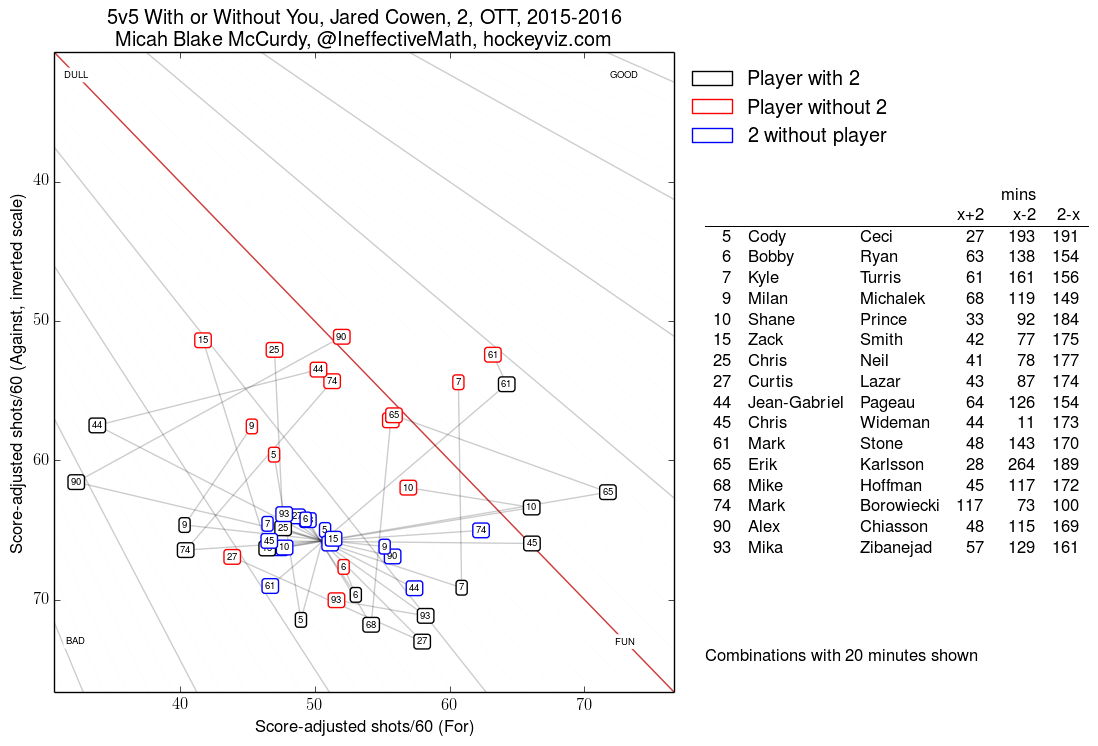
While last year Cowen was a negative possession player regardless of who he was playing with, at least this year he has shown some improvement when paired with Erik Karlsson or Chris Wideman. Please observe the figure below.

The 74 inside the blue box represents Jared Cowen’s possession numbers when not playing with Mark Borowiecki.

So far this season, Jared Cowen has not been as much as a tire fire when not paired with Mark Borowiecki. I realize I’m grasping at small sample size straws here, but it’s pretty much the only bit of positive data we’ve got, and I think if you can give Borowiecki and Cowen 15 games together, you can also afford to give Wideman and Cowen at least five. In addition, if you’re the sort of person who cares about optics, I’d say it’s easier to bench a guy making $1.3MM a year instead of one who’s making $3.7MM this year. As an added bonus, playing Cowen with Wideman would also satisfy my craving to have a defensive pairing that looks like Arnold Schwarzenegger and Danny DeVito from the movie Twins.

Is this ever going to happen? Well, I’m not so sure…

What’s Going To Happen Instead

The biggest advantage I have is that when you change coaches your team is in turmoil and we were a chasing a playoff spot right from when I took over. When you’re chasing or trying to come from behind all the time, a lot of times you’re not as patient with players. You can’t let a guy figure it out on the power play. You can’t let a guy figure it out in the top six forwards because you just think there is too much at stake. I think the biggest advantage is to have the camp, get it going … You still want to get off to your best start possible but not every game is do or die. You’ll probably let some players play through some situations that I didn’t let them last year when you’re under the gun. – Dave Cameron, September 12 2015

Well, part of the reason why I traded Eric Gryba was to give Jared Cowen a chance to play. I felt that, like you mentioned, that for the last 19 or so games last year, he didn’t play. Partly because of injury, but partly because he couldn’t get a spot. I want to get him a chance to play… – Bryan Murray, September 24, 2015

I believe we are at Peak Cowen. Based on the above quotes from management, I think it’s clear that Dave Cameron is going to play Jared Cowen for 20 or 40 or 60 or 80 games this season regardless of how much he struggles. I don’t know how many games it will take, but at some point Cameron’s going to have seen enough. Once that happens and Cowen comes out of the lineup, I believe he will be coming out of the lineup for good. If you want to see less of Jared Cowen, I’m sure all you have to do is wait. With that said, I think that Dave Cameron does Jared Cowen and the Ottawa Senators at large a great disservice if his plan for the 3rd pairing is to simply fire Borowiecki and Cowen at the brick wall an infinite number of times until they break through. I am often loathe to criticize coaching decisions because I believe coaches are both more qualified than me and in possession of more information than I have, but we are now approaching the one-fifth mark of the season, and at a certain point a coach’s patience begins to look like the absence of a Plan B. It’s a coach’s job to put his players in a position where they can succeed, and I think it’s become clear that Jared Cowen cannot succeed next to Mark Borowiecki (or vice versa). Maybe Cowen can’t succeed next to anyone, but if management is so keen to “see what they’ve got” before burying him in the press box or AHL, why not confirm that with some hard, honest-to-God data points?

We got a single game of a Cowen-Ceci pairing in last night’s gong show, but all indications are that Cameron will be going back to Cowen-Borowiecki starting tomorrow night. This makes a bit a sense, as it contains the hilariously poor defensive zone coverage to the 3rd pairing instead of allowing it to metastasize to multiple pairings, but it also looks like merely playing out the string until Bryan Murray decides Cowen’s had enough of a chance.

Fixing Jared Cowen might be a problem without any solution, but Dave Cameron owes it to everyone involved to look for one. Scratch Boro, free Wideman. Either do what’s best for the team, or do what’s best for Cowen. Don’t maintain the status quo which is neither. Anything less is a waste of everyone’s time and money.

6 Pithy Observations of Questionable Importance from RITHAC

[Ed note: Things are slightly busier than usual at what a cynical observer would refer to as “my real job”, but I had half this post written and I wanted to finish and post it while it could still be remotely considered “topical”. Please enjoy this mostly unedited, poor excuse for content and, as always, thx u 5 reading.]

I don’t really “do” hockey analytics. I’m just a guy who knows how to math and read, or at least that’s what I put on my resume. I still try to keep abreast of what’s going on in StatsWorld (AKA the least exciting theme park in existence) because it broadens my horizons in terms of my ability to understand what’s happening on the ice, and gives me another interface with which to connect to general hockey discussions.

That said, I know stats aren’t everyone’s jam. But here’s something to consider: if you’re a person who dismisses analytics as unimportant, first of all that’s really cool because I had no idea Brian Burke read this blog1, and secondly you’re on the wrong side of history. Mathematical analysis started trumping human intuition in a bunch of other fields before it got to sports. No one raves about their stock broker saying “I love this guy! Doesn’t use any mathematical tools at all, he just goes with his gut!”, and analogous attitudes really shouldn’t persist in sports once Don Cherry goes off the air. If this fact bothers you, you ought to start making your uneasy peace now. Science works, and it is precisely for that reason that it’s not going anywhere.

(If you’re simply the sort of person who dismisses analytics in hockey as uninteresting…I can’t really help with that and you should probably stop reading now. I promise I’ll be back next month with a funny post. Sorry.)

Anyway, in a halfhearted attempt to stay ahead of the curve, I went to the Rochester Institute of Technology Hockey Analytics Conference last weekend to talk hockey with some of my favourite nerds, and also Steve Burtch. Based on what I’ve seen and heard, here is what I think you need to know about where hockey stats are at and where hockey stats are going.

1. There is no one-size-fits-all analytics background

When all you’ve got is a hammer, everything starts to look like a nail. When you’ve got a finance background, as Kyle Stitch does, you can use that to apply beta values to analyze player consistency and contract risk. When you’ve got a business background, as Carolyn Wilke does, you’re particularly good at examining performance expectations with respect to contract size. When you’re a former goalie like Nick Mercadente, you become a lawyer, but then you also talk a lot about goalies. Hockey analytics is made all the more rich by the wide variety of backgrounds in the community, and you ignore people who are coming from a “non-traditional” background at your own peril and ignorance.

2. It is difficult to make predictions, especially about the future

At the team level, it’s been shown pretty consistently that shots (shots, in this case, being used in the Micah Blake McCurdy sense of the word, which is to say a shot on net, a miss, or a blocked shot) is a good indicator of team success in the long term. There will always be exceptions, but in the aggregate, shots are cool and good. However, if one is trying to use analytics to determine an individual’s talent level, things get a little more tricky. Ideally, you want a metric that measures talent to be fairly repeatable because you’re assuming talent is constant. To this end, goaltending and defense still lack a comprehensive and repeatable metric that can be used with authority. Evaluating junior players across different leagues also remains an underdeveloped area in hockey analytics.

The state of the union is that while goaltending, defense, and drafting are three very important considerations for a hockey team’s long term success, these are the things that have proven most difficult to create useful metrics for. When The Non-Believers say “Stats can’t tell you about what’s important”, in a way they’re right (for now).

However if you MUST trot out a stat about any of these things, please bear in mind that goaltending talent is differentiated most by save percentage of “high danger” shots, relative shot percentage (CorsiRel%) is a pretty repeatable metric for defensemen except when it’s not, and your guess is as good as mine when it comes to drafting.

3. This ain’t a scene, it’s a damn arms race

One of the more interesting trends is manual creation of new data sets. Jen Lute Costella in particular seems to have an ability to marshal a large number of loyal followers that is rivaled only by Voldemort (Look, you may not have agreed with everything The Dark Lord did, but you can’t deny he was a fantastic community organizer.), and she has used her army of devotees to track everything about every goal for the past seven years. This has resulted in a terrifingly large data set which, I’m told, has information that goes out to Row DO in Excel. Ryan Stimson’s Passing Project is another great example of people going out there and collecting data they wanted but didn’t have.

As the analytics community continues to approach the limits of what can be learned with shot-based metrics, the real cutting edge work is going to be done by people who have an infrastructure in place to create new, accurate data sets. As such, the days of becoming the next big hockey analytics superstar with nothing more than a spreadsheet and a dream are likely over at this point. You’re gonna need to bring some friends.

4. Work being done on the old data is going to inform what to look for in the new data

It seems reasonable to assume that more data is always better, but I don’t think that’s true. Everyone in analytics is trying to find the needle of truth inside the haystack of data, and simply dumping more data onto the haystack does not necessarily mean better inferences can be drawn. Faulty assumptions may mean that you end up going down a rabbit hole for a very long time. You still have to have an idea of where to look for what you’re trying to find. As such, a strong fundamental understanding of what’s important will be paramount in future research.

A good example of this was in Micah Blake McCurdy’s excellent presentation on zone starts. Intuitively you’d think that player usage must have an effect on player shot metrics, but Micah has shown that this effect is exceptionally small on average. The idea of a player who gets sheltered or buried is mostly a myth, but an assumption that usage is important may have led to bad analysis later down the line.

5. This new data is going to be difficult to interpret without knowledge of hockey systems

I would like to use an example from Jen’s spiffy data set to illustrate this point. One of the things Jen and Her Merry Band of Geeks tracked was the zone in which the 1st and 2nd assists originated. One of the things I noticed was that Kyle Turris has five times as many assists that originate in the defensive zone as Bobby Ryan. Now, is this because Kyle Turris plays with better puck moving defensemen, or is it because Bobby Ryan is not very effective off the rush? One couldn’t tell you without watching a lot of video or having a great deal of knowledge about Ottawa’s breakouts and offensive zone systems.

Context is important when using a stat, and it will only become more so in the future.

6. Integration is the watchword at the professional level

One of my least favourite tropes on Twitter is “If Hockey Team X hired an analytics expert, they could spend $100K a year to save $5 million a year.” There seems to be this idea that a smart person with access to war-on-ice.com should be able to pop up at meetings and say “Don’t sign Dan Girardi!” and fix the New York Rangers forever. However, as professionals such as Jack Han and Matt Pfeffer spoke at length about their experiences within hockey organizations, it’s clear that organizational buy-in is necessary for an effective contribution. Unless an analytics specialist has the ability to be involved in multiple levels of the hockey operation, they will simply be the person who delivers graphs to the coach or GM.

BONUS OBSERVATION: 7. The phrase “driving possession” needs to die.

“Drive possession” is just a way of saying “be good at hockey” for people who want to sound smart. It’s a term so catch-all that it’s been rendered largely meaningless. In the future, come specific or don’t come at all.

1. Low key, I think Brian Burke is one of the smartest guys in hockey. For one thing, his ability to troll a community that consists almost entirely of ostensibly intelligent people is unmatched. Dale Tallon could hold a press conference solely to announce “People who are interested in stats do not understand hockey, nor will they ever experience the loving touch of another human.”, and he wouldn’t even trend on Facebook. Only Brian Burke possesses that rare and wondrous ability to be totally confident in his own ignorance in such a way as to infuriate those around him. Also, if you take Burke at his word (which is not something I believe you should necessarily do), he is a guy who willingly eschews information that most people agree would make his job easier while still being quite good at his job. Think about that for a minute: Brian Burke intentionally handicaps himself, and yet is still one of the world’s thirty or twenty or fifteen best hockey general managers. That is amazing to me. Don’t dismiss Brian Burke; he’s got a lot more going for him than he’s given credit for.

Sens Spend Money on Infrastructure, Not Players. What Does It Mean?

If you have a working Twitter account, you’ll have noticed that the Senators organization rolled out Whe Welcome Wagon for social media folk and traditional media alike yesterday. The Sens wanted to showcase the new renovations that have been made to the Canadian Tire Centre. The CTC now has more Tim Hortons, food by Farm Boy, and you can now put your poutine in a wrap/burrito in what must surely be an affront to both God and nature. Poutine is not a sandwich; that’s one of The Ten Commandments. There was also some discussion of the “Enhanced security measures” which are most likely to solve a problem that never existed at a cost to some fans who will now feel even more uneasy attending games, but that’s a story for another time1. These renovations and additions come fresh on the heels of parking lot paving, new lighting systems, and a new jumbotron.

The Sens have been remarkably consistent with infrastructure improvement rollouts for the past few seasons. Whether it’s the new lights, or the parking lot paving, or TV screens in the concourse, the improvements are always modest, announced with a press release, and then mocked a bit on The Twitters because “Haha, who announces a new television outside of section 316? That’s classic small town Sens doing small time stuff!”. I will admit to my own culpability in maintaining this pattern, but I only tease because I love2.

On the real though, I’m inclined to let the Sens talk up their sexy new box seats as much as they damn well please. It was only a few season ago that there was a prominent blogger who was going hard in the paint regarding Eugene Melnyk’s finances and the overall fiscal health of the Senators organization in general. When you consider how much these financial concerns have rooted themselves in the consciousness of the fanbase, one can hardly blame the org for hitting the general public with a soft #actually every time they invest money into the off-ice product. Whenever I read a Senators press release that says something like “Parking Lot 6 is being paved”, I interpret that as the Sens saying “Oh really? Would a broke organization do THIS? *makes it rain all over a pavement roller*“.

In light of this, I think it’s time to stop thinking of the Senators as a Budget Team, and time to start thinking of them as A Team with A Budget. While still in the bottom half of spending league-wide, the Sens now spend more money on salaries than five (5) teams, and are closer to the salary cap then they are to the cap floor. They are not a cap team and they don’t look like they’ll even try to be a cap team for the foreseeable future. However, maybe, just maybe, it’s time to stop looking at every single hockey personnel decision from the perspective of The Almighty Internal Budget. Every time a prospect signs a contract that could have been worth more money, there’s always a reaction that’s something like “Sens are lowballing their prospects again. Hope the fact they cheaped out because of the budget doesn’t cost them later.” Every time a team that is not the Sens makes a trade, there’s always a reaction along the lines of “Sens probably didn’t have the money to make the Boychuck/Saad/Hamilton/Sharp trade work, so they didn’t go for it.”

To this I say “Gotta hear both sides”. Hell, the Sens spent $15MM on renovations this summer alone! That’s like 2.3 Erik Karlssons (or 2 Bobby Ryans, if you prefer). Little improvements to The Gameday Experience show that the Senators are probably not incredibly tight against their operating budget unless you genuinely think Paul Maclean’s contract getting picked up by Anaheim was the difference between Lot 9 getting paved or not.

All this to say that if you enjoy griping about the Sens personnel decisions, please continue. Second guessing professionals is one of my favourite pastimes. I do it all the time on airplanes and in hospitals. Just keep in mind that it’s getting harder and harder to argue that money is the predominant driving factor behind why the Sens didn’t trade for Nick Leddy or offer Mike Hoffman more money.

If management screws this up, it’s gonna be because who they put on the ice, not because of what’s in the corporate bank account.

1. I’m aware that the Sens likely had no choice in whether or not to adopt this league wide protocol. I still think it’s bad for everyone. The Sens have to invest money to solve a non-existent security problem, the CTC’s ingress will become more congested than it already was due to the increased time it will take to get through screening, and a number of already marginalized fans will be forced through even more hoops in order to watch the team they love. Please read Andrew’s post for his thoughts on this matter. These security measures are a net loss any way you slice it. That is all I have to say on this.

2. I swear this is the reason.

9 Pithy Observations of Questionable Importance from the 2015 Rookie Tournament

While I was putting in work in London last weekend, I figured I might as well watch some games while I was in the area. This was my first opportunity to see a number of Sens prospects in person, and I have some thoughts which I will now share.

So without further ado, let’s play Eye Test!

1. Who was there was just as notable as who was not.

While Ottawa still sent a good percentage of their prospects, they still weren’t playing with a full deck. Nick Paul was held out due to injury, and Mikael Wikstrand was forced to withdraw midway through the first game against Toronto. Freddie Claesson wasn’t on the team for reasons I can’t be bothered to look up. Players such as Colin White, Kelly Summers, Miles Gendron, and Quentin Shore were held out for NCAA eligibility reasons. Consequently, Ottawa filled out the rest of their roster with players on amateur tryout contracts. This is obviously a win-win for everyone, but it also means given that Thomas Chabot and Marcus Crawford is unlikely to be a pairing we ever see again. Grains of salt for everyone!

2. Thomas Chabot is pretty decent.

It took me a while to come around on Chabot. Chabot’s a perfectly adequate defender in his own zone, but didn’t blow me away at any point. Then with the Sens Rooks down a goal late in the game against Toronto, Chabot took off on an end to end rush that resulted in the tying goal. Chabot would go end to end a few more times against Pittsburgh, always looking dangerous when he jumped up into the rush. What I liked most about this was that Chabot wasn’t just a free-wheeling downhill player; he was obviously picking his spots very carefully. He’s no Ceci or Karlsson i.e. the type of defensive prospect who can jump right in at the NHL level at contribute right away, but there’s lots to like already and I’m looking forward to watching his development.

3. Gabriel Gagne was the surprise of the tournament for me.

Most of what I’d heard about Gagne could have been summed up in two adjectives: big and lazy. The day he was drafted, I heard someone tell Ian Mendes “To watch him play, you’d think he’d scored his 35 goals by accident.” Check out this post by The 6th Sens to see what other sick buzz Gagne was getting. Based on this, I expected a big lumbering forward who just parked himself in front of the net and waited for rebounds to enter his stick swinging radius. What I didn’t expect was his speed. There’s a big difference between being a fast skater and looking like a fast skater (Just ask Colin Greening), and Gabriel Gagne looks fast. He was not afraid to take people on, beat people to pucks, and go hard into corners. If that’s what Gagne looks like when he’s lazy, I can’t wait to watch him when he tries.

4. I don’t get the Ben Harpur hype.

I’m just going to come out and say it: I don’t see what the Sens see here. Harpur looked big, slow, and took bad penalties. He’s probably the player I have the lowest opinion of following the tournament. I’d like to see a Freddie Claesson call-up well before I see a Ben Harpur call-up.

5. Tobias Lindberg reminds me of Jakob Silfverberg and I’m not just saying that because all Swedes look the same to me.

Having watched Tobias Lindberg thrive in the OHL last year, I was really looking forward to seeing him in person. As my favourite part of the Puempel-Dzingel-Lindberg line, he did not disappoint. I thought his game was very reminiscent of Jakob Silfverberg’s. He didn’t have speed that would blow you away, but he was very solid at both ends of the ice and showed off his lethal shot and quick release in overtime against Toronto. Any Ottawa fan worth their salt loves them some Swedish prospects, and Tobias Lindberg will fill that Silfverberg shaped hole in anyone’s heart who still misses Jakob even though we have Bobby Freaking Ryan on the team now.

6. Matt Puempel has just the slightest whiff of Dany Heatley about him.

One of the wisest things about hockey I’ve ever heard was “The difference between a good Dany Heatley game and a bad Dany Heatley game is two goals.” Basically if Dany Heatley wasn’t scoring, he wasn’t helping your team win. That line was constantly running through my head as I watched Matt Puempel. Puempel would be out there, playing solid, but not really stepping outside his lane or doing anything special. Then suddenly the puck would be in the back of the net and #26 was celebrating. Insofar as “having a nose for the net” is actually a thing, Matt Puempel does appear to possess that trait. Away from the opposing net, Puempel looked good but not exceptional.

Keep in mind that Puempel spent time on the penalty kill, so I wouldn’t want to give the impression that he’s deficient in his own zone. He was obviously one of the stronger defensive players on the team or the coaching staff wouldn’t have put him in that position. Still, one might worry how he’ll look if he’s on a line with Zack Smith and Chris Neil during the preseason. I would put him on a line with Mika Zibanejad and Bobby Ryan just to see what happens.

7. Filip Chlapik did not impress-uh-me much.

I’m already on a pretty big hater grind when it comes to the Q. Sure it’s the league that produced Sidney Crosby and Mario Lemieux, but it’s also the league that produced Alexandre Daigle and Marek Zagrapan. Whenever someone says, “This QMJHL prospect looks super skilled.” what I hear is “This prospect looks super skilled in a league where defense and goaltending are just hypothetical constructs.” This is not to say that I don’t believe good players can come from the Q because that would be ridiculous. However, I do know a lot of people who really wanted to draft Sean Couturier over Mika Zibanejad who don’t believe that anymore.

What does this have to do with Filip Chlapik? Well, I can’t say that he stood out to me. On the other hand, his wingers, Max McCormick and Francis Perron, both had huge tournaments (4 points in 3 games) so he must have been doing something right. Also he’s only 18 so maybe I should just chill out and rag less on a guy playing his first games in a Sens uniform.

If I were to sum my impression into one headline it would be “Area Prospect Will Require Some Years to Develop”. Call me, Ottawa Sun.

8. William Nylander is a menace to society.

Nylander was the best player I saw all weekend. He looks poised to fill The Phil Kessel Memorial “I Can’t Believe We Have To Play This Guy Again” Role on the Leafs for years to come. I can’t wait until they run him out of town.

9. 3-on-3 overtime is like the Wild West.

There is so much open ice during 3-on-3 play. Every rush either feels like an odd-man rush or is an odd-man rush because one of the wingers got stuck low when the puck went the other way. I can’t wait to watch this in the NHL. Each overtime will be assured two things: it will be very fun, and it will not last very long. Sounds like my wedding night, basically.

The David Legwand All-Stars

One development in sports coverage in the past 25 years is the increase in fan and media access to players. With the social media explosion, fans now have unprecedented access to their multi-millionaire heroes and can really get to know players and their personalities. Bobby Ryan bought an RV! Clarke MacArthur bought a tiny motorcycle! Cody Ceci is very trusting! Who doesn’t have things in common with these people? Little off-ice moments such as this are how a player as otherwise marginal as Kaspars Daugavins can become so beloved by the fanbase.

But still, some players slip through the cracks. This is likely by design. Some guys just want to go to the rink, be a professional, and go home. They aren’t in this to make friends. Nobody embodied The Milford Mantra of being neither seen nor heard more than David Legwand. Remember that big moment David Legwand had this season? Me neither. In fact, the only thing I remember about Legs (???) is when he loomed up from out of nowhere in the middle of a “We made the playoffs!” celebration video. That’s it. David Legwand was The Grey Man in Ottawa. He wasn’t good, he wasn’t bad, he was just sort of…there.

So here’s a salute to The David Legwand All-Stars: Players who are completely unmemorable for whatever reason. Let’s do some internet research and see if we can learn a thing or two about them today!

Goalie

Alex Auld

Stats in Ottawa: 57 GP, 18-22-9, 2.66 GAA, .906 sv%

Representative YouTube Highlight:

Life Comes At You Fast Wikipedia Page Excerpt: Initially, Auld was expected to be the undisputed starter in Florida. However, the July 25 signing of Ed Belfour introduced some competition, and Belfour eventually won the job as starting goalie. Controversially, in October, Auld was hospitalized while ‘horsing around’ with Belfour, with suspicions that Belfour had assaulted him.

There are lots of ways of being a memorable goalie. You can be very good. You can be very bad. You can be part of a terrible trade. You can be part of a trade that’s terrible for a different reason than the other one. You can get hurt at the worst possible time. You can get hurt all the time. You can have a very controversial mask. You can have the least controversial mask. Somehow Alex Auld did none of these things.

Forwards

Andreas Dackell

Stats in Ottawa: 401 GP, 65 G, 115 A, 104 PIM

Representative YouTube Highlight:

Life Comes At You Fast Wikipedia Page Excerpt: After acquiring Bill Muckalt from the New York Islanders the Senators traded Dackell due to his more expensive contract. He was traded to the Montreal Canadiens during the 2001 draft for a seventh round pick.

As a defensive forward, Andreas Dackell was the Erik Condra of his day. He was also Swedish. Basically if Andreas Dackell played for Ottawa when Twitter was around, he’d be Top 3 in popularity. Instead he’s simply remembered as The One Who Wasn’t Magnus Arvedson. As always, timing is everything.

Bruce Gardiner

Stats in Ottawa: 181 GP, 22 G, 32 A, 146 PIM

Representative YouTube Highlight:

Ok, actually that does seem pretty memorable. My bad. I’ll take the L on this one.

Life Comes At You Fast Wikipedia Page Excerpt: On May 4, 1986, Gardiner, who was 14 years old at the time, helped rescue two men and two boys from possible hypothermia on the Mattagami River along with some friends. On December 11, 1987, he was awarded the Medal of Bravery. The story was later reenacted on the television show Heart of Courage.

Players Who Surprisingly Have More Games Played as a Senator Than Marc Methot:

Bruce Gardiner
Peter Regin
Ricard Persson
Dean McAmmond

Perception of time is weird.

Vaclav Varada

Stats in Ottawa: 117 GP, 12 G, 27 A, 84 PIM

Representative YouTube Highlight:

Life Comes At You Fast Wikipedia Page Excerpt: He was later traded to the Ottawa Senators for Jakub Klepiš before the 2003 trade deadline in an attempt by the Senators to become a tougher and gritty team, en route to the Senators’ first Eastern Conference championship series against the defensive-minded team, New Jersey Devils.

Vaclav Varada did most of his best work with the Buffalo Sabres, thus making him the original Robin Lehner.

Defense:

Curtis Leschyshyn

Stats in Ottawa: 200 GP, 3 G, 23 A, 78 PIM

Representative YouTube Highlight:

Life Comes At You Fast Wikipedia Page Excerpt: Leschyshyn is an avid cyclist and cycles 40–50 miles a day.[citation needed] Leschyshyn has been a participant on Battle of the Blades.[citation needed]

200 games played! That’s the same number of games as Mika Zibanejad. Yet, Leschyshyn’s main claim to fame is the time I rhymed his name with “incision” to win a freestyle rap battle in the Ottawa Underground Battle Rap League (OUBRL).

Lance Pitlick

Stats in Ottawa: 228 GP, 11 G, 25 A, 190 PIM

Representative YouTube Highlight:

What I’m taking away from this highlight reel is that Lance Pitlick liked to hit dudes in the head a lot. Also: is Lance Pitlick the most surprising former NHL player to have a highlight reel?

Life Comes At You Fast Wikipedia Page Excerpt: This biographical article relating to an American ice hockey defenseman is a stub. You can help Wikipedia by expanding it.

I think we’re done here.

Great Moments in Sens Off-Season History

Now that Bluesfest is over, we are officially deep into the summer and the news coming out of the NHL seems to be a little slow. You might think that slackers like Bob Mackenzie or Elliotte Friedman are doing it right by taking off to the cottage for two months rather than dissecting the minutiae of which RFA’s pre-arbitration salary request is the most preposterous, but you’d be wrong. The hockey off-season isn’t just about contract negotiations and salary cap escalators. There are some great hockey stories that come out of every summer, if only you have the eyes with which to see them.

Don’t believe me? Here are some great moments from past off-seasons in Ottawa.

August 3rd, 2014: Bobby Ryan calls his Aunt Louise to wish her a happy “Big Six-Oh”.

June 29th, 2009: Jim O’Brien is recognized by a fan while dining alone at Baton Rouge. The fan does not say hi.

August 4th, 2012: Chris Phillips tries to invite Chris Neil to his cottage for the weekend, but accidentally sends the text to Sergei Gonchar instead. Luckily, Gonchar declines the invitation.

July 22nd, 2003: Shawn Van Allen does an internet search for his name and learns a thing or two about astrophysics.

July 17th, 2008: Ray Emery has a quiet day where nothing remarkable happens.

July 3, 2014: Clarke MacArthur spends time with his daughter while his wife goes out for drinks with her girlfriends. After his daughter is in bed, Clarke catches the last two innings of the Jays game.

June 8th, 2007: During locker cleanout day, Dany Heatley finds a collection of turtlenecks thought to have once been owned by Alexei Yashin.

July 6th, 2013: Robin Lehner just so happens to be at home during the delivery window and receives or a UPS package he was expecting. The contents of the package were undisclosed, but are thought to have been “organic” in nature.

August 20th, 2002: Mike Fisher watches the classic Seinfeld episode “The Contest” for the first time. He feels guilty for laughing at it.

July 7th, 1999: Petr Schastlivy learns that Beavertails are both delicious and not actual beaver tails. His first Beavertail is a classic cinnamon-sugar flavour.

June 28th, 2012: Zack Smith remembers he is nearly out of paper towel before checking out at the grocery store. He does a small, private fist pump as he leaves the store with paper towel.

August 29th, 1996: Janne Laukkanen discovers a local Valu-Mart that carries his favourite brand of pickled herring.

Various Dates: Erik Karlsson goes to a concert.

August 12th, 2009: Chris Campoli throws out any of his socks or underwear that have holes in them. He buys new socks and underwear from the Joe Fresh section at a Westboro Loblaws.

July 27th, 2008: Joe Corvo declares that the Red Hot Chili Peppers’ early stuff is “pretty underrated”.

June 14th, 2001: Wade Redden accidentally grabs a bottle of red Gatorade instead of his usual blue following a morning run. He drinks the red Gatorade anyway.

July 29th, 2010: Pascal Leclaire accidentally drops a plate following dinner, but the plate doesn’t break. However, the plate is slightly chipped and is only ever used when all other plates in the house are dirty.

August 17, 2013: Jason Spezza has an extremely desirable parking spot stolen at the last second. He just laughs it off and parks two rows further down.

Posted in Uncategorized | 1 Reply