Our Special Little Guy Wins the Norris

Clearly it’s the best time to trade him. His value will never be higher! We could get a second round pick for this year’s draft.

Not much to say here that hasn’t already been said: Karlsson’s win is only an upset in the context that people who haven’t really watched him play that much don’t like his lack of penalty killing. But hey, it’s an award without any clearly outlined criteria. What do you expect? Don’t hate democracy. He could just have easily been robbed because Weber was “due.” I find the Jack Adams way more problematic. (It’s awarded to the coach who does the most with the least OR the coach who takes over midway and makes the biggest difference. Never mind that these two things aren’t valued relative to each other very well, or that we don’t know if “doing the most” is as important as “having the least.” Ugh, who cares.)

Anyway, Pierre McGuire said he puts the over/under on Norris trophies for Karlsson at three, which is amazing.

Especially nice to see the win against former Senator and The One Who Got Away, Zdeno Chara.

Anyway, this is just a quick note to say congratulations to Our Special Little Guy on the best week of his life. I know that if I won a major award on the same week that I made $45.5 million, I’d probably have a spring in my step. We hitched this blog train to the right player. Good thing we didn’t name ourselves “For Relaxing Times, Make it Konoptka Time.”

Goofy goalie market bodes well for Sens

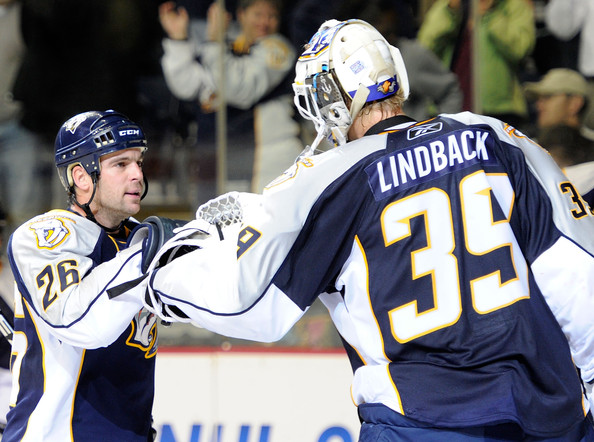
Stevie Y traded some significant assets for Nashville goalie prospect Anders Lindback the other day – not a bad return for Dave Poile, considering Lindback is a former 7th round pick. Lindback is a big guy (almost as big a Ben Bishop) and has played a combined 38 games in the NHL to date with good numbers, albeit in a terrific defensive system. And so the assumption is that he is ready to carry a team on his own.

This strikes me as flawed logic, but it’s about as conventional a concept as you’ll come across in today’s NHL. We’ve worked up a narrative: a club will have a veteran starter and a young backup. When the backup has a few good games – let’s say he hits 20 games played in a season – the analysts start talking about him being ready to be a starter, and how the club has a decision to make. This creates a little bit of drama to write around, an excuse to use the term “goalie controversy,” and subsequently a market for this new “starting” goaltender.

My fundamental skepticism is derived from the notion that playing a game every other week isn’t the same as playing 60+ games in what seems like the most psychologically demanding position in professional sports. There are plenty of examples of these young goalies being handed the keys to a franchise only to flounder.

Toronto traded for Calder-winning Andrew Raycroft, and immediately signed him; despite a bad season, he had hardware to his name, and was considered not only a solid prospect, but a goaltender young enough to provide stability in the position for a decade. After Raycroft bombed out, the club traded 1st and 2nd round picks to San Jose for Vesa Toskala, with hilarious results. Toskala’s numbers playing behind Nabokov in San Jose were very respectable, but he was considered sub-replacement level with the Leafs.

Mike Smith was traded from Dallas to Tampa Bay after being mentored by Marty Turco, and was a central asset in the package that brought Brad Richards to Dallas. Smith was treated as the solution to Tampa’s longstanding problems in net. (As Lindback is now treated.) The irony being that the most stability the franchise has enjoyed in years was due to a 42 year old Dwayne Roloson standing on his head. Mike Smith was unceremoniously released, and signed on the cheap in Phoenix.

Josh Harding in Minnesota has had trade rumors around him for years, but a few key injuries kept other teams from biting. Likewise, goalies are being mentioned in several of the potential packages for Rick Nash, and I pity to poor soul who gets traded to Columbus and billed as the team’s savior in exchange for their franchise player and captain. Columbus is likely to trade their best player for tomorrow’s Josh Harding.

And it’s not just the desperate clubs, without UFA options or prospects. Some go so far as to call Vancouver’s Cory Schneider not only a starting goaltender, but an “elite” “franchise” player. He played 33 games this season, a career high, with very good numbers. But how does he fare playing twice that, in a market that expects to win a Cup? You can say a lot about Luongo and that terrible contract, but he’s a starting goaltender, and probably top ten in the league. To me, it’s just nuts to think that he’ll be traded for next to nothing when Schneider seems as much as a risk and can probably yield you much more in a trade.

So what does all of this have to do with Ottawa? Well, the Sens are in the relatively novel position of having some prospect depth in net. The club has two exciting young netminders in Ben Bishop and Robin Lehner, and has stated that they intend to draft another goalie this year. And while I’m usually one to go with quantity when it comes to goaltenders, I have to wonder if the market for prospects is getting too good to pass up.

Let’s say this season gets off to a poor start, and Ottawa looks like it will miss the playoffs. (We’ll have plenty of season prediction posts in due time, but it should be evident if you’ve read my soapboxing that I think this is likely.) Bishop is right on the cusp of being considered one of those goaltending prospects just waiting to become a starter. With nothing to lose, the club could get him his experience and drive up his value. In the offseason next year, with Bishop still an RFA, any number of teams who feel they were one quality save away from being where they wanted to be gets a phone call. Could Murray turn the 2nd rounder he gave up for Bishop into something much better, or even make Bishop the cornerstone of some silly package for next year’s Rick Nash?

And then there’s Lehner, who is younger than Bishop but entered some elite company after winning playoff MVP on last season’s Calder Cup winning Binghamton team. I’d hate to see him go, but his stock is definitely on the rise.

Goaltending is so fickle that it’s hard to understand why GMs risk any amount of money or picks on supposed “sure things.” I’d feel about as comfortable heading into a season with a mix of three or four cheap veterans and prospects as I would with an anointed starter on a big ticket contract. But the offseason is here, and GMs are about to get nutty. Ottawa would do well to exploit the panic of others.

Draft strategy / two articles in two days?!

That’s right! Two posts in two days! It can only mean one thing: my boss is away at conference.

Anyhoo, interesting article over here. I’m a sucker for anything that goes back and reads the tea leaves of former drafts for trends. This one points out that because the developmental timeline for most defencemen is longer than a forward, it’s more difficult to forecast their ceiling. Because it’s easier to whiff on taking them, it makes less sense to use a valuable first round pick on the back end. This is discussed in the context of the LA Kings, who used several first round picks on defencemen over their horribly long rebuild, and saw few of them become contributors. In the end they signed UFAs like Mitchell or Scuderi, or saw players drafted in later rounds like Voynov become bigger contributors. (Doughty is the elephant-sized exception to this rule.) The same can of course be said of goalies, though for some reason this is common knowledge while the defenceman principle has yet to shine through.

If you have a top five pick it rarely matters: you’re going to get a good player (though not necessarily an elite one). The point sort of being that there are two basic draft assumptions that mid-round drafters like Ottawa can live by:

  1. Never draft a goalie or defenceman in the first round; always a forward. First round picks are too valuable to risk on something so hard to predict.
  2. Draft more defencemen overall than forwards. Because of the difficulty in predicting who will succeed, you need to up your chances of success. Just use later picks.

The interesting thing this year is that so many defencemen are projected to go in the first round. A number of mock drafts have a couple of D going in the first few picks – Ryan Murray, Mathew Dumba, Morgan Rielly, maybe Jacob Trouba – but I really wouldn’t be surprised to see a few of these players slip down the board. Murray’s probably going to get picked early, but I can’t see too many teams leaving a Teuvo Teravainen or Sebastian Collberg on the board so they can draft one of many solid-looking D who are still years away from playing.

What this means for Ottawa, perhaps, is that they’ll have a slew of quality defencemen log jamming the mid-round and not a lot of quality forwards available. It puts the team in an interesting spot: do you go with common wisdom, trade down, and simply grab more defencemen later on? Or do you use your pick on one of these spurned defencemen and hope like hell you got the right one?

Sens TV set to winny Canadian Emmy, the “Jemmy” / We’re back on the internet

In case you didn’t see it, Sens TV has a new edition of their behind-the-scenes look at scouting meetings. It has less intrigue than last year’s Senate Reform (TM Silversevens and janked by everyone else), where the Sens had several picks and needed to kick off their rebuild right. But I’m glad to say that the overturned milk crates with mics taped to them make their glorious return.

Also, check out the cabinets full of scotch in the background:

Is there a better job in the world? It’s like Mad Men, except nobody has a particularly impressive vocabulary. At one point one of the scouts says “warrior. battler. fighter.” or something to that effect, apparently not caring that these all mean the same things.

What I find most interesting is that these guys even spend time arguing over the semantics of whether a guy is going to be second line or third line. Why don’t they just have some formula mocked up wherein they plug in each scout’s assessment of each player’s tools, combine the values and weight them appropriately relative to 1) how much that scout saw of that prospect, and 2) the importance of each tool to the team’s overall system, and then have the formula spit out a value to rank each player. I don’t know, maybe they already do that, and this scrum is just the process of refining each scout’s individual ranking. And of course it’s a two minute thingy on the promotional website, here for our entertainment. But the process seems frustratingly inefficient. “Let’s argue about every single available player and then rank them.” It would be a fun job, but a silly process.

Interesting to note that the players available at 15th overall are probably third liners and defenseman who can move the puck but aren’t top pairing, and the scouts seem to bear this out. They reveal about everything they can without giving away who they prefer, but none of what’s being said is particularly electric. All this to say that the pick this year is ripe for a trade. Just as Murray traded the 16th overall pick for David Rundblad, perhaps you see management trade this year’s pick for a prospect a year ahead in their development. Or maybe you see it packaged with one or more of Ottawa’s prospects or roster players to make a big splash for a player like Rick Nash, though obviously I wouldn’t bet on that.

It’s been a while since we updated. Sorry about that. I want to take this opportunity to express some admiration for both SilverSeven and The6thSens, who have been updating almost daily, somehow, despite the utter lack of anything to write about. And they’ve made it interesting, too. Those guys know what they’re doing. But back to us.

One thing I noted was this Puck Daddy piece on how the Wild are expected to outbid everyone for Zach Parise. We also know that Carolina is going to spend to the cap to try and bring him in. My thoughts on this are well documented.

I feel so, so sorry for the fans of franchises like Minnesota’s. If Brad Richards could get the kind of deal he got – he scored 66 points and was a -1 last season, and he made TWELVE MILLION DOLLARS on the first year of a nine year deal – then we can expect the bidding to get absolutely nutty for Parise, who is younger and has a higher ceiling. What do you think it gets up to? Could we see another deal of Kovalchuck-ian proportions, topping $100 million? If the league is open to deals that take the player to 42 years old, Parise could get 15 years.

And all this after the Los Angeles Kings win the Cup after years and years of patient building and drafting. Sure, they brought in expensive free agents, but they waited until their window of contention was open before they traded those prospects and spent that cash. Not only did they win, they could repeat with most of that lineup intact. Hell, they can even afford to go after Parise if they wanted to. Will the Wild and Hurricanes ever learn? Hopefully Sens brass take the lesson to heart.

This Year’s Free Agent Class Induces Vomiting

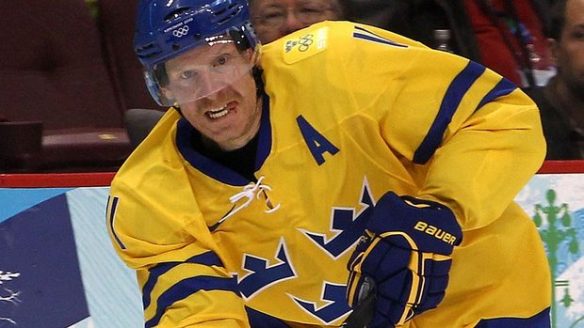
I put this picture here because this is the best player we could bring in this offseason.

Hi there, WTYKY readers. Sorry for dropping off the face of the earth. As is tradition following each Ottawa Senators playoff exit, we retreat to a sweat lodge in Muskoka, take massive amounts of peyote, and shoot crossbows at trees from ATVs. Following that we curl up into a ball and mutter, “Please don’t sign Penner…please don’t sign Penner…Kovalev ten million over two…Kovalev ten million over two…” Judging from the fact our site traffic dipped down to negative a billion hits, I take it this is roughly what we’ve all been doing.

So anyway, we all feel much better now. And I note that other, more dedicated and professional Senators blogs have dipped their toes into free agency. WELL WE HAVE OPINIONS TOO GUYS.

Bryan Murray (he’s still the GM, right?) mentioned something about wanting a defensive defenceman and a top six forward from the free agent market this offseason. Well, I’ve got news for you, Bryan Murray, and I’m sure nobody else has pointed this out: you and everyone else. Plus Ottawa is a small market team whose owner is continuously talking about not being able to spend like other teams. (Because, as we all know, a team that sells out every single home game needs to make it to the second round of the playoffs just to break even.) So let’s get this out of the way: yes, Zack Parise and Ryan Suter are really good. A quick look at their stat lines and CORSI confirm it. We’re not getting either of them. Some idiot team is going to spend way more than even these two players are worth to bring them in.

So who’s left? Well, take a look at this list. First reaction is of course to vomit all over myself. (Again.) Alex Semin, he of 21 goals and $6.7MM salary this season, will be the fourth most sought after player? A 40 year old Jaromir Jagr who’s treated like a revelation for getting 54 points on a line with Claude Giroux? (Nick Foligno got 47 points.) You know how you can tell the UFA market is screwed up? 33 year old Olli Jokinen can put up 23 goals 61 points and everyone will say “he’ll get signed if he keeps his demands reasonable,” but an older Jagr is considered a pleasant surprise at more money and less points. Reputation precedes logic.

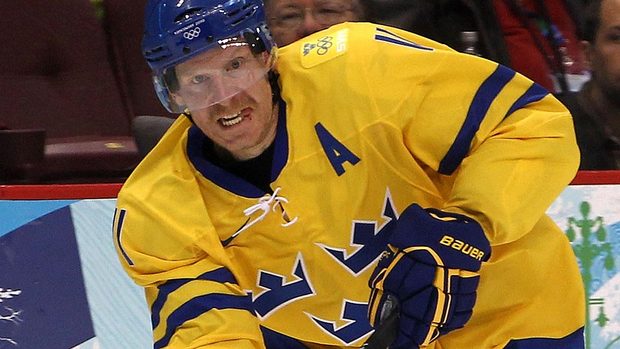
Anyhoo, the thin market is made especially acute for Ottawa by the fact that many of the available mid-level free agents are centers, a position that Ottawa has some depth in with Spezza, Turris, the recently re-signed Peter Regin, the recently 19 year old Mika Zibanejad, and so on. What Ottawa needs is some wingers, and the selection ain’t pretty. In fact, other than Parise, there isn’t a single winger on that THN list. (Dustin Penner and Ray Whitney get an honorable mention.)

The prize pick of my litter is P.A. Parenteau. He’s unheralded because he plays for the Islanders and no one heralds that team, but he put up fantastic numbers last year – 18-49-67 in 80 games, and 53 points with 20 goals the season before. For some reason he doesn’t have numbers on Behind the Net, so I can’t check his CORSI, but it’s the Islanders, so let’s assume that his CORSI is terrible and his relative CORSI is great. He only made $1.125MM last season, and is 29 years old. I’d be really surprised if Garth Snow doesn’t take a run at re-signing Parenteau this off-season, especially because he’s been locking up his core and he has a bajillion dollars in cap space. But if he hits the market, Parenteau is my number one choice. If opposing GMs have access to Cap Geek and Wikipedia like I do, and I suspect they might, watch for Parenteau to be signed by whoever misses out on Parise to a contract that truly boggles the mind and makes us all lose faith in hockey forever.

Brad Boyes is far from his salad days playing with Paul Kariya in St. Louis, and he looked like a pile of steaming garbage in Buffalo, but as a reclamation project he could be a 20 goal guy. On the other hand, he could turn into a flop of Cheechooian dimensions. I’d offer him $17 an hour and see if he bites.

I like Calgary’s David Moss. He only put up 9 points in 37 games this season, but in his only full season he put up 20 goals, and had 17 in 58 last year. He’s a left winger, and his relative CORSI is respectable.

Andrei Kostitsyn plays professional hockey, though he’s probably done with this basket case of a country after playing in Montreal. Look for him to sign with a team that doesn’t have local television coverage. Either that or the Minnesota Wild, completely lacking any game plan at all, will sign him to a five year, $25MM deal to play on a line with Dany Heatly so the two of them can skate around with their sticks in the air waiting for a pass from Mikko Koivu, who will be hurt and in the press box.

As in most years, if you’re in the market for a third liner, you’re in luck. There are plenty of grinding, character guys like Adam Burish, Tanner Glass, Taylor Pyatt, and Brandon Prust. (Tanner, Taylor and Brandon of course being the most hockey playerish first names ever. Adam sort of sounds like a competitive swimmer to me.) But if you’re looking for a top six player who can put up 20-25 goals, well…like I said, it’s you and everyone else buddy. Unless you think Krisitian Huselius or Niklas Hagman have something left in the tank. I’m not even sure those two guys are still alive.

And of course there’s Dustin Penner. I’ll let the myriad analyses to come do the work, but I will point out that if a player has terrible puck possession numbers, doesn’t put up points, and isn’t a goalie, he probably isn’t going to do well on a team whose system is built entirely around puck possession and needs a goal scorer. (But he’s big! Such a big guy.)

As for defenseman, there’s a more diverse stable of those mid-level, $3MM-$4MM guys – Brad Stuart, Barrett Jackman, Matt Carle – and while I won’t be particularly upset to see any of those guys in a Senators uniform, most of them sport even or negative relative CORSI ratings on good teams, and I don’t see how they would be an improvement over our in-house mid-level $3MM-$4MM guy: Filip Kuba.

It seems difficult to quantify who exactly is a ‘defensive’ defenceman and whether or not they’re a good one. I mean, Hal Gill is available, but is Hal Gill a pretty decent defensive defenceman or the worst player in the world? It seems like he can only be one or the other. People bitch about his inability to skate all season long and then boom: every trade deadline, there he goes, traded to a contender for a second round pick. Maybe we should sign him just because Ottawa doesn’t have a second round pick for the next two seasons.

There are a couple of puck-moving and hybrid d-men that I think will get ridiculous deals, but I’d still like to see Ottawa in on. Dennis Wideman is an obvious one. Johnny Oduya is only 30. Bryan Allen is…okay, Bryan Allen isn’t that good. Matt Hunwick in Colorado might be ready for some more minutes at only 26 years old and having played about 16 minutes a night up until now. Mike Lundin in Minnie is in the same boat. Would it be weird to bring in Carlo Colaiacovo and make him play in Toronto every other night? Hey, Chris Campoli and Mike Commodore are available! Umm…Matt Carkner? 

So as you can tell, there’s plenty of decent, affordable, young defensemen out there, and there’s also a 2-for-1 sale on garbage. But if the object is to replace Kuba’s 20+ minutes a night, then I think we’ve got a problem.

Get ready for a shock: I’m kind of pessimistic about next season. Yeah, I know! Didn’t see that one coming. But Ottawa probably can’t duplicate a number of improbable last–minute comebacks, a relatively injury-free season from all key players, the highest scoring defenseman by two light years, Michalek’s insane shooting percentage for 2/3rds of the year, and will probably will lose Dany Alfredsson and a top pairing D in Kuba. And let’s be honest, they weren’t exactly contenders to start with. So unless all of this moderation talk from Murray and co. is an elaborate scheme to distract from the massive, front-loaded, multi-year contracts they’re preparing for Parise and Suter, well…welcome to the Ottawa Senators, Dustin Penner.

A Day in the Life of a Sun Hockey Writer: Don Brennan goes trolling

My first impulse is to ask “How does Brennan look players in the eye and ask them questions in the post-game scrum?”

And my second is, “I hope there’s an organization-wide ban on reading the Ottawa Sun.”

Feelings are largely positive and sentiment high after an unexpected trip to the playoffs. Anderson kept the Senators in most of their games against the Rangers, and he peaked with a 1-0 shutout in game five to send Ottawa home with a 3-2 series lead. He provided the Senators with the sort of competent goaltending they’ve lacked for years. (In related news, the St. Louis Blues, who made Brian Elliott their starting goaltender, were just swept.)

I’m actually okay with a little bit of speculative writing. We do it here. Blogs always propose outlandish deals and moves. It’s part of what makes a community of writing important: we drive one another to consider the outlandish, to think outside the box. If there were only one or two publications or sites covering the Senators, you can bet you’d get a lot more “ra-ra” fluff pieces. We wouldn’t even have advanced statistics if not for that loveable pre-blogger Bill James.

Sure, I’m concerned about the media in this town becoming an obstacle to attracting free agents. And I’m concerned about a prominent hockey writer in our city taking a second to piss all over the good feelings we all have. (Though I’ve done it.) But Brennan has a point: when it comes to goaltending, Ottawa moved from a position of relative weakness into a position of relative strength. If you presume that Ben Bishop can be a starter (not a solid presumption by any means), and you presume that other teams are desperate for goaltending, then you might assume that Ottawa could get a return for Anderson.

But: “trading Anderson, even as part of a package, could answer the need for both a proven, point-producing forward and a defensive defenceman” (my emphasis) is patently ridiculous. These must be the sort of articles that make GMs roll their eyes and cringe when they see press passes issued.

And there is the subtle distinction between speculative writing and trolling. One offers up a hypotheses and then tests it with scenarios, precedent, statistics, or at least logical justification. Trolling is the outlandish for the sake of it. It seeks a response. You can pump out about 15 trolling articles a day.

What guys like Brennan never seem to do is explore the fraternity of a franchise – the notion that there are core guys, bound like a family, and the organization makes a commitment to them as much as they make a commitment to the crest on their chest. Anderson, like it or not, is one of those guys. He was signed with that in mind. And unless there’s a Heatley-esque meltdown, he’s not moving. And it’s sort of insulting to the underlying values of hockey-building in small markets to treat these players as mere resources, to be swapped in and out at the dictatorial whims of a capricious media and the fans who consume it.

Large market teams can do that; there will always be a flood of UFAs who will take a 12 year deal to play in New York or Philly. Ottawa: not so much. We need to be in it for the community, for the group in the room, and ultimately to win. Media could explore possible moves relative to this small-market reality. Instead, it’s fantasy hockey redux.

Brennan either doesn’t get it, or, as I suspect, gets it perfectly and is trolling. After all, we’ve seen this sort of glib, manipulative piece before. It’s only a matter of time before he talks to a half-dozen people on Elgin St., calls it a “poll” and runs a headline about how everyone in Ottawa wants Anderson gone.

Are big ticket players ever worth it?

Ottawa has a very big decision to make. Erik Karlsson, he of the astronomical defensive scoring, potential Norris winner, and at the ripe old age of 21, is due a new contract. Though to read about it, it seems like what he’ll earn is as disputed as his claim to the Norris.

Some reference Mike Green’s $5.25MM / year, implying that, like Green, Karlsson is an offensive specialist. Others reference Drew Doughty’s $7MM / year and over many more years, implying that Karlsson is a complete, and foundational, player. There are even a few that think Karlsson will exceed that amount, especially if he gets fewer years and if he beats out Shea Weber, who is about to earn something insane, for the Norris. Eugene Melnyk, for what it’s worth, hopes Karlsson remains “reasonable.”

Melnyk’s comment is actually pretty appropriate in a league where reason is usually the first victim of contract negotiations. The community of savvy businessmen that are the NHL’s General Managers can sometimes display the memories of goldfish. Every July 1st, a few big markets who make free agents a pillar of their team-building strategies (and smaller ones aspiring to be like them) get into escalating bidding wars over the scraps from the UFA table. Poorer teams, in a bid to hang on to their talent, offer decade-spanning “long-tail” contracts to their RFAs to spread out the financial burden. Prices and term are artificially raised. The next generation of players start salivating. The result being that when you have a player like Erik Karlsson—very young, very promising, but in only his third season—he gets paid for potential and the assumption that he will maintain his current level of play.

The league is bogged down with player contracts that are insane relative to the value earned. It gets so bad that every once in a while, when a new CBA needs to be negotiated, the GMs paint pictures of financial apocalypse, teams are allowed to buy out contracts without salary cap penalties, or salaries are rolled-back altogether at the expense of all players. As soon as the bidding re-opens, the flavor of the week gets paid.

Alex Ovechkin is, or at least was, a generational player. To do anything but give him what was the most lucrative contract in the history of the sport would have been viewed as asinine and obtuse by a public whose perception is fueled by a hyperbolic media. George McPhee probably would have had a fan mutiny on his hands if contract negotiations had dragged out any longer than it takes to wire some cash overseas. A couple of seasons later and Ovechkin is playing 14 minutes a night for Dale Hunter, setting new career lows in points every season, and with a brain-melting $97 MM still outstanding on his contract. (Dellow has a nice post on the subject here.)

He may be only the most extreme example, but take a look: every team seems to have at least one of these guys—Vinny Lecavalier, Eric Staal, Brad Richards, Roberto Luongo, Thomas Vanek, Dany Heatley, Ilya Kovalchuk…even Sidney Crosby if you take his concussions into account. These players establish themselves as elite and then begin a precipitous drop in productivity until, finally, they inhabit veteran roles, sometimes as top six players. Valuable, to be sure, but not providing an equal return to the vast investments made. Those who do produce above-average seasons sometimes do so with preferential ice-time and zone starts. Their teams, having spent so much to procure their services and often handcuffed by no-trade and no-movement clauses, have little choice but to push all their chips in and hope they didn’t buy a lemon. Even those who produce at an elite level for many years are hard pressed to produce relative to their salaries. And I’m not even getting into the Scott Gomez, Rick DiPietro and Ilya Bryzgalov contracts.

(If you have oodles of time, here’s a 100 page thesis on player salaries and performance. The author concludes, basically, that you can link salary to performance in a statistically siginificant but generally inaccurate way. I haven’t delved into his methodology enough to know if he’s privileging point production over defensive play. There’s no mention of CORSI or Zonestart from what I can see. Forbes’ article on ‘efficient’ teams is probably a more, eh, efficient read. Interesting to see New York in the top five, having reformed, a little, from orgiastic spending.)

It’s a question to keep in mind when teams consider taking on Rick Nash’s contract by trade, making a bid on Zack Parise, or when rebuilding teams like Ottawa or Edmonton look to re-sign their young stars. Conventional knowledge suggests you can’t compete without having some core players to build around, but the prices for those types of players seem insane in a league where half the teams are constrained by the salary cap and the other half are barely scraping by financially.

Dirk Hoag over on On the Forecheck made the point forever ago that the Nashville Predators’ version of “money puck” is premised on a very basic assumption that GMs overpay for point production and undervalue defense. This might be because point production is very easy to understand in terms of its quantifiable value, and it may be simply because their teams are much more exciting to watch with offensive dynamos in the lineup. But for years, Nashville let seemingly integral players walk and they only got better. Building from the net out, they’ve been a goaltender factory, and consistently draft and develop premier defensemen. (That trend is now apparently set to end, with the team ramping up to spend a billion dollars on Ryan Suter and Shea Weber, having already locked up Pekke Rinne.) They trade for and sign great two-way players. You’d never see them getting involved in a Kovalchuk derby. While it may be true that you need to overspend on that flashy point-producer to get your team over the hump into true contention territory, it’s hard to imagine building around these types of players.

Which brings me to the uncomfortable question of what to do with a player who we all love to death and want desperately to see in a Senators uniform for many years, but who might just command a contract in excess of the monster Heatley and Spezza deals handed out post-Cup-run. As a premier point producer, Karlsson is a particular risk for massive overpayment. There’s no question that Karlsson has made Ottawa a team worth watching this year; he’s the engine for MacLean’s entire system. But I can’t emphasize enough that that’s this season. Paying with the assumption that Karlsson is going to be a perennial Norris contender, while nice to imagine, isn’t really realistic.

I’m not exactly advising that we package Karlsson up and trade him, but what I think needs to happen, in as professional and respectful a manner possible, is for the club to play hardball with the RFA. There’s going to be enormous pressure on Bryan Murray to show up with a blank check. He could walk out of those meetings with pretty much any deal and, so long as he doesn’t make Karlsson the highest paid defenseman in the league, he’ll be lauded for getting a “complex” deal done. But the true ramifications of this deal won’t become apparent until a couple of seasons down the line, when perhaps the team is trying to re-sign their other young players. By then it’ll be another GM’s problem.

The thing is, signing these types of elite players isn’t something that GMs have to do all that often, and it can be tempting to simply lock them down and keep an eye on the jersey sales. The short life-span of your average GM probably doesn’t encourage austerity and conservation. These problems are systemic, but it doesn’t mean we can’t be aware of them.

I would point, I suppose, to our very own, homegrown cautionary tale, who goes by the name of Wade Redden. I’m sure it must have been tempting, having chosen Redden over Chara and knowing how important his puck-moving skills were to the team’s system, to lock him up long-term. And perhaps Ottawa did try to do that. In the end, he signed for only two seasons, after which he was allowed to walk and, as we all know, was signed to a monster contract by the New York Rangers, who enjoyed the worst seasons of Redden’s career and are now paying him to be a mediocre player on their AHL squad.

Ottawa doesn’t have the kind of money to bury their mistakes in the minors.

Karlsson is the main reason, in my mind, that this season of Senators hockey was so much fun to watch. But with Melnyk hinting at an internal cap, a raft of prospects in the system who represent the future of the organization, and other teams constantly shooting their own feet off with these enormous deals, I’d much rather overpay for a few short years than lock this franchise in to a lifetime of nervous hoping. I hope we get to see Karlsson play for many years to come, but more than that, I hope he plays like he did this year. Senators management only has control over one of those two things.

Revisiting Prior Idiocy

Always fun to go back to pre-season predictions the day after it all comes to a close. Here are ours.

Basically, we were wrong like everyone, but not AS wrong as hockey writers not affiliated with the Senators. We thought the team would suck, but wouldn’t finish in the lottery range.

What we were most wrong about

Injuries: I really thought that this team would be derailed if it lost any amount of time from Spezza, as at the time they hadn’t traded for a second line center. Add to that Gonchar, Michalek, and Alfredsson probably missing games and I guess I wasn’t wrong about what would have happened to the team, per se. It just never happened. Most shocking, Spezza played 80 out of 82 games. Injuries were a non-factor. We all thought this team’s lack of depth would kill it. Turns out we never had to deal with that.

Rundblad: He wasn’t a factor at all. Which isn’t to say that he wouldn’t have been had Ottawa taken their time and developed his game, but we put way too much emphasis on Rundblad as a key to Ottawa’s puck possession game. He barely played, when he did he was sheltered, and finally he was traded.

Filatov: We kinda, sort of thought he would be a first line player. Yeah, about that…has anyone seen him? Is he still alive? So this is what it feels like to be a Columbus Blue Jackets fan.

MacLean: I thought he was an old-school coach who preached nothing but work ethic and provided little nuance to his system. One season in and I’m not ready to proclaim him a genius of hockey systems – his teams were brutally out-shot all season long, which is strange when you’re playing an uptempo puck possession game – but he was bailed out by Anderson most nights, and he seems to have succeeded in creating a culture around the club. He rallied the team.

What we were right about

Basically just that the team wouldn’t be as bad as people said it would be. Every single Senator had career worst seasons in 2010-2011, and that was unlikely to happen again. In my own words, “Even slight rebounds from Phillips, Kuba, Gonchar, Regin and Foligno, and some decent goaltending – it doesn’t have to be spectacular, just decent – and this team is much better than last year.”

We also said Karlsson would be the face of the franchise and that Cowen would make the big club, but I think everyone was saying that, even in the preseason.

Next year’s prediction

Because it’s never too early to make a prediction about next season, even if it’s the day after your season ends.

I’m feeling extremely positive about this season, but that’s relative to expectations. “House money” is a term you see thrown around these days, and it reinforces the assumption that this team was never expected to be good. Anyone who watched the team closely knew that it was unlikely that they’d be lottery pick-bad. But now a new reality has been established. The Senators are a playoff team, and all expectations are relative to that accomplishment. I don’t think either assumptions – that the team is horrible, or that it’s competitive – are really all that reasonable.

To me, this season was a mirror image of the season before: a lot of unlikely things had to happen for us to get this result, and if you’re a betting person, you’d obviously bet on those unlikely things not happening again.

Here’s what had to go right for this team to basically sneak into the playoffs as the eighth seed:

  • Karlsson turns in a Norris-worthy season. Is this his natural level of play? He tailed off at the end. Was that regression to the mean or just a young player tiring after a long season and looking to get stronger next year?
  • The team wins several games in dramatic fashion, scoring late, and getting timely goals from unlikely sources.
  • Full seasons from Spezza, Kuba, Anderson and Gonchar. Mostly full seasons from Alfredsson, and Michalek.
  • Michalek plays on pace for about 45 goals for half the season with a just unreal shooting percentage.
  • Alfredsson doesn’t regress as a 39 year old, but actually rebounds.
  • Ottawa is underestimated by pretty much everyone, and faces a lot of backup goalies, even when they’re in a playoff position.

I guess what I’m saying is that if this team stays exactly the same – Kuba and Alfredsson come back, and the prospects that come in play minor roles – then I would expect to find ourselves a few points lower in the standings. If Alfredsson and Kuba are gone, well, that’s two significant holes in the team.

At the beginning of this year I predicted that the Senators would finish 11th. I’m very happy to be wrong, but part of me looks at this lineup and all the luck we had and thinks that this is still an 11th place team.

Which is my way of saying: get ready for an avalanche of articles about Zach Parise.

So, now what?


The strange thing about Silfverberg’s insertion into the lineup last night is that MacLean puts such a premium on roster spots being earned through hard work. For example, last night, with the team down two goals in the third period, MacLean barely played Spezza. Where most coaches would go back to their $7MM man, MacLean knows that you can’t throw the baby out with the bathwater. You don’t preach work ethic all season long only to say “just kidding” when the games matter most.

So it’s puzzling that MacLean would turn to Silfverberg after finally getting what he needed out of Bobby Butler, after a strong performance by Mark Stone, who’s been practicing with the team for days, and after a season’s worth of hard work by Colin Greening.

Silfverberg didn’t look too bad for a kid who got off a plane about 24 hours earlier. He looked lost at times, falling over Michalek in front of his own end and chasing the Rangers around, but he didn’t make any glaring mistakes. The question is why we were relying on someone in that position to start with? Hype is fun, but is that all it was?

Now the Senators have a huge decision to make and only one game left. There’s no room for error. Who plays?

Jakob Silfverberg: you could always bet that he was just getting his feet wet and will be much better next game. A couple of days of practices and some time to get rid of the jet lag could do a world of good. Though you’ve gotta ask yourself why Jakob gets that benefit of the doubt. Even the best players need more than a few minutes of ice time to get acclimatized. Can he be a difference maker? Is it fair to expect him to be?

Mark Stone: did not look out of place at all in game five, though he did receive oodles of power play time after that beauty assist and wasn’t the answer to all of the Senators’ offense questions. If not for Craig Anderson, that game might have turned out very differently, and the series would be over now. Still, Stone looked composed and confident. Perhaps more importantly, he put Spezza in a position where he felt like he could shoot the puck rather than go for a stroll in the country.

Bobby Butler: he’s been patchy all season long, though of all of the options here, Butler’s played with the most desperation. It looks like MacLean’s message has finally gotten through. Oh, and he also tends to shoot the puck every once in a while, which makes one Senators player doing that.

Colin Greening: Remember him? Played on the first line pretty much all season? Greening hasn’t been killer playing with Smith and Neil, though that line has been very good thanks to Neil’s decision to annoy the ever-loving crap out of everyone in the state of New York. Greening is just a good, solid player who knows when to crash the net. Could simplifying our strategy be the answer here?

Mika Zibanejad: “Oh ah Zibanejad / say oh ah Zibanejad” has a nice ring to it.

A baconator came to me in a dream. And spoke with my father’s voice.

VARADA. THIS IS YOUR FATHER.

WHY DID YOU DOUBT? WHY DO YOU DOUBT THE SILFVERBERG AND THE ALFREDSSON? WHY ARE YOU SO CYNICAL ABOUT THE SENATORS’ ABILITY TO ‘BELIEVE IT’? DID YOU NOT RECEIVE YOUR TOWEL? ITS INSTRUCTIONS WERE CLEAR. DOES THE TOWEL SAY ANYTHING ABOUT CORSI OR FENWICK? NO, IT DOES NOT SAY ANYTHING ABOUT CORSI OR FENWICK.

WHY DID THE SENATORS NOT LISTEN TO THOSE SITTING AROUND YOU AND THEIR INSTRUCTIONS TO “SHOOT IT”?

ANYWAY, GAME SEVEN IS GOING TO BE INTENSE. AND NOT ONLY BECAUSE THE NHL MAY AS WELL RELEASE A LIVE FUCKING PANTHER ON THE ICE FOR ALL THE ARBITRARY BULLSHIT THE OFFICIATING IMPOSES ON THIS GAME. WHEN WAS THE LAST TIME YOU WATCHED AN NBA GAME AND SAW ONE TEAM GET 10 FREE THROW CHANCES IN A ROW, OR AN NFL GAME THAT SEES ONE TEAM GET A 40 YARD PENALTY? YOU NEVER HAVE. BECAUSE THOSE SPORTS ARE REAL THINGS. THEN AGAIN, SENATORS GET A GOAL WITH 32 SECONDS LEFT AFTER WHAT WAS CLEARLY GOALIE INTERFERENCE AND SKATE KICK. WHATEVER THE FUCK. WHO EVEN CARES AFTER THIS RANDOM CRAP.

YOU SHOULD NOT HAVE DONE YOUR DEGREE IN ENGLISH LITERATURE.

ASIDE: CHRIS NEIL WAS BOSS TONIGHT.

PUCK DADDY: “In a series that’s seen its share of inconstant, sometimes horrific officiating, who knows how Game 7 will play out.”

NO KIDDING. TOO BAD IT WILL HAVE ONLY 50% TO DO WITH ACTUAL HOCKEY.

ANYWAY: 20,000 FREE BACONATORS CAN’T BE WRONG. HOPE THE PANTHER IS ON OUR SIDE NEXT GAME. GO SENS.