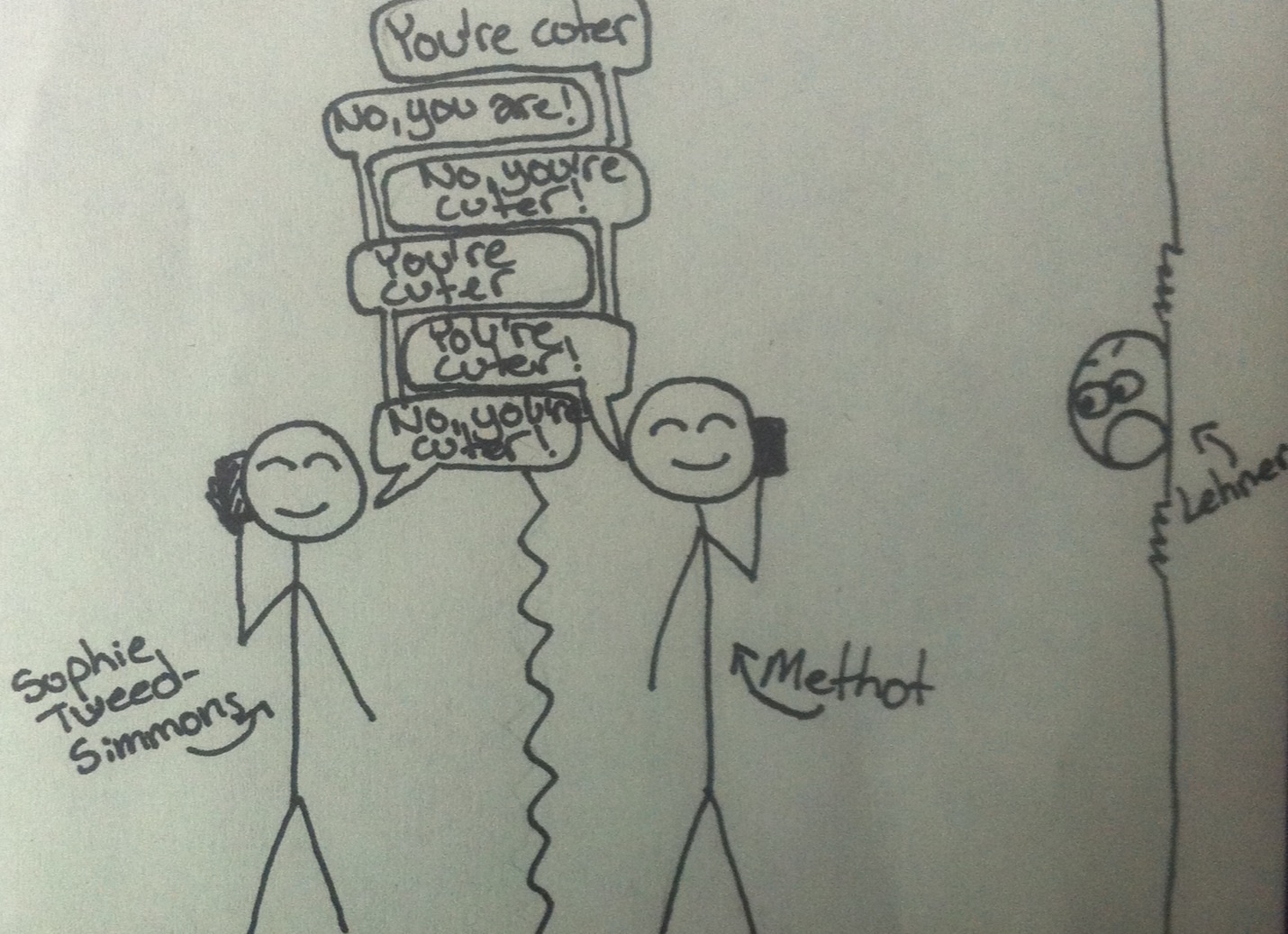

Tactic Talk, or a talk show in text format that is neither interactive nor anything like a talk show

Funny-Talk-Show-Is-he-cheating

In which James and Varada exchange emails about what changes Paul MacLean needs to make to Ottawa’s tactics to help them to be a successful, which is to say different, team of hockey players. Varada just kind of sets up the question and lets it hang there like a fart, but then James explores the studio space.

Varada:

The point at which analytics guys have to sort of try to imagine what it’s like to play hockey

It’s been quite the summer for analytics. I’m not going to run through all of the events, because it’s August, and every post on every hockey blog is hashing and re-hashing these events and extrapolating on the seismic shifts they imply. Suffice to say that the summer of 2014 marks the pre- and post- point in the hockey timeline, the point at which teams started systematically referring to evidence and trends in data to inform their decision making. (And, as a result, the fan community no longer has access to great sites like MC79 or Extra Skater. The price you pay, I suppose.)

There are a couple of interesting things here for the statistically inclined to consider. First was that while the blogging community got to be a part of something genuinely culture-changing, we are now in the post-implementation phase. How do we define ourselves now? It’s a little like the baby boomers growing up and bringing their anti-authority perspective to the corporate boardroom. Maybe it shook up the way people did business, but it also made dissent a little less meaningful. You can say fuck the system right up until they sell you a fuck the system t-shirt, y’know? We already have our share of people with proprietary metrics, trying to sell NHL teams on their turnkey solution. It doesn’t really feel like us against the world anymore.

It’s also a challenge because we have to think about the next phase of our discussion about analytics. It’s no longer just about looking at outcomes and saying “player x and clearly better than player y, so they should use him more.” I once read with Taylor Hall where he said he understood the concept of possession metrics, but hadn’t encountered a person who could explain how he should play differently to improve on those metrics. I don’t envy Tyler Dellow here. He might be able to identify trends in data that will help management make a decision on one player over another, but it’s a real challenge to understand how to translate trends into tactics. (Let alone explain it to a superstar player who went first overall and makes $6MM a year.) It’ll happen – video technology and zone entries are a step in that direction.

This is important for Sens fans to think about because we have a team that needs to shift tactics to win, and we don’t necessarily have the literacy to say how.

Flash back to two years ago – the lockout shortened season. Ottawa has positive possession metrics, and the second best goals against average, despite allowing more shots on goal than most teams. They enjoyed a series of improbable comebacks that generated the moniker ‘pesky’ (when I guess it could have been ‘lucky’). People start describing them as the second best defensive team in the league. They make the playoffs (as a 7th seed – still a bubble team in my books), beat the Canadiens (who they match up well against) and are summarily executed by the Penguins. Good stuff.

Everyone taps them as a team on the up and up, even a team that will win the Presidents’ Trophy, and we’re all psyched.

The next year the team is essentially the same. They allow even more shots on goal, but manage to stay a positive possession team because they also take a lot of shots. People start to talk about them as an ‘event’ team, one that creates a lot of on-ice events, both for and against. The goaltending regresses to league average, and boom: we’re on the wrong side of the bubble. Now people are writing knowing articles about how the season before Ottawa wasn’t in fact defensively sound, they just rode unsustainably hot goaltending through a small sample size of a shortened season.

So here we are, in 2014-2015, and Ottawa has lost their best offensive player. Their defense remains largely the same. There are many young players peppering the lineup who can trend up or down – they’re unknown factors. As a blogger out in the world, feeling his way around, I wonder if this team can survive playing the same brand of event hockey.

To their credit, they’ve talked about needed to cut down on the shots against, being harder to play against in their own zone, etc. This team simply can’t replace Spezza’s production with what it has, especially when having Spezza’s production last year wasn’t enough to get them into the show.

But here’s where it gets tough, because I don’t play professional hockey: how? What, tactically, can the Senators do to cut down on the shots against, but maintain the shots for? And do they even have the personnel to make the sort of tactical changes they need to make? They’ve spoken at length about needing to ‘try harder’ and be ‘harder to play against,’ but you know every other team in the league is also doing those things.

This, to me, is the first real test of Paul MacLean’s coaching. He needs to either change something fundamental about the system or double-down on what the team has done to date, emphasize hard work (even more), and root for lucky comebacks and great goaltending. I don’t mean that sarcastically – it’s probably easier to do, and doesn’t risk alienating the dressing room. But if at the end of this season Ottawa is bottom five in shots against and on the outside looking in, it’s going to take a draft lottery win for people to overlook the tactical gaps in Ottawa’s approach.

James, what does Ottawa need to do to improve? What possible changes can they make to tactics?

James:

Send Paul MacLean’s Evil Twin (creatively known on this site as Evil Paul MacLean) to a Dungeon in Grostenquin, France.

By reinstating Jack Adams winner Good Paul MacLean, he’d have the benefit of learning lessons from Evil Paul MacLean’s shortcomings such as:

Don’t put Neil and Phillips on the goddamn Power Play like, ever…fucking again. Even if the team is decimated by injury. Plz. & Thx. TTYL (not on the power play).

Look, I suppose to a degree I get what Evil Paul MacLean was trying to do there. It was early in the season, the team was really struggling to put it together and the coach got all, “If you’re not going to stand in front of the net like I asked, I’m going to put a guy out there who will [and I’m taking you all to hell with me].” If there’s one thing I appreciate about Chris Neil it’s that he WILL stand in front of the net. It’s a terrible but important job. Remember when Shea Weber injured two of our players in one shift with those deathclappers of his (one Cody Ceci sent off bleeding from the head despite wearing a helmet and the other Craig Anderson WHO’S A FUCKING GOALIE)? Celebrate the moments of our lives.

Anyway, I get that there might not be a list of volunteers snaking around the block to get in front of Erik Karlsson point bombs – though you could make a hell of a living doing it! But even still, just by merit of being on the ice, by reputation alone Neil is likely to be the first guy to take you OFF that power play than to score on it.

The use of Phillips is even more perplexing. He actually has an okay shot but it’s no secret that Big Rig haaaaates having the puck in his possession and as such has an underrated first pass due to making his exit passes lightning quick so the puck doesn’t have to be on his stick anymore. Hot potato hands is not exactly a fetching quality to have in your point man.

*Looks at post it note* Oh cool, Patrick Wiercioch scored more power play goals in his 53 games than Phillips did in the last two seasons…but that’s just me, boring old fashioned “I like goals on the power play James” (That’s what they call me).

Probably too late to mention this but I’m not even trying to turn this into a throw Phillips and Neil under the bus session. If MacLean’s going to tap them on the shoulder during the power play, it’s their job to hop over the boards and play. My problem is that our entertainment value suffers in order to “punish” the high skill players. In the end I felt our eyes were the ones truly punished.

Heyyyyyy the top line of Turris, Ryan and MacArthur has great chemistry!

Cool, cool…very cool…now if you can just go ahead and give the other players a chance to develop some chemistry by…I don’t know, how about letting them have more than a couple of periods to gel with each other. Yeah, that would be really great.

No one bore the brunt of musical chairs more than Jason Spezza did last year. I mean, look no further than the year he played the whole season with Greening and Michalek. Michalek is a good if inconsistent winger and Greening is…a human being.

Result of a season together: Milo a career high 35 goals (I know right? 35. That would be a career high for Bobby Ryan!) and Greening got a stupid contract earning 17 goals. Where was I going with this? Good luck in future endeavours Jason Spezza…I mean oops wait…Call me a crazy but allowing the players a chance to adjust to each other could posit results on the score sheet.

That goes for defensive pairings too. I feel like the only set defensive pairing the team had last season was Phillips-Ceci which, hey, makes perfect sense. Keep the rookie with the 36 year old with 1100 games under his belt. But despite carrying 8 defensemen, it seemed like pairings should have been sorted out by the end of the season but it still felt psychedelic. Of course the shuffling had something to do with players like, and I’m not going to name names here: Jared Cowen playing nowhere near where you’d expect a guy who held out for a new contract despite being offered 8 years (Bullet of committing a near decade status: Dodged).

Methot went from playing pretty much exclusively with Karlsson one year to what I like to imagine is Paul MacLean taking a huge hit from a bong and exhaling through his nose and saying, “You know what would be so trippy? Gryba-Methot…think about it man…it’s sounds like “Grabbin my thoughts” which is like, what the NSA is trying to right now, man. See, check it out, I was reading this article on Prison Planet…” And it goes on like this till the pizza guy gets there. Methot is speedy, left handed and defensively minded. PLZ play him with speedy right handed and offensively minded Karlsson. Crow all you will about EK’s defensive shoddiness, Cowen was the worst defensive player on the team last year…punish him, don’t promote him to the top pairing with a guy who takes a lot of risks. If it was up to me, I’d have swapped Cowen in and out of the lineup with Wiercioch depending on who was playing better. Then again, the goings on of Patrick Wiercioch’s love life are none of my business.

Don’t Have Last Year’s Schedule This Year.

Funny, because as rough as it was to start the season on a road trip and facing a host of powerhouse Western teams, the Sens did come back home with a .500 record. If that same road trip took place in say January, I’d think that a .500 finish was pretty acceptable. For the team, however, that’s got to be a pretty lukewarm way to start the season off morale-wise. What was worse was soon after they were back they had to play a bunch of those powerhouse West Coast teams again…and heyyyy, they lost to all of them. On top of that they blew a Saturday afternoon home game to the Oilers sparking a season long tradition of not showing up to very, VERY winnable HOME games because something something afternoon?

Phun Phakt: Ottawa didn’t win any of their weekend games in October. Period. The result? 4 wins on the month…CAUSED BY BAD BABYSITTING. As a big believer that the points you bank in October push you into May, Ottawa’s slow start may indeed have cost them a Wild Card spot. They ended the season only 5 points back of Columbus and Detroit. Who knows how it would have shaken in out in this alternate universe but had Senators managed 3 W’s in their 5 weekend games in October, things would no doubt have been a hell of a lot more interesting come April.

Analytics Are So Hot Right Now But the Sens Can Also Be Trailblazers By Being One of the First Teams in the NHL to Practice the Shootout.

Maybe it’s just a smoke screen in order to keep Don Cherry from publicly making fun of them for being a “BUNCHA SEXY FANCYBOYS” (his words) but that the Sens and a host of other teams claim to not practice shootouts regularly is a mystery to me and frankly kind of pisses me off as a fan. The shootout is new (not really) and controversial but like it or not it is AN ACTUAL PART OF THE GAME THAT LITERALLY DECIDES WINS AND LOSSES.

No stats available (sorry but it’s summer and I’ve got BBQing to get to. Thanks for reading tho!) but safe to say we got dummied in the shootout last season and lost out on a lot of points as a result. I pray to Jah that at least goaltenders get a pre-game rundown of their opponent’s top players’ shootout tendencies. If not, to me, that would be like a pitcher not studying batters’ swing tendencies pre-game.

On the bright side, Ottawa being one of the youngest teams in the league could bode well for them in this respect going forward. I tend to think that most forwards born in the 1990s or who hail from the Continent of Europe are at least half decent at the shootout (Proof: Jarrko Ruutu was pretty good at shootouts so…). The Sens have a few youngsters, Euros and even Euroyoungsters on hand who have some moves, so I don’t get why the coach wouldn’t devote some time for his shooters to sharpen their skills. Or for their goalies to sharpen up at stopping them (RobinLehnerRobinLehnerRobinLehner).

Summed up: Fancyboys = W’s

Actually Beat the Toronto Maple Leafs.

Yes, yes, yes, this one sounds petty and I can own that but you cannot lose every game of the year to a division rival that is actually worse than you and expect to be successful as a team. Especially when Ottawa already seems to have a tough time beating Boston, Tampa and Detroit. BTW for those of you currently hitting the Comment button (j/k, Spam only), no, I do not count Ottawa beating Toronto 1-0 in the 2nd last game of the season when both teams have been mathematically eliminated from the post-season as a win. I’m a tyrant like that. Beating this very mediocre crew at least half or more than half of the time (Dare 2 Dream) would do wonders for not only the Sens place in the standings but also my ears listening to dickheads in Phil Kessel jerseys* down at the rink who are forever talking a gang of shit like the team they like isn’t a complete embarrassment.

Idea: Have coach force Sens players take the bus from Scotiabank Place all the way back downtown after losing to Leafs to illustrate the shit they are putting their adoring fans through until they can start getting the job done.

*Note to Kessel jersey fellas: Hi, I know we like different teams and all but when we’re out there playing on the same side, try your best to remember that even though his name is proudly displayed across my shoulders, I’m not actually Erik Karlsson and it’s okay to pass to me when I get open in the slot instead of passing back to the constantly out of breath dude at the point because he is wearing a Van Reimsdyk jersey. You do it every time and it’s getting very weird. Have a great summer and see you in hell, James.

How about you, dear reader? What tactics can Ottawa employ? Feel free to hit the comments with, you know, actual hockey stuff about zone entries and player tendencies and such.

Sens extend notable, established NHL forward Clarke MacArthur…does that sound sarcastic? I’m being serious

macarthur-clarke2488

Pictured here with Chris Neil

Hot on the heels of locking up essential 11th defenceman Mark Borowiecki, the Senators announced (and by Senators I mean Eugene Melnyk on a conference call talking about something else) that they’ve signed Clarke MacArthur to a five year deal paying him less than $5MM a year.

I don’t think there’s much in the way of analysis needed here: it’s just an awesome signing all around. When you look at what NHL salaries are doing, and what they’re likely to do in the next few seasons, this is great value for a top six forward with great possession numbers who you know can play in your lineup. With Kyle Turris’ high value contract they’ve got 2/3rds of a top line locked down for about $8MM. So let’s take a moment and applaud management for a well negotiated deal.

MacArthur was heading to UFA status in a market where someone like Mikhail Grabovski – also an effective possession forward – gets $5MM a year. So he might have left money on the table here. But keep in mind that this is a player who wanted to stay in the area (I think that’s how Ottawa signed him to that first high value deal in the first place), and a player who, inexplicably, hasn’t really stuck anywhere. I don’t think MacArthur was treated like a core player in Buffalo, Atlanta, or Toronto. In Ottawa he played a career high in ice time (17:38 a game; his career average is 15:24), was trusted to play on the top line, and now he’s got the term to go along with it. He rewarded the team’s trust in him by signing for less.

So THIS is what they mean when they say “the deal has got to work for both sides.”

I’ve seen a couple of blogs talk about how players decline as they hit their 30s, and I think that’s fair. MacArthur also had a 15.1% shooting percentage last year, so I don’t think you’re going to see him light it up this season, or any season soon. (Or, as Melnyk put it, “tear up the ice” which…what?) But MacArthur is in that sweet spot of being a core player on a reasonable deal and yet not being considered a star. The expectations will always be just right for him. Put up 40-50 points; be defensively responsible; and don’t make too much money. The fans will never turn on you this way.

Judging by the fan poll over on Silverseven, you guys like the deal a whole lot. As of today a whopping 95% of the almost 600 people who’ve voted like the deal.

One wonders who’s next. I think when you have a whole host of pending UFAs, one contract can be a sign of others soon to come. It’s a signal that the team will spend to keep its core together. I’m going to guess the team finds a way to get Methot under contract, Anderson looks at the ridiculous goalie market and opts to sign cheaply to back up Lehner, and the Ryan contract goes quite a bit longer. I hope I’m wrong about that last one.

Posted in Uncategorized | 1 Reply

Sens extend notable, established NHL defenceman Mark Borowiecki for three more years

1297489652339_ORIGINAL

“You DO look like a Ninja Turtle!”

Yesterday Ottawa very quietly announced that they’ve made Mark Borowiecki a multi-millionaire.

21 NHL games played. 1 point. -2. About 70 penalty minutes. He has a Fenwick For percentage of 46%. (Yost has a good graph here. Basically Borowiecki is barely a replacement level defenceman, and already 25 years old.) He has little experience, little room to grow, and thus no leverage.

Better lock that guy up!

Seriously, this is bizarre, but still accords with the kind of team Ottawa tends to be. Ottawa locks up their young guys early, gives them relatively low contracts on the off-chance that they’ll reach their ceiling and provide value. It’s the kind of thing poor teams do, what poor teams have to do, to gain a competitive edge. The same logic was employed to lock up Jared Cowen, who’d never been a top four defenseman, on the premise that he would become one anyway, and Colin Greening, on the off-chance that he would continue to score goals and be able to play anywhere in the lineup. Sometimes it doesn’t work out.

And sometimes, as with Turris and Anderson, it does. When you get a player at value, it usually more than pays for when the bet doesn’t quite pan out. If Borowiecki turns into our sparkly new Matt Carkner, well, look at what Carkner signed for on Long Island. Borowiecki receives an extremely modest $100,000 raise every year, and will play about 10 minutes a night to show leadership / get punched in the face.

Furthermore, Borowiecki has paid his dues in the Ottawa organization. 185 AHL games, most of which spent as a leader on a competitive team. Maybe it sends a signal to the prospects that if you play the game the way management wants and you work hard enough, you’ll be rewarded.

Or maybe it sends the signal that the team values pugnacity and grit over skill. The bigger issue remains Ottawa’s decision to lock up all of these mediocre defensemen – it’s death by a thousand paper cuts. A bottom half of Borowiecki, Gryba, Phillips, Wiercioch and Cowen does not currently inspire fear. It doesn’t make much sense to give multi-year deals to bottom-half players. These guys are eminently available on the free agent market. How does Joe Corvo get a one year deal, and Borowiecki three?

Weirder is the timing of this extension. With high priority negotiations like Ryan, MacArthur, Methot and maybe even Anderson underway, Ottawa manages to squeeze in the time to extend a guy who isn’t likely to do anything this season to increase his leverage. I mean, whatever – way to be proactive, guys. But they pretty much just made the guy untradeable.

And I’m not trying to read too much into it (like, does the Borowiecki extension mean that Methot negotiations aren’t going well? That Gryba or someone else is about to be traded?).Or the fact that we just locked up a player who’s like a Chris Neil for the back end. Gotta get those quality penalty minutes throughout the lineup. But it’s weird. And as the summer of hockey analytics continues to roll out, seeing your favorite team make a totally weird move like this feels like we’re heading in the opposite direction.

Sens retire one of only three nice jerseys they’ve ever had after wearing it, what, twice?

168090524

The story is here, courtesy of Icethetics. (Scroll dooooooown.)

Apparently Ottawa won’t wear its off-white version of the heritage jersey in the 2014-2015 season. The word “retire” was even used. I think they wore it twice: during the heritage classic and once more, against Montreal.

As much as this summer has been an Ottawa sports pessimists’ wet dream due to financial issues, the departure of Jason Spezza, and the return of losing football to the capital, this – and I don’t want to seem hysterical here – is the worst thing since the Great Depression.

Why? I don’t need to tell you that Ottawa’s jerseys have had a propensity to suck. They’ve sucked for years. Other than the original jersey…

ALEXANDRE DAIGLE SENATORS

Player: unknown

…Ottawa hasn’t had a jersey you could be remotely excited about. It’s been on an Atlanta Thrashers level of quality, really. Check out Chet Sellers’ Summer of Disappointment post for Puck Daddy for all of the morbid details pertaining to the Senagoth / Starfleet uniform.

The 3D redesign isn’t horrible, I guess, so much as generic, and cheesy, and antiseptic, and soulless and aaaaarggh it’s horrible it’s so horrible. We’re not even getting into SNES with flying squirrel armpits. Man, our jerseys have been teeeeeerible. The team could have gone shirtless like the gladiator with mic problems and it would have been an improvement.

So it was with some excitement that Ottawa went from having, hands down, one of the stupidest uniforms in the league to….maybe, one of the best? Top ten at least? Maybe even top five if you eliminate original six bias? (C’mon the Habs are a C with an H in it. Boston is a B.)

The black heritage jersey was so good that we all took it for granted that eventually a white one would be introduced. And then the white one was so good we all took it for granted that they’d be our new primary jerseys, and our third jersey could be, you know, whatever who cares. (If there’s a god they bring back those originals, though they be cursed with a pirate curse.)

So it is equally surprising to hear…no? We’re going to head into the season with, yet again, the 3D SenHead? I know the NHL’s policy on new uniforms is fairly draconian and requires much synergistic coordination, so let’s hope this decision has more to do with timing and less to do with introducing yet another jersey.

Because I think we can all agree that if the Senators’ marketing department plans on introducing yet another jersey, that there is greater potential for yet another overdesigned, cartoonish, What Dads Think Their Kids Think Might Be Cool jersey than there is yet another knock-it-out-of-the-park good design.

Dudes: you’re sitting on gold here. You did it. You got to the finish line. You introduced jerseys that absolutely everyone – EVERYONE – likes. Just wear them!

What is the most money a team should spend on a single player?

NOTE: Due to a sorting error in my spreadsheet, I had the incorrect median EVP/60. Post corrected.

168090524

Handsome Shrek

It probably goes without saying that, in a cap league, a team’s allocation of money goes a long way toward ensuring depth. This goes doubly for poor teams with less money to spend.

It seems that the approach of most NHL teams has been to identify and lock up their core players, complementing them with a rotating cast of young players on ELCs, free agent veterans, and reclamation projects. This has led to situations where pending free agents, having delivered as core players, reap massive deals taking up huge percentages of the cap. In many cases, high-end draft picks are given huge, long-term deals on the basis of potential alone.

What’s interesting to me is how the perception of a player’s above-averageness is transformed from a relative salary-to-production scale to a less tangible premium. Every point (or point of possession) above the league average that a player produces costs more than a point toward the average.

The question isn’t whether a player like Jonathan Toews is worth $10.5 million, because that’s what any team with the means would pay Toews to play for them. In the strictest sense, a player is worth what the market will pay him. The question is whether any above average player is worth paying a premium for.

It’s not hard to see this applied to Bobby Ryan. If he gets paid north of $7 million by Ottawa, it will be in part because he’s good, in part because he’s a core player, and in part because Ottawa gave up a lot to get him and doesn’t have any other option. But if you question the underlying logic of why teams pay a premium for anyone, then what else could Ottawa do with that money?

If your allotment of cap space is $70 million, that gives you $3.5 million per player, per position. That’s a convenient breakdown; some articles peg the average salary of an NHL player at $2.4 million, and that was two years ago, when the cap was lower, so for the purposes of this article we’ll assume it’s about a million higher. (If anyone has a spreadsheet of all of the salaries in the NHL that allows for a quick average on the cap hit, please hit the comments section.)

One might imagine a team populated by $3.5 million players being decent, but would it be good enough to win a championship? To even make the playoffs? Let’s assume that every player making that amount was worth the money – this would be a team of Clarke MacArthurs, not Derek Engellends. What about then?

The thinking goes that you need a game-breaker: someone who can be relied upon to produce above the league average. In the absence of a hockey equivalent to baseball’s WAR stat – wins above replacement, or what a player produces relative to what someone else might have produced in their place – we’re left with imperfect measures of value. We have league average salary, league average and median point production, and league average and median possession metrics. It’s a bit like hitting the broad side of a barn with a tank shell and calling yourself a marksman.

Let’s look at Alex Ovechkin. I got some heat in the comments of my Worst Contracts post for calling him one-dimensional and not worth the money.

Alex Ovechkin – 2013-2014

Cap hit – $9,538, 462

EVP/60 – 1.74

Corsi For – 49.3%

Corsi Relative – +2.5%

NHL – 2013-2014

Cap hit – $3,500,000

EVP/60 – 1.29 (median)

Corsi For – 50.14% (average) 50.5% (median)

Corsi Relative – 0.08% (average) +3.0% (median)


So if the median even-strength-point-per-60-minutes is 1.29 and the average cap hit $3,500,000, you have a relative value of $2,713,178 for every averaged point-per-60. Similarly, if the median Corsi For is 50.14%, you should pay $69,805 for every positive point of Corsi For. In 2013-2014, Ovechkin received $5,481,874 for every averaged EVP/60 and $193,477 for every point of CF.

It’s an admittedly limited scope. We’re looking at point production here, not exclusively goal production, which is what Ovechkin is known for (especially powerplay goal production). You’d also have to account for other, non-performance factors: how much swag does Ovechkin sell? How many season tickets? Does a team full of league average players produce the same kind of brand loyalty as a team with a superstar and a bunch of role players? There are a lot of moving parts.

But the fundamental question remains: does it ever make sense to pay a premium for an individual player? Ovechkin is a generational talent, but is paid such an extreme premium that you have to wonder if he, or anyone, is worth it.

How about other superstar players? Ryan Getzlaf had the best EVP/60 at 3.12, and makes $8,250,000 per year, working out to $2,644,230 per average EVP/60. So, if you’re literally the best player in the league in this category, then you deliver value.

This isn’t necessarily stupid; being above average means being exceptional. A player who produces higher than average should be paid more for every point they produce above the average. However, the question remains: is it worth it to pay someone $8.25 million to produce above the average, or to use the savings to ensure higher rates of production further down the lineup, where you might have, before, only had the resources to spend league minimum on some plugs?

An interesting analysis would be to look at all of those players who are only slightly above league median and average in terms of point and possession production and see what sort of premium they receive. I suspect it’s highly variable, but that across the league teams pay their core talent a premium in order to lock them up long-term. Eric Staal’s contract is terrible. Kyle Okposo’s is great. But generally speaking, teams tie their identity to a group, and then are forced to overpay them.

So, what’s the alternative? Could a team actually populate a roster with $3.5MM players who produce 1.29 EVP/60 and 50.14% CF? Would anyone buy tickets to see a team like that?

It’s slim pickings on the free agent market, and those pickings would be made especially slim by the insistence of players that they go to teams who have star players because they’re perceived to be better. An easier method would be to draft and develop above-average players, only to trade them when they’re due their big payday for a package of average performers on average salaries.

What would Edmonton look like if it had traded Eberle, Hall, and Nugent-Hopkins for packages of value players instead of giving them $6 million a year each? They wouldn’t have high end players, but then they’d also not have Luke Gadzic at $800,000 or Matt Hendricks at $1.850 million in their bottom six. I guess the Oakland As and Tampa Bay Rays have been doing this forever, so much so that their fans don’t raise a stink when they trade away a star player just before his big payday.

The interesting thing is that the 2014-2015 Ottawa Senators are about as close as we’ll get to testing this theory. Outside of a few stinker contracts (Cowen, Greening, Neil) and one particularly high-paying one (Karlsson) the team is made up of players making league average salaries or less and producing at league average or more. If they spent to the cap, but on players in that $3.5 million / 1.29 EVP/60 / 50.5% CF range, it’s not hard to imagine them on the right side of the bubble.

Unofficial Leak: The Ottawa Senators Marketing Department’s Short List of Possible 2014-2015 Slogans (and The Accompanying Mid-Game Entertainment For Each)

[All credit here goes to Dusty, who left these in our inbox like that great coworker who leaves a thing of Timbits in the kitchen and doesn’t call attention to it because he knows they’ll be more delicious if you just find them.]

“Where’s Your RED At?” (A group of local dad-rock journeymen to provide a Sens themed interpretation of the immortal Basement Jaxx party jam.)

“Bringing Out The RED” (in tribute to the classic 1999 Nicolas Cage/Ving Rhames film, the zamboni will be outfitted to look like an ambulance and the harmonica riff from “TB Sheets” will be played when goals are scored)

“Capital Funishment” (Spartacat wears an executioner’s hood, carries an axe. Pretty straight forward stuff, this one writes itself.)

“This Town Needs a REDnema” (to feature a fun ‘between periods’ video of the “Partyman” scene from the 1989 Batman movie, but instead of portraits, the video is edited to look like the Joker is painting over pictures of rival hockey players. It’s a tall order, but I think the Sens’ in-house AV dept. is up for the challenge.)

[As an aside: can we have a conversation about “Batdance?” This is Prince at his trollingest, right? It’s seven minutes long. He’s dressed as the Joker, but with Two Face makeup on. He starts the song by saying “Get the fuck up!” And despite all of this, he still manages to shoehorn in a legitimately brilliant and sexy part, which is of course the breakdown with the troupe of Vicki Vales. If you think Prince wouldn’t be up for being involved in an Ottawa Senators promotional campaign…well, Batdance.]

“Death SENtence” (ignore this one, this was just an early draft of “Capital Funishment”.)

And now, your 2014 All Good Contracts Team

Benn, Jamie »

$5.250MM

Dallas

Seguin, Tyler »

$5.750MM

Dallas

Oshie, T.J. »

$4.175MM

St. Louis

Kane, Evander »

$5.250MM

Winnipeg

Tavares, John »

$5.5MM

New York Islanders

Van Riemsdyk, J. »

$4.25MM

Toronto

Boyes, Brad »

$2.625MM

Florida

Turris, Kyle »

$3.5MM

Ottawa

Stempniak, Lee »

$900,000

New York Rangers

Roussel, Antoine »

$2MM

Dallas

Goc, Marcel »

$1.2MM

Pittsburgh

Moss, David »

$800,000

Arizona


Keith, Duncan »

$5.5MM

Chicago

E-Larsson, O. »

$5.5MM

Arizona

McDonagh, Ryan »

$4.7MM

New York Rangers

Shattenkirk, K. »

$4.25MM

St. Louis

Gilbert, Tom »

$2.8MM

Montreal

Volchenkov, Anton »

$1MM

Nashville


Neuvirth, Michal »

$2.5MM

Buffalo

Lack, Eddie »

$1.150MM

Vancouver

I thought, as a corollary to last week’s All Bad Contracts Team post, I would take a stab at the best contracts.

Rules:

  • No ELCs. Otherwise it would be too easy to stick half the top five picks from the last five years in a chart and call it a day.
  • I still adhered to the salary cap. This was especially a challenge without ELCs, and explains why I had to leave off guys like David Backes and Johan Franzen, who would be improvements over, like, David Moss. I also think that Erik Karlsson has a great contract, but I was trying to find an extra million, so I picked Ekman-Larsson at a million less.
  • The contact has to represent value. For example, I think Duchene is totally worth $6MM a year, and he’s a pretty good number one center. But I also think he’s being paid fairly.
  • I tried not to include too many deals where the player received what was perceived to be value at the time, and seems low by today’s standards. Were Sidney Crosby up for a new contract now, he’d get Kane / Toews money. But he was only paid slightly below market value at the time.
  • Goaltending is a bit of a mindfuck. In the last few years, starting goaltenders have been getting paid. Rask, Quick, and Crawford are all going to take up about 10% of your cap right away. I’ve long been a proponent of affordable goalies, given that it’s a crapshoot of a position. So, with that in mind, Eddie Lack had pretty good numbers last year, and Neuvirth is a league average goalie making average money. I also considered Anderson at just over $3MM, Jonas Hiller at $4.5MM, and the biggest mindfuck of all, Luongo at only $4.5MM.

These guys in total come in just under the cap at $68.6MM.

Omissions? Protestations? Hit the comments.

Your 2014 All Bad Contracts Team

Nash, Rick »$7.8MM

New York

Staal, Eric »$8.250MM

Carolina

Ovechkin, Alex »$9.5MM

Washington

Cammalleri, Mike »$5MM

New Jersey

Lecavalier, V. »$4.5MM

Philadelphia

Semin, Alexander »$7MM

Carolina

Umberger, R.J. »$4.6MM

Philadelphia

Horcoff, Shawn »$5.5MM

Dallas

Callahan, Ryan »$5.8MM

Tampa

Filppula, V. »$5MM

Tampa

Bolland, Dave »$5.5MM

Florida

Neil, Chris »$1.9MM

Ottawa


Streit, Mark »$5.25MM

Philadelphia

Myers, Tyler »$5.5MM

Buffalo

Johnson, Jack »$4.35MM

Columbus

Wideman, Dennis »$5.25MM

Calgary

Engelland, Deryk »$2.9MM

Calgary

Gonchar, Sergei »$5MM

Dallas


Ward, Cam »$6.3MM

Carolina

Pavelec, Ondrej »$3.9MM

Winnipeg

Just for fun on a Friday afternoon, I thought I’d put together an All Bad Contracts team. Here’s what I’ve got. Omissions? Protestations? Hit the comments!

Teams with the most representation: Philadelphia, and Carolina have three turds apiece. You might also include Columbus, with one contract of their own (Johnson, though it was given to him by Los Angeles) and two they gave to players on other teams (Umberger and Nash). Calgary has some stinkers in there, and I almost included Jonas Hiller, which would have qualified them.

The cap hit for this team is $108.8MM, or about $39.8MM over the cap.

Up front you have a trio of declining superstars. It might be controversial to include Ovechkin, given the goal-scoring hardware he’s racked up, but I think with all of the money they’ve sunk into his contract and the fact that he’s basically a powerplay specialist with zero accountability at this point, his might actually be the most disastrous contract of the bunch. He’s signed until 2021, and makes $10MM a year in cash for the next seven seasons.

For the most part, I hesitated to include superstar deals. You won’t see Kane, Toews, Perry, Getzlaf, Crosby or Malkin here. When a franchise player is due a new contract, I feel the team often doesn’t have much in the way of leverage. Columbus couldn’t really give Rick Nash, who they’d built their entire identity around, less than they did. Same for Carolina and Staal. So I don’t blame them too much, but in the cold light of 2014, these deals still look awful, and will only get worse with time. These three guys in particular exemplify the sort of line that can produce points, but nowhere near tantamount to their salaries.

Our second line guys don’t seem too, too egregious until you bunch them together. The fun thing is how these $4MM-$5MM guys, if couched on a line with low-cost ELCs, or other high-value contracts, don’t seem too awful. They’re NHL veterans, after all. But taken together…that’s $16.5MM, or about a quarter of the total cap allowance, for 124 points last year. Semin’s an elite possession driver, but had only 42 points last year, and missed about 20 games to injury.

The third line is made up of character guys you wouldn’t kick off of your team, though they’re overpaid in the extreme. The Callahan deal is especially bad. Yzerman was backed into a corner of wanting to show something for the Martin St. Louis deal, and so gave Callahan too much term and cash. Like Umberger, he’s a leader-y guy making elite production money. Horcoff isn’t particularly good at hockey anymore. (Though I guess it’s worth noting his pay is a couple mill below his cap hit.)

That fourth line is legitimately awful. Bolland and our own Chris Neil bring literally nothing to the ice for that money. Bolland’s deal was the laughing stock of the UFA period this year. Filppula isn’t a bad player, but it’s hard to understand why Yzerman had to give a complementary scorer in Detroit so much to coax him to Tampa to play with one of the best players in the world in Stamkos.

The process of putting together this team helped me to understand how much leeway Yzerman has received over the past couple of years. Yzerman gets a lot of praise for transforming Tampa into a quasi-contender (if third last in the league followed by a first round sweep counts as contending, which it doesn’t), but he’s spent enormous amounts of owner Jeff Vinnik’s money doing it. Every UFA period, he’s right up front handing out long-ish deals to players like Matt Carle, Anton Stralman, Callahan, Filppula, and Boyle. Right now they’re over the cap by almost two million. If Tampa doesn’t do something soon, the shine is going to wear off. Especially when he has to give Stamkos a billion dollars.

On the back end, you have a whole lot of cash spent on a whole lot of mediocrity. No one is really out-and-out awful, except for Deryk Engelland – the rare Defenseman Enforcer! Because you really want to be down a defensemen when killing off a major penalty. Jack Johnson is a noted possession black hole who makes everyone around him worse and is signed until the end of time. Tyler Myers illustrates the problem of signing someone for their potential. Gonchar is 200 years old.

And in net, Cam Ward was 47th in the league in SV% last year, a stunning .898 average, and makes over $6MM a year. That might be the worst contract in the league right there. Pavalec’s trials and tribulations have been well documented. He’s signed for two more seasons after this one, which is amazing.

So…how do you think this team would do? Depending on whether they’re in the West or the East, I think they have a shot at the playoffs. But they’re likely going to miss, and spend a fortune doing it. See, Ottawa? It could be worse!

Giant Sized Summer Special: Is Ottawa more defensively responsible now than it was last year?

mt3

There’s no need for a set-up. Just take a look at last season’s team stats:

  • Goals-per-game: 2.79 – 11th in the NHL
  • Goals-against-per-game: 3.15 – 27th in the NHL
  • Powerplay: 18.4% – 14th in the NHL
  • Penalty Kill: 80.9% – 22nd in the NHL
  • Shots per game: 32.8 – 4th in the NHL
  • Shots against per game: 34.7 – 29th in the NHL
  • Fenwick for percentage: 50.8% – 13th in the NHL
  • Shots for percentage: 49.1% – 20th in the NHL

At a glimpse, the 2013-2014 Ottawa Senators were a team that could score, but couldn’t outscore their opponents. Both coach Paul MacLean and GM Bryan Murray have stated on multiple occasions that the goal for the coming season will be to cut down on the number of shots allowed, possibly at the expense of some offense. So let’s take a look at our new lineup, the moves made, and whether it’s reasonable to expect a more defensively responsible team this season.

Assuming a lineup:

Obviously there are a lot of moving parts here. Let’s presume that Stone and Hoffman will be given a chance to compete for a top six spot, with whomever is cold being bumped down to the bottom six. I’m also assuming that the team doesn’t destroy Lazar’s potential by allowing him to be cast as savior of the franchise at 19 and given top minutes right away. (Though we can assume he’ll get some games during the season, possibly those first nine games before he must be sent down without burning a year on his ELC.)

The top line of MacArthur – Turris – Ryan will almost definitely stay intact. The rest of the lineup, without a go-to offensive catalyst (unless Hoffman and Stone are those guys) will be some combination of Michalek, Legwand, Chiasson, Hoffman, Stone, Greening, Zibanejad, Condra, Smith and Neil.

Curiously, the defense remains much the same as last year: Karlsson with Methot or Cowen, Ceci with Phillips, and Gryba, Wiercioch and Borowiecki all duking it out for about 8 minutes of ice time.

Anderson spends another year checking his brake lines and Lehner spends another year awaiting the Hour of Ascension of the Beast.

The O:

The biggest change here is the loss of Spezza and Hemsky and the addition of Legwand and Chiasson. Though the way the players will be paired and used will be variable, that we lost a center and winger and then gained one of each, and that not much else changed with the team, makes it possible to do some direct comparisons and see if we’re indeed any more defensively responsible.

Jason Spezza and David Legwand comparison [all stats from here on in via Extra Skater]

Spezza scored 15 more points than Legwand in eight fewer games, though he received about a minute more of ice time per 60 minutes of play, had a higher shooting percentage, and more favorable zone starts.

Interestingly, while Legwand is being cast as a two-way forward – I called him a plug on our last podcast – he played an enormous amount of time on the power-play – almost as much as Spezza did – and way less time on the penalty kill as Spezza.

Also interesting is that Legwand and Spezza played with a similar quality of teammates and against a similar quality of competition. They are within 0.3% of each other in both regards.

Spezza’s Corsi relative was slightly negative, where Legwand’s was slightly positive, though both are within 0.5% of each other.

The players also had a comparable PDO, around 97, which means one might expect a slight bump in numbers for both as they rebound to league average on-ice save percentage. They had extremely similar penalty differentials, with each taking just under 20 more penalties than they drew.

The only really big discrepancy is their shots per 60 minutes of play, where Legwand produces almost four fewer shots than Spezza.

It’s no surprise that Legwand is not as offensively capable as Spezza. But my takeaway here, and what people might not know, is that the two players have been used in very similar ways, and Legwand hasn’t been a defensive standout in that time. Perhaps as a result of a lack of center depth in Nashville, Legwand was employed as their principle playmaker. Far from being your reliable utility forward, he was relied on to produce offense, and his ice time reflects that.

Another way of putting it is that Spezza didn’t have it much easier than Legwand. And while Spezza was slightly deficient defensively compared to Legwand, he more than made up for it in terms of shot and point production. With Spezza you end up with a net gain in production; with Legwand, perhaps not so much. So, for those subscribing to the idea that Ottawa swapped out an offensive dynamo for a defensive one, while you might be technically right that there’s a difference, you still have a net loss over the course of a season in terms of production. Legwand isn’t that much more responsible, but he’s a whole lot less dangerous offensively. This is borne out by their overall Corsi differential, which is fairly substantial; Spezza’s is almost three full points better, which is significant in Corsi Land. After all, you don’t care how a player produces possession, just that they do. Be careful what you wish for, Sun readers – you have your hard working, loveable plug now.

Now, this doesn’t account for how Ottawa may choose to use Legwand in this upcoming season. Maybe he flourishes as a utility forward, when he isn’t expected to produce any offense. But there’s a big enough body of evidence to suggest that Legwand, while a legit top six NHL forward, is not an improvement on Spezza at all. Ottawa fans might like bringing in Legwand because he’s a veteran, gritty, and so on, but they better hope those intangibles translate into effects elsewhere.

Of course the big plus for Ottawa is that Legwand is $2MM cheaper than Spezza this season and on a short-term deal. He costs half as much as Spezza, and there’s no expectation from his camp that the team re-sign him for six to eight years after next season. If Ottawa management were pouring those savings into other areas, we might be able to justify the switch. But, as we know, they’re not. For now, this biggest benefit of this swap is to Melnyk’s bottom line.

Alex Chiasson and Ales Hemsky comparison 

Maybe it’s not fair to do a direct comparison between a 14 year NHL veteran and a player with the equivalent of one season under his belt, but Ottawa lost a top six player and traded for someone who, in their mind, was another, so the comparison stands.

And, much to my surprise, Chiasson actually doesn’t do too badly. Though he scored 8 fewer points in four more games, he generated about as many shots per 60 minutes in about the same amount of ice time, against comparable competition, and with a comparable quality of teammates. Their Corsi was almost identical, though on the other hand Chiasson’s teammates outperformed him. (Though on the OTHER other hand…Dallas was a top ten possession team last year, so that ain’t so bad.)

Chiasson’s PDO was two points lower, too, suggesting a slight bump up, potentially narrowing the gap in their offensive production even further. Even though Chiasson did enjoy significantly more powerplay time than Hemsky, all else being equal it’s reasonable to expect them to produce similarly next year.

Over a full season, while Chiasson is a slight downgrade on Hemsky, it’s not as big as I initially thought it would be. When coupled with the fact that he’s making less than 1/4th what Hemsky is making on his entry level contract, this is a high-value swap. (Again, assuming those savings would be funneled elsewhere which yadda yadda yadda they won’t be.)

You might expect a marginal decrease in production here, but I’m far less concerned than I am about the use of Legwand over Spezza.

The Youngins:

One unknown here is whether Stone, Hoffman, and/or Lazar can step into top six roles and contribute. We don’t have the numbers for Lazar, and looking at Stone and Hoffman, neither of them have huge sample sizes from last season.

But both produced great Corsi ratings, both overall and relative to their teammates (Stone’s is particularly good). Neither saw strong competition, indicating some degree of being sheltered, and their PDOs were almost smack average (Stone’s is actually a point higher) so we shouldn’t expect a huge swing in regression to the average.

What’s interesting is that while both players’ underlying possession numbers are good, this didn’t translate into particularly impressive point production. There’s a couple of ways we can interpret this.

Either these guys will learn to finish (which one hopes comes with experience) and translate those shots and possession into points. Or they’re both essentially versions of Erik Condra – strong possession players who can’t finish to save their lives. Or they simply haven’t been put with the right linemates to translate possession into goals.

Small sample size, again, but their strong possession numbers imply that they can contribute to the team, especially if they take away minutes from other bottom six players whose careers are in decline – see Greening, Colin and Neil, Chris.

The D:

The horror show begins…

Nothing terribly novel to say here. There wasn’t much in the way of change on the backend for Ottawa. The most notable changes here are that Mark Borowiecki’s contract becomes one-way, and that Eric Gryba was re-signed to a one-way deal. Neither of them are particularly good. That management seems especially high on Borowiecki because he, I don’t know…sticks up for his teammates or whatever, seems like more evidence of old-schoolism at play. Oh, and they also let Joe Corvo, the weirdest fucking signing of last year, walk. Which, you know…great.

The result: a glut of bottom pairing defensemen on a team that allow more shots than almost any other team last year. Beyond Erik Karlsson and Patrick Wiercioch, no defenseman did particularly well in terms of possession.

I won’t really look at Erik Karlsson. (Spoiler: he’s good!) Borowiecki doesn’t have huge sample sizes. That leaves Cowen, Methot, Phillips, Ceci and Wiercioch.

Jared Cowen, as has been well-publicized, was atrocious. In a good-PDO year, his penalty differential was terrible, and he had the lowest shots per 60. (Though he didn’t get much in the way of power play time, and was relied upon to clear the crease and wave his stick around like a dowsing wand.) His possession stats weren’t as bad as I expected, though they were mediocre.

Chris Phillips is also trending downwards and was inexplicably renewed. He was sheltered, but also had the worst PDO of the group. That means he might rebound slightly, if his regression doesn’t more than erase that rebound. The best case scenario seems like one where he’s still barely, BARELY, a 3-4 guy. Like everyone has already said: why did this guy get two years again?

As has been mentioned on this blog and elsewhere, the banishment of Patrick Wiercioch to the press box for huge chunks of the season was totally mysterious. He’s a strong possession player, producing more shots per 60 than any of the rest of the group. Maybe it was the plethora of left-handed shots on the team, but playing Cody Ceci and Jared Cowen over Wiercioch is just one of those things we’ll have to chalk up to the coaches and management knowing something about him that we don’t. Stop smoking meth, Patrick Wiercioch.

However, Marc Methot wasn’t nearly as bad as he was made out to be, having been divorced from Erik Karlsson from much of the year. His possession stats were respectable, and here’s hoping that his ice time is restored. It might not be enough to remove this team from the bottom of the league in terms of shots against, but given the apparent lack of forthcoming changes to the defensive corp, it’s a no-cost move. Ottawa just needs to use what they have more effectively. You could argue that we used up last season to develop Cowen.

Goaltending:

Not much to say; both had below league average save percentages, but only by about .03% – and that’s impressive considering the number of shots they faced. Anderson saved the team’s bacon in the shortened season with a legendarily unsustainable hot streak, and when he came back to earth this year, the team suffered. No surprise there.

Lehner played more games than ever before, and should continue, in this last year of Anderson’s contract, to shoulder the load unless the team falls quickly out of contention and they play Anderson in order to bolster his trade deadline value. Anderson has been a warrior for Ottawa though, and continues to be a workhorse on a mediocre team. If he’s willing to re-sign on an affordable deal to play backup to Lehner, I think the team has to explore that. Any other goaltender’s head would have exploded facing 45 shots a night.

That top line:

I know the chemistry between Turris, Ryan and MacArthur was a pleasant surprise, and that Ryan was playing with a hernia or something, but we should temper expectations for next season. This line had a consistently high PDO, which means regression to the mean. Turris, who will now be expected to be the team’s number one center – there’s really no other option – may have it especially hard, seeing his quality of competition skyrocket as teams no longer have to worry about matching up against Jason Spezza.

It’s not all doom-and-gloom – between Turris being a still-young and developing player, and Ryan healing, you may get a wash as they regress. But for those hoping that the top line is going to pick up their game in the absence of Spezza and Hemsky, the odds aren’t very good. That doesn’t mean they’re a bad line – all three have excellent possession stats. But from a team perspective, I’d expect their production to hold where it was, and thus the team still ends up with a net loss in production.

Tactics:

There’s a huge X factor here, which is Paul MacLean’s coaching. That’s obviously where our publicly available stats fall short. We know how players have traditionally be used. We don’t know how they will be used.

We may assume that MacLean will continue to preach an up-tempo style combined with a “whole rink” “hard work” mumbo jumbo voodoo combo that pretty much every single NHL coach insists on. But we could be wrong. Hey, even Bruce Boudreau – one of the most successful possession coaches in the league over the last decade – changed his style to be more “defensively responsible” after his Capitals teams experienced some playoff disappointment.

Maybe MacLean discovered something this summer while sitting on his dock staring out into the water and he’ll bring a Dr. Strange-like epiphany home that makes Jared Cowen not pivot like a dump truck. Don’t ask me. I just traded for Jagr in NHL 2014 and scored 56 goals with him. Have you tried turning down the difficulty, Paul?

The rest of the division:

Boston and Montreal look very good, like locks for the post-season, though Boston may start to decline slightly. Tampa upgraded hugely this year, though they were second last in the league the year before and were swept out of the first round this year, so who fucking knows with that team. I think they’ll be pretty impressive. Detroit is pretty much in full decline, but they have the horses to make it in the weak east. Toronto didn’t change much, and are due for a weak season given their underlying possession stats. Florida and Buffalo are awful.

That puts Ottawa pretty much where they were last year – 5th in the Atlantic, and on the outside looking in.

In conclusion:

My takeaway here is that Ottawa can expect a lower offensive output from their forwards this year, based solely on the huge disparity between David Legwand and Jason Spezza. Worse, perhaps, is that the assumption that Legwand and Chiasson are significantly more responsible than Spezza and Hemsky just doesn’t hold up. If anything, they’ll slow the bleeding and save the franchise money, but that’s it. The team will end up with an even larger net loss in production.

For this version of the Ottawa Senators to produce a net gain in goals, they’ll have to do the following:

  • Shore up their bottom six. Letting Matt Kassian walk is an automatic improvement. Zach Smith, Colin Greening and Chris Neil got killed last year, and took way, WAY more penalties than they drew. (Especially Neil.) Relying more often on Zibanejad as your third line center, and one or both of Stone and Hoffman in place of Neil and Greening should help turn around the bottom six’s production. If we see Neil and Phillips on the powerplay again this year, we may as well just start researching the draft.
  • Take Patrick Wiercioch and Marc Methot out of the doghouse. I can understand that if Jared Cowen develops into a top-two or top-four defenseman, one season of growing pains is going to seem like a small price to pay. But given he didn’t have a down-on-his-luck-year last year and still sort of stank, one hopes that development and continued healing from hip surgery contributes to better play. If not, then play the horses you have.
  • Do whatever it is you do to make young players develop. Ottawa might not be able to sneak into the playoffs if Stone, Hoffman, and Ceci all stay where they were next year. It would help if Zibanejad, a blue chip prospect, took a step forward and was given more responsibility.
  • I don’t look at penalties much in this post…but holy hell did Ottawa take a lot of them. Again, and probably for the millionth time, playing Chris Neil and Jared Cowen a bit less will help in this regard. MacArthur took a lot of penalties, but made up for it with production. Neil and Cowen…not so much.
  • Shootouts. Ottawa was 7-7. Not bad – actually right in the middle of the league, so they personify league average. But with a little luck in this total crapshoot of a standings rigger, they could make up the gap.
  • Go shopping. In the last few weeks we’ve seen Nashville pick up three players legit NHLers for about $3MM total, any of whom could have shored up Ottawa’s depth or sat in the press box for less than it cost to sit Wiercioch last season. I’m especially bummed that Ottawa wasn’t interested in bringing back Anton Volchenkov. He was a fan favorite when he was here, nobody resented his choice to leave for term in New Jersey, and he brings exactly what the team needs. At this point there’s not a ton left – Mike Del Zotto, Dustin Penner, and David Booth all look like they could contribute in a depth role – and the market has been set at about one year, $1MM.

In the end, the team is not going to bottom out. They’re a bubble team who can finish anywhere from 12th to 6th in the standings in the East, barring any massively unsustainable runs of good or bad luck. The team will produce a similar result to last year, but they’ll save more money doing it. And that’s good news for Eugene Melnyk, at least.