Keeping Melnyk out of the papers…

New-York-Islanders-The-Team-Wallpaper-

“You can’t have it both ways and say, ‘Well I want this for me, but I want you to do this with me and the team.’ It’s ‘which one do you want?’”

And with that statement in his latest Citizen interview, Senators owner Eugene Melnyk broadcasts to every player in the league that Ottawa is never going to be the kind of place where you’ll be paid market value while, at the same time, it aggressively improves. He may as well have said “Actually, you can have it both ways. You just have to play somewhere else.”

It’s debatable whether Detroit is better than Ottawa. On paper they look pretty close. But in Detroit, they signed all of their premier players for fair market value, and were still able to make additions this off season. They added Stephen Weiss and Alfredsson while already having locked up their core–Zetterberg, Datsyuk, Kronwall, Howard, and Franzen.

Now, you could argue that these decisions will be Detroit’s undoing. They gave Weiss an annual cap hit of $4.9 million for five years, which is a big commitment to someone who could end up being their third line center. They’ve locked up older players on long terms, and barely made the playoffs last year even before these players started to hit their declines. Detroit may have really painted themselves into a corner here.

But that’s not the argument that Melnyk is making–in the dead of August, when everyone will hang on his every word, he’s not saying “It’s just not smart hockey to do what Detroit is doing.” The argument he’s making is that Ottawa is a poor team, and will never be able to spend the way a team like Detroit can. And the numbers bear that out–Detroit is spending about $13 million more on salary than Ottawa.

All of which is fine–this is what the game is like in a smaller market. But my point is that Melnyk has literally nothing to gain, from a hockey perspective, by going to the papers to talk about how poor he is. He’s branding the team an also-ran: the last place you should think of signing if you’re a free agent who wants to play for a contender.

(Of course he does have non-hockey related goals, which the Citizen story mentions: “[Melnyk] has been aggressively lobbying Ottawa city council to back his bid to bring a new casino to land around the newly named Canadian Tire Centre, which would add another revenue stream to the hockey and concert dollars that flow in.”)

Optics are important, and it doesn’t matter that Detroit finished in the same position as Ottawa last year, and it doesn’t matter that, on paper, Detroit is about even with Ottawa in terms of talent for the coming season. Just look at Alfie’s comments:

“I didn’t really see myself making a change, if you had asked me a week ago […] But then thoughts started creeping in. Everybody knows Detroit’s goals are always to be at the top of the game and to win championships and they’ve done that in the past.

Ottawa is clearly getting value from their players at the moment, fielding a competitive team with the third lowest payroll in the league. But this doesn’t bode well for the future; Michalek goes UFA next year, and Spezza and Ryan the year after that. The team’s entire top line could be gone, not because we can’t afford to pay one or two of them, but because those players know that if they receive market value they’ll also have to be content to play on their own. There won’t be any reinforcements coming. The owner just said so, effectively tying one of his GM’s hands behind his back for the coming negotiations.

Melnyk never seems to learn. He has nothing to gain when he goes on the radio or in the papers and spouts off about forensic studies and Leafs fans, except, I suppose, that it’s gratifying to be invited on the radio simply because of who you are. But it’s not just a rich guy surrounded by yes men occasionally making an ass of himself; he actually hurts the team with his unchecked comments. You send a message to your players when you’re prepared to spend, and if you’re not, then the least you can do is stay the hell out of the damn papers.

[Update: the stories about this are everywhere this morning. Travis Yost summarizes particularly well:

“…in an interview with the Ottawa Citizen, Eugene Melnyk more or less contradicted everything said by both the general manager and departed captain, and Melnyk’s story seems to jive pretty well with what’s believed to have really happened behind closed doors.

[…]

So, did Bryan Murray lie to the player when he represented that the team could sign Daniel Alfredsson and bring in additional talent, or did Bryan Murray lie to the media when he represented that the team had suggested as much to Daniel Alfredsson? One of those is a certainty. We just don’t know which one. Yet. ”

Over on The Score, they’re asking if Ottawa is “Nashville or Phoenix North.”  One stupid interview by the blabbermouth owner and he makes his own GM look like a liar and the team look like an unstable commodity when this should be one of the more exciting seasons in years.

And just like that, because it’s August and Melnyk apparently doesn’t have a press secretary, the team has yet another distraction. It’s only a matter of time before the players start getting dragged into it.]

The cost of doing the NHL’s business

940-optimism-8col

Given the 2012 lockout, it should come as no surprise that I’ve spent some time thinking and writing about profitability in hockey over this past year. As various contracts are signed and new developments emerge, I occasionally referred back to those old posts, and it occurred to me that August—the dead of hockey winter—is the perfect time to try and consolidate all of my thinking on this subject into one big post. It’s something I’ve wanted to do for some time; but given recent news around the Minnesota Wild, I finally found myself inspired enough to do some typing.

So, without further ado, I present to you: an English major trying to write about hockey economics. Enjoy!

The cost of doing business v. underlying value

Last week, the Minnesota Wild reported a loss of $30 million during the 2012-2013 season. This figure seemingly verifies predictions made during the 2012 lockout, especially by ownership hawks like Wild owner Craig Leipold, who sought cost certainty even if it would come at the expense of half a season of hockey.

That $30 million number, at a glance, is alarming; the Wild play in an established hockey market, they made the playoffs last year, and they have an intriguing mix of veteran stars and terrific prospects. If even they, in those conditions, can incur such a loss, then were the hardliner owners right to be so gloomy?

But we should be cautious when speaking about snapshot reports, because those reports—looked at in isolation, often released at strategically opportune times, and only presenting a few of the many factors that describe a franchise’s ability to produce value—are, and have long been, the ammunition NHL owners use to negotiate for increasingly favorable terms.

It’s important not to speak only of short term losses without also looking at the underlying value of the investment. To say that a hockey team is only losing money is not unlike buying stock and treating it as a loss because the money is no longer in your bank account. Unless the value of the stock is decreasing too, nobody would refer to your investments as a loss. But it’s become routine for NHL owners to do just that—reporting exclusively on operational costs without also talking about the health of their investment. Perhaps more troubling, some in the media breathlessly report these losses without providing additional context, creating cognitive dissonance with Commissioner Gary Bettman’s own triumphant announcements of soaring league revenues.

While we don’t have access to ownership’s valuations, Forbes does release their own estimates of the value of each NHL franchise. If you remove the outliers from the list—the top and bottom five franchises, which either gained an exorbitant amount of value, saw no growth, or saw losses—your middle 20 franchises increased in value between 1%-16%, or an average of just over 7% on an average value of $235 million. So even if your franchise experiences moderate growth of about 5%, the underlying value of your franchise is increasing by about $12 million year-over-year. As anyone with a sad little RRSP will tell you, a 5% annual return on an investment is nothing to scoff at, and if you can keep your operational costs under that annual return more often than not, you’re not “losing money.”

Which isn’t to say that it isn’t challenging to maintain liquidity. Most businesses with operating costs in the tens of millions are heavily leveraged—which is to say, their owners borrow money to fund costs and bide their time while underlying value builds. And we did just go through an international financial liquidity crisis where no one was able to raise capital. Appreciative value—or the lack thereof—sunk the housing market in 2008. (Though then again, most mortgage owners didn’t go into the transaction knowing that they’d have to cover operational losses through ups and downs, and the bubble that burst was a pretty big one.) It’s a challenge, to be sure—but again, to paint NHL franchise ownership strictly as a money-losing endeavor is to only look at one small aspect of the transaction. That NHL owners were willing to suffer through not one, but two lockouts, should imply that they’re more than willing to take the long view on their investment.

Hockey related revenue v. everything else

So far, we’ve only talked about the cost of owning a franchise contrasted with the value of the franchise itself. But what about other investments that aren’t necessarily hockey related, but are only possible because you own a hockey franchise?

Hockey related revenue became a bit of a dirty word during the lockout, precisely because nobody was able to agree on what it was. Those who own NHL teams are fond of presenting strict operating costs-to-hockey revenue calculations in order to demonstrate how tepid their balance sheets are. The players, rightfully, wanted to look at all of the tangentially related revenue streams in order to understand just how much money the league was making. The owners spent much of the lockout playing a shell game—changing their definitions, or just generally burying figures in mountains of boxes of paperwork.

Think of owning an NHL team as a portfolio of investments. Sure, you own a team, and as a result you can sell tickets, and jerseys and foam fingers, and hot dogs and beer, and you sign a local television deal, or maybe partner up with other businesses for endorsements. All of those things together may not, actually, come close to paying player and staff salaries, operating an arena, chartering flights and paying jet fuel. If you strictly compare the costs of operating a hockey team to the revenue generated, then yes: you might come up with a loss.

But owning a pro sports franchise is not opening a lemonade stand, where you might compare lemons purchased to glasses of lemonade sold. (The lemon in this case is Alex Kovalev.) Does ownership also own neighboring real estate? Once the fixed costs of operating an arena are eaten up by hockey related revenue, what other events are taking place that drive profit? (A cursory look at the Xcel Energy Center’s website shows upcoming concerts by Taylor Swift, Mumford & Sons, Justin Timberlake, Michael Bublé and Blake Shelton.) What sort of tax incentives or public contributions does the team extract from city council? If you own your building you can sell naming rights. My god: parking. Let’s not even talk about what’s happening in Brooklyn.

As you can probably tell, arena ownership is a major factor here. Some NHL owners also own their building; others receive a fee from the city for “operating” the arena (and then sometimes farm that responsibility out to a third party); still others simply pay the owner rent and try to subsist on hockey related revenue alone. (R.I.P. Atlanta Thrashers.)

But the possibilities really are myriad, and not always clear to us. The Maple Leafs (along with the Marlies, Raptors, and Toronto FC) were purchased by two telecommunications and broadcasting giants who now not only own the infrastructure and delivery devices for their services, but the content. It’s possible that if you want to watch Tyler Bozak and David Clarkson hoist the Stanley Cup, you’re going to have to pay Bell and Rogers about five different ways to get it. Therefore, it’s naïve to think that the value of the Maple Leafs should be calculated on the basis of how many tickets they sell and what they charge for beer at the Air Canada Centre.

We have no way of knowing the true value of a portfolio without the owners really opening up their books. But we should remain skeptical when a team talks about operating losses, because the portfolio itself is only made possible through ownership of a pro team. Sometimes that portfolio will lose value because, say, the economy of Arizona is based on real estate and the real estate economy just collapsed. But in most cases, we might assume that a diverse portfolio of interconnected investments is well worth the operating costs of a hockey team.

So…are the Minnesota Wild really losing money?

After all that, the answer is…probably, yeah. The Forbes valuations shows middling growth in 2012 (2%); the amount of debt the Wild are carrying as a percentage of underlying value is ninth highest in the league at 52%; the Xcel Energy Center isn’t owned by the Wild, but by the city of St. Paul (though the Wild do “manage” the space); and the value of the franchise, at least by Forbes’ estimate, is down to $218 million from the $225 million Craig Leipold paid back in 2008. All in all, the team doesn’t seem to have been a terribly solid investment, but then we did just go through a protracted financial crisis which saw the value of boutique investments like sports franchises impacted. Viewed on a 10-20 year timeline, Leipold may yet recoup his investment, assuming of course that he can stomach the operational costs in the meantime. And, of course, we don’t know the other ways Leipold might be leveraging his ownership of the Wild to make money. When I see $30 million in losses, I think either Leipold is inept, or isn’t telling us the whole story.

All of which puts yet another question mark next to the decision to sign not one, but two marquee free agents. Ownership committed to paying obscene bonuses to Ryan Suter and Zach Parise—tens of millions in up-front dollars that couldn’t be prorated in the event of a lockout. Part of the Wild’s losses is bad luck; part is questionable decisions by management, or an inability to leverage their investment in a hockey-mad market. But surely it can’t all be blamed on a broken economic system or player salaries.

How do we solve this?

One could argue that there’s really nothing to solve. Pro sports franchises are long-term investments in which most value isn’t derived until the point of sale. Snapshot reports of operational losses never tell the whole story unless they’re at least presented in relation to changes in underlying value. Malcolm Gladwell has argued that franchise ownership is always a bad business, certainly relative to the other ways you might invest your money, and that billionaire owners should be content to simply enjoy the privilege of owning a pro sports team. Maybe there’s really nothing for us to do but to notice when owners get hysterical about losses and be alert as to what’s happening with the public purse.

Even still, there are genuinely challenged groups: a team like the Islanders, in an aging arena and questionable location, unable to get new real estate development approved and with ownership that can’t bankroll a cap floor team let alone a cap ceiling one, is guaranteed to see stagnation. (See again: Brooklyn.) There are teams who derived no revenues from non-hockey related events because they didn’t own their arenas or weren’t paid to manage the facilities. Obviously Phoenix is a mess. Non-traditional markets like Carolina, Florida, Tampa Bay, and Nashville remain not so much long term investments as looooooooong term investments, more on the order of affecting culture change than anything else.

However, the teams at the top of the revenue list—Toronto (the first NHL team to be valued at $1 billion), New York, Montreal, Vancouver, Detroit, Chicago—are generating such staggering value that even marginal increases in revenue sharing can buoy the bottom five teams.

How should owners conduct themselves?

I’m an Ottawa Senators fan, and my relationship with Eugene Melnyk is a complicated one. He rescued the team in a pre-cap, pre-revenue sharing world, when the team was in bankruptcy and facing a very real, existential threat. He brought some semblance of stability and, for a number of years, kept Ottawa competitive in the salary department.

He also has a tendency to go on sports radio and talk about how desperate the franchise is for money right before season tickets are about to go on sale, or compare Canada to an Eastern European country when he’s pressuring city council to approve the construction of a casino near his land. In Ottawa, many are familiar with his oft-repeated assertion that the Senators need to make it to the second round of the playoffs just to break even. It begs the question: if a team is top ten in attendance (6th overall in 2012-2013) and sets ticket prices right in the middle of the pack (15th in 2011-2012), and still can’t break even without consistently being one of the best eight teams in the league…then who can?

On the one hand, I’m sensitive to the fact that it’s difficult to cover operating expenses in the millions, or tens of millions, especially when it’s difficult to borrow money. On the other, when an owner cries poor, these reports are often, and quite transparently, designed to squeeze more out of a fan base or local politicians. Darryl Katz’s scaremongering exploits in Edmonton are well documented, and have resulted in Edmonton city council committing to cover $542 million (in a city of about 800,000) to construct an arena and surrounding complexes. In bankrupt Detroit, whose urban center is slowly descending into The Road-like conditions, valuable franchises like the Red Wings and Tigers also get public funding for new arenas at a time when public schools are closing and paramedics are asking for used car donations so they can continue to pick up patients.

[Update 7/8/2013: thanks to an anonymous commenter on this post, who provided the following:

“I recommend this article:

http://www.wingingitinmotown.com/2013/7/29/4554706/broke-detroits-bankruptcy-and-its-new-arena-complex for more information on the funding for the Red Wings new arena. The funding for the new arena is not taking away money from public schools or paramedics, and the project should be hugely beneficial to Detroit’s economy in the long run.”

Upon reading further, anonymous is right. The arena is being funded, in part, by Michigan state bonds, and in part by Wings’ ownership’s developer. The money does not come strictly from the city, nor from the public school or health infrastructure funds.

The argument might still be made that this amounts to state-facilitated funding to construct sports and entertainment infrastructure, and one could also argue that if you’re going to put shovel-ready projects on the ground to create jobs that other systems are more deserving, but no one can imply that the Detroit Red Wings’ organization is simply getting a pay-out from money otherwise earmarked for schools or paramedics. That’s too direct a connection to make, and one I should have been careful not to imply in the previous paragraph.

But there’s still a lot of murkiness, both around the numbers and ethically. I think my key takeaway from the article is the following:

“It should be noted that the overall financial picture is still extremely fuzzy. Some outlets report two-thirds public funding, while others report that Ilitch is paying the majority of the cost. The Detroit Downtown Development Authority, according to the Associated Press, has long been allowed to pay Detroit’s general obligation bonds with $12.8 million that otherwise would have gone to schools throughout the state of Michigan. The general picture of the finances that seems to be surfacing is that roughly 44 percent of the funding will be public, and the rest will be paid for by Olympia Entertainment Incorporated, the developer owned by Mike Ilitch.”]

…none of which is really ownership’s fault. They present us with only some of the facts, and it’s up to us—the readers and writers, who care about hockey, and about the cities we live in—to ask questions and spread the word. I have no doubt that some owners are, in fact, losing money. At this moment, Craig Leipold may be one of them. But until we get a little bit of honesty and transparency going—especially after two soul-crushing lockouts—it will be up to us, the fans, to demand the whole story.

Today We Are All Ottawa Senators Season Seat Holders

Have you seen this? Let’s talk about this.

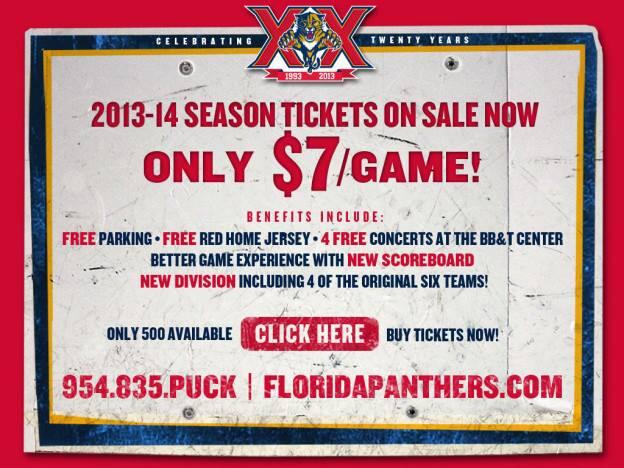
How is this deal economically viable? Even if it’s only for 500 tickets…though once those 500 are gone how much do you want to bet you can just phone up 954-835-PUCK and say you want the Crazy Ass Deal above and they’d give it to you out of desperation. Let’s calmly review the incentives for making this $287 dollar commitment to YOURRRRRRRR Floridatown Pantherrrrrrrrrssss (whoo uuup till earrlierrr thiiis weeek haaad aaaa hiiiigher payroooll thaaaan Ottaaaawwaaaaaa)!!!

1. Free jersey. $200 retail…likely slightly cheaper in the States. I would estimate $150-$160 USD. Either way a great, great perk many fans who put 1000s of dollars up would kill for. In this case it’s in exchange for buying tickets at less than a third of the price of an upper 300 level seat at a Sens game.
2. Free PARKING (for the whole fucking season!) if you consider it at Ottawa’s $12 rate at 41 games home games that’s a potential of nearly $500 lost per season seat holder. At the advertised 500 season tickets it’s a potential quarter million dollars swallowed….though maybe the Panthers’ arena isn’t buried in the Florida everglades like ours is and not as many people have to drive…Still, cheap out on the estimate and lop even 50K off that and it’s still 200 grand they could be doubling Bobby Butler’s salary with. Oops, just looked it up, the arena is located in a suburb of Fort Lauderdale. Lots o’ driving. Lots o’ parking.
3. FOUR not one not two…FOUR free concerts at the Church of Latter Day Saints Center (or whatever). Free parking for that shit too? Also, does that include notoriously big ticket names like Bruce Springsteen, U2 or Fleetwood Mac? Those tickets probably take the loss on a greater scale in the nosebleeds than they would behind the home bench at a Panthers game. If said season seat holder chose to scalp these concert tickets it would be 100% profit for them! Pick expensive enough concerts, sell the tickets at the right price, you’re looking at your season ticket package paying for itself right there. The rap game Adam Smith up in this piece.
4. Improved experience with new scoreboard just in time for 20th anniversary season! Hmm, this one sounds familiar. Except, you know, Florida’s scoreboard sounds like it will be installed in time for their 20th season. Also, the Florida Panthers owner (I looked it up it’s Dick Cheney) doesn’t sound like he’s expecting the fans to kiss his hairy beanbag for replacing a scoreboard THAT WAS LITERALLY SHORTING OUT DURING NHL GAMES THAT COUNT and replacing it with the industry standard after 20 years. Congratulations on investing in your own property after a decade of ownership Euge…oh no, no THANK YOUUUUUUU *buys 12 dollar can of Heineken and eight dollar poutine*
5. New and Exciting Division! Awwwwwwwwwe this one is actually so frigging adorable. Acting like the dissolution of the South Easy Division bodes well in ANY way for the Panthers’ on ice product. Well, actually I guess Buffalo is in their division now…so there’s that? Actually more original six teams does mean more potential revenue for the Panthers given all the snowbirds in Florida. Apparently you might as well be at the Bell Center when Montreal is in town. Have the citizens of Detroit made their way South yet like in The Road?
I’ve been of the opinion that though Melnyk may not be as wealthy as say, Mark Cuban,  I think he exaggerates when he makes his vague proclamations about the financial situation surrounding the team (What? Our Euge? Exaggerate?). I don’t think that Ottawa is the Rangers (few are) but 2 rounds of playoffs to break even? Give me a fucking break the team has missed the playoffs TWICE in the near decade he’s owned it. Note: In one of those missed years they introduced a third jersey that a surprising amount of people bought for some reason. Think that doesn’t compensate? Trust me there’s a sweet mark up on a $200 dollar polyester long sleeve shirt. Ottawa apparently has pretty decent ticket prices as far as the rest of the league goes but has one of the higher attendance rates. Factor in all those playoff games over the past ten years where I’m going to go ahead and say the tickets are NOT decently priced and how you dont have to pay the players in the post season….How is there not money there? I’ve paid over $100 dollars to sit in 30 dollar seats in ROUND ONE watching the 8th seed get pounded by the no.1 seed. Fans are opening their wallets and doing their part.
Listen, I can be a little hard on the season seat holders. Hey, I love you guys, you help pay the bills, but sometimes we troglodytes don’t like hearing about how hard it is out there for a pimp and how because you have enough money to attend every home game that the line to meet, get a photo and autograph with Erik Karlsson was too long so you had to settle for Jim O’Brien and…actually you know what that does sound like all kinds of boring. I take it back.
Anyway, I have to say, if I had the money to buy season seats (Ladiiiies) season after season and less than a calendar year removed from ANOTHER lockout that largely had to do with the distribution of hockey related revenue, I would flip my lid if I saw this Florida thing! I mean I’m not a season seat holder and I am. Makes those post-lockout fan incentives seem like nothing. Thanks for the free bag of popcorn! Can I has four free concerts with that? Consider that just last night The Justin Beibler Dancers performed a sold out show at Canadian Tire Piazza where you best belieb a lot of parents parked at a handsome fee…not to mention the venuEUGE gets a cut of the merch sales. This is all in the off season btw.
I’m saying if Eugene commanding that Murray work on the cheap whilst improving a playoff team that routinely sells out games, just hosted the all star weekend, has fans that have adopted the 3rd jersey like it’s the home uniform oh and they just DID make that coveted second round all while operating in the cap basement; gets people talking about how the sky is falling for the organization then what is success? Most importantly, what in the fuck does this Panthers season ticket deal mean?
I’m not saying Post-Divorce, Post-Getting in Legal Shit Eugene is Scrooge McDuck backstroking through as many gold coins as he once was but in a small market sport like NHL hockey an owner who cries poor tends to get the casino. One needn’t look further for proof than how Oilers owner Darryl Katz went on that little weekend trip down to Seattle to sniff around retail prices and magically got that big helping hand to build that brand new stadium he was looking for. If you’re going to run a team as terribly as the Oilers I imagine the NHL prefer you do it in a place where people actually attend games.
In closing, these guys didn’t become billionaires by being terrible negotiators. They leave that to the Paul Holmgrens of the world.     

The best (read: worst) turnkey solutions in hockey

collage-perfectsolutions

One of my favorite aspects of amateur (and professional) hockey commentary is how every team is depicted as being one small move away from being a contender. I suppose it’s somewhat dissatisfying to say, “The key to success is the slow, methodical drafting and development of prospects in the context of a strong, puck-possession system coupled with increased spending on complementary talent at strategically opportune times. And luck.”

I’m as guilty as anyone of simplifying. I can remember at one time suggesting that Ottawa needed to go after Steve Yzerman before he was hired as Tampa Bay’s GM. Look at the moves that guy has made! Great, great job, me from 2010.

But hey, it’s July, there’s nothing else to write about, and this blog puts food on my family’s table (they’re dead)…so let’s go! Here are my favorite turnkey solutions to instant success. Favorite because they’re ridiculous.

4) Get a puck moving defenceman…no, wait, get a shutdown defenceman

Defence is a little bit harder to quantify than offense, since it doesn’t lend itself to goals and assists so much as on-ice vision and “hockey sense.” (Which is like spider sense, but with a high school education.) This is especially apparent when armchair hockey experts get involved.

Success requires a delicate balance between moving the puck with a great first pass; driving possession with puck handling skills; a good shot from the point; a good shot from everywhere else that isn’t the point; blocking shots; sound positional play; and consistently putting people on their ass. (This also applies to every single player on the ice who isn’t the goalie.)

But because a defenceman’s skills get codified in this way, it ensures that if your team, say, gets creamed by Pittsburgh, you can always pick one or more of those things and say “we gotta get more of that.”

For this reason, Erik Karlsson can be an absolutely dominant offensive player, and perfectly competent defensive player, but if Ottawa loses an important game you can be sure someone will start looking longingly in the direction of a Hal Gill-type who has the frame and mobility of a dumpster full of Sega Saturns.

There’s a sign hanging on my office door that reads “Ottawa is currently in need of a puck moving defenceman” on one side and “Ottawa is currently in need of a shutdown defenceman” on the other, and I flip it over depending on my mood.

3) Trade for a goaltender

While it’s true that a goaltender on a hot streak can have a transformative effect on your team, getting one is sort of like buying a packet of scratch tickets and standing out in the convenience store parking lot, scratching all of them, one after another.

Does it make sense to lock a guy down for years if he has a solid record? Nope, because he’ll still have a stinky night every once in a while, and single-handedly lose the game, and when that happens, we’ll agree that he actually sucks and is not worth his salary. Is it worth it to do goaltending on the cheap? Nope, because management will be blamed for handicapping their team right out of the gate, unless…they win the cup.

Anyway, there aren’t really any reliable statistics for goaltenders, which leads to us conflating their performances with team factors so that basically we’re just admitting that we don’t know anything. (See: our stupid insistence on saying “this goaltender has X number of wins!” as if it doesn’t matter at all that they’re playing for one of the best teams in the league.) Highly regarded goaltenders can become busts overnight. (See: every highly regarded goaltender the Leafs have ever traded for.) And so goalies become this kind of logical black hole where improving your goaltending will solve everything, but you will never, ever be able to finish improving your goaltending.

Ask Tampa about this one when they give up on Ben Bishop and Anders Lindback in the middle of next season and trade yet more picks for Ryan Miller / Jonas Hiller / Jaroslav Halak.

Ottawa specific example: Sens trade worst-goaltender-in-the-league Brian Elliott for oft-injured and on-the-decline Craig Anderson, and both immediately become amazing.

2) Leadership

Like goaltending, but even less track-able, I have no doubt that adding some veteran leadership is probably a good idea. I just don’t know how much leadership is the right amount. One veteran is probably too little. How about two or three? That’s pretty good. How much leadership is contained in each veteran? The answer is Eight. Eight out of 10 leaderships.

Oh, and be careful, because at some point it becomes “too many voices in the dressing room.” This is also known as leadership poisoning. If this happens, immediately kill one veteran player.

If leadership was a factor that could be cross-referenced to success, you have to think Pittsburgh wouldn’t have been swept by Boston. Brendan Morrow! Jarome Iginla! Sidney Crosby! Paul Martin’s been around awhile, right! How about Detroit? They’re pretty old. They don’t seem to win the cup every year anymore.

Anyway, in Ottawa’s worst season in years, they still had Chris Phillips, Daniel Alfredsson, Sergei Gonchar, Mike Fisher, Chris Neil, Filip Kuba, Jason Spezza, and Alex Kovalev. Now they’re made up of a school bus full of teenagers and they’re fuckin’ awesome. So figure that one out.

And, the number one best (worst) way for a team to instantaneously get better….

1) “Get Tougher”

Nothing contributes to the performance of an NHL hockey team like signing or trading for a player with minimal ability to play NHL hockey, putting him on the roster at the expense of a kid who could probably use the development time, and then playing him six minutes a night. Whatever swagger your team develops as a result of having a tough guy with a funny mustache on it (I’m developing a metric called SWAGFAC to sell to NHL teams) is probably immediately wiped out in the one instance in which he finds himself in a critical situation and the team gets scored on because he didn’t realize that he was holding his stick upside down.

Montreal is probably the funniest, and most recent example of trying to raise one’s SWAGFAC™. They basically got mugged in the first round last year by…who beat them, again? Hold on, let me look it up…hmmm…can’t find it anywhere. And then they went out and signed another tiny, skilled forward in Danny Briere.

BUT DON’T WORRY BECAUSE THEY JUST TRADED A PICK TO FLORIDA FOR GEORGE PARROS.

Parros had two points in 39 games and was a ghastly -15. Is it even fair to look at his possession metrics? They’re not very good! He played less than seven minutes a night, and when you look up his profile on behindthenet, your computer just makes a long, slow farting noise and then crashes.

Oh, but don’t worry, because he had 57 penalty minutes…good for 50th in the league. He had four more penalty minutes than Mike Ribeiro.

I’m picking on Montreal here–and really, when you give up an asset, even if it’s only a 7th round pick, for an enforcer who doesn’t enforce and who can’t play hockey, you kind of deserve it–but most teams are guilty of this at one time or another. Ottawa traded a sixth round pick for Matt Kassian, though at least his possession numbers aren’t horrific, and he’s funny as hell.

———————————————————

So there you have it. Four sure-fire ways to take your hockey team–no matter how putrid and terrible they are at playing hockey–and instantly make them into a contender.

Sign an enforcer. Trade your shitty goaltender for another shitty goaltender. Sign two veterans (or kill two veterans). And have more, or less, of one, or both, of puck-moving or shutdown defencemen. Simple!

And if Ottawa doesn’t do one or more of these things I’m going to be furious.

Ottawa…I’m Coming in #lalala: The Changing of the Guard in Das Kapital

“@NHL_Sens…just wanted to say @WTYKY got hosed in the hashtag contest….make this shit right! <3, BR #REALTALK"

Hello, it's still summer.

Listen, your father and I would like to talk to you about the Ottawa Senators for a moment. HEY! and just where do you think you're going? OUT!? Ahhhh nuh, nuh, nuh, nuh, nuh. Sit right down young lady/man/no judgments. Do you have any idea how hard your Varada and I work to put a blog over your head and opinions on the table in mid July? Well, okay then…where was I…

I remember a friend making an interesting observation about the Sens during a time when things were going not so grand for the boys..lets call it “around 2010-2011”. He said, “It just seems like Ottawa isn’t a fun team to play on anymore.” He was right. Morale seemed very low among fans and players alike. I mean no moment encapsulates what my friend (that’s right) was getting at more than Erik Karlsson getting told that he just made the All Star team (via the6thsens.com). Ugh…I can hardly stand watching that clip as there is just so much sharing of the laughter and love. Nothing says congratulations like “Take your sock off” and a terse, unsmiling handshake.
I don’t want to put it all on Clouston but he was definitely the figurehead of those stern times. No disrispeck, but in the post Dan[n]y Heatley era…how to put this delicately…the team was filled with strong silent types. Look, I’m not saying Martin Gerber isn’t a barrel of laughs. His Chaucer puns are not going to be replaced by Robin Lehner overnight but I think 😉 is a great start to a new chapter. Seriously though, before we move on was there ever a more boring player on the Senators than Martin Gerber? Sound off with your choice in the comment section!

Don’t get me wrong, I’m glad that there is still a veteran core to keep things balanced. I am happy to say, however, that the days of Erik Karlsson sitting alone at the kid’s table while old Uncle Phillips takes time out from telling old Uncle Kuba stories about the how you couldnt get tin while we were chasing the Kaiser during the Great War to remind King K that he isn’t leaving the table until he finishes every last one of his vegetables.

I’m sure it’s no surprise that I’m going to talk about social media now. It makes a lot of sense that as the youngest team in the league a lot of players would be using twitter but really your account is only as engaging as you make it right, Shean Donovan? Not only does Ottawa have a lot players on twitter but they have several who are quite good at it.
Erik Karlsson hasn’t even been tweeting all that long and has already started a fan favorite hashtag with #lalala. Note: I’m also a fan of his lesser appreciated #whocares. He’s sayin what we’re all thinkin! His picture game is pretty tight as well, what with his posts about his “funky” new shoes or sharing his drunk faced antics with Andre Petersson (a player that used to be considered a top prospect in Ottawa’s system). Ek, unlike many star players, is a really worthwhile folllow.
Also enjoyable is the endless chirping between Marc Methot, Z Smith and Matt Kassian over who is the biggest hipster on the team. (Spoiler: None of you are! You’re all hulking millionaire pro athletes!) Not to mention that fake account devoted to making fun of Jim O’Brien run by Kassian. I mean I thought that was my job but still, game recognize game!
Considering new addition Bobby Ryan has around as many followers as the average member of the Wu Tang Clan, not only does the profile of the team get raised it also allows we followers an opportunity to get to know the players’ personalities a little bit in a way that a post game interview doesn’t. Turns out they actually have personalities!
It’s not all fun and games though…Mika Zibanejad’s website remains fucking TERRIBLE.

Despite this so far being a post about twitter that’s not entirely the point I want to make. To me the changeover in team culture extends beyond getting a window into what wedding Erik Condra is attending.
The most significant shift in attitude has been behind the bench in my opinion. His Jack Adams win kind of speaks for itself but can you honestly imagine a better fit for the squad than Paul MacLean? He did more to boost morale in his first press conference than Paddock, Hartsberg or Clouston did in their respective tenures in Ottawa.
The way he handled Therrien and Prust during the series with the Habs? I haven’t felt swagger like that in Ottawa since the days of Ray Emery’s Steve Harvey inspired zoot suits and his dropping of rap singles on our heads back in 2007. Who wouldn’t want to go through the wall for a guy like MacLean? He knows what it’s like to be a player and knows what it takes to win as a coach. You can tell by the way he carries himself, what he says and how he treats his players.
When a coach doles out nothing but toughness I think it loses it’s effectiveness pretty quickly. It’s requires balance. Under the impression Paul MacLean is a big softy that can’t get real talk with his team? Ask Latendresse, Regin, O’Brien, Filatov, or Butler what being in his doghouse is like. He doesn’t like your play, he’s not afraid to bury you in the press box indefinitely. Something tells me it means a little more when Big P loses his shit with you. Like you’ve really let the guy down. With the league getting younger and younger and Ottawa being it’s youngest overall team a father figure like P Mac is such a great fit and so far, it shows.

Lastly, ugh…I don’t know how I’m going to do this…*siiiiiiiiiiigh* okay, there’s only one way to say it, Doniiiii Brennan wrote an article the other day about Spezza making a great choice for captain that I….that I………………………..that I really agreed with. THERE ARE YOU HAPPY? I SAID IT. I READ AND LIKED HIS ARTICLE OKAY, GOD.
I do think Spezz would be a great choice and one that the team wouldn’t regret.
Do I think Spezza would make a better captain than Daniel Alfredsson? I think their personalities/legacies are almost too different to compare. I am open to the idea that Spezza’s personality might be a little more suited to leading this particular young group. He’s been in the league long enough to be considered a veteren, he has the performance cred to back up his position as leader but he’s still young enough to relate to the pups. He’s hip for a dad! He knows what the new rapping songs by The Skrillexes are. He has a tamagotchi. In fact he has two. See, cool. Leadership. Synergy. Willenium.
With the departure of face of the franchise Daniel Alfredsson, 2013-2014 will truly be a new chapter for the franchise. I still haven’t fully come to grips with how we’re about to see our first games without Alfie in nearly 2 decades. Will it be better? Well, with no Stanley Cups and as a person who tunes into games uhhh, yeah, I frigging hope so. There’s no guarantees but I do know that the past two seasons have been as exciting to watch as any other in my recollection. This team looks fun and exciting to be a part of again. On the heels of their deepest playoff run since 2007 I’d say that this year the Sens are coming in hot. I just made that up.

Whaaat is the deeaal With Jared Cowen’s RFA Status!?

More like Jerry SIGN on the dotted line feld *throws self in Tiger pit at the zoo*

More like Jerry SIGN on the dotted line feld *throws self in tiger pit at the zoo*

The sudden announcement that due to some miscalculation Jared Cowen was no longer on the last year of his entry level contract but in fact a restricted free agent due for resigning caught many including myself and probably the organisation way off guard.

It’s interesting when a procedural error is made pro-sports, eh? It really shows how there is no room for mistakes in the business. Remember when those qualifying offers accidentally weren’t sent to a bunch of those Blackhawks players a couple years back? That was sch a rare piece of news.
I mean it’s one thing to make a bad personnel decision like giving Rick DiPietro a 15 year contract only to get handcuffed by it when he goes and has a legendary rash of injuries. As a number 1 overall pick (speaking of miscalculations, a goalie as #1 pick) he could have just as easily been Martin Brodeur and having him locked down for his entire prime at a steady price would look perfectly logical. Gambles are like that I guess. I digress, what I’m saying is, something like this is such an anomaly that it almost seems like a scandal when it happens.
I’ve heard rumblings that this move was Cowen’s agent flexin’ to get back at that the Sens for sending him to Binghamton during the Lockout where he made…still more money than most people.
I’ve also come across a lot of concern that the Senators will not be able to afford this additional signing on top of Condra and Wiercioch because if we’ve learned one thing this off season THERE ARE A LOT OF FINANCIAL EXPERTS OUT THERE ALL OF A SUDDEN! CONGRATS! Actually come to think of it I know one of our readers used to be an accountant for the Sens…and another one has a Phd in Economics from Oxford…maybe I should just stop being such a smart ass about everything (nah). It is true that the organization has made it clear money is tight.  I want to go on a psychedelic journey with you as to why this unforeseen problem could bode well for the team’s budget in the long run.
We’re starting to see that being an upstart rebuilding franchise that’s drafted well and found diamonds in the rough does have a consequence to it. Every year or two the GM of such a team will find him/herself having to resign a whack load (actual unit used) of players. In some cases this jump can be insane. See: Karlsson cap hit increasing over 5 times in size on just his second contract. This year is starting to get into that world of bargain deals going away. Sure, Karlsson is special in that he emerged as an elite talent and 6.5 Illuminati Space Bucks is actually a deal but how are you NOT going to sign a guy like Erik Condra at this point? Condra’s an unknown to the rest of the league but a total unsung hero to Ottawa who bailed the team with remarkable consistency when Ottawa took ALL the penalties all year. I mean, it’s not like Condra’s going to break the bank but what I’m saying is the Condras are going to add up. We find ourselves somewhere in the middle with Cowen.
A towering top ten pick like Cowen is the last guy you want added to the pile of this year’s RFAs right? Well, actually holdez le phone mon chum. I thought about it and you know what, this might not be the worst thing for our beloved budget squad. Sure his pedigree is very good, keep in mind before his reconstructive knee surgery he was looking to get picked top 3 and STILL went top 10 as an injury gamble, he was also huge in that Calder Cup win, etc. but this might prove to be an advantageous year to sign him.  Cowen has been good, quite good at times, but still hasn’t done a ton at the NHL level. Due to his hip labarum tear (barf) that sidelined him for nearly all of the AHL AND NHL seasons, his overall poor play in the playoffs and at less than 100 games played in the NHL, Cowen is still very much a guy who still has a lot to prove. To put it in perspective the oft injured Ryan Hopkins-Nugent, who was drafted in 2011 to Cowen’s 2009, has already played more REGULAR SEASON games than him (when you use an Oiler as comparable you HAVE to use regular season games, *wink*).
In the negotiating room I think some of the points I’ve outlined above will favor the Senators. Injury or no the facts of the case are that in 2013 he had 1 point in the regular season and went -6 in the playoffs and looked shaky doing it. Honestly, Cowen has shown flashes of beastliness (which is like CORSI but more scientific) but I can’t deny that the jury is still out on what he could amount to which is why I think this could be a good time to sign him. If he’s the beast with some offensive potential he was projected to be it’s likely a steal, if he’s a so-so defender well, contract looks reasonable and a 6 foot 5 defenseman is something you can typically find a market for. Here’s hoping he makes whatever deal he gets look like a bargain (doiobviously).
It seemed a little premature to resign Kyle Turris when Murray did but now Ottawa has a 2nd line centre who’s produced quite well here, particularly in the playoffs (12 pts in 17 gp) locked up at a very reasonable $3.5MM per year cap hit.
The value of Cowen’s contract will ultimately be up to how he performs on the ice but I forecast that he’s comin’ in on the cheap…also he looks like Seinfeld.

Okay, so our hearts were torn out. But is our favorite hockey team actually better?

Pittsburgh Penguins v Ottawa Senators - Game Four

There’s been a lot of talk of last Friday being one of the most transformative in franchise history. While it’s definitely, say, top five, I don’t know if it’s up there with the launch of the rebuild; with letting Chara walk; with running the jewels AKA trading Yashin for everything in the Islanders’ cupboard; or with trading Hossa for Heatley. Ottawa lost two top six forwards and gained two top six forwards. Before we assess whether or not Friday was a game changer, we should ask if Ottawa is actually a changed team, and if they’re any better.

Here are a couple of assumptions:

  • It’s easier to predict the performances of Bobby Ryan at age 26 and Clarke MacArthur at age 28 than Jakob Silfverberg at age 22 and Daniel Alfredsson at age 40. The former are in that sweet spot of being in their prime and having a few NHL seasons under their belt. But Silf is a sophomore and Alfredsson may be due for a major regression. The latter’s performances could be all over the place.
  • The Bobby Ryan trade probably would have happened even if Alfredsson stayed, which makes it a Ryan v. Silfverberg comparison, and a (very unfair) MacArthur v. Alfredsson comparison.

On the face of it, the answer to the question of whether the Sens are a better team seems to be yes and no. Alfie’s intangible factors don’t lend themselves to quantification and measurement. Leadership, connection to the community, “being clutch” (if that’s actually a thing and not just creating enough positive memories over many seasons in one market to be thought of fondly in that market) may or may not actually win you hockey games. However, when looking purely at the on-ice skills Alfredsson brought, the unpopular conclusion has to be that he’s actually a replaceable player. Not easily replaceable—he’s an experienced two-way forward who played in all situations and drove possession—but it’s possible. And, when we look at what MacArthur brings, Murray’s done it.

Looking purely at possession stats via behindthenet, Ottawa is pretty clearly better off. Relying primarily at QoC and Corsi Relative, Mac faced stiff competition and tilted the ice in the right direction, though he played two minutes less a night than Alfredsson on average. His shooting percentage has remained near 14% his whole career, too, implying reliability; he isn’t due for a sudden dip. As a one-to-one comparison, and with Alfie’s intangibles removed, MacArthur has better statistics, is younger, and is cheaper. Without being in the dressing room and not knowing how the rest of the team’s performance is affected by the leadership void (again: if that’s a thing), if we’re being unsentimental about all this, then I think it’s very fair to say that Clarke MacArthur is at least a serviceable replacement for Alfredsson as a second line winger.

(As an aside: what Toronto is thinking in paying Clarkson $5.25MM for seven over paying MacArthur $3.25MM for two, I’ll never know. But given the community’s reaction, nobody really knows.)

Ryan, as you might expect, received some favorable matchups in a bid to create offense—but not nearly as favorable as Silfverberg received in his freshman season. Silfverberg is really the X factor in all of this, given that he’s so young and could, any season now, take a step beyond the perimeter shooter that he was in 2012-2013. He shot the puck more than anyone on the Senators not named Karlsson (aside #2: Karlsson is fucking amazing), but had long stretches of ineffectiveness where MacLean kept him on the top line anyway, perhaps for lack of options. Without Silfverberg stepping forward, Ryan is pretty clearly an upgrade in every conceivable category except salary.

And speaking of salary, Ottawa does end up spending about $2MM more of it, though the possession boost between Ryan and Silfverberg is very significant. If you treat the MacArthur / Alfredsson swap as a wash (Mac is younger, cheaper, and has better statistics, but doesn’t have the intangibles), Ottawa pays a little bit more, easily upgrades on Silfverberg’s 19 points in 48 games last season, and is still spending less on salary that almost every other team in the league. My nutshell conclusion here is that, at this point in time, Bobby Ryan and Clarke MacArthur at $8.35MM is better than Jakob Silfverberg and Daniel Alfredsson at $6.4MM. Obviously this changes as Silfv develops, Noesen becomes an NHLer, and Anaheim uses that first round pick. But that’s the snapshot.

Of the other X factors here, I think the biggest is whether Ottawa will use the (relative) cap savings of having these two cheaper scorers to go out and spend on another veteran player and silence the intangibles crowd. There are some enticing names still out there, and Ottawa could still leave the free agency period up a forward instead of swapping out two for two. If we’re really concerned about what ephemeral leadership qualities we lost when Alfredsson and Gonchar walked out the door, then Murray could always throw some money at Brenden Morrow. Won’t Jagr play for anyone who pays him? Hey, even Milan Hejduk is available–he won a cup, right?

Why I Am Feeling Okay About Everything YEEESSS Even the Alfie Thing

“See girl, only thing I’m tryin’ to extablish with you is not who’s right and who’s wrong but what’s right and what’s wrong, Real Talk.” – Robert Sylvester Kelly

Hi welcome to this website. How’s everyone’s day going? *pretends to listen to story about re-grouting bathroom tiles* Hey I think that’s the TOPS… Say, shut up a minute and lets unpack the drama filled Friday that was.

First off, I am glad that you and I are here after a weekend has passed and we’ve had time to bury our feelings under a thick blanket of pizza and beer.

Personally I spent my Friday morning trading jabs with people in the Sensphere. I’d say that they were just buying into media hype and that they thought the sky was not falling because Alfie was not yet signed. I mean, after all, Murray himself had flat out said in the press THE DAY BEFORE s and I quote, “Chill the fuck out, the shit’s good as done I GOT THIS H’YUH.” Then boom the most hockey obsessed source on the planet TSN dropped that Alfie was indeed headed to Motown. Shit. Uhhh. Hmm. Owww. Then Bryan Murray goes and makes a bit of a troll move: Guys, I know the captain and face of the franchise is gone but don’t worry NOW YOU CAN CHEER FOR THIS TORONTO MAPLE LEAF. I’ve braced for something like Alfie’s departure for a long time but must admit I was as gutted as any other Senators fan when it actually happened, as evidenced here by this embedded tweet that i cant get to look like the opposite of bullshit:

WTYKY@wtyky
Line idea:Macarthur – Turris – <Hole where heart used to be>

Thoughts?

Not the greatest follow up that could have happened. Then complete radio silence from the organisation which caused a period of rage on the Sensphere that I do not wish to relive here. Little did we know that a few hours later that Bryan Murray had completed what was the biggest trade in Sens history since Ottawa acquired Dan[n]y Heatley for Marian Hossa when he landed power forward Bobby Ryan of the Ducks (cool team name j/k) for Jakob Silfverberg, propsect Stefan Noesen and Ottawa’s 1st round pick in 2014.

Okay, now I’ve done my recap of the events that transpired. We’ve all had a weekend to eat so much junk food, meet our friend Steven for drinks to talk about it, and we’ve all gone and seen Wu Tang Clan perform…well maybe it was just me that did that stuff but you know what? NO JUDGMENTS with whatever way you’ve been coping.  I’ve had a couple of days to think about it and you know what? I feel okay with how it shook out.

First thing’s first: Don’t get it twisted, losing Daniel Alfredsson sucks big time. I’ve been proudly wearing my red number 11 to games and out on the shinny rink for years. I’m as big an Alfie fan as you’ll meet. I’ve been saying for a couple of seasons now whenever the trade deadline time came around and rumors were flying that hey if Alfie wanted to leave he’d have all the right in the world too. He’s done more for the franchise than any player in its history and no one can ever take that away from him. He wants to go for a cup? Go for it. Now that it’s happened I must admit it was way harder to come to grips with than I had anticipated.
It also didn’t help that it went down the way it did. I’ve read articles that blame Alfie, ones that blame management and everything in between. All I know is that situations like this happen all the time in the NHL and this time it’s happening to us and it sucks. It also made me sympathize with Toronto fans and how they had to basically go through Friday for nearly an entire off season with Sundin. That had to have been rough.  So, one way or another it happened and frankly it could have been worse. I’ll take the quick band aid rip off way. So that’s it? That’s how I’m okay with it? No not entirely.

WARNING THINGS ARE ABOUT TO GET PRETTY “REAL TALK” UP IN HERE SO READER DISCRETION IS ADVISED …also, haters to the left. 

Whether it was gamesmanship or not I vividly remember Brian Burke’s reaction to Dany Heatley’s trade request. He said that whenever he receives such notice from a player no matter who they are that they can basically get the fuck out because he ain’t got no time for half steppin. While I don’t feel quite THAT harsh, honestly, if Alfie’s head’s not fully here and committed to Ottawa I’m fine with him playing somewhere else in his twilight. I still love him. I just hope he’s not disappointed when the Red Wings DON’T win the Stanley Cup [Real Talk]. Also, if the team is on a budget does anyone think maybe the 5.5 million dollars he eventually commanded was a bit much for a guy who’ll turn 41 this year? [REAL TALK!] While it’s also quite fair to say that Alfie is a very, very special 40 year old and that you should pay absolutely anything to retain the captain we know that the Senators are not really in a position to get wild salary-wise especially with several RFA’s still to resign…including newly discovered restricted free agent Cowen (Murray get on that btw).  Alfie gets a crazy pay day and gets to play for what he feels is a contender. Happy trails see you at the number 11 retirement where I will stand and cheer….aaaand probably cry because my psychologist says I have a very healthy emotional relationship to the Ottawa Senators.

Next, despite that absolutely gutting subtraction from the team can we not say that that was an absolutely huge Free Agent day for Bryan Murray? For all the griping about the urgent need for top 6 scoring help that we’ve all been guilty of the past few years Murray not only lands a top six winger but also a top THREE winger? Damn. Since Heater’s exodus to San Jose/Minnesota/Golden Corral Buffet and Grill, how much ink has been spilled about Spezza needing a legit top flight winger to play with? Here he is folks. Here he is. The price was steep and I will definitely miss Jakob Silfverberg who had big potential here but ever since the 2011 draft when Ottawa took 3 forwards in the first round alone you knew quality some young forwards were going to get moved at some point. Anaheim made sure they got a great return in Silfverberg a quality prospect and a 1st round pick. I think that this is the big boy version of the Turris for Rundblad and a second trade. Stings to do but if it fulfills a team need with a high quality player well that’s how big trades work in the NHL nowadays. Both teams have to win. The Seguin / Eriksson plus deal is a great recent example. You might lean one way or the other but the word “fleece” tends to be hyperbole when important players move nowadays.
With the additions of Ryan and MacArthur (still adjusting to rooting for this guy after years of hate!) I cannot dispute that Ottawa’s top six is not just improved but vastly improved. This morning’s uhh…RE-addition of Joe Corvo (900K for a bottom pairing defenseman who can move the puck well? I will TAKE that)  also helps the back end and gives a little more time for Ceci and Borowiecki to develop.
There are no guarantees in sports but MacArthur and Ryan do not have the same questions surrounding them like the far past their primes Kovalev and Gonchar did nor the “can this guy play a full NHL season without dying 1000 deaths” that Cheechoo and Latendresse had looming over them. These acquisitions are tremendous until further notice. Ottawa will have young, able quality guys coming into camp who will be ready to play and likely very excited to be part of an exciting young group that features a career point per game centre, the best defenseman in the game, a very high quality goaltending tandem and the coach of the year. (See what i did there!)

In closing, one need not look further than the banner of this blog to know what we’re staring in the eyes of here. We’ve been quietly discussing for a couple of years now what the Senators next chapter would look like when Alfredsson inevitably made his leave. In 2013-2014 we are going to get to see it. I was as gutted as the next fan when it happened and felt bruised as to how it went down but you know what? I cant deny that it’s a very exciting time to be an Ottawa Senators fan. We’ve lost our heart and soul but we will find a new one. The sheer determination and bravery that Erik Karlsson showed this year has really stuck with me as I’m sure it did many others. As did his enthusiasm to sign back here long term as soon as his entry level deal was up. Will he be made captain? I’d be in favor of it. Will he actually? No ( but maybe just not yet).  To me, this couldn’t happen at a better time. If we lost Alfie during the Cory Clouston era? I’d have jumped out of a goddamn window. Like I’ve already worn out, if it was going to happen it was going to happen and there’s nothing we fans can do to change it. I am just thankful that it went down when there’s not only heaps of promise going forward but now an additional will to take it to the next level and some very exciting players to help do it. Let me be the first to say it: Welcome To Your Karlsson Years ©®™™™™©®™

CMT1996

If Mike Modano can play for anyone other than the Stars….

And if Mats Sundin can play for anyone other than the Maple Leafs…

And if Jarome Iginla can play for anyone other than the Flames…

And of course if Ray Bourque can become synonymous with what just happened…

…then we were naive to think Alfredsson wouldn’t do what he just did. In fact, we were probably taking him for granted.

Detroit’s a very good team. Better than Ottawa, probably. It’s also full of players who will likely be on Sweden’s olympic team in Sochi next year–a camp that Alfredsson wasn’t invited to. If he can show that he and Zetterberg, Franzen, Kronwall, and Samuelsson can play together, he might get another shot at a medal. Let’s not underestimate that.

We’ll never know what the discussions looked like between management and Alfredsson, but you can be sure of one thing: Detroit is going for the Cup, and Ottawa is not. As of right now Detroit is spending $20MM more on salary than Ottawa. Their players are in that age bracket. They’re going for it, and they’re as good a bet as any, especially with Detroit moving out of the West next season and into–gulp–Ottawa’s new division. Detroit is going to absolutely tear the living shit out of Florida, Tampa, Buffalo, and, yes, Ottawa, instead of having to play Chicago, St. Louis and Nashville all the time.

What’s more worrying for me is the message this sends to the rest of the team. Ottawa isn’t ready to spend to win now. Ok, then… How about next season, when Michalek’s deal is up? How about in two seasons, when it’s Spezza, Methot and Anderson? In a salary cap world, the really talented players are going to get their money somewhere. It’s whether or not the team gives them something to believe in that convinces them to put on our sweater instead of another’s.

I can’t speak for James or Steven here, but this is my gut reaction in the hours following the news. Alfie is entitled to this: he’s played on more than a few cash-friendly contracts in his day, and like the players I mentioned above, when he comes back to Ottawa he’ll get a hell of a salute and his jersey in the rafters. This isn’t the end of the world. We’ll get over it. But for now: man, this just sucks.

[Note: this was posted before the Bobby Ryan trade. I still don’t know if Ottawa is “going for it,” but obviously the game done changed…a bit.]