The cost of doing the NHL’s business

940-optimism-8col

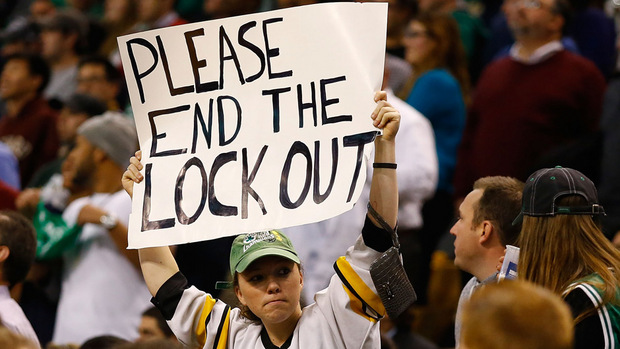
Given the 2012 lockout, it should come as no surprise that I’ve spent some time thinking and writing about profitability in hockey over this past year. As various contracts are signed and new developments emerge, I occasionally referred back to those old posts, and it occurred to me that August—the dead of hockey winter—is the perfect time to try and consolidate all of my thinking on this subject into one big post. It’s something I’ve wanted to do for some time; but given recent news around the Minnesota Wild, I finally found myself inspired enough to do some typing.

So, without further ado, I present to you: an English major trying to write about hockey economics. Enjoy!

The cost of doing business v. underlying value

Last week, the Minnesota Wild reported a loss of $30 million during the 2012-2013 season. This figure seemingly verifies predictions made during the 2012 lockout, especially by ownership hawks like Wild owner Craig Leipold, who sought cost certainty even if it would come at the expense of half a season of hockey.

That $30 million number, at a glance, is alarming; the Wild play in an established hockey market, they made the playoffs last year, and they have an intriguing mix of veteran stars and terrific prospects. If even they, in those conditions, can incur such a loss, then were the hardliner owners right to be so gloomy?

But we should be cautious when speaking about snapshot reports, because those reports—looked at in isolation, often released at strategically opportune times, and only presenting a few of the many factors that describe a franchise’s ability to produce value—are, and have long been, the ammunition NHL owners use to negotiate for increasingly favorable terms.

It’s important not to speak only of short term losses without also looking at the underlying value of the investment. To say that a hockey team is only losing money is not unlike buying stock and treating it as a loss because the money is no longer in your bank account. Unless the value of the stock is decreasing too, nobody would refer to your investments as a loss. But it’s become routine for NHL owners to do just that—reporting exclusively on operational costs without also talking about the health of their investment. Perhaps more troubling, some in the media breathlessly report these losses without providing additional context, creating cognitive dissonance with Commissioner Gary Bettman’s own triumphant announcements of soaring league revenues.

While we don’t have access to ownership’s valuations, Forbes does release their own estimates of the value of each NHL franchise. If you remove the outliers from the list—the top and bottom five franchises, which either gained an exorbitant amount of value, saw no growth, or saw losses—your middle 20 franchises increased in value between 1%-16%, or an average of just over 7% on an average value of $235 million. So even if your franchise experiences moderate growth of about 5%, the underlying value of your franchise is increasing by about $12 million year-over-year. As anyone with a sad little RRSP will tell you, a 5% annual return on an investment is nothing to scoff at, and if you can keep your operational costs under that annual return more often than not, you’re not “losing money.”

Which isn’t to say that it isn’t challenging to maintain liquidity. Most businesses with operating costs in the tens of millions are heavily leveraged—which is to say, their owners borrow money to fund costs and bide their time while underlying value builds. And we did just go through an international financial liquidity crisis where no one was able to raise capital. Appreciative value—or the lack thereof—sunk the housing market in 2008. (Though then again, most mortgage owners didn’t go into the transaction knowing that they’d have to cover operational losses through ups and downs, and the bubble that burst was a pretty big one.) It’s a challenge, to be sure—but again, to paint NHL franchise ownership strictly as a money-losing endeavor is to only look at one small aspect of the transaction. That NHL owners were willing to suffer through not one, but two lockouts, should imply that they’re more than willing to take the long view on their investment.

Hockey related revenue v. everything else

So far, we’ve only talked about the cost of owning a franchise contrasted with the value of the franchise itself. But what about other investments that aren’t necessarily hockey related, but are only possible because you own a hockey franchise?

Hockey related revenue became a bit of a dirty word during the lockout, precisely because nobody was able to agree on what it was. Those who own NHL teams are fond of presenting strict operating costs-to-hockey revenue calculations in order to demonstrate how tepid their balance sheets are. The players, rightfully, wanted to look at all of the tangentially related revenue streams in order to understand just how much money the league was making. The owners spent much of the lockout playing a shell game—changing their definitions, or just generally burying figures in mountains of boxes of paperwork.

Think of owning an NHL team as a portfolio of investments. Sure, you own a team, and as a result you can sell tickets, and jerseys and foam fingers, and hot dogs and beer, and you sign a local television deal, or maybe partner up with other businesses for endorsements. All of those things together may not, actually, come close to paying player and staff salaries, operating an arena, chartering flights and paying jet fuel. If you strictly compare the costs of operating a hockey team to the revenue generated, then yes: you might come up with a loss.

But owning a pro sports franchise is not opening a lemonade stand, where you might compare lemons purchased to glasses of lemonade sold. (The lemon in this case is Alex Kovalev.) Does ownership also own neighboring real estate? Once the fixed costs of operating an arena are eaten up by hockey related revenue, what other events are taking place that drive profit? (A cursory look at the Xcel Energy Center’s website shows upcoming concerts by Taylor Swift, Mumford & Sons, Justin Timberlake, Michael Bublé and Blake Shelton.) What sort of tax incentives or public contributions does the team extract from city council? If you own your building you can sell naming rights. My god: parking. Let’s not even talk about what’s happening in Brooklyn.

As you can probably tell, arena ownership is a major factor here. Some NHL owners also own their building; others receive a fee from the city for “operating” the arena (and then sometimes farm that responsibility out to a third party); still others simply pay the owner rent and try to subsist on hockey related revenue alone. (R.I.P. Atlanta Thrashers.)

But the possibilities really are myriad, and not always clear to us. The Maple Leafs (along with the Marlies, Raptors, and Toronto FC) were purchased by two telecommunications and broadcasting giants who now not only own the infrastructure and delivery devices for their services, but the content. It’s possible that if you want to watch Tyler Bozak and David Clarkson hoist the Stanley Cup, you’re going to have to pay Bell and Rogers about five different ways to get it. Therefore, it’s naïve to think that the value of the Maple Leafs should be calculated on the basis of how many tickets they sell and what they charge for beer at the Air Canada Centre.

We have no way of knowing the true value of a portfolio without the owners really opening up their books. But we should remain skeptical when a team talks about operating losses, because the portfolio itself is only made possible through ownership of a pro team. Sometimes that portfolio will lose value because, say, the economy of Arizona is based on real estate and the real estate economy just collapsed. But in most cases, we might assume that a diverse portfolio of interconnected investments is well worth the operating costs of a hockey team.

So…are the Minnesota Wild really losing money?

After all that, the answer is…probably, yeah. The Forbes valuations shows middling growth in 2012 (2%); the amount of debt the Wild are carrying as a percentage of underlying value is ninth highest in the league at 52%; the Xcel Energy Center isn’t owned by the Wild, but by the city of St. Paul (though the Wild do “manage” the space); and the value of the franchise, at least by Forbes’ estimate, is down to $218 million from the $225 million Craig Leipold paid back in 2008. All in all, the team doesn’t seem to have been a terribly solid investment, but then we did just go through a protracted financial crisis which saw the value of boutique investments like sports franchises impacted. Viewed on a 10-20 year timeline, Leipold may yet recoup his investment, assuming of course that he can stomach the operational costs in the meantime. And, of course, we don’t know the other ways Leipold might be leveraging his ownership of the Wild to make money. When I see $30 million in losses, I think either Leipold is inept, or isn’t telling us the whole story.

All of which puts yet another question mark next to the decision to sign not one, but two marquee free agents. Ownership committed to paying obscene bonuses to Ryan Suter and Zach Parise—tens of millions in up-front dollars that couldn’t be prorated in the event of a lockout. Part of the Wild’s losses is bad luck; part is questionable decisions by management, or an inability to leverage their investment in a hockey-mad market. But surely it can’t all be blamed on a broken economic system or player salaries.

How do we solve this?

One could argue that there’s really nothing to solve. Pro sports franchises are long-term investments in which most value isn’t derived until the point of sale. Snapshot reports of operational losses never tell the whole story unless they’re at least presented in relation to changes in underlying value. Malcolm Gladwell has argued that franchise ownership is always a bad business, certainly relative to the other ways you might invest your money, and that billionaire owners should be content to simply enjoy the privilege of owning a pro sports team. Maybe there’s really nothing for us to do but to notice when owners get hysterical about losses and be alert as to what’s happening with the public purse.

Even still, there are genuinely challenged groups: a team like the Islanders, in an aging arena and questionable location, unable to get new real estate development approved and with ownership that can’t bankroll a cap floor team let alone a cap ceiling one, is guaranteed to see stagnation. (See again: Brooklyn.) There are teams who derived no revenues from non-hockey related events because they didn’t own their arenas or weren’t paid to manage the facilities. Obviously Phoenix is a mess. Non-traditional markets like Carolina, Florida, Tampa Bay, and Nashville remain not so much long term investments as looooooooong term investments, more on the order of affecting culture change than anything else.

However, the teams at the top of the revenue list—Toronto (the first NHL team to be valued at $1 billion), New York, Montreal, Vancouver, Detroit, Chicago—are generating such staggering value that even marginal increases in revenue sharing can buoy the bottom five teams.

How should owners conduct themselves?

I’m an Ottawa Senators fan, and my relationship with Eugene Melnyk is a complicated one. He rescued the team in a pre-cap, pre-revenue sharing world, when the team was in bankruptcy and facing a very real, existential threat. He brought some semblance of stability and, for a number of years, kept Ottawa competitive in the salary department.

He also has a tendency to go on sports radio and talk about how desperate the franchise is for money right before season tickets are about to go on sale, or compare Canada to an Eastern European country when he’s pressuring city council to approve the construction of a casino near his land. In Ottawa, many are familiar with his oft-repeated assertion that the Senators need to make it to the second round of the playoffs just to break even. It begs the question: if a team is top ten in attendance (6th overall in 2012-2013) and sets ticket prices right in the middle of the pack (15th in 2011-2012), and still can’t break even without consistently being one of the best eight teams in the league…then who can?

On the one hand, I’m sensitive to the fact that it’s difficult to cover operating expenses in the millions, or tens of millions, especially when it’s difficult to borrow money. On the other, when an owner cries poor, these reports are often, and quite transparently, designed to squeeze more out of a fan base or local politicians. Darryl Katz’s scaremongering exploits in Edmonton are well documented, and have resulted in Edmonton city council committing to cover $542 million (in a city of about 800,000) to construct an arena and surrounding complexes. In bankrupt Detroit, whose urban center is slowly descending into The Road-like conditions, valuable franchises like the Red Wings and Tigers also get public funding for new arenas at a time when public schools are closing and paramedics are asking for used car donations so they can continue to pick up patients.

[Update 7/8/2013: thanks to an anonymous commenter on this post, who provided the following:

“I recommend this article:

http://www.wingingitinmotown.com/2013/7/29/4554706/broke-detroits-bankruptcy-and-its-new-arena-complex for more information on the funding for the Red Wings new arena. The funding for the new arena is not taking away money from public schools or paramedics, and the project should be hugely beneficial to Detroit’s economy in the long run.”

Upon reading further, anonymous is right. The arena is being funded, in part, by Michigan state bonds, and in part by Wings’ ownership’s developer. The money does not come strictly from the city, nor from the public school or health infrastructure funds.

The argument might still be made that this amounts to state-facilitated funding to construct sports and entertainment infrastructure, and one could also argue that if you’re going to put shovel-ready projects on the ground to create jobs that other systems are more deserving, but no one can imply that the Detroit Red Wings’ organization is simply getting a pay-out from money otherwise earmarked for schools or paramedics. That’s too direct a connection to make, and one I should have been careful not to imply in the previous paragraph.

But there’s still a lot of murkiness, both around the numbers and ethically. I think my key takeaway from the article is the following:

“It should be noted that the overall financial picture is still extremely fuzzy. Some outlets report two-thirds public funding, while others report that Ilitch is paying the majority of the cost. The Detroit Downtown Development Authority, according to the Associated Press, has long been allowed to pay Detroit’s general obligation bonds with $12.8 million that otherwise would have gone to schools throughout the state of Michigan. The general picture of the finances that seems to be surfacing is that roughly 44 percent of the funding will be public, and the rest will be paid for by Olympia Entertainment Incorporated, the developer owned by Mike Ilitch.”]

…none of which is really ownership’s fault. They present us with only some of the facts, and it’s up to us—the readers and writers, who care about hockey, and about the cities we live in—to ask questions and spread the word. I have no doubt that some owners are, in fact, losing money. At this moment, Craig Leipold may be one of them. But until we get a little bit of honesty and transparency going—especially after two soul-crushing lockouts—it will be up to us, the fans, to demand the whole story.

The best (read: worst) turnkey solutions in hockey

collage-perfectsolutions

One of my favorite aspects of amateur (and professional) hockey commentary is how every team is depicted as being one small move away from being a contender. I suppose it’s somewhat dissatisfying to say, “The key to success is the slow, methodical drafting and development of prospects in the context of a strong, puck-possession system coupled with increased spending on complementary talent at strategically opportune times. And luck.”

I’m as guilty as anyone of simplifying. I can remember at one time suggesting that Ottawa needed to go after Steve Yzerman before he was hired as Tampa Bay’s GM. Look at the moves that guy has made! Great, great job, me from 2010.

But hey, it’s July, there’s nothing else to write about, and this blog puts food on my family’s table (they’re dead)…so let’s go! Here are my favorite turnkey solutions to instant success. Favorite because they’re ridiculous.

4) Get a puck moving defenceman…no, wait, get a shutdown defenceman

Defence is a little bit harder to quantify than offense, since it doesn’t lend itself to goals and assists so much as on-ice vision and “hockey sense.” (Which is like spider sense, but with a high school education.) This is especially apparent when armchair hockey experts get involved.

Success requires a delicate balance between moving the puck with a great first pass; driving possession with puck handling skills; a good shot from the point; a good shot from everywhere else that isn’t the point; blocking shots; sound positional play; and consistently putting people on their ass. (This also applies to every single player on the ice who isn’t the goalie.)

But because a defenceman’s skills get codified in this way, it ensures that if your team, say, gets creamed by Pittsburgh, you can always pick one or more of those things and say “we gotta get more of that.”

For this reason, Erik Karlsson can be an absolutely dominant offensive player, and perfectly competent defensive player, but if Ottawa loses an important game you can be sure someone will start looking longingly in the direction of a Hal Gill-type who has the frame and mobility of a dumpster full of Sega Saturns.

There’s a sign hanging on my office door that reads “Ottawa is currently in need of a puck moving defenceman” on one side and “Ottawa is currently in need of a shutdown defenceman” on the other, and I flip it over depending on my mood.

3) Trade for a goaltender

While it’s true that a goaltender on a hot streak can have a transformative effect on your team, getting one is sort of like buying a packet of scratch tickets and standing out in the convenience store parking lot, scratching all of them, one after another.

Does it make sense to lock a guy down for years if he has a solid record? Nope, because he’ll still have a stinky night every once in a while, and single-handedly lose the game, and when that happens, we’ll agree that he actually sucks and is not worth his salary. Is it worth it to do goaltending on the cheap? Nope, because management will be blamed for handicapping their team right out of the gate, unless…they win the cup.

Anyway, there aren’t really any reliable statistics for goaltenders, which leads to us conflating their performances with team factors so that basically we’re just admitting that we don’t know anything. (See: our stupid insistence on saying “this goaltender has X number of wins!” as if it doesn’t matter at all that they’re playing for one of the best teams in the league.) Highly regarded goaltenders can become busts overnight. (See: every highly regarded goaltender the Leafs have ever traded for.) And so goalies become this kind of logical black hole where improving your goaltending will solve everything, but you will never, ever be able to finish improving your goaltending.

Ask Tampa about this one when they give up on Ben Bishop and Anders Lindback in the middle of next season and trade yet more picks for Ryan Miller / Jonas Hiller / Jaroslav Halak.

Ottawa specific example: Sens trade worst-goaltender-in-the-league Brian Elliott for oft-injured and on-the-decline Craig Anderson, and both immediately become amazing.

2) Leadership

Like goaltending, but even less track-able, I have no doubt that adding some veteran leadership is probably a good idea. I just don’t know how much leadership is the right amount. One veteran is probably too little. How about two or three? That’s pretty good. How much leadership is contained in each veteran? The answer is Eight. Eight out of 10 leaderships.

Oh, and be careful, because at some point it becomes “too many voices in the dressing room.” This is also known as leadership poisoning. If this happens, immediately kill one veteran player.

If leadership was a factor that could be cross-referenced to success, you have to think Pittsburgh wouldn’t have been swept by Boston. Brendan Morrow! Jarome Iginla! Sidney Crosby! Paul Martin’s been around awhile, right! How about Detroit? They’re pretty old. They don’t seem to win the cup every year anymore.

Anyway, in Ottawa’s worst season in years, they still had Chris Phillips, Daniel Alfredsson, Sergei Gonchar, Mike Fisher, Chris Neil, Filip Kuba, Jason Spezza, and Alex Kovalev. Now they’re made up of a school bus full of teenagers and they’re fuckin’ awesome. So figure that one out.

And, the number one best (worst) way for a team to instantaneously get better….

1) “Get Tougher”

Nothing contributes to the performance of an NHL hockey team like signing or trading for a player with minimal ability to play NHL hockey, putting him on the roster at the expense of a kid who could probably use the development time, and then playing him six minutes a night. Whatever swagger your team develops as a result of having a tough guy with a funny mustache on it (I’m developing a metric called SWAGFAC to sell to NHL teams) is probably immediately wiped out in the one instance in which he finds himself in a critical situation and the team gets scored on because he didn’t realize that he was holding his stick upside down.

Montreal is probably the funniest, and most recent example of trying to raise one’s SWAGFAC™. They basically got mugged in the first round last year by…who beat them, again? Hold on, let me look it up…hmmm…can’t find it anywhere. And then they went out and signed another tiny, skilled forward in Danny Briere.

BUT DON’T WORRY BECAUSE THEY JUST TRADED A PICK TO FLORIDA FOR GEORGE PARROS.

Parros had two points in 39 games and was a ghastly -15. Is it even fair to look at his possession metrics? They’re not very good! He played less than seven minutes a night, and when you look up his profile on behindthenet, your computer just makes a long, slow farting noise and then crashes.

Oh, but don’t worry, because he had 57 penalty minutes…good for 50th in the league. He had four more penalty minutes than Mike Ribeiro.

I’m picking on Montreal here–and really, when you give up an asset, even if it’s only a 7th round pick, for an enforcer who doesn’t enforce and who can’t play hockey, you kind of deserve it–but most teams are guilty of this at one time or another. Ottawa traded a sixth round pick for Matt Kassian, though at least his possession numbers aren’t horrific, and he’s funny as hell.

———————————————————

So there you have it. Four sure-fire ways to take your hockey team–no matter how putrid and terrible they are at playing hockey–and instantly make them into a contender.

Sign an enforcer. Trade your shitty goaltender for another shitty goaltender. Sign two veterans (or kill two veterans). And have more, or less, of one, or both, of puck-moving or shutdown defencemen. Simple!

And if Ottawa doesn’t do one or more of these things I’m going to be furious.

Okay, so our hearts were torn out. But is our favorite hockey team actually better?

Pittsburgh Penguins v Ottawa Senators - Game Four

There’s been a lot of talk of last Friday being one of the most transformative in franchise history. While it’s definitely, say, top five, I don’t know if it’s up there with the launch of the rebuild; with letting Chara walk; with running the jewels AKA trading Yashin for everything in the Islanders’ cupboard; or with trading Hossa for Heatley. Ottawa lost two top six forwards and gained two top six forwards. Before we assess whether or not Friday was a game changer, we should ask if Ottawa is actually a changed team, and if they’re any better.

Here are a couple of assumptions:

  • It’s easier to predict the performances of Bobby Ryan at age 26 and Clarke MacArthur at age 28 than Jakob Silfverberg at age 22 and Daniel Alfredsson at age 40. The former are in that sweet spot of being in their prime and having a few NHL seasons under their belt. But Silf is a sophomore and Alfredsson may be due for a major regression. The latter’s performances could be all over the place.
  • The Bobby Ryan trade probably would have happened even if Alfredsson stayed, which makes it a Ryan v. Silfverberg comparison, and a (very unfair) MacArthur v. Alfredsson comparison.

On the face of it, the answer to the question of whether the Sens are a better team seems to be yes and no. Alfie’s intangible factors don’t lend themselves to quantification and measurement. Leadership, connection to the community, “being clutch” (if that’s actually a thing and not just creating enough positive memories over many seasons in one market to be thought of fondly in that market) may or may not actually win you hockey games. However, when looking purely at the on-ice skills Alfredsson brought, the unpopular conclusion has to be that he’s actually a replaceable player. Not easily replaceable—he’s an experienced two-way forward who played in all situations and drove possession—but it’s possible. And, when we look at what MacArthur brings, Murray’s done it.

Looking purely at possession stats via behindthenet, Ottawa is pretty clearly better off. Relying primarily at QoC and Corsi Relative, Mac faced stiff competition and tilted the ice in the right direction, though he played two minutes less a night than Alfredsson on average. His shooting percentage has remained near 14% his whole career, too, implying reliability; he isn’t due for a sudden dip. As a one-to-one comparison, and with Alfie’s intangibles removed, MacArthur has better statistics, is younger, and is cheaper. Without being in the dressing room and not knowing how the rest of the team’s performance is affected by the leadership void (again: if that’s a thing), if we’re being unsentimental about all this, then I think it’s very fair to say that Clarke MacArthur is at least a serviceable replacement for Alfredsson as a second line winger.

(As an aside: what Toronto is thinking in paying Clarkson $5.25MM for seven over paying MacArthur $3.25MM for two, I’ll never know. But given the community’s reaction, nobody really knows.)

Ryan, as you might expect, received some favorable matchups in a bid to create offense—but not nearly as favorable as Silfverberg received in his freshman season. Silfverberg is really the X factor in all of this, given that he’s so young and could, any season now, take a step beyond the perimeter shooter that he was in 2012-2013. He shot the puck more than anyone on the Senators not named Karlsson (aside #2: Karlsson is fucking amazing), but had long stretches of ineffectiveness where MacLean kept him on the top line anyway, perhaps for lack of options. Without Silfverberg stepping forward, Ryan is pretty clearly an upgrade in every conceivable category except salary.

And speaking of salary, Ottawa does end up spending about $2MM more of it, though the possession boost between Ryan and Silfverberg is very significant. If you treat the MacArthur / Alfredsson swap as a wash (Mac is younger, cheaper, and has better statistics, but doesn’t have the intangibles), Ottawa pays a little bit more, easily upgrades on Silfverberg’s 19 points in 48 games last season, and is still spending less on salary that almost every other team in the league. My nutshell conclusion here is that, at this point in time, Bobby Ryan and Clarke MacArthur at $8.35MM is better than Jakob Silfverberg and Daniel Alfredsson at $6.4MM. Obviously this changes as Silfv develops, Noesen becomes an NHLer, and Anaheim uses that first round pick. But that’s the snapshot.

Of the other X factors here, I think the biggest is whether Ottawa will use the (relative) cap savings of having these two cheaper scorers to go out and spend on another veteran player and silence the intangibles crowd. There are some enticing names still out there, and Ottawa could still leave the free agency period up a forward instead of swapping out two for two. If we’re really concerned about what ephemeral leadership qualities we lost when Alfredsson and Gonchar walked out the door, then Murray could always throw some money at Brenden Morrow. Won’t Jagr play for anyone who pays him? Hey, even Milan Hejduk is available–he won a cup, right?

CMT1996

If Mike Modano can play for anyone other than the Stars….

And if Mats Sundin can play for anyone other than the Maple Leafs…

And if Jarome Iginla can play for anyone other than the Flames…

And of course if Ray Bourque can become synonymous with what just happened…

…then we were naive to think Alfredsson wouldn’t do what he just did. In fact, we were probably taking him for granted.

Detroit’s a very good team. Better than Ottawa, probably. It’s also full of players who will likely be on Sweden’s olympic team in Sochi next year–a camp that Alfredsson wasn’t invited to. If he can show that he and Zetterberg, Franzen, Kronwall, and Samuelsson can play together, he might get another shot at a medal. Let’s not underestimate that.

We’ll never know what the discussions looked like between management and Alfredsson, but you can be sure of one thing: Detroit is going for the Cup, and Ottawa is not. As of right now Detroit is spending $20MM more on salary than Ottawa. Their players are in that age bracket. They’re going for it, and they’re as good a bet as any, especially with Detroit moving out of the West next season and into–gulp–Ottawa’s new division. Detroit is going to absolutely tear the living shit out of Florida, Tampa, Buffalo, and, yes, Ottawa, instead of having to play Chicago, St. Louis and Nashville all the time.

What’s more worrying for me is the message this sends to the rest of the team. Ottawa isn’t ready to spend to win now. Ok, then… How about next season, when Michalek’s deal is up? How about in two seasons, when it’s Spezza, Methot and Anderson? In a salary cap world, the really talented players are going to get their money somewhere. It’s whether or not the team gives them something to believe in that convinces them to put on our sweater instead of another’s.

I can’t speak for James or Steven here, but this is my gut reaction in the hours following the news. Alfie is entitled to this: he’s played on more than a few cash-friendly contracts in his day, and like the players I mentioned above, when he comes back to Ottawa he’ll get a hell of a salute and his jersey in the rafters. This isn’t the end of the world. We’ll get over it. But for now: man, this just sucks.

[Note: this was posted before the Bobby Ryan trade. I still don’t know if Ottawa is “going for it,” but obviously the game done changed…a bit.]

Not quite the weekend grab-bag

So, this is a thing I found on the internet.

So, this is a thing I found on the internet.

A little pre- and post-‘Free Agent Frenzy’ grab bag, anyone?

Save the players from themselves

What is it going to take before hockey players cast a suspicious eye in the direction of the Philadelphia Flyers? How can anyone seriously believe that the contract they sign there will be worth the paper it’s written on? Sure, Vinny Lecavalier got a full NMC out of his five year deal with the Flyers, but that won’t stop them from pressuring him into a trade or buying him out when the next flavor of the month comes along. Not to mention that the team’s near-constant wheeling and dealing comes at the expense of any semblance of stability, planning, or development. Lecavalier could have gone almost anywhere in the league, and like so many players before him, he was convinced by the Flyers of all people that this time everything will be different. Meanwhile, the last sucker who bought that line will get sent down to the minors to make room for Vinny.

If I’m the NHLPA, I look into making some sort of resource available to my clients whereby anonymous surveys of market and ownership are shared with the full membership. Maybe the Flyers organization truly is an outstanding place to work, but the optics remain terrible. Players who make a commitment to that team are repeatedly burned by an ownership that overreacts to every development. The only way the management’s behavior will change is if the resource on which they depend the most–players–collectively say enough is enough….

…but at the end of the day, I guess that’s just the cost of doing business with a large market team like the Flyers or Rangers. If you’re a 20-something kid getting paid millions, you probably want to do it in a major American city on a team where money is no object and the goal, year in and year out, is the Cup. You just have to pray you’re never caught on the outside.

Anyway, I’m looking forward to 2015-2016 when Brad Richards and Vinny Lecavalier are both playing together on the same team, probably for John Tortorella in Vancouver, and the Flyers have just signed Jason Spezza to a 7 year deal paying him $10MM per.

Melnyk’s money

The object of my offseason affection Grant Clitsome has signed a deal to stay with the Jets. My idea to go after Clitsome went over like a lead balloon with you readers, but I maintain that there’s potential there as a low-cost alternative to Sergei Gonchar. Clitsome signed for three years and just over $2MM per, which was probably more term than Ottawa would have liked to give out anyway. I’ll be watching his numbers this year to see if my prediction bears out.

Murray is going to have to find some other low cost players like Clitsome if he wants to improve his club, because everywhere else, we’re reading about how Ottawa’s ‘internal cap’ of $50MM will keep them from pursuing any high end free agents, and may even be challenging what should be a slam-dunk re-signing of Danny Alfredsson.

Look: if Melnyk doesn’t have the money, he doesn’t have the money. There’s no trying to will funding into existence if it isn’t there. Also, my comments about how if there’s any year that Ottawa should be a cap team, it’s this year weren’t meant to imply that Ottawa should go after, say, Vinny Lecavalier. Throughout the rebuild I’ve preached restraint, and I remain a fan of good value. There are a number of intriguing players available by trade, players who have potential, are relatively low cost, and wouldn’t take a massive package of prospects to land. However, Murray has to have the green light from its billionaire owner to spend. Not a lot more–just what we need to add some scoring punch up front.

But it has to be asked: if this team can’t spend more than $50MM on salary every year, why is that? I’ve written over and over again that it’s not at all clear to me how revenue on this team works. I get that we’re not New York or Toronto, and don’t have an insane television deal–but then, that describes most of the teams in the league, and we keep hearing about record revenues. Ottawa remains a top ten team in ticket sales, with an average ticket price, average merchandising sales, and one assumes an average TV deal. If a team operating in those conditions simply has to be the third lowest spending team in the league just to break even, then I think we deserve to know how that works. We suffered through two lockouts to establish cost certainty for owners. Now that we have it, we’re hearing even more about sacrifices. If that’s the way it is I’ll understand, but let’s get a little bit of transparency around here. Give the fans some credit. They can understand these things.

As for Alfie, I’ve been a lonely voice in the woods on this one: I’ve felt for a long time that he should probably play elsewhere. Not that I want him to, but just that his best bet to win a Cup before he retires is probably with another team. Let’s be honest – it’s probably not going to happen elsewhere either. He’s lucky to still be so effective at his age; this is beyond his last chance to make a push. But with Melnyk looking through his couch cushions for change just to be able to re-sign Eric freaking Condra or pay Alfie something resembling market value, I don’t think any of us would really blame him for checking out all of his options.

The draft and the media

Too bad I’m a hockey news junkie, because this cycle of hype and nothingness is getting old fast. TSN talked up the draft for days in advance, promising an unprecedented number of moves, and they weren’t halfway through the first round before they were hyping this Friday’s ‘FREE AGENT FRENZY.’ Yes, it will be quite a frenzy for the services of…Mike Ribeiro and Ryan Clowe.

As for the Senators, drafting a safe player who projects as a third line center isn’t the worst thing you can do at 17th. It’s the Zack Smiths of the hockey world that make it go around. But Curtis Lazar doesn’t help the Senators for at least a few seasons, nor is it a swing for the fences. I know every manager was asking for something insane to move up (seriously–why on earth would anyone trade Erik Karlsson to draft another player who is only potentially as good as Erik Karlsson?), but with Toronto showing it possible to get a good (not great) player in Bolland for later picks, you wonder what was actually on the table if the 17th was in play. But once again – it all comes down to money.

How long before we see teams try Kickstarter campaigns to bring in that puck-moving defenseman or backup goalie they need so badly? “Hey fans–you want us to sign David Clarkson? Pony up!” Maybe Melnyk can pass a collection plate around during exhibition games and have a pre-recorded message from Alfie begging for change on the jumbotron.

Is Ottawa a Cap Team?

Every year, strategically timed when season tickets  go on sale, Eugene Melnyk makes a radio or television appearance in which he says something about how this team needs to go to the second round of the playoffs just to break even, or is a small market team that could relocate unless all of the chips fall just right. I’ve taken up a lot of time on this blog talking about all of the revenue Melnyk doesn’t count in his estimates–non-hockey events at the arena he owns because he owns the team, as well as merchandising and television revenues–and I won’t belabor it again here. I am willing to accept, however, that Ottawa is not Philadelphia or New York. We won’t, nor should we, seek to spend to the cap simply because we can, or as a matter of competitive principle. With the team in rebuild mode, it hasn’t made much sense to throw money at veterans.

This year is different, though. A unique confluence of events has conspired to a point where it only makes sense for Ottawa to spend to the cap, if only for a season or two.

  • The team is already competitive, having made the playoffs in their last two seasons and winning a round this year, and has over $22 million in cap space with no key players to sign outside of Alfredsson, Condra, and Wiercioch. The latter two players won’t cost the team much more than their expiring deals. Let’s say that drops them to $16 million in cap space–that’s plenty enough to sign a marquee top six forward (or two) and a top four defenseman.
  • The big money powers in the East–Boston, Pittsburgh, Philadelphia, New York–will all be shedding players rather than adding them in order to lock up their core members and become cap compliant.
  • Great young players like Zibanejad, Turris, and Silfverberg are in, or are about to enter, their primes.
  • The team will likely get one more year of Daniel Alfredsson.
  • It’s the last year of Bryan Murray’s deal.
  • You have to think that the extra round of playoffs, even if it was only a couple of extra home games in a 5 game loss to the Pens, means the team saw a bump in team revenues. After all, Ottawa ran with the fifth lowest payroll all season long. [Sidenote: how does player insurance work? With Spezza and Karlsson injured, I know they get paid, but does that come out of Melnyk’s pocket or the insurance company’s? If the latter, Ottawa had the lowest payroll in the entire league, while still being top ten in attendance, and enjoying the additional playoff revenue. All of this after a totally unnecessary lockout.]

If there was ever a season to go for it, it’s now. There’s the cause, the will, and the means.

It reminds me of the Blue Jays’ situation, which can obviously serve as a cautionary tale as much as anything: with the powers in their division scaling back on salary to come into compliance with MLB’s luxury tax rules (sorry if I’m messing up the terminology…baseball, amiright?), and with the good young players to complement veterans, Alex Anthopoulos brought in over $200 million in new salary. Now, it hasn’t exactly worked out for the Jays, and with hockey being even more chaotic than baseball, signing a couple of UFAs won’t be all it takes to stack up in a league with this kind of parity. But the conditions have never been so perfect for a spending spree. The takeaway from the Jays’ spending hasn’t been success, but enthusiasm. Remember what it was like during that round one win against Montreal? Imagine going into this season as a presumptive favorite for the Cup.

So open up the wallet, Melnyk. This is no time to tout small market economics. We paid the price with two lockouts to get the cap, and it’s been a long six years since our trip to the Finals. Recognize an opportunity when it’s staring you in the face and go for it.

Patty Wiercioch, Ottawa’s offensive defenseman question, and the UFA market

120227_GrantClitsome

Last season, I made a bit of a stink over letting Filip Kuba walk. I’m not a huge fan of Kuba, and didn’t think for a moment that Ottawa should have matched the two year, $8MM contract Kuba eventually received from Florida. But his exit raised larger questions about consistency and reliability on the Ottawa blueline. Guys who can play 20 minutes a night don’t come along every day, and Kuba, while not flashy, was something of a proven commodity. We knew he complemented Karlsson well enough. It made sense to me to try and re-sign him.

Thankfully, the acquisition of Marc Methot made the debate a bit of a moot point. Methot not only stepped into Kuba’s shoes, he played tough minutes, and quite well, with and without Karlsson. Thank god that worked out, because Ottawa gave up a good young top six forward in Foligno to get Methot. Also thank god the loss of Kuba was further mitigated when Sergei Gonchar ate up minutes and carried the offensive torch for Karlsson while he recovered from a severed achilles tendon.

But Ottawa has entered another off-season allowing another veteran to walk to a team who opted to give out another expensive two year deal. Murray has to wonder where the cavalry is coming from this time. It’s those depth, second line guys who populate your system, and allow coaches to give their elite players space.

Karlsson will still play 30 minutes a night, if healthy. (Or even if he isn’t, as it’s suspected he was still recovering in the playoffs. It certainly looked like it at times.) But unless Murray turns to the free agent market, or gives up another prime asset in a trade, it seems like he’ll be leaning on Patrick Wiercioch to develop.

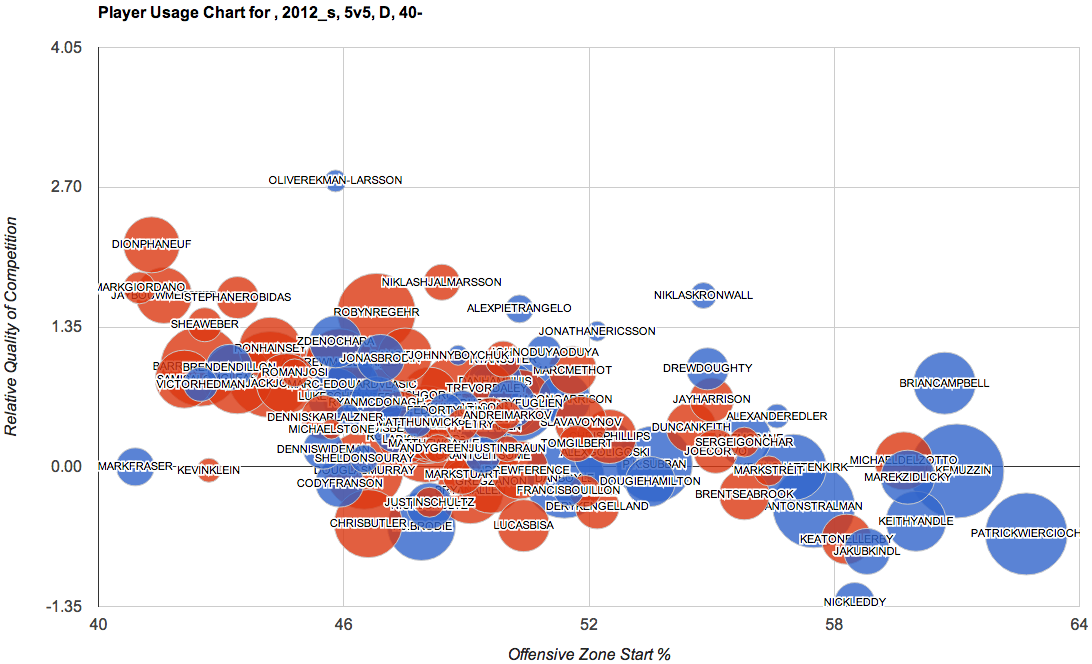
On the surface, Wiercioch had a strong season last year. 19 points and 5 goals in 42 games officially qualifies you as an offensive defenseman in my books. But this chart (which I saw in this Score blog post about Dion Phaneuf) caught my eye:

defencemen-usage-chart

This is 5v5 usage for defensemen over 40 games this season, and check out that big blue dot in the lower right hand corner. Wiercioch received more offensive zone starts, and against weaker competition, than almost every other defenseman in the entire league. He was effective in that position (as evidenced by the size of that blue dot–he drove possession in that role), but what this chart demonstrates is that he isn’t going to be the kind of minute-eating, all-around guy that Gonchar and Kuba were. He’s a weapon to be used extremely selectively. It’s also why, despite his numbers, Wiercioch found himself scratched at times for players like Eric Gryba. Gryba won’t get you the points, but you can lean on him when the game suddenly shifts and you find yourself pinned in your own end.

The point being that while Wiercioch is good at what he does, and you want that kind of player at your disposal (it’s why Anton Babchuck keeps finding work), it’s not likely that in one season he’ll morph into the kind of defenseman Ottawa needs–a reliable second pairing player who is responsible defensively, can play quality minutes, and can also drive possession.

The solution might be a full season of Jared Cowen, though he lost a year of development and looked lost against Pittsburgh. (Not to draw conclusions from that about Cowen; the Pens are a good team.) But a quick glance at the UFA market for offensive defencemen shows it’s better than I thought.

There are higher profile guys like Tomas Kaberle, Ryan Whitney, or Ian White available, but none of them have had particularly good seasons of late, are clearly in decline, and will cost. A guy like Zidlicky or Scuderi can put up minutes, but will cost you a pretty penny. (Or 400 million pennies a year.) Which brings us to Grant Clitsome.

Clitsom put up decent numbers and possession metrics on a weak Winnipeg team playing about 16 minutes a night last season. He was on pace for about a 8-24-32 stat line if it had been a full season, which would have been a career high by far, and he was a +10 on a team that was bottom five in goals against. His shooting percentage (7.1%) wasn’t particularly out of line with his career average (6.5%).  And he was affordable, playing out a two year, $2.5MM contract. At 28, he has a year or two left of prime output if you assume defensemen develop on a longer timeline than forwards.

Even if some regression is to be expected (it was a contract year), Clitsome is the kind of player I think Murray is hoping Wiercioch will develop into–a player who can put up points and play in both ends of the rink. If you only look at offensive zone starts, though, where Clitsome had a 49.4% to Wiercioch’s 62.7%, Patty has a long way to go.

Next season is going to be interesting. Improving on making the playoffs and winning a round by hoping Karlsson will continue to be a wizard and injured players will stay healthy seems naive. Hoping that the addition of another scoring winger will be enough, especially if we lose Alfredsson, also seems naive. It’s going to be those hidden gems that allow the Senators to keep taking the rest of the league by surprise.

Trade Targets 2013

271032-superstar-ice-hockey-dos-screenshot-trading-players-ega-s
James took a look at free agents a couple of weeks ago. Another option for Bryan Murray heading into the draft is trading for the scoring, top six forward the team so desperately needs.

I took a look through Capgeek, and here’s a list of forwards that I think Ottawa could trade for who are 1) low cost in terms of salary (relatively speaking) / high reward, 2) could be traded for without parting with an insane, Rick Nash-style package of prospects and picks, 3) mostly don’t have NMC/NTCs in their contract, and 4) are often playing for teams who will need to shed salary to get under the cap. In some cases their cap hit is larger than their actual salary. And there’re question marks next to nearly all of them.

What does Ottawa have to give up? Well, in addition to the 17th overall pick in this year’s draft, they also have three former 1st round picks in Noesen, Puempel and Ceci who have yet to play in the NHL. There are quality prospects (though not blue chippers) in Da Costa, Hoffman, Pageau, and Prince. And there are two NHLers in Silfverberg and Zibanejad, who you have to think are only on the table for an absolutely killer deal.


David Booth

– I liked Booth when he was in Florida…though so did everyone, which is why Mike Gillis traded for him and why he’s now stuck with an injury prone scoring forward who hasn’t been that effective. Booth has two years left on his contract, and if he’s healthy he’d make a good complementary winger for Spezza. He’s also a left winger, which is a spot where Ottawa can be weak.

Ryan Malone

– Another left winger on a team with sky-high salaries, though he’d have to waive his NTC to come to Ottawa. Malone has a $4.5MM cap hit, but his salary in both of his final two years is $2.5MM. Seems like he could fit into MacLean’s two-way hockey mantra.

Joe Pavelski

– I was surprised to see that Pavelski didn’t have a NTC/NMC, and at $4MM with only one year left on his contract, he’d be pursued heavily if he’s indeed on the block. I don’t see him being worth a bidding war (look at what San Jose got for Ryan Clowe), but it’s worth kicking the tires. He is a centerman, which Ottawa doesn’t need as badly, though as the6thsens guys pointed out recently, our depth at center isn’t as good as we sometimes insist it is.

Devin Setoguchi

– Minnie is spending a ton of money on a mediocre lineup, and Setoguchi only has one year left on his deal. At $3MM, and not much required to get him, he might be worth the risk–though his game seems to have degraded badly over the past two seasons. He’s 26.

Dustin Brown

– This would be an absolute coup, and Ottawa would need to pay through the nose to get him. Brown played a diminished role in this year’s playoffs, often relegated to the third line on a deep team, and he only has one year left on his contract. It’s probably not worth paying a king’s ransom (wah-wah) for one year of Brown before he tests the UFA market, but he instantly makes the team better, and is a great young leader on a team of young, character players. I’d love to have him in a Sens uniform.

Derick Brassard

– He’s a centerman which, again, Ottawa doesn’t need as badly, but he seems to fit the mold of a Bryan Murray trade: good pedigree (drafted 6th overall), stuttering development, connections to Columbus. He only has one year left on his deal, but he’s an RFA after that, so Ottawa retains control. He’s right in that age wheelhouse too, at 25.

Ales Hemsky

– Hoo boy, this one is probably contentious. Most people seem to think that Hemsky sucks. Most in the analytics community seem to think he…sucks less. Personally, I think he makes a lot of money in a market that is thoroughly sick of losing. He’s a focal point for a terrible team. He makes $5.5MM this year, which is a bit hefty, but could probably be got for a pick or mid-tier prospect unless one of those desperate big market teams gets involved and fucks everything up like they usually do.

Scottie Upshall

– I liked Upshall when he was in Philly, and sort of hoped that Ottawa would throw him an offer before Dale Tallon went nuts that one year and signed every mediocre free agent on the market. Upshall is borderline top six, and so might not be worth the risk, and he’s got two years at $3.5MM left. Which, again, was pretty stupid, Dale. But if he can reclaim his spark-plug scorer acumen, giving up a late pick for a salary dump might seem brilliant.

Mike Cammalleri

– Is Calgary rebuilding? I guess so, but it’s hard to say with Feaster and that ownership group. Camm has one year left at a whopping $6MM, but would look awesome next to Spezza. You’d probably have to get into a bidding war with somebody. There is the benefit of knowing that Calgary probably isn’t going to wait until the trade deadline to trade him; everyone knows that that team is going to suck this year. They should unload at the draft if they can.

Chris Stewart

– I wish…St. Louis will probably re-sign him–he’s an RFA without a new deal–but Stewart is just the kind of power forward Ottawa would love to have line up in their top six. St. Louis also needs to re-sign Pietrangelo and Shattenkirk, so they’re kind of screwed. They might be willing to part with a complementary, big forward, especially since he had a down year playing in Hitchcock’s defensive system. Alongside Dustin Brown, this would probably be my #1 player to see in a Sens uniform.

Radim Vrbata

– He’s pretty much the only scoring threat in Phoenix’s lineup, and he has a NTC and a great relationship with his team. But, as always, ownership issues in Phoenix make this a possibility. Would they trade him now and get something in return rather than watch him walk next year, as he only has one year left on his deal? He’s older (32), but would be a decent replacement for Alfie if the captain retires.

Blake Wheeler

– Like Stewart, Wheeler is an RFA in need of a deal. If they can’t get something done in Winnipeg, could they trade him? Would Ottawa want to put themselves in a situation where they give up assets in advance of a contract negotiation, removing all leverage? (cough cough Flyers cough.)

Bryan Little

– Another centerman, another RFA without a deal, and another player who is probably not worth the package required to get him. But might be worth a second look if negotiations don’t go Winnipeg’s way.

Alex Burmistrov

– This one is pretty intriguing, as Ottawa has been linked to Burmistrov in the past. Apparently there’s a good deal of interest there, and Winnipeg is less than enamored with the 21 year old centerman (10 points in 44 games will do that). He’s an RFA with pedigree, having been drafted 8th overall. This has ‘Kyle Turris’ written all over it.

The Wacky East and Chaos Theory

tumblr_lxx7x4gfGL1qill7p

I find that from every occurrence in hockey, analysts will draw one of two universalizing and entirely contradictory conclusions: either that the game is the predictable outcome of systems with a liberal sprinkling of occasionally small sample sizes to spice things up, or that the game is complete chaos and basically we know nothing.

The Stanley Cup playoffs exemplify these principles; either a team goes on a hot streak and defies expectations, or one of the league’s few elite teams goes all the way. Everything is deliberate and careful, or the Hockey Gods bless the Chosen Ones. In either scenario, the analysts (I’m including myself here) are able to point to the result and nod knowingly. We knew something like that would happen.

The Kings are the perfect example. Last year absolutely nobody was picking them to win the Cup. Everyone knew they were good, sure; maybe everything would align, just as it did, but I don’t think they were being talked about the way people talk about the Penguins. They won it all, and now they’re included among those elite teams. Chaos turns into a sense of structure. Only the truly deserving ever win, and we know that, because when we win we retroactively talk about why they’re truly deserving.

But now, the East is turning everything on its head again. Ottawa handily defeats Montreal because Montreal is an overachieving team that didn’t have the mental fortitude or team system for playoff hockey. Then Ottawa is handily defeated by the Penguins because the Penguins are a class above in talent. Now the Penguins are being destroyed by Boston, and the analysts are struggling to understand why. I saw some picking the Pens to sweep Boston. The narrative thread of fish being eaten by bigger fish is fraying.

So what does this matter to Senators fans? Well, as we all know by now, expectations are everything. Back when the Senators were dominating the regular season, anything short of a conference final was considered a disappointment. Players were traded and coaches fired after extremely successful seasons ended without a Cup. (Al Vignault nods silently and John Tortarella nods then throws a desk chair through a window.) These past couple of years, just being invited to the dance has been enough. But now there’s an expectation: is Ottawa on a linear path to greatness? Are they ready to elevate their game yet again, to go from “bubble playoff team” to “elite contender”? Is it ridiculous to even presume that these things happen so predictably? Next year we could see Ottawa with none of the injuries finish second last overall, for all we know.

We should watch the Pens-Bruins series closely this year. A team that is probably as stacked as any I’ve ever seen is being handled, and easily. It’s as if two careful, intentional systems were placed across from one another and produced only chaos. It’s fascinating, and it’s hard to know what we can learn from that series, except that even under the best of circumstances–two generational talents, incredible scorers up and down the line-up, a deep defense, veterans everywhere–we’re all subject to the cruel randomness of this weird, wacky sport.

Roundtable of Death: Actual Death Edition

tod

It’s time for our end of season wrap-up. Thanks to everyone for reading this season; it was a great one. Make sure to follow us on Twitter, where James routinely kills it, and come back during the summer, when this blog converts back into a blog about devil sticks.

It really was the best of times
 

Varada: Preseason predictions, including my own, had the Sens as a bubble team at best. And I guess they were a bubble team, but on the right side of 8th place, and with their playoff probability well above 80% all season long. We got great looks at Silfverberg, Zibanejad, and Wiercioch, had some pleasant surprises in Pageau and the trade for Conacher, and enjoyed a number of improbable comebacks and gutsy wins. And, of course, they won a playoff round for the first time in six years. How could you call this season anything other than a success?

James: I think the biggest plus I take out of this season (and I truly feel there were many) is that though many players very green, this team has depth that can get the job done. I say this is my biggest takeaway because just a few short years ago plugging a Binghamton player or two into the lineup even for a short period of time was to see a different team. Ottawa’s always had good players but if they went down the team would suffer greatly. Do you have any substantial memories of Cody Bass or Roman Wick? The Ottawa Senators actually had a more successful season than the previous without Jason Spezza, Erik Karlsson and largely Craig Anderson and Milan Michalek. Of course I’d have preferred full seasons from these stars but if 7th seed post season birth from a bunch of rookies and old men isnt team development I dont know what is. Cant wait to see the star players combine with the capable reinforcements. I dont know if there’s ever been a more exciting time to be an Ottawa Senators fan.


Gonchar is going to be a decision

Varada: He was a bit of a revelation this year, even if 27 points in 45 games and unspectacular possession stats still aren’t worth $5.5MM a year. But you don’t find a player with 19 seasons of NHL experience under his belt every day, and that experience probably went a long way when the team needed stability and leadership while weathering injuries. Looking at the Sens’ lineup, I don’t see someone who will step in and play 20+ minutes a night. MacLean seems to have thought the same, praising Gonchar in his post-season presser.

I think at this point nobody would be particularly torn up to see Melnyk’s money go back into Serge’s bank account. At the same time, do you remember Kuba? Solid stats, steady partner for Karlsson, a bit older, lots of experience, cup ring…and Florida gave him $4MM a year for two years. My point being, somebody is going to overpay for Gonchar, and if it’s Ottawa I guess that’s ok–but it will still be overpayment.

James: I agree with your points and think Gonchar had a very good season for Ottawa. When it comes to resigning Gonchar the decision to let him walk is an easy one for me. It’s not an indictment of his play. You’re right about all those things. A calmness with the puck that just cannot be taught, solid point production, raised his game unexpectedly: Hey, mind filling in indefinitely for a guy who plays up to 30 mins a night and is the defending Norris winner? THX BRO! Guy was instrumental in salvaging the season. That said, he is 39 years old. I thought he played a lot younger than that… well until about the post season. And hey that’s cool. Some of the young guys looked old against the Penguins. I just think its going to take 2 years to resign Gonchar and I don’t think Ottawa should do that. It’s not the money its the time. If Murray can convince him to sign for 1 year, yeah do it. Two? I’m going to take names of people who argue me and come back to them when we’re watching a 41 year old Sergei Gonchar play an 82 game season on the youngest team in the NHL.. 

It’s clear Karlsson has a steady partner now in Marc Methot who I thought was the best, most consistent defenseman all season for Ottawa. I think we’re all a bit down on Jared Cowen right now but he looked so normal out there that we quickly forgot how rusty he probably was. The guy hadnt played NHL hockey in nearly a calendar year when he came back. For me, I trust Cowen can take on second pairing minutes. Next Patrick Wiercioch. His game is not perfect but thrust into 42 games thanks to injury, Wiercioch, a rookie, was the second highest scoring defenseman on the team and finished a team high +9. All that at a paltry 15 minutes a game. The kid has some ability. Below that, guys like Benoit and Gryba (who played first pairing a lot this season LOL) have shown they can play at the NHL level and there’s always the emerging Boroweicki to consider. Notice I havent even mentioned Phillips yet who had his best season in years. Is Cowen – Wiercioch a viable second pairing? Obviously I’m not sure but this is still a rebuild and this season’s injury troubles showed me you actually can hand the keys over to the kids to an extent. I’ll take having a first pairing of a Norris winner and a fast, strong and physical shutdown beast and let MacLean play around with the rest over signing a very good 39 year old to term. If that doesnt cut the mustard, trade a little of that depth for a top 4 d man. With Karlsson – Methot we don’t even need an elite guy. Grow Sens Grow. 

Ottawa’s depth isn’t even truly appreciated yet

 
Varada: As much fun as it was to watch Ottawa’s young guns this year, remember that they still have three first round picks–Noesen, Puempel, and Ceci–who have yet to play an NHL game. You’ve got Stone on the cusp of breaking into the NHL, and others, like Hoffman and Shane Prince, making strong cases for themselves. Lehner is cutting the brakes on Anderson’s car right now. Who knows what other hidden, Pageau-like gems are in the system. Ottawa might lose some veterans next season, but there’s a version of this team that’s two or three seasons away that is going to blow the doors off the league.

Add to that a Norris trophy winning defenceman, a (probably) Jack Adams winning coach, a great development team in Luke Richardson’s B-ham Sens, and the fact that the contenders in the East are entering their twilight years of contention, and this team’s best years are ahead.

James: A huge, huge thing for me was seeing Robin Lehner get tossed into a second round playoff game and make some huge stops against some Elite shooters. Lehner went in ice cold and did not look scared in the slightest out there.  Maybe the pressure was off because the team was losing so badly but I think it would be assholish of me to assume the pressure is ever off playing the no.1 seeded team in the playoffs. Ice water in those veins. J/K you have to have a heart to have veins. I’m not trying to say anything extreme here like make him no. 1 or anything. That’s just amazing experience right there. I’m one for preaching patience with developing goaltenders but I must admit watching his dominance in Binghamton and composure during his call up that the 21 year old Lehner is way, way ahead of the curve.

I can’t move on from this topic without talking about Jean Gabriel Pageau. Look, I called the shit out of this from the get go but we’re not going to talk about that too much *brushes diamonds off platinum shoulder* We’ve seen breakout late season performances (Bobby Butlah) and unexpected playoff dominance (Peter Regin) but this one feels different. I’m not going to overdo it but with all the quality prospects Ottawa has I was waiting for a kid to come out of the woodwork and put up an undeniable performance. Pageau has been that so far. There were points in the PLAYOFFS where he looked like the most complete player on the team. Not bad for a guy with 9 NHL games under his belt going into the post season. I think he’s a lock to to make the team next year. With a coach who rewards quality of play the way P Mac does, what line he lands on will be squarely up to Pageau.

Lastly, as far as development goes, I actually think it’s good for the young guys on the team to experience overcoming the struggle of a season filled with adversity, the glory of a dominant playoff win and then a pretty thorough ass kicking at the hands of the best team in their conference. Over the past two seasons there’s been a lot of fast tracking of experience. Consider that as of this writing Jakob Silfverberg has played only 4 fewer playoff games than Rick Nash. No. 3 overall Kyle Turris, has now played 21 more than the entire Edmonton Oilers’ top five in scoring. Unfair stat? Whatever fun is fun.
Several great looking young players are solidifying their sports in the lineup and there are more potential prospects than spots on a roster. Some smart moves and patience could turn this into a very, very dangerous team quickly.

We’re a year closer to the heritage jersey being made our primary jersey

 
Varada: For real. This has to happen. Death to the 3-D head.

James: Yo. I’d like to remind everyone out there that IM ONLY FUCKIN WITH HOT SHIT. How are so many people still rocking that Senagoth jersey? The Heritage is the nicest jersey since the original one. OH SURPRISE, SURPRISE Fan designed and brought to prominence by a fan petition. Open your wallets and show that the other jersey’s theyve tried to push on us stink. Just dive in. What a Karlsson uni isnt as safe a bet as an Alfie at this point? You leave the organization to their own devices and you get the SNES. You know what id like to see more than anything?

Image courtesy of Le Collectif

Twasnt broke, twidn’t need fixing.