
Well, it’s happened. The Ottawa Senators have traded the best player in franchise history and hollowed out the soul of the team for years to come. James, Varada and Luke react with cooler heads than anyone might have thought.

Well, it’s happened. The Ottawa Senators have traded the best player in franchise history and hollowed out the soul of the team for years to come. James, Varada and Luke react with cooler heads than anyone might have thought.
The Ottawa Senators are proud to share the vision for the future of our team and this organization. We are about to launch an exciting plan to rebuild our team and we are inviting you to be a part of our rise to new heights. #OttawaRising pic.twitter.com/hok2jYCUVi
— Ottawa Senators (@Senators) September 11, 2018
There’s a level on which the bizarre 10:05 PM tweet from the Ottawa Senators’ official account undoubtedly represents an unprecedented low point in the modern history of the team or, at the very least, of the Eugene Melnyk era.
There’s another level, however, on which what happened last night was depressingly predictable given the continued underinvestment in what most large businesses take for granted: public relations and media strategy departments, professional writing and rigorous field testing of a message, good old-fashioned managing up and an actual, clear vision of progress. No healthy organization would have allowed this quality of a product in this kind of a toxic environment to see the light of day. This video – this utterly if unintentionally hilarious monstrosity of an attempt to control the damage – is the inevitable outcome of a franchise gone to seed.
Here are a few of the things I was thinking as I watched the ratio under that tweet surpass a thousand replies:
Perhaps weirdest is the owner taking the opportunity to tell the fans that he’s not going anywhere for a long, long time. This, after a summer in which #MelnykOut became the organic, unifying meme this team has never been able to create itself. Maybe Melnyk is out of touch with how his customers feel, or billionaires just have brain worms from years of people sucking up to them, but if he has even the slightest sense of what’s going on then the inclusion of this little tidbit can’t help but feel like a big “fuck you” to those of us who can’t bring ourselves to buy a ticket if it means giving Eugene Melnyk a dollar. He’s saying he’ll outlast us.
And finally, I feel for the veterans in that dressing room on unmoveable contracts: Bobby Ryan, Craig Anderson, Marian Gaborik, Mikkel Boedker, and Zack Smith. When they signed those contracts, the team seemed to be trending up. Now they’re trapped between an owner nobody can control, an irate fanbase, their own declining abilities and the complete lack of a future. Craig Anderson, in particular, who’s been a warrior for the team for the better part of eight years and probably the best goalie the Sens have ever had, is about to be on the receiving end of a really bad team’s really bad season. I hope they find a home for him elsewhere and a real chance to end his career competing for a Cup.
In the end, what we’re left with is our own work. Last night’s spontaneous combustion of our favorite team was at least a moment to appreciate the creativity and passion of the fans on twitter. We deserve better than this. At least we’ve got each other.
— Capital Gains (@Capital_Gains65) September 11, 2018

Ottawa Senators fans are in the market for a new team. Over the past year, Eugene Melnyk has seemingly gone out of his way to make it impossible to want to attend a Senators game if it means contributing in any way to his financial well-being. He’s certainly gassed any goodwill remaining in the tank after rescuing the team from bankruptcy over a decade ago.
But how evil is Eugene Melnyk, really, when compared to his fellow billionaires? So long as the NHL’s business model requires some wacky rich guy or gal to want to add a hockey franchise to their Batcave, we’ll be dealing with a veritable rogues gallery of arch-conservatives and moldy white dudes who made their fortunes in less than inspiring ways. The odd consortium of local business interests, like those in Nashville and Winnipeg, are in the minority. So, if you’re going to pick another team to root for, you may as well make the relative level of each majority owner’s evilness a starting point.
How does a guy working off the side of his desk assess the evilness of a billionaire owner of a hockey franchise? In three airtight ways:
There are a few safe assumptions you can make about anybody whose personal fortune is in the billions of dollars. First, they probably sit on the board of a foundation or fundraising entity, usually associated with their business or hockey club. This doesn’t mean that they donate significant proportions of their personal wealth to that organization, though you can assume that they give something to their foundations, including money and time. They also probably donate some small, undisclosed amounts to various causes and campaigns. For this article, I was looking for philanthropic involvement above and beyond the occasional conference call to hear about foundation financials.
This article is meant to be a jumping off point for your own irresponsible Googling. I didn’t do a deep dive to find out if the St. Louis Blues’ owner once punched a goat at the petting zoo. Obviously, this is not a comprehensive or scientific assessment of evilness, both because I don’t have the time and because notions of morality are socially constructed and ratified via discourse and as such are easily subjected to a posteriori deconstruction whether or not you believe in essentialist beliefs. This is evidenced, first and foremost, by the following usage of Dennis Hopper’s portrayal of Bowser from the 1993 movie Super Mario Bros:
EVILNESS RATING SCALE
Only a little bit evil 
Pretty damned evil
Mostly evil
Almost exclusively evil
Insufficient information on Wikipedia to assess evilness 
| Anaheim Ducks | Henry Samueli | Anaheim Ducks Hockey Club LLC | 2005 |
Evilness of primary industry
“Broadcom Inc. is a designer, developer and global supplier of products based on analog and digital semiconductor technologies within four primary markets: wired infrastructure, wireless communications, enterprise storage, and industrial & others.”
Okee doke.
Philanthropic activities
To date the Samueli’s have committed over $500 million to philanthropic causes, many of them involving STEM research and education. They’ve been involved in integrative and alternative medicine, which can be contentious. They’re worth $3.8 billion.
Only a little bit evil
| Arizona Coyotes | Andrew Barroway | IceArizona Acquisition Co., LLC | 2014 |
Evilness of primary industry
He’s a hedge fund manager.
Philanthropic activities
None reported. Apparently he’s only worth about $50 million. I have no idea how Arizona is still a hockey team.
Insufficient information on Wikipedia to assess evilness
| Boston Bruins | Jeremy Jacobs | Boston Professional Hockey Association, Inc | 1975 |
Evilness of primary industry
Delaware North is a global food service and hospitality company. The company also operates in the lodging, sporting, airport, gaming and entertainment industries.
Philanthropic activities
A bit over $50 million, most of which went to the University of Buffalo. Some medical research and funding the Bruins Foundation to improve the lives of children. Keep in mind, he’s the 481st richest person in the world, worth about $4.7 billion. For what’s it’s worth, Jacobs is apparently a bit of a hardliner when negotiating the CBA with his players.
Pretty damned evil
| Buffalo Sabres | Terrence Pegula | Pegula Sports and Entertainment; Hockey Western New York, LLC | 2011 |
Evilness of primary industry
Holds business interests in natural gas development, real estate, entertainment and professional sports
Philanthropic activities
$100 million to Penn State’s hockey program and $12 million to Houghton College. He’s worth $4.3 billion. I dock him a bit here for his philanthropy mostly being support for sports programs.
Pretty damned evil
| Calgary Flames | N. Murray Edwards | Calgary Sports and Entertainment | 1980 |
Evilness of primary industry
Canadian oil sands.
Philanthropic activities
None reported. He’s worth $2.2 billion.
Almost exclusively evil
| Carolina Hurricanes | Tom Dundon | Gale Force Sports And Entertainment, LLC; Carolina Hurricanes Hockey Club | 2018 |
Evilness of primary industry
Financial services and entertainment.
NOTE: After publishing, a reader sent me this article about how Dundon profited off of sub-prime loans. I think you could be justified in adding another evil to the pile.
Philanthropic activities
None reported. Net worth unknown, but it’s at least $1 billion. If his charitable work was significant, you’d think some info would be out there. He’s new to the scene, so maybe more will emerge with time.
Pretty damned evil
| Chicago Blackhawks | Rocky Wirtz | Chicago Blackhawk Hockey Team, Inc. | 1954 |
Evilness of primary industry
Real estate, wine and insurance.
Philanthropic activities
None reported. He’s worth $4.2 billion. Is docked points for being hockey’s equivalent of Gilded Age money.
Mostly evil
| Colorado Avalanche | Ann Walton Kroenke | Kroenke Sports & Entertainment; Colorado Avalanche, LLC | 2000 |
Evilness of primary industry
Heiress to the Walmart fortune
Philanthropic activities
Vice President of the Audrey J. Walton and Ann Walton Kroenke Charitable Foundation. In 2014, the foundation had assets exceeding $3 million. Her worth is $6 billion. That’s pathetic. Also Walmart busts unions and keeps pay low.
Almost exclusively evil
| Columbus Blue Jackets | John P. McConnell | Colhoc Limited Partnership; The Columbus Blue Jackets Hockey Club | 2000 |
Evilness of primary industry
Worthington Industries is a global diversified metals manufacturing company
Philanthropic activities
Unknown. Wealth unknown.
Insufficient information on Wikipedia to assess evilness
| Dallas Stars | Tom Gaglardi | Dallas Stars LP | 2011 |
Evilness of primary industry
Owns a company that operates hotels and restaurants.
Philanthropic activities
Unknown. Wealth unknown.
Insufficient information on Wikipedia to assess evilness
| Detroit Red Wings | Estate of Mike Ilitch | Ilitch Holdings Inc.; Olympia Entertainment; Detroit Red Wings, Inc. | 1982 |
Evilness of primary industry
Owns Little Ceasars pizza chain.
Philanthropic activities
These are pretty extensive, so I’m just going to quote from the Wikipedia page:
“The Ilitchs established a travelling kitchen to feed the needy, which has served over 2 million so far. In 2006, inspired by a veteran returning to civilian life after losing both of his legs in war, Ilitch founded the Little Caesars Veterans Program to provide honorably discharged veterans with a business opportunity when they transition from service or seek a career change. Ilitch received the Secretary’s Award from the U.S. Department of Veterans Affairs for this program in 2007; it is the highest honor given to a civilian by the department. The Little Caesars Amateur Hockey Program, established by Ilitch in 1968, helped thousands of children.Additionally, Ilitch Charities for Children was founded in 2000 as a non-profit foundation dedicated to improving the lives of children in the areas of health, education and recreation. In 2008, the charity was renamed Ilitch Charities and its focus was broadened. The new charity invests in the community’s future by supporting innovative, collaborative and measurable programs that promote economic development and spur job growth, as a means to address social issues such as poverty, unemployment, homelessness, and hunger. As a result of his philanthropy, the School of Business for Wayne State University in Detroit is named the “Mike Ilitch School of Business”
From 1994 until her death in 2005, Ilitch paid Rosa Parks’s rent to enable her to live in a safer part of Detroit. (!)
Worth $6 billion.
Only a little bit evil
| Edmonton Oilers | Daryl Katz | Rexall Sports Corporation; Oilers Entertainment Group | 2008 |
Evilness of primary industry
Pharmacy, real estate and entertainment.
Philanthropic activities
Katz has donated “over $50 million” to organizations and institutions, such as pharmacy schools and hospitals. He’s worth $2.9 billion. Is docked points for duping Edmonton City Council into paying for his hockey arena.
Mostly evil
| Florida Panthers | Vincent Viola | Sunrise Sports and Entertainment; Florida Panthers Hockey Club, Ltd. | 2013 |
Evilness of primary industry
Trading and marketing. For what it’s worth, Trump nominated him for Secretary of the Army.
Philanthropic activities
Various donations to military organizations and a Catholic Theology university department. He’s worth about $1.8 billion.
Almost exclusively evil
| Los Angeles Kings | Philip Anschutz and Edward P. Roski | Anschutz Entertainment Group, The Los Angeles Kings Hockey Club LP | 1995 |
Evilness of primary industry
Anshutz controls everything from “energy, railroads, real estate, sports, newspapers, movies, theaters, arenas and music.” He is described as a Christian conservative. Rosky is in real estate.
Philanthropic activities
Anschutz donated over $100 million to educational institutions, and has won awards for his philanthropy. Anshutz is worth a stunning $12 billion. Rosky has donated $23 million to arts education and $25 million to health research. His foundation awards $2 million annually. Rosky is worth another $5.8 billion.
Only a little bit evil
| Minnesota Wild | Craig Leipold | Minnesota Sports and Entertainment; Minnesota Wild Hockey Club, LP | 2008 |
Evilness of primary industry
Telemarketing.
Philanthropic activities
None reported. Wealth unknown. “Leipold is a prominent Republican and supporter of George W. Bush and Mitt Romney. The Xcel Energy Center hosted the 2008 Republican National Convention.”
Almost exclusively evil
| Montreal Canadiens | Molson family | Club de hockey Canadien, Inc. | 2009 |
Evilness of primary industry
Depends on where you stand on the sale of massive amounts of watery beer.
Philanthropic activities
The Molson Family Foundation has awarded grants to artists for a half-century. “The Molson Family Foundation, together with several members of the family, contributed the major part of the funds required for the construction of the Molson Fine Arts Building at Bishop’s University.”
Only a little bit evil
| Nashville Predators | Thomas Cigarran | Predators Holdings LLC | 2007 |
Dude doesn’t have a Wikipedia page (seriously), but I think he owns long-term care homes in Tennessee under the name American Health Corporation.
Insufficient information on Wikipedia to assess evilness
| New Jersey Devils | Joshua Harris | New Jersey Devils LLC | 2013 |
Evilness of primary industry
Co-founded Apollo Global Management, which, uh, “specializes in leveraged buyout transactions and purchases of distressed securities involving corporate restructuring, special situations, and industry consolidations.” He’s a prominent Trump supporter, advising on Trump’s extremely successful infrastructure investment plan. He was almost offered a job in the administration despite (or because of) lending $184 million to Jared Kushner.
Philanthropic activities
None reported. Worth $3.5 billion.
Almost exclusively evil
| New York Islanders | Jon Ledecky and Scott D. Malkin | New York Islanders Hockey Club, LP | 2014 |
Evilness of primary industry
Not a lot of info on either of them. Malkin owns some retail.
Philanthropic activities
None reported. Wealth unknown.
Insufficient information on Wikipedia to assess evilness
| New York Rangers | James L. Dolan | The Madison Square Garden Company, New York Rangers Hockey Club | 1997 |
Evilness of primary industry
From what I can tell, he mostly runs the Madison Square Garden Company and I think works or has worked for Cablevision, which I think does something related to cable and vision.
Philanthropic activities
Dolan has mostly collaborated with Cablevision’s philanthropic efforts to fight cancer and support first responders. I don’t know if he’s got any personal skin in the game or what his overall wealth is.
Pretty damned evil
| Ottawa Senators | Eugene Melnyk | Capital Sports Properties; Ottawa Senators Hockey Club Limited Partnership | 2003 |
Evilness of primary industry
Drugs. Horses. Horses on drugs.
Philanthropic activities
You know what? Melnyk doesn’t fare badly by my airtight Evil Meter. His wealth is reported at $1.21 billion, though we know he has significant debt. Even if he didn’t, that’s paltry compared to the size of the fortunes on this list. And his philanthropic activities are pretty diverse, if not comprising a massive proportion of his fortune. He’s donated at least $8.8 million of his personal wealth to various health care and elderly care initiatives, but he seems to be very involved in a number of philanthropic organizations, including, of course, the Sens Foundation. Check out the philanthropy section on his Wikipedia. It’s longer than most. Is docked points for being an absolute prick.
Pretty damned evil
| Philadelphia Flyers | Brian L. Roberts | Comcast Spectacor; Philadelphia Flyers, LP | 1996 |
Evilness of primary industry
CEO of Comcast
Philanthropic activities
From what I can tell, Roberts has won a bunch of awards for being a decent guy and progressive CEO but I don’t see any information about donations of personal wealth. He’s donated more money to Democrats than Republicans, for whatever that’s worth.
Pretty damned evil
| Pittsburgh Penguins | Ronald Burkle and Mario Lemieux | Lemieux Group LP | 1999 |
Evilness of primary industry
Burkle is “co-founder and managing partner of The Yucaipa Companies, LLC, a private equity and venture capital firm that specializes in underperforming U.S. companies in the distribution, logistics, food, retail, consumer and light industrial sector.”
Mario Lemieux is Mario Lemieux.
Philanthropic activities
Burkle’s philanthropic activities are extensive. His Ronald W. Burkle Foundation’s mission is to “positively influence people around the world and their communities” by supporting programs that “strengthen international understanding, foster worker’s rights, empower underserved communities, nurture the arts and architecture, engage children in learning and advance scientific research.” No idea what its endowment is. He’s worth about $2 billion. Lemieux works with various charitable causes related to cancer research.
Only a little bit evil
| San Jose Sharks | Hasso Plattner | Sharks Sports and Entertainment; San Jose Sports & Entertainment Enterprises; San Jose Sharks, LLC | 2002 |
Evilness of primary industry
Co-founder of SAP SE software.
Philanthropic activities
Plattner has donated tens of millions to AIDS research and also “contributed more than €20 million which enabled reconstruction of the historic exterior of the Stadtschloss (in Potsdam), which had damaged during World War II and demolished in 1959. At the time, it the largest donation ever gifted in Germany by a single individual.” Plattner is worth $13.1 billion.
Only a little bit evil
| St. Louis Blues | Tom Stillman | SLB Acquisition Holdings LLC; St. Louis Blues Hockey Club, L.P. | 2012 |
Tim Stillman doesn’t have a Wikipedia page. I think he runs a beer distributor.
Insufficient information on Wikipedia to assess evilness
| Tampa Bay Lightning | Jeffrey Vinik | Lightning Hockey LP | 2010 |
Evilness of primary industry
He ran a hedge fund.
Philanthropic activities
Vinik has given at least $13 million. I don’t know what he’s worth, but in 2017 he didn’t even make a list of the top 35 billionaires in Florida, although, granted, Florida is where shitty billionaires tend to congregate.
Only a little bit evil
| Toronto Maple Leafs | Larry Tanenbaum | Maple Leaf Sports & Entertainment, Ltd.; Kilmer Sports, Inc. | 1996 |
Evilness of primary industry
Like Dolan in New York, Tanenbaum basically runs the media empire that is his sports holdings.
Philanthropic activities
He received the Order of Canada for his philanthropic work, but I don’t have personal amounts. He’s said to be worth about $1 billion.
Only a little bit evil
| Vancouver Canucks | Francesco Aquilini | Canucks Sports & Entertainment | 2004 |
Evilness of primary industry
Owns an investment firm and real estate.
Philanthropic activities
He’s apparently worth about $2 billion, and has given extensively to hospitals and wildlife preservation charities and efforts, but I don’t see amounts.
Only a little bit evil
| Vegas Golden Knights | Bill Foley | Black Knight Sports & Entertainment, Hockey Vision Las Vegas | 2016 |
Evilness of primary industry
Financial services lawyer.
Philanthropic activities
Worth and contributions unknown.
Insufficient information on Wikipedia to assess evilness
| Washington Capitals | Ted Leonsis | Mounumental Sports and Entertainment | 1999 |
Evilness of primary industry
Financial services lawyer.
Philanthropic activities
He’s worth about $1 billion and runs the Leonsis Foundation, the endowment of which I don’t know, but it’s given to more than 400 charities.
Only a little bit evil
| Winnipeg Jets | Mark Chipman | True North Sports & Entertainment, Ltd. | 2011 |
Evilness of primary industry
He was a lawyer and now seems dedicated to running the Jets.
Philanthropic activities
He’s apparently worth about $500 million and there’s no reported philanthropy.
Insufficient information on Wikipedia to assess evilness
WHAT ABOUT GUY LALIBERTE?
The potential new owner of the Ottawa Senators is worth about $1.4 billion, which isn’t really that much more wiggle room than Melnyk, but that’s for a future article. He apparently doesn’t have much of a philanthropic interest and, worst, he’s one of those “space tourists” – a guy who spent a fortune so he can have a fleeting experience travelling to the International Space Station rather than change people’s lives through modest contributions to health and education. Not very promising. I actually rate him worse than Eugene Melnyk. Laliberte seems like a much wackier billionaire without much more money than peak Melnyk. Be careful what you wish for.
Mostly evil
Conclusions:
Across the board, philanthropic activities pale in comparison to overall wealth. You have to be a multi-billionaire to play in this club, but philanthropic activities are usually in the tens of millions at best. That’s not nothing, and I understand personal wealth doesn’t necessarily mean liquid cash. But we do see, in some cases, people worth multiple billions of dollars only finding time to gift a percentage point of a percentage point of their wealth to worthy causes.
The California-based teams feature the most philanthropically-minded owners. Los Angeles’ ownership group has given hundreds of millions of dollars. Anaheim and San Jose’s owners have both given tens of millions. Also, none of them seem to be involved in something overly evil as a side hustle. California is a decent place to start.
Pittsburgh’s Burkle and Lemieux might also be a serviceable choice, though I know it’s hard for Sens fans to imagine themselves rooting for the Pens. Vinik in Tampa also seems like he wouldn’t preclude fandom. I’d also give Philly an honorable mention because of all of those Good Guy CEO Awards. If you require a Canadian team, Montreal and Vancouver seem like safe bets. And, as much as it hurts to say it, Toronto would be a perfectly reasonable team to root for.
For my money though, I’m thinking Detroit. I mean, the Rosa Parks thing alone, on a list of prominent Republicans, is probably enough to seal it for me. But not only does the Ilitch Family have an extensive philanthropic history, they also sell pizza. Pizza! Most of the other owners here you have to squint and look at sideways to think of as harmless. Pizza is about as harmless as it gets, at least on this list. Pizza might be the only thing on which we can all agree in these polarized and polarizing times. Also, Sens fans don’t have much of a rivalry with Detroit, Alfie played there, and they selected Zadina (which Ottawa should have). They’re like an alternate universe Sens who did the things we wanted them to. They also suck and have some Bobby Ryan contracts of their own. Detroit seems like a natural fit.
For that reason, I’m making my 1B team the Detroit Red Wings. Let’s go, you stupid Wings!
NOTE: I received the following very interesting information from a Detroit-based writer for the Detroit Metro Times that I encourage you to consider:
I respectfully disagree with your assessment of Mike Ilitch. Over the course of a decade or so, he quietly bought up large pieces Detroit’s Cass Corridor neighborhood, forced out any tenants, and left the buildings to rot so he could get hundreds of millions of dollars in taxpayer money to “redevelop” it with a new “arena district.” (Some of that money should have gone to Detroit’s super poor school district). Some called it “dereliction by design.” But even worse is that he didn’t follow through on most of what he promised, and the neighborhood is a bunch of boarded up buildings that he owns surrounding Little Caesars Arena. There’s no “district.” That was a scam to get more taxpayer money. He also destroyed a bunch of historic buildings and built parking lots in their place. So we gave this guy hundreds of millions of dollars and we got parking lots that he profits off of and vacant buildings. The Ilitch parking lot desert is a thing we have here, and there’s a lot more I don’t have the time to detail. The guy is a villain, and public opinion is turning against him. I wrote a story on the topic here: https://www.metrotimes.com/news-hits/archives/2017/09/12/how-the-ilitches-used-dereliction-by-design-to-get-their-new-detroit-arena You can also check out a FB page that popped up this year called “Terrible Ilitches” that tracks their misdeeds. https://www.facebook.com/TERRIBLEILITCHES/

I have no interest in listing here the most recent iterations of our daily hell, the various, sordid events and utterances of the Ottawa Senators brain trust that comprise what we can now confidently call the most disastrous year in the history of the Ottawa Senators. It’s been bad, but this isn’t some run-of-the-mill bad experience like your best player getting hurt for a season, or missing the playoffs by a point after losing the last game of the season in a shootout. No, we’re not so lucky as to be a Florida Panthers or Carolina Hurricanes, perpetual also-rans who aspire to scary goodness. The 2017-2018 Ottawa Senators were the kind of bad that should have any sane person questioning if they can go on being a fan of this team at all.
Suffice it to say that there are tiers of awfulness, each with corresponding degrees of despair that impact one’s enthusiasm and ability to interact with a team. They are, as far as I can tell, roughly as follows:
At one point or another this year, the Senators have existed in one or more of these tiers. Pending the outcome of the Randy Lee trial, the Senators are even getting into solid No Fucking Around, We All Need to Move On territory. It begs the question: what are the limits of loyalty in a universe of entertainments offered by questionable people? How could a person possibly justify continued allegiance to something as ultimately arbitrary as a good game of puck-n’-stick amid all of this ugliness? At this point, it’s not only a matter of frustration or of not wanting to be accused of being a fair-weather fan. We are faced with a situation where if somebody accuses you of not being a real fan you might be able to credibly say, “The Assistant GM tried to coerce a 19-year-old into fucking him.” We’re a few short months away from being asked by various hockey writers to carefully consider the Senators development camp and pre-game schedule, as if we don’t live exclusively inside the sucking sound of an airplane toilet. What are we possibly expected to do when confronted with that absurdity, that clarion-clear declaration of moral stupidity as the waves of content wash over our borders? Oh, no! Is Patrick Sieloff getting too much ice time? The Assistant GM tried to coerce a 19-year-old into fucking him. Is the coach playing a talented forward with Tom Pyatt? The Assistant GM tried to coerce a 19-year-old into fucking him. Should we have taken Zadina over Tkachuk? THE ASSISTANT GM TRIED TO COERCE A 19-YEAR-OLD INTO FUCKING HIM. How can we possibly get up for reading a team-by-team Off Season Winners and Losers post that is destined to replace Ottawa’s letter grade with an ancient incantation that you die when you read?
Here are four strategies that I have, at various times over the past few months, contemplated employing in some desperate attempt to stay a fan of this thing I used to love.
This is the equivalent of Chief Bromden smothering Randle McMurphy with a pillow, except in this scenario the Senators fan is both the euthanizer and euthanized. It involves the willful negation of one’s critical faculty, which shouldn’t be too hard because we decided to be sports fans in the first place (hey-oh!). To employ this strategy is to remove even that basest of discerning qualities: the ostensible selection of a favorite team based on its questionable affiliation with the city one lives in or used to live in. This strategy is tantamount to attending a conference about dairy farming and hearing a former Olympian give a speech about the nature of excellence: it means anything to anyone which means it means nothing to anybody.
This is the way my dad enjoys sports. He stands up and cheers when either team scores. He seems pretty happy. You could take him to a 6-2 game between the last place and second-last place teams and he’d exclaim as he left, “that was close one!” He’s not stupid. He built an electric scooter out of spare parts and designs telecom networks for a living. He just has his priorities straight.
I’ve seen a few people here and there declare (mostly on Twitter, which seems designed to facilitate doubling-down on the morally dubious) that they will remain Ottawa Senators fans no matter what. Obviously, it’s possible to admire this, but I’m not sure what they mean, really, when they say they’ll stay a fan. Is it possible to be a fan of a team that is equal parts bad, not entertaining, and evil all at the same time? What does being a fan look like? Is it attending games and having fun despite all of these things, or refusing to emphasize these things at all? Would the feelings of joy or pain at wins and losses be genuine feelings with some semblance of your brain containing information about what’s happened this year? Can people turn it off and on like that? One could, I suppose, find some meaning in the stubbornness of the act, the resolute, unapologetic, politically incorrect loyalty to a compromised thing because it’s Our Thing. One might wear a SNES jersey, insisting it an underappreciated design, down Bank Street and past the Redblacks game, with all of its happy fans, and hold up that “number one” finger and say, full of sincerity, “we’re the best!” and it would elicit at least sympathy from others.
“The arc of the moral universe is long, but it bends toward justice” is something that you might be tempted to say about this situation but it wouldn’t be appropriate because we’re talking about a fucking hockey team and not civil rights. Put another way: people’s memories are short and you should know that this suckiness, too, shall pass in time. The intervening year(s) tuning out from this team and tuning into something else will reveal themselves to be all of the time you’re always talking about not having enough of. You don’t have to snuff out your fandom like a puppy you drown in the basement sink. Just freeze that puppy in the basement freezer to be taken out some years later when the team has been sold and Chabot is being traded for futures and it looks like we’re about to embark on a fool-proof rebuild where every second-round pick hatches like a Yoshi egg to reveal a perfectly serviceable third-line winger. Someday this team will be owned by somebody just evil enough to ignore, and it will be okay to be a fan again.
This is a tough one. Even after everything I’ve written above, this feels sort of drastic and I don’t know if I’m there yet. I can’t help but feel, however, like to do anything less than swear off the Senators for good is a little bit like justifying enjoying Woody Allen movies because we’re just sooooo good at keeping the art separate from the artist. Is that what we’re good at or are we actually good at keeping our humanity separate from our nostalgia for long playoff runs, 11:11 “Alfie” chants, and Zdeno Chara rag-dolling McCabe? Why hold on in the face of utter futility and Melnyk’s omnipresent dourness? Those memories will still be there. Alfie is still out there, playing ping-pong, getting happily fatter. There are 30 other teams in the league vying for our attention, to say nothing of the other hockey leagues, other sports, and entirely different interests. I found out the other day that Ottawa 67s season’s tickets are $400. $400!!! That’s the price of a game-worn David Legwand jersey, who was a player Ottawa voluntarily signed during free agency after which he scored 27 points in 80 games in one season with the team. The 67s have the added advantage of playing in a newly-renovated arena located downtown, which is something we’re still a public feud about financing away from achieving with the Senators. And, in years to come, if asked why you don’t follow the Senators anymore, you can say, “I stopped following the team after the 2016-2017 season,” and people will absolutely know what you’re talking about without further detail. Because, odds are, you won’t be the only one they’ve encountered.
—–
So: what are you supposed to do? Yes, you, reading this blog, risking discovery by your boss, ready to flush it all away for some clarity in these trying times. Well, I’ve designed the following handy decision-tree to help you decide which strategy will guide you back to happiness and health.
WHAT IS YOUR FAVORITE KIND OF SENATOR?
In this latest episode of the WTYKY podcast, James and Varada discuss the meaning of Ottawa’s fourth overall selection in the 2018 NHL draft, management’s decision to bring back the entire coaching staff after a disastrous season, and also my new zine, Hockey Brunch (www.hockeybrunch.com). Music by the Hives.

A shortie this time around, featuring only Varada. It’s like you’re experimenting with the kid’s meal at McDonald’s. Enjoy.
What an embarrassment.
An entire fanbase, sitting on the edge of their seats, refreshing Twitter, waiting to see if the owner of their favorite team will destroy it. An entire trade deadline day, covered to the hilt by every network and dominated by speculation about when – not if – Ottawa will self-immolate.
Obviously, there’s a lot of blame to go around, and a huge share of that blame is Eugene Melnyk’s. He’s been so ham-fisted in the way he’s handled the past, well, several years, that they should use him as a case-study in crisis-management courses. But even if he’d revealed himself to be an insightful hockey thinker during one of his many interviews on Toronto sports radio, it should have signaled to the league that he was a meddlesome owner.
The owner is supposed to be invisible and sign the checks. When cornered at charity events, he should recite the line: “I let my hockey people make the hockey decisions.” Behind closed doors, sure, he’s the owner and if he wants to call the GM from Barbados and offer his thoughts on goaltending, that’s his right. But airing dirty laundry on sports radio should have been a red flag to the league.
The reason it hasn’t been over the years is that Melnyk used to be rich. Now he’s not, so now it’s a problem, but that wasn’t exactly out of the realm of the imagination. In Melnyk, we find proof positive that the NHL has been and perhaps continues to be far too comfortable with the risks associated with sole proprietorship of one of its franchises.
Melnyk bailed out this franchise over a decade ago and was welcomed as a conquering hero. Little did we know then that the pharmaceutical industry was about to experience a decade of contraction and that Melnyk’s personal fortune would shrink considerably. Hindsight is 20/20. But what can the league learn from this, only the latest in a long history of embarrassing owners? If tomorrow a different, whacky billionaire showed up whose fortune had been earned in, say, telecommunications or real estate, will the league make the same mistake in rubber-stamping the transfer of ownership just so long as he or she shows a bank statement with a lot of zeros?
Throughout the league, we see fanbases handcuffed to the investment portfolios of billionaire personalities: Jeff Vinik, Jeremy Jacobs, Ted Leonsis. The going is good in many of those markets, and not all billionaires are made equal. (Melnyk looks like a tin-pot dictator next to Vinik.) But we’re one worldwide liquidity crisis away from the league selling one of its franchises to the two guys who made Saw.
What’s the alternative? I couldn’t help but alight upon this Tweet yesterday:
https://twitter.com/theeked/status/968183172746932226
What Winnipeg and Nashville have in common is not only patience – not that either franchise has had the funds to be especially hurried – nor is “good ownership” defined. What they also have in common is a diverse ownership group. It’s true that someone chairs that group and there’s usually a majority owner, but when a significant proportion of the funds for a franchise are put up by others, there tend to be mitigating governance structures that prevent a whacky billionaire returning from a rough weekend in Atlantic City from cutting payroll.
The league can and should be doing much more to build ties between potential owners at the local level. It can start by establishing principles for NHL owners that include public relations. What kind of sanction has Melnyk faced for threatening relocation during the league’s 100th-anniversary celebration? A stern phone-call from Gary Bettman? Having to film a canned statement on the league’s dime? To what can the Board of Governors refer when considering that one among them is comparing their product to fast food and what kind of sanctions are available to them? What diversity of investments should a group of investors create before they can realistically bid on a team?
Yes, Melnyk is the most stereotypical, embarrassing kind of clueless tyrant imaginable. Everyone in the league – not just in Ottawa – should be concerned when an owner takes over as President and fans are kicked out of games for holding up signs that criticize him. But we shouldn’t entirely villanize him without asking what sort of conditions led to him having such power over a franchise. The Ottawa Senators will be sold at some point; I can only hope that the league is changing the way they do business so that they don’t simply hand the keys over to some other, budding Melnyk.
In this episode, James and Varada welcome very special guests Chet Sellers and Luke Peristy of the Chet Sellers and Luke Peristy Podcast, and we collectively struggle to find anything to talk about because so little is going on in the world of the Ottawa Senators other than the slow-motion destruction of the very thing we all love so dearly.
Music by James.
So, Ottawa managed to get out from under one of its two supposedly unmovable contracts, dealing Dion Phaneuf and Jersey Shore-looking Nate Thompson to Los Angeles for the haunted shade of Marian Gaborik and fourth-liner Nick “Not Quentin” Shore. Ottawa keeps 25% of Phaneuf’s salary, which immediately becomes Ottawa’s third-highest paid defenseman.
Who won the trade? Some will say “whoever got the best player,” which is clearly LA in that they received “a” player. Others will say, “Ottawa sheds millions without giving up any picks or prospects” and that’s fine too. I don’t really care. They’re both true. The only winner in these “winner and loser” debates is the paywall.
What I’m most interested in is looking back at the Dion Phaneuf contract itself and how our collective thinking about it has evolved. Or not evolved.
Toronto
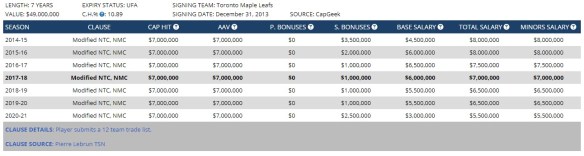
Back in 2013, when Toronto signed Phaneuf to his 7-year deal worth almost $50 million (a “monster” deal, if you will), I remember listening to James Mirtle guesting on a Pension Plan Puppets podcast. (Give me a break. I was on a bus in the winter. It was stuck on ice. I wasn’t going anywhere.) What Mirtle said then seems true today or at least prevails as consensus opinion: that defensemen who can play more than 20 minutes a night are extremely difficult to come by. Was the Phaneuf deal bad? Sure, Mirtle conceded. But it didn’t matter. Paying him on this bad deal was not as bad as not having him on the roster at all, as you can only replace somebody who can play more than 20 minutes a night with somebody else who can play more than 20 minutes a night.
Here was a player who’d served in leadership since a young age and whose YouTube reel includes the kind of open-ice hits that makes you want to buy light beer and care about which trucks won the most J.D. Power and Associates awards. The presumption was, at that time, that millions in wasted money are just the price you pay to have what amounts to a rare specimen. If a player like Phaneuf ever became available on the free agent market or for trade, you’d have to pay the exact same bad contract – or worse – on top of possibly giving up assets. A bird in hand is better than two bastards in a basket, as they say.
Toronto went on to win four Stanley Cups.
Ottawa
I’ve always found the myth perpetuated by the Toronto contract a little bit hard to swallow. Let’s say you’ve got somebody on your roster who plays, on average, between 10 and 16 minutes a night. Most teams have a few of these guys. Let’s take Freddy Claesson, who makes $650,000 a year to Phaneuf’s $7,000,000. Is the four minutes of ice time that Phaneuf plays worth all of that extra coin? Sure, Phaneuf players tougher minutes and in tougher situations. Plus, there are all of the intangibles he provides, which, unlike some, I attribute at least some value to. But both players’ possession numbers are, in the scheme of things, equally underwhelming. What is it about the difference between 16 minutes and 20 minutes that separates the acceptable from the elite, and what is it about Phaneuf that gives him that edge? Would it really crater the team’s chances to give 20 minutes to a series of unknowns making nothing and see who sticks? Is it really worth $6,350,000 to not have to find out?
Bryan Murray said yes, it is, and not only said he’d take on Phaneuf’s bad contract – without Toronto having to retain any salary – but threw in a 2nd-round pick to boot. (Ask any Sens fan: every 2nd-round pick works out.) Toronto did take back a series of junk contracts that weren’t providing Ottawa any value, but the underlying assumption remained intact: players like Dion Phaneuf are rarely available, so you do what you have to to get them on your roster. Even as Toronto was doing whatever it had to it get him off their roster.
The deal wasn’t a disaster for Ottawa, especially if you attribute some of last year’s run to the Eastern Conference Finals to Phaneuf’s play (debatable) and the development of some rookies to his stabilizing presence in the locker room (the definition of debatable). There’s also a world in which the deal worked out even better for Ottawa. In that other, better world, Phaneuf’s guidance enables Cody Ceci to become the bedrock top-four defender at age 23 that Ottawa hoped he would be, as opposed to what he is now, which is sub-Tom Preissing.
In the end, Phaneuf ended up on some league-wide “worst contract” lists, coming in ahead of even Bobby Ryan, a scoring winger with seven goals who’s making more money and is signed one year longer.
Sure, the contract was bad…but how else do you get him on your roster???
Los Angeles
Which brings us to the latest victim of the “you can’t just find these guys anywhere” mentality. Ottawa, just as Toronto did before them, took on millions in bad contracts, from which they will derive close to zero value, just to get out from under Phaneuf’s contract, which at least was providing some value. That’s how little value he’s providing, as the type of guy you can’t just find anywhere. Ottawa prefers to pay money for nothing than to pay more money for what he provides.
Will he provide value to Los Angeles? He can’t help but provide some, in the sense that he is technically present and alive on their blue line. Is that value really so much greater than literally any replacement-level defencemen Los Angeles has in their system? Than *squints* $650,000 Kevin Gravel?
Conclusion
There’s some magical quality assigned players who “can play more than 20 minutes a night.” I’ve certainly invoked it on our podcasts and elsewhere. And I do believe that if the NHL regular season is more a marathon than a sprint (it feels that way to me, and all I’m doing is drinking beer on the couch) then having someone who can be not terrible for a third of the game, game-in and game-out is truly something to look for. In the sense that you should try to draft those guys, keep them in-house, and squeeze value out of their RFA years. Once you pay them like the supposedly rare commodity that they are, the situation takes on the air of self-legitimizing logic. Of course Phaneuf plays more than 20 minutes a night, because you’re paying him like it.
I’m not sold that the tens of millions you have to pay in bad contracts is really preferable to a “defense by committee” approach or by giving ice time to young and cheap players and seeing how they do. Consider this: between Toronto and Ottawa, teams have taken on the combined contracts of Milan Michalek, Colin Greening, Jared Cowen, Marian Gaborik and Nick Shore – $29.1 million in dead salary, or roughly 60% of the value of Phaneuf’s contract – just to get out from under it.
This will obviously be a sticking point as Ottawa approaches the Karlsson contract. 2014’s $7 million per / $50 million contract is today’s $12 million per / $100 million contract. You can make more of an argument that you can’t find a Karlsson anywhere else – he’s a generational talent, unlike Phaneuf – but as the journey of Phaneuf’s contract shows us, these gifts can quickly become curses and you feel curses in years.
Varada and James catch up about the inevitable degradation of their shared hobby, the Ottawa Senators, a team in apparently steep decline.

