Where Do the Ottawa Senators Go from Here? The Next Season, the Next Decade

Offseason Recap

In: William Eklund, Andre Burakovsky, Samuel Ersson

Out: Brady Tkachuk, Lars Eller, James Reimer 

I won’t relitigate it too much: Brady Tkachuk’s a good player, he’ll do well in Florida. His behavior was at times endearing and at times alienating. It would have cost a lot to keep him, perhaps more than you want to pay for a power-forward who plays on the wing who’s already started missing a lot of games to injury. And he handled his desire to leave about as well as could be expected. As a person who lived through the Dany Heatley trade request, this was a relatively tidy exit, and everyone seems ready to move on. Tkachuk was fun to have on the team, and he’ll be fun to root against. I commend everyone for mostly keeping their heads.

Ottawa General Manager Steve Staios did well to get three first round picks, including the ninth overall, and a second rounder for Tkachuk, given the complete lack of leverage he had, though the relative quality of the return is not equal in value to Tkachuk himself. 

Staios traded the ninth overall to the Sharks for William Eklund, the kind of player a fanbase get obsessive over when their team uses a top ten pick to select him but nobody else knows anything about. Accordingly, Sharks fans seem pretty heartbroken to part with him. Pierre McGuire floated on the Sick Podcast that Ottawa wanted Eklund in that year’s draft, that the Sharks had committed to not taking him and went back on it (whatever that means) and so Ottawa (infamously) took Tyler Boucher 10th overall. So it’s a player the organization has liked for a long time. He’s three years younger than Tkachuk, has draft pedigree (he was rated the top non-North American skater in the draft), and is on an affordable deal. And of course he’s good friends with team mascot Fabian Zetterlund. I’m excited to see what he can do.

I’m reminded that when Ottawa traded away Erik Karlsson, the return was roundly lambasted at the time as a massive loss for the franchise. Well, that return turned into Tim Stützle, and Josh Norris, who begat Dylan Cozens. There’s a line from a Kipling poem: If you can meet with Triumph and Disaster / And treat those two imposters just the same. You can win or lose a trade, but only fleetingly. It’s helpful to maintain perspective. Let’s see where both Tkachuk and Eklund are in five years. Tkachuk could be an aging forward, battling injuries, with an untradable boat anchor of a contract. Or he could win the Conn Smythe. Or both.

Given Florida traded Samoskevich to Seattle to make room for Tkachuk, I’m curious to know if he was ever floated as part of the return to Ottawa. He’s a promising young player with the same kind of grit Tkachuk provided, but it’s not the kind of thing that keeps me up at night. Maybe if Florida includes him, Ottawa doesn’t get the ninth overall, which means they don’t get Eklund, who seems to have a higher ceiling as a point scorer. I would have loved a scenario in which they get Samoskevich in lieu of one of those later first rounders, and still get the ninth/Eklund. Anyway, it will be interesting to compare the two players’ careers over time.

I don’t hate the Burakovsky trade as much as some. The team is looking for cheap scoring, which is a contradiction in terms. You only get it by taking a flyer on reclamation projects. They got a Cup-winning veteran who has shown he can score sometimes, on a relatively cheap deal, for a sixth round pick. He’s horrendous defensively, so you give him favorable zone starts and powerplay time and hope he can convert more than Tkachuk could on Stützle’s wing, or at least get the puck to Cozens, who sometimes seems like the only guy on the team who can score goals. If the goalscoring and playmaking works but his terrible qualities outweigh them, you pad his stats and he’s gone at the deadline for more than a sixth rounder – there’s always a market for a Cup-winning veteran on an expiring deal. Or he’s a disaster and all you’ve wasted is money. We’ll never know what else was on the table and what could have been instead of this deal, but seeing Mason Marchment get almost $7M per year and five years from the Sharks, I understand Staios not wanting to play in that sandbox.

Errson’s stats are terrible, but Staios basically said those stats don’t count because they intend to use him differently than he’s been used in other systems, and he’s deferring to his goaltending coach. I don’t know enough about goaltenders’ styles nor hockey systems to know if that kind of statement is ridiculous or another example of how publicly available statistics fall short. Either way, Ersson and Merilainen will have a chance to battle each other for a chance to provide what has recently been unattainable for Ottawa: league average goaltending.

The Short Term

The 2026-2027 season might be a rough one for the Ottawa Senators. Ottawa squeaked into the playoffs last year, although they were almost a 100 point team, the result of the Atlantic being an absolute bloodbath. Their playoff eligibility that season coincided with down years for Toronto, Florida, and Detroit. 

Well, according to the Athletic, Toronto is the 4th most improved team this offseason, and Florida the 6th most. So the Atlantic was tough, and it got tougher. Buffalo, Tampa, and Boston got worse, according to that Athletic article, and Buffalo is the least improved team in the league with the loss of Tuch and two middle-six defenders. Hapless Detroit somehow also got worse and that’s not even accounting for the potential loss of Dylan Larkin. But Ottawa is the second least improved team in the league. So if you’re looking for three teams in the Atlantic that could find themselves on the outside looking in, Detroit, Buffalo and Ottawa would be reasonable bets.

On the other hand, Linus Ullmark went from one of the worst goaltenders in the league in Goals Saved Above Expected during the regular season to one of the best in the playoffs. So who knows what the Senators produce with solid goaltending? And lest we forget that Tim Stützle is only 24 and Jake Sanderson only 23. The Senators could very well find themselves on the right side of the bubble again.

It’s worth noting that the top 10 of the 2027 draft class is projected to be seven of 10 centers. Top-line centers are so hard to find that Philadelphia just signed Leo Carlsson to an $18M/year offer sheet trying to get one. So, if there’s a year for Ottawa to take a step back and add a blue chip prospect, this might be it. The team could also jettison Amadio, Giroux, Burakovsky, and Foegele at the deadline, add the draft haul to the 2nd rounder they got from Florida in the Tkachuk trade, and restock their prospect pool. There are worse things than missing a year of the playoffs while keeping all of your core players. Ask Toronto, who took a year off and ended up with the first overall pick.

The Long Term

There’s a lot to like about the Ottawa Senators’ long-term position. If they re-sign Batherson at $10M, Kleven at $4M, Zub at $7M (all on the higher end of what they’re estimated to get), and trade or let all other UFAs over 30 walk, they’ll be sitting at ~$92.2M against a 2027-2028 $113.5M cap, or just shy of $21.5M in cap space with all core players locked up and only depth signings to consider. You want to bring Amadio, Foegele, and Giroux back for another lap? They’ll have the room to do it. Or they can be replaced, or they’ll have the space to swing big on a trade.

Every planet in the Ottawa Senators’ solar system revolves around the twin stars of Tim Stützle’s and Jake Sanderson’s contracts. I cannot overstate how big of a deal it is that those two are signed long-term at about $8M per year. In a league where Connor Bedard is already getting $15M and Leo Carlsson is getting $18M, Tim Stützle, who scored 90 points in his third season, and was better than a point-a-game last season and was a plus player, is making a little more than half of Bedard’s AAV. Sanderson is already getting Norris votes (he tied for ninth in voting) and he’s 23.

I was accused online of glazing Dorion’s legacy, but I’ll stick by what I actually said: Dorion signing these guys to these contracts is such a big deal that it almost nullifies the boneheaded stuff, of which there was a lot. If he’d signed them both to $5M X 4 bridge contracts, Senators fandom would be running around with its hair on fire right now about how we don’t have cap space to sign them both and might have to lose one. The Carlsson deal has changed the league; if he’s an $18M player, then what is Stützle, who has better numbers and better underlying stats?

It also means that Tim Stützle and Jake Sanderson are going to make $20M apiece in 2031-2032, right around the time Andlauer is going to be trying to finance a new arena’s construction. The team has to do everything it can to win in the next five years. There’s a lot of potential – the league will have a new television deal, and league expansion will result in more lucrative expansion fees for owners. But that’s probably going to result in an even higher cap and NBA-like contracts for the league’s best players, and Ottawa will be trying to keep two of them.

There’s less to be enthusiastic about when it comes to Ottawa’s prospect pool, which consists of Yakemchuk, a truly unique defensive prospect who electrified at times when he debuted last season but on the whole got caved in, and a collection of toolsy depth who are years away. The farm team could really benefit from another blue-chipper or two. 

The Bottom Line

I’m imploring everyone not to overreact if the Senators take a step back next season. Their core is locked up long-term on team-friendly deals. Boston, Tampa, and Florida are all aging, trying to win one more Cup before entering the waning years of their contending window. Buffalo, Toronto, and Detroit are intriguing mixes of young talent, bloated contracts, and big question marks. Montreal is really the only team in the division that seems to be both just entering its peak years and with an airtight cap sheet.

If the question is, “Who is your pick going into next season?” Ottawa might not be at the top of your list. But if you could only pick one team in the Atlantic to compete with for the next decade, for me it comes down to Ottawa and Montreal. It will be important to keep that in mind when we hit the do-or-die days of March 2027, no matter where Ottawa finds itself in the standings.

Should the Sens Trade Brady Tkachuk? A Mostly Unhinged Examination

In which Varada seeds disinformation and erodes democratic values

So we’re doing this again.

The Senators get their first-round teeth kicked in, fail to meet the whole “these guys are built for the playoffs” mythology we’ve constructed around them, and a small but vocal corner of the internet looks at Brady Tkachuk’s contract, his brother’s Florida zip code, and his offseason house in New Jersey, and decides that the only logical path forward is to ship the captain out of town for parts. Every spring, the rest of us pour a beverage and try to talk them down.

I wrote on Bluesky that “You have to admit, Sens reporters and hockey podcasters repeatedly “reporting the news” that there’s speculation about Tkachuk without citing any sources except each other speculating about it isn’t just annoying and a distraction, it’s pretty unethical journalism.” 

And “The coach, GM, and player are straight up chastising journalists to their face for manufacturing news and the news story those journalists will run the next day will be headlined “trade speculation is only beginning.” It reads like a threat!” 

My opinion hasn’t changed. I strongly believe reporters whose job is to investigate and report are being lazy writing blog posts like the one I’m writing here. There is nothing to report. Am I being lazy by writing about this topic anyway? Yes! I am not a professional hockey reporter.

Let’s call this kind of post what it is: fun speculation. If you don’t find it fun to speculate, that is fair (and healthy). If you do, read on. But keep in mind that what this post does not contain is news.

So, with that caveat delivered, let’s engage with it. Pros. Cons. Trade packages. Therapy. The works.

The thing nobody wants to talk about: the window

Before we get to whether Ottawa should trade Brady, we need to establish why this conversation isn’t insane. It’s because of two contracts that look more ridiculous every time the salary cap goes up.

Tim Stützle is signed for $8.35M through 2030-31. He’s 24. Jake Sanderson is signed for $8.05M through 2032-33. He’s 23.

When Stützle signed his deal in 2022, his cap hit was 10% of the league cap. Next season, with the cap projected at $104M and rising, that same contract is going to eat about 8%. By the back half of the deal, he could be a top-line center taking up less cap space than your average second-pairing defenseman. Sanderson is on a similar trajectory.

This is the entire ballgame. Pierre Dorion, in between making moves that are still emotionally damaging Senators fans, accidentally signed two of the better long-term value contracts in the league. The challenge — the thing Steve Staios actually has to solve — is building a Cup contender around two stars whose deals are getting more team-friendly every July 1.

Tkachuk’s $8.2M is fine. It’s not the problem. And the $12M minimum he’ll get on his next deal is probably also “fine.” But “fine” is a relative concept when the players around him are “absurdly underpaid.”

Pros of trading Brady (the case for chaos)

1. Tkachuk has a no-movement clause and two years left. This is not a five-year runway. Trade him in 2027 and you’re trading a 28-year-old rental who controls his destination. Trade him this summer and you get something close to peak value for a player coming off five straight 30-goal seasons. Waiting is expensive.

2. The roster construction problem is real. Ottawa’s lineup right now: a top-six winger making $8.2M (Tkachuk), a top-line winger/center making $8.35M (Stützle), a #1 D making $8.05M (Sanderson), and the contracts you’ve seen handed out at every other position. There’s a version of this team where the Tkachuk dollars get redirected into a 2C, a real top-pairing right-shot defenseman, and depth scoring — and that team is structurally better than the one with Tkachuk on it.

3. A star winger is the least valuable kind of star. Capology 101: an $8M top-pair right-shot defenseman is a unicorn, an $8M top-line center is the cost of doing business, and an $8M winger is — politely — a luxury good. Tkachuk is an elite version of the cheapest position on the ice. The dollars do more work literally anywhere else on the roster, which is the entire reason this conversation exists.

4. The “is he the captain of a contender” question. Brady plays incredibly hard. He also takes penalties at a rate that would make a Bruin or a Flyer blush, and the playoffs have not exactly been a coronation. This is the most heretical pro on the list. We move on.

5. He’d presumably approve a destination he wants. The list of teams he’d say yes to is short, but every team on it has assets Ottawa actually needs. That’s leverage — small leverage, but leverage.

Cons of trading Brady (the case for not setting your own house on fire)

1. He is, by a wide margin, the best power forward Ottawa has produced since the Alfredsson era, and trying to replace 35-goal, 200-hit seasons is a fool’s errand. The math of trades like this is brutal: you almost always lose the deal in pure-talent terms and have to make it up on construction.

2. He’s not just “intangibles” good. He’s actually good. Brady has won everyone over with his compete level, his leadership, his attitude, and his ability to raise his game in high-pressure moments that are not the first round of the NHL playoffs. These are important, if occasionally overvalued, characteristics. But Brady’s underlying numbers are also, to use analytics terminology, “stupid.” I’m not sure how you replace this (per HockeyViz):

Tkachuk: 0.62 xGF/60 (+25%) / -0.08 xGA/60 (-3%)

McDavid: +0.57 X GF/60 (+23%) / -0.10 XGA/60 (-4%)

3. The optics in Ottawa would be apocalyptic. “We traded our captain to clear cap” is a sentence that ends GM careers in this market. Even if it’s the right hockey move, it requires the trade return to be visibly excellent on day one — not “in 18 months when the kid develops” excellent.

4. Tkachuk has an NMC and presumably likes Ottawa. This entire conversation is conditional on him being willing to leave. Every report so far suggests he isn’t. If you ask and he says no, you’ve just told your captain you tried to trade him. Have fun with that locker room.

5. The Stützle/Sanderson window thing cuts both ways. Yes, those contracts are great. They’re also great with Tkachuk on the roster. The window doesn’t open because you trade him; it opens because the other two are signed.

OK fine, what would the trade look like

Three scenarios, in decreasing order of “I would actually do this.”

The Florida thing

Sens get: Anton Lundell, Mackie Samoskevich, 2027 1st Panthers get: Brady Tkachuk

Lundell is 24, signed at $5M through 2029-30, and is exactly the 2C Ottawa hasn’t had since the invention of indoor plumbing. Samoskevich is a young top-six winger coming off his ELC. Brady gets to play with Matthew, signs an identical deal, and hopefully visibly declines on the same trajectory as his brother and an Atlantic division rival is crippled with $30 million worth of contracts tied up in two ineffective power forwards. Net cap impact: roughly a wash, depending on what Samoskevich signs for.

The Devils thing (a.k.a. “fix the right side”)

Sens get: Simon Nemec, Dougie Hamilton Devils get: Brady Tkachuk

This is the one that solves Ottawa’s actual structural problem. Nemec is 22, a former #2 overall, RFA, and a long-term answer on the right side of the blueline. Hamilton is 32, expensive, and not the future — but he’s a real top-four RHD for two years while Nemec develops, and the Devils have been openly trying to move him. Brady gets to commute home from his New Jersey house. The Sens fix two roster holes with one trade and finally have a top-four right side that doesn’t make you want to lie down.

The Rangers thing

Sens get: Alexis Lafrenière, Braden Schneider, 2027 1st Rangers get: Brady Tkachuk

Two 24-year-olds, both signable long term, one of whom is the right-shot defender Ottawa has been trying to acquire since the Harper administration. The downside is the cap math: Lafrenière at $7.45M plus Schneider’s next deal will probably push Ottawa $3-4M over what Tkachuk currently costs. (But not what he would cost after re-signing.) You’re betting on volume over a single star, which works only if you actually believe Lafrenière is about to break out. Some days I do. And it would be fun to have three picks from the top five in the 2020 NHL draft.

So, should they?

Probably not. Probably they keep him.

The honest read is that the only deal where Ottawa unambiguously wins is the New Jersey one, and that requires the Devils to part with both Nemec while shedding Hamilton and open up a massive hole on the right side of their defence corps. It can be done. It probably won’t be.

The Florida deal is the most fun/traumatic and the most likely to actually get agreed to despite the fact that both teams are in the Atlantic, but Lundell + Samoskevich + a pick is a lateral move, not an upgrade — you’re basically swapping star power for depth and praying the depth ages well. Now, if Florida were to offer their first round pick in this year’s draft (currently eighth overall), we’d really have a conversation…

The Rangers deal is the one Twitter wants and the one that costs Ottawa the most cap flexibility for the most uncertain return. This has shades of trading for Nikita Filatov and hoping he reaches his potential, which is a pretty unfair thing for me to say about Lafrenière.

The boring answer — keep Brady, find a 2C in free agency or via a smaller trade, or just keep working with Cozens to develop his defensive game, and ride the Stützle/Sanderson contracts into the next three seasons. The window is open because of those two deals, not because of any one move Staios might make this summer.

But if it’s July 14th and Brady walks into the GM’s office with a list of four teams, well…use promo code “WTYKY” for 20% off your first online therapy session with Sens Shrink.

Your Half-Assed 2025 Round 1 Preview: This Ain’t Your Daddy’s Battle of Ontario (Thank Christ)

Hello, and welcome back to playoff hockey.

Folks, it’s been a minute. The last Half-Assed Playoff Previews I wrote in 2017 were some of my finest work, which basically perfectly predicted the dynamics at play of each series. In contrast, this playoff preview is going to double-down on the “half-assed” part of the title. Nevertheless, as this series is simply an irresistible tchotchke to rotate in my mind, I feel compelled to call this series purely in terms of balls and strikes. Check out WTYKY Voicemails if you want my feelings, I’m just doing science here.

5-on-5

In the red corner, here are the 5v5 results for YOUR Ottawa Senators this season:

Unless you are very new here, there should be little in this graph you find surprising. Chabot, Stützle, Tkachuk, and Zub are good. Zetterlund is good because he’s played a lot with Stützle, Giroux is kind of washed, Sanderson should be better except he’s spent a lot of time with Hamonic, etc. The main takeaway here is that Ottawa has very few weaknesses outside of their 3rd pairing, but HOOOOOOOO BOY what a weakness! It might be too early to make the Big Reveal about what I think is gonna happen in this series, but fuck it: if the Leafs find a way to regularly get their top 6 including Matthews, Marner, and Nylander in various permutations on the ice against a pairing with Tyler Kleven, Travis Hamonic, or both on it, the Sens are almost certainly cooked. Write it down, take a picture, send it to Coming In Hot, if the Sens lose, it’s gonna be because Hamonic and/or Kleven are implicated in several goals against. If Jensen is healthy enough to play and Matinpalo can float Kleven on the 3rd pairing, Ottawa might be able to put just enough duct tape over this massive hole in their 5v5 dry wall to see them into the next round, but I think the mismatch of Toronto’s top 6 vs. Ottawa’s bottom pair is going to be the main thing that decides the series, at least at 5v5.

Brady Tkachuk and Tim Stützle will do fine regardless of which matchup they get, and Ottawa’s 3rd line of Grieg-Pinto-Amadio will probably also do fine, which is why Toronto will be trying to find any other matchup they can possibly get for Matthews et. al.

Kauze 4 Konzern: what is Dylan Cozens doing over there so close to the “Bad” part of the graph? I don’t have any alarm bells going off when I watch him, but man, it sure would be nice if our 2nd line centre had better 5v5 results after a solid 20 games to find his legs with the Sens. Something to keep an eye on.

Meanwhile, in the blue corner:

I’m just here to call balls and strikes, so let’s call a strike right now: the Leafs are a very good top 6 forward cor(e/ps), one good 1st D-pairing, and a bunch of scrubs. Their big trade deadline acquisition of Scott Laughton stinks, their best young prospect, Nick Robertson, stinks, their toughest tough guy, Ryan Reaves, stinks, and their guy with an umlaut in his name David Kämpf also stinks. Tim Stützle is going to eat David Kämpf’s mittagessen in the Umlaut Name Battle. Even their Domi stinks. Fuck this team with extreme prejudice. No one outside of the guys I’ve heard of scares me even a little bit, and they shouldn’t scare you, or anyone on the Senators, either. The Sens are going to get 30 minutes each game where the Leafs have Frozen Dinner on the ice, and it will be up to them to make the most of that time. Dylan Cozens needs to find a way to go ham against “Bobby McMann”. Come on, buddy, I believe in you!

Special Teams

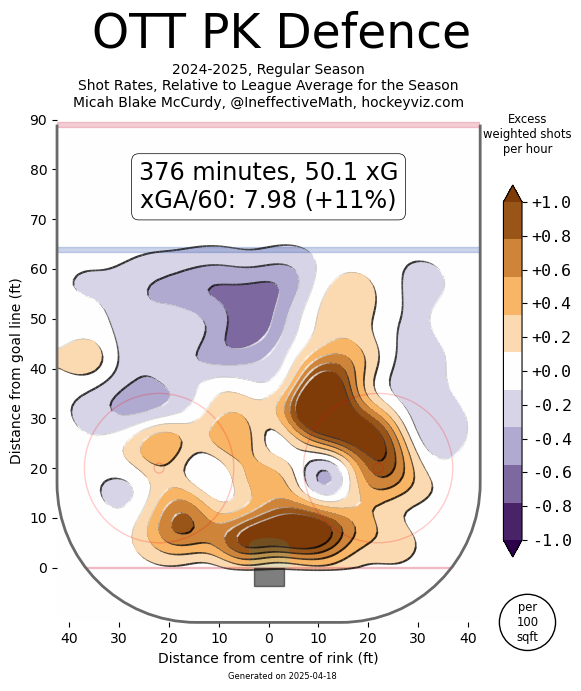
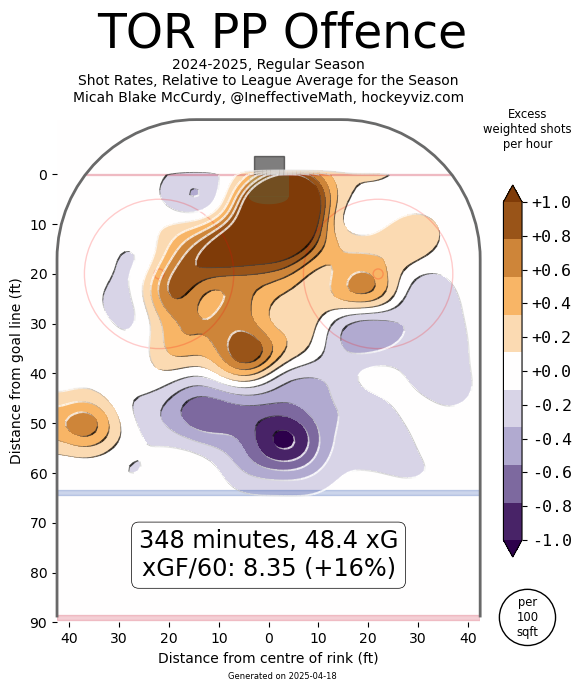
I’ll keep this brief: Toronto’s powerplay is very good, and Ottawa’s penalty killing is kind of shitty. I don’t think Ottawa’s going to be able to fix their entire PK in 36 hours, so my recommendation is that they simply take as few penalties as possible. Much like the Curious Case of Ottawa’s 3rd Defence Pairing, special teams represents another avenue through which the Sens hopes in the series might be killed off like Sean Bean in that movie or television show of your choice.

Goaltending

This one is genuinely interesting. In the red corner, while Linus Ullmark has certainly had his share of ups and downs, I think most Sens fans would describe his performance this season as quite satisfactory. Meanwhile in the blue corner, prior to my pre-playoffs investigation, I had assumed that Anthony Stolarz was a kind of Mid goaltender who was merely riding a hot streak. What I didn’t realize until recently was how hot that particular streak was. 75 GA per 100 xGA is a Hamburglar level of hotness. I don’t think that level of goaltending is sustainable, mostly because I don’t think Anthony Stolarz is comparable to Dominik Hasek in terms of goaltending ability, but is being as good as Linus Ullmark sustainable? It might be! It’s certainly sustainable for Linus Ullmark. Someone who is smarter about goaltending than me, someone with puck tracking data, or both, should investigate what’s going on with Anthony Stolarz because the possibility that Ottawa does not have the advantage in net in this series is a serious one. We’ll call this part of the matchup a toss-up, because I’m feeling optimistic, but if Toronto ends up with the best goalie in this series, I’ll be forced to conclude that it wasn’t really surprising.

Cool! It’s like nothing has changed in the past 20+ years!

Season Series

Throughout the regular season, Toronto has failed to convincingly outplay Ottawa except for when they trail and Ottawa does nothing but try to protect the lead. Also, Ottawa has only trailed Toronto for something like 7 minutes total in three games. I don’t think this proves that Ottawa has a significant advantage heading into the series, but it does make me feel better, and reduce the perceived likelihood that Toronto will dominate the series. In short: it will be up to Toronto to prove that the playoffs are different, because in the regular season Ottawa has handled the Leafs in a way that they could only dream of handling the powerhouses of Buffalo and Montreal.

X-Factor: Playoff Experience

Call it wish-casting, call it fan-fiction, call it a vision that was revealed to you in a dream, the fact of the matter is that while we all SAY that we KNOW that Brady, Timmy, Tommy, Sandy, and Ridly will be Playoff Gamers, we won’t know for certain until Sunday night. Will they be able to treat these games just like any other game even though they aren’t just any other game? Probably! But it could be a wild first 10 minutes. Hopefully the veterans like Giroux, Amadio, Jensen, and *makes gagging motion* Nick Cousins can help the younger guys calibrate the energy they need to bring. In the blue corner, Toronto has no shortage of playoff experience. All that experience is terrible, but they definitely have it. Take Auston Matthews, for instance. Auston Matthews already has 55 career playoff games under his belt, even though he’s only won a single playoff series since 2017. He’ll be the last guy on the ice who is going to act like he hasn’t been there before, because if there is one place he has been before, it is Round 1 of the Stanley Cup playoffs.

So, what do? This is a true double-edged sword for both teams. If Ottawa can meet with triumph and disaster, treat those two imposters as just the same, and plant the seed of doubt in the fertile soil of the famously fragile Maple Leaf psyche, they could ride the momentum to a quick series win. On the other hand, the longer the Leafs are allowed to stay comfortable, the better it is for them. That’s why this is a true X-factor.

My recommendation: use a post-hoc rationalization to show that the eventual series result was inevitable the whole time.

The Wisdom

I don’t think Toronto has a lot of ways to win this series, but I think that Ottawa has a lot of ways to lose it. Getting their bottom D-pairing stuck in matchup hell, sending Toronto to the PP too many times, and getting too high on their own emotional supply while playing undisciplined hockey, are the three massive rakes that they must avoid stepping on to get past this eminently beatable Maple Leafs team. Luckily these rakes are highly visible and avoidable. Let’s not get it twisted, this Leafs team is deeply unimpressive, maybe the least impressive Leafs team since 2017, and they never would have won the division if they hadn’t been floated to an inflated record by a combination unsustainably strong goaltending and lucky record in one goal games. Ottawa should feel blessed to get the opportunity to face them in the first round as a wild card team.

And speaking of goaltending, there is admittedly an outside chance that Stolarz simply continues to be hotter than the surface of Venus, and that the Leafs will win this series no matter what Ottawa does. But here is my retort: that’s life! If you don’t want to risk losing because the other team had a hot goalie, then playoff hockey might not be for you. Ultimately, Ottawa’s superior top-to-bottom depth, boundless energy, and renowned players who already play with a “playoff style” (read: are extremely fucking irritating at an almost-spiritual level), combined with Toronto’s biblical levels of swaggerlessness and mental strength which is about as resilient as a gingerbread space station, all point to one most likely outcome for this series:

Senators in 6