Tanks for the Memories: A Long History of the Worst Kept Secret in Hockey (Part 1)

Tanking is the process of trading veteran players who can net some return (younger players, prospects, picks, or emotional relief) in favour of dressing younger, inexperienced players still learning the game at the pro level or veterans who have earned the Not Good label in hopes of getting the first pick in the draft. Lots of fans, media folks, and organizations object to tanking. I don’t object to it on principle but there are lots of reasons to hate the process: you’re favourite players are getting shipped out, you’re not going to the playoffs any time soon, and losing sucks. However, I don’t understand those who object to the process on some sort of sportsmanship or moral grounds when we collectively, actively ignore far greater transgressions by those within the game.[1]

Tanking isn’t going anywhere, it isn’t unique to NHL nor is it particularly new.

The NBA instituted a draft lottery in 1985 after rumours the Houston Rockets, among other teams, had deliberately lost in an attempt to secure the first overall pick. The weighted lottery was added in 1990 in response to problems with the envelope system (fans wondered if it was incredibly rigged). The weighted system in the NBA gives the team with the worst record only a 25% of landing the first pick, but the best chance of any non-playoff team. Still, the weighted system didn’t stop tanking and teams have become more and more open about the process in recent years. The NBA attempted further reform to the draft system in 2014 to discourage the practice, but the changes didn’t have the required votes to pass.

It comes as no surprise to anyone that follows the NHL that the league was slower to realize what was going on. The tanking story usually starts in the mid-1980s with the Pittsburgh Penguins and Mario Lemieux but the idea of valuing elite, young, affordable talent over past their prime veterans while simultaneously cheating the system is actually older than that.

The NHL Amateur Draft was a relatively new process (it was instituted in 1963) when the league expanded for the first time in the late 1960s. Some of the new teams, California, Los Angeles, and St. Louis in particular, made egregious mistakes with the greatest draft shark in the game: Sam Pollock. Pollock, GM of the Montreal Canadiens, used a combination of scouting and guile to trade mostly established players for high picks. Picks weren’t valued as they are today and established players probably had a certain appeal in new markets. The threat of high draft picks bolting to the WHA, which began play in 1971, added extra uncertainty to drafting top prospects. Essentially, Pollock helped tank other teams, acquired their high picks, while winning four Stanley Cups from 1967-68 to 1972-73. Pollock used those high picks to draft Steve Shutt and Hall-of-Famers Guy Lafleur and Larry Robinson, setting the Canadiens up for a run of four straight Stanley Cups in the late 1970s.

But that’s not really tanking because expansion teams are bad and he didn’t run his own team into the ground! Setting aside the early success of the St. Louis Blues and the Philadelphia Flyers, yes teams like the Golden Seals were bad. But Pollock was proactive and manipulated the situation to his advantage, ensuring the right team finished dead last. He knew he wanted Lafleur in advance and made a trade with the Seals a year before the 1971 draft when Lafleur was eligible. Pollock sent Ernie Hicke (who the Seals would leave unprotected in the 1972 Expansion Draft) and Montreal’s first round pick in 1971 to California for Francois Lacombe (who would go on to be a WHA journeyman), the Seals first pick in 1971, and cash. That’s right, California owner Charlie Finley, who negotiated the trade, paid for the privileged of being on the losing end of one of the worst trades in NHL history (Jerry Jones Team Building ModelTM ftw).

However, midway through the 1970-71 season, California just wasn’t bad enough. So Pollock made a deal with the worst team and likely owners of the 1971 first overall pick, the Kings, to make them slightly better. Pollock traded Ralph Backstrom, a former Calder Trophy winner and perennial All-Star in the 1960s, who was no longer in Montreal’s plans, to Los Angeles for Gord Labossiere and Ray Fortin. Backstrom was rejuvenated in Los Angeles and was just enough of an offensive threat to help push the Kings out of last place, leaving the Seals with the worst record and the Habs with the first overall pick. This is the Pollock Tank Method where other teams do the tanking for you and you win eight championships in 12 years, while only missing the playoffs once. It relied on a relatively new drafting system, an influx of inexperienced GMs and owners, and an ever-present threat from a rival league. This method will never happen again so I hope you enjoyed this story.

***

Fast forward about ten years and we get to a more familiar kind of tanking: the Pittsburgh Penguins playing like shit for the right to draft Mario Lemieux. The Penguins were bad, attendance was low, and the team was in financial trouble. There were rumours the franchise would fold. The Pens finished last in the league in 1982-83[2] and were on the way to another terrible, forgettable season the following year.

But in Pittsburgh’s terribleness, was opportunity. Unfortunately, they just weren’t bad enough. The New Jersey Devils were also dreadful and in last place. So over lunch one day, GM Eddie Johnston and head coach Lou Angotti hatched a plan to lose as many games as possible. Goaltending prospect Roberto Romano was sent down, one of the team’s good players, Rick Kehoe was hurt,[3] and Johnston traded another, team captain Randy Carlyle, for picks at the trade deadline.[4] Angotti remembers a game when the Pens took a 3-1 lead in the first period only to have his GM burst into the dressing room during the intermission to ask what he was doing. The Pens managed to lose that game 6-3. Pittsburgh lost 18 of the last 21 games of the season, include the final six by a goal margin of 36-15.

Did it work? Yes. The Penguins finished with a record of 16-58-6 and 38 points, three points back of the New Jersey Devils, securing the first overall pick. The Penguins drafted Mario Lemieux and the Devils landed Kirk Muller. Now, Muller was a good NHLer, a captain, and a future Cup-winner. But he wasn’t elite. While Mario didn’t don the Pittsburgh jersey at the draft, he did come to a contract agreement with Johnston shortly after.[5] Unlike recent tank attempts, the goal of this tank was to save the franchise from folding, and drafting Lemieux secured Pittsburgh’s future (he would save them again from bankruptcy in 1999). The Devils protested the Penguins tactics, but to no avail and draft reform was still a long time coming.

And there were casualties. Pens coach Angotti wouldn’t return for the 1984-85 season and wouldn’t coach again in the NHL. Johnston left the Penguins in 1988. Most importantly, the Penguins still weren’t any good.

What this tank didn’t do, however, was make the Penguins appreciably better.

After finishing dead last in the league two years in a row, the Pens finished sixth in the division in 1984-85, and second last in the league. In fact, during the first six seasons of Lemieux’s NHL career, the Pens finished higher than fifth in their division only once (losing in the second round of the 1989 playoffs).

The Pens needed some trades but also a lot of luck. It was Pittsburgh’s good fortune that two-time 40 goal scorer and two-time Norris Trophy winner Paul Coffey had a contract dispute with Oilers GM Glen Sather after the pair won a third Cup together in 1987. Coffey held out and Sather wouldn’t budge.[6] In November 1987, Sather surprised the hockey world when he traded Coffey, and two other players for a package from Pittsburgh in which 1985 second overall pick, forward Craig Simpson, was the centrepiece. Simpson scored 56 goals that season[7] between Pittsburgh and Edmonton, where he played with future Hall-of-Famers Glenn Anderson and Mark Messier. Simpson would never reach those heights again and was more a 30 goal, 60 point player in Edmonton. Coffey had two season of 100+ points in Pittsburgh, and another 90+ point season while always averaging well above a point-per-game.

Several key trades, in addition to the Coffey trade, pushed the Pens from atrocious to contender to champions. Midway through the 1988-89 season the Penguins acquired number one goalie Tom Barasso from the Sabres for Doug Bodger and Darrin Shannon. At the 1990 draft, Pens GM Craig Patrick shipped a second round pick to Calgary for five time 40+ goal scorer and future Hall-of-Famer Joe Mullen.[8] Injuries limited Mullen’s playing time during the 1990-91 regular season, but he was a key contributor in the playoffs. The following season he had another 40+ goal season (42 goals, 87 points) and the Penguins had another Cup. Pittsburgh acquired another, point-per-game offensive defensemen for peanuts early in the 1990-91 season. Larry Murphy was a key performer for Canada at the 1987 but was coming off two disappointing and injury-plagued years with the North Stars (a team I totally forgot he played for). The Pens acquired him for two journeymen defenders, Jim Johnson and Chris Dahlquist.[9]

The deal that put the Penguins over the top happened at the deadline in 1991. Patrick traded offensive star John Cullen, Jeff Parker, and 1986 first round pick Zarley Zalapski to the Hartford Whalers for defensemen Ulf Samuelsson, Grant Jennings, and forward Ron Francis. Cullen never produced at the same rate, battling injuries and cancer, Parker played four games with the Whalers before suffering a career-ending knee injury, and Zalapski had a productive, if unspectacular, NHL career. Samuelson was one of the dirtiest, irritating players to play against, and his nickname was Robocop.[10] But they also got a future Hall-of-Famer, one of the best two-way players (future Selke winner) and one of the top-10 offensive players in league history in Francis.[11]

With their first round picks from 1983 to 1990 the Pens drafted a selection of mediocre players, with the exception of Lemieux. The Penguins used those picks to select Bob Errey (1983), Craig Simpson (1985), Zarley Zalapski (1986), Chris Joseph (1987), Darrin Shannon (1988), Jamie Heward (1989), and Jaromir Jagr (1990). Of the group, only Jagr was a star (actually a superstar and best player in the league for a time). However, the Penguins were able to trade some of these players for veterans they could actually use.

80s politics also helped the Penguins build a contender. When Reagan said “Mr. Gorbachev, tear down this wall!” it would change hockey forever.[12] The Penguins were just one of the many beneficiaries of the fall of the Iron Curtain in Eastern Europe. As communist regimes fell in Eastern Bloc countries and the Soviet Union between 1989 and 1991 it changed a lot of things, and hockey was no exception. The makeup of hockey changed forever, with an influx of European players. Veterans from professional teams were now coming in greater numbers but now prospects could be drafted without the need to defect. This meant that you couldn’t just take a flyer on Dominik Hasek in the tenth round of the NHL Draft anymore like Chicago did in 1983. NHL teams needed to enhance their European scouting and be able to make proper evaluations on European players.[13]

Social upheaval came to Czechoslovakia in November 1989.[14] By the following month a new, non-Communist government had formed. What this meant for the Penguins was that 18-year-old Jaromir Jagr could be drafted the following summer without defecting. The Penguins left nothing to chance, selecting Jagr fifth overall. Jagr helped the Pens win a Cup as a rookie and set the franchise up for the next decade.

Finally, they got their hockey ops in order. After Eddie Johnston left in 1988 the Pens made another misstep at GM: hiring Tony Esposito. Esposito lasted a year and a half before he was let go. Craig Patrick replaced him and he set the franchise on the right path. The Pens went through three head coaches before Patrick took over as interim head coach in 1989. Patrick hired another soon-to-be member of the Hall of Fame, Bob Johnson in 1990. He led the Pens to their first Cup, but was diagnosed with brain cancer in the offseason, dying in November 1991. Patrick named as Johnson’s replacement the team’s Director of Player Development and winner of five Stanley Cups with the Montreal Canadiens, Scotty Bowman. Bowman coached the Penguins to another Cup in 1992, his second Cup with the team, because that’s kind of what he does.

The Pens Cup-winning teams of 1991 and 1992 had six Hall-of-Famers[15] and only Lemieux was homegrown. The other five were acquired through trade, with the exception of Bryan Trottier who signed as a free agent. This was a team built through trades (lopsided deals) and that was only possible once they got their front office in order. So yeah, the Lemieux tank worked but in 1983-84 the Pens weren’t actually planning a rebuild because they were facing extinction. There was no plan beyond play horribly, draft Lemieux, live to see another day. Building a contender and Cup winner, however, took some luck, smart hires, and shrewd dealing.

***

Fast forward seven years. Eric Lindros was a Very Big Deal in the months leading up to the 1991 draft. That might not seem like something special to newer and younger fans who remember Malkin or Ovechkin hype, foaming at the mouth for Sidney Crosby, Tyler or Taylor, Fail for Nail, and the most recent McDavid-Eichel anticipation. As much as Lafleur and Lemieux were obviously coveted, Lindros was the most hyped draft pick ever heading into June 1991. In a way we have him (but really the media) to thank for what we do to top prospects now. I mean, he played for Canada at the 1991 Canada Cup as an 18-year-old alongside Wayne Gretzky and co.[16] He was a Very Big Deal.

The Quebec Nordiques were very bad. So bad that they sort of became synonymous with losing. But that wasn’t always the case. In fact, for most of the 80s they were a pretty good NHL team. Prior to the 1987-88 season, the Nordiques had missed the playoffs only once in the NHL, during their first season in the league, 1979-80. In fact, Quebec’s rivalry with Montreal wasn’t simply provincial, it was based in heated playoff battles. Over the course of six seasons in the 1980s, the two teams played each other four times in the playoffs, with the Habs eliminating the Nordiques every time except the first meeting in 1982.[17] Quebec went from first in the Adams division in 1985-86 to fifth in two seasons. Dale Hunter, the fifth-leading career scorer with the team, was traded after the 1986-87 season beginning an exodus that would see most of the team’s veteran talent move on. Anton Stastny, one of three Stastny brothers to play for Quebec,[18] returned to Europe after the 1988-89 season. Finally at the trade deadline in 1990 the Nordiques traded franchise career points leader Peter Stastny and runner-up career points leader Michel Goulet within a day of each other after a decade with the Nordiques.[19]

Quebec finished in last place in 1988-89 and again in 1989-90, winning just twelve games that season. If there was any team primed to tank for a talent like Lindros, it was Quebec, who had already jettisoned their best players. But it wouldn’t be that simple.[20] Quebec walked away with the best player in the 1987 draft when they selected Joe Sakic 15th overall.[21] Joe didn’t get the tanking memo and scored 48 goals in 1990-91 with less support than a training bra. In 1989, Quebec made Mats Sundin the first European to ever be selected first overall. Sundin had a good rookie season in 1990-91 finishing with 59 points in 80 games.[22] And that was basically it for Quebec’s offensive punch. Tony Hrkac[23] was third in scoring with 48 points.[24] The ancient Guy Lafleur (remember him?) chipped in 12 goals and 28 points.[25] The Nordiques were bad and seemed destined to secure the first overall pick for the third straight year.

The only problem was they just weren’t bad enough.

Fortunately, Floyd Smith, GM of the Toronto Maple Leafs, was willing to help out. It’s not that the Leafs are inherently generous by nature, it was that they managed to fuck up the 1991 draft well in advance. Despite being one of the worst teams in the 1980s, the Leafs were desperate to finish as high in the standings as they could in 1990-91. On the surface of things, that might seem odd. Toronto was bad and Lindros would have transformed the club instantly. He was also reasonably local (he grew up in Toronto) and the Leafs have a history of coveting hometown stars.[26] But the Leafs didn’t have their first round pick.

Why?

Because Floyd Smith, who’d taken over from Gord Stellick[27] in the summer of 1989, made a move early in his tenure that would negatively shape the franchise until the present day. Rather than hold on to as many upcoming draft picks as possible,[28] Smith traded the Leafs 1991 first rounder to the New Jersey Devils for Tom Kurvers (aka the Original Phil Kessel). An offensive defenseman, Kurvers was coming off what would be his best season in the NHL (16 G, 50 A, 66 P in 70 games). He produced at a similar rate in his first season with the Leafs (15 G, 37 A, 52 P) and helped the Leafs make the playoffs. If the Leafs had just traded their first rounder in 1990, this probably wouldn’t have gone down as one of the worst trades in team history.

But 1990-91 started off slow. The Leafs were bad but Kurvers couldn’t get going either. He was limited to 19 games and had just three assists. So in January 1991, Toronto shipped him to Vancouver for Brian Bradley.[29] Bradley had a decent start to the year with Vancouver (31 points in 44 games) but mustered just 11 assists in his 26 games trying to help the Leafs avoid the basement. Smith spent the season trying to avoid the dire consequences of the original Kurvers trade. He made 13 trades during the 1990-91 season[30] picking up 14 players and assorted picks.[31]

So if the Leafs weren’t actually tanking, does it follow that the Nordiques were? Well, the proof is in a deal the two teams with each other in mid-November. Quebec sent Aaron Broten, Lucien DuBlois, and Michel Petit[32] to Toronto for Scott Pearson[33] and a couple second round picks (that never amounted to much). The veterans Quebec sent to Toronto weren’t good, but it still weakened the Nordiques and the return package didn’t help their NHL team that season.

So did it work? Yep! The Nordiques were terrible and finished in last place for the third season in a row. Expansion team San Jose picked next, and New Jersey, owners of the Leafs first rounder, picked third drafting the actual best player in the draft, Scott Niedermayer. Everyone got what they wanted, especially people who like to watch the Leafs suffer, or at least made the best of a bad situation. Everyone except for Eric Lindros that is.

Before the draft, Lindros signaled he didn’t want to play for the Nordiques, believing that it’s “isolation” and the French language would limited his marketability.[34] Quebec drafted him anyway. Lindros one-upped Lemieux when he both refused to put on the Nordiques jersey and wouldn’t agree to terms with his new team. The team’s president, Marcel Aubut, insisted that Lindros would be the centrepiece of Quebec’s resurgence or he wouldn’t play in the NHL. Lindros spent the 1991-92 season in the OHL back with the Generals and also represented Canada at the Olympics. He kept busy. The Nordiques wouldn’t budge.

It wasn’t until the 1992 draft[35] that the Lindros situation was resolved. The Nordiques agreed to a trade with both the Flyers and the Rangers for Lindros.[36] The Flyers filed a complaint and the deal went to an arbitrator who sided with the Flyers 11 days later. The package Quebec did receive from Philadelphia included Steve Duchesne, Ron Hextall, Kerry Huffman, Mike Ricci, Chris Simon, Peter Forsberg, the Flyers first round pick in 1993 and 1994, and $15 million.

The deal was transformative. Hextall was moved for a pick used to draft Adam Deadmarsh. The Nordiques drafted Jocelyn Thibault with one of the picks they got from the Flyers and he was flipped to Montreal, along with Martin Ručinský and Andrei Kovalenko, for Patrick Roy and Mike Keane.[37] Roy was integral to Colorado’s two Cup wins in 1996 and 2001, when he won the Conn Smythe Trophy. Forsberg won the Calder in 1995 and both the Hart and Art Ross in 2003. However, tanking for Lindros was transformative because the Nordiques traded him, acquiring a player of similar calibre in Forsberg and players the team would use to acquire members of the Colorado core. But this wasn’t the plan and it wasn’t the move they wanted to make.[38]

Obviously, the franchise got the player they wanted so the tank worked. But drafting The Next One didn’t stabilize a financially precarious franchise in need of a new arena[39] because Lindros never dawned a Nordiques jersey.[40] Peter Forsberg may have had the better career, but he was never going to reach the mega star level that Lindros would have if he had played his prime in Canada, a player who was both best in the league and Canadian. While the Lindros trade won Colorado two Cups, the delays of Lindros not agreeing to terms with the Nordiques and for the pieces from his trade to bear fruit, hurt Quebec.

It’s also hard to ignore that the franchise’s best player was drafted four years earlier when the team was still good. Nor would any of this had happened if the Leafs weren’t actively trying to help Quebec tank to avoid further embarrassment. Tanking for Lemieux saved the Penguins franchise, but tanking for Lindros didn’t have the same success in Quebec.

That brings us to 1993, the Ottawa Senators, and the tank that would change hockey forever. More on Daigle and contemporary tanking in Part 2.


[1] Oh wait, yes I do. Tanking is in a roundabout way an attempt to creating a winning franchise. Condemning an athlete’s (or team’s) racism, sexism, homophobia, transphobia, or other discrimination usually gets in the way of that. But hey, let’s lose the right way.

[2] Without even trying!

[3] Not on purpose, just a happy coincidence.

[4] Important to distinguish Carlyle the player from Carlyle the coach from Carlyle the philosopher. Carlyle the player was “probably the worst player to win the Norris ever” according to my dad.

[5] What a show that would have been. In the first televised NHL draft Lemieux refused to wear the jersey of the team that just drafted him because they couldn’t agree on a contract. For all the handwringing we get now when a player at the end of his ELC asks for a trade, we sort of forget the several instances in the past when rookies often said “nope” immediately to the team that drafted them.

[6] After the Coffey deal it would become increasingly evident that Oilers owner Peter Pocklington’s cheapness could be relied on. He kept the salary of the league’s best player, Wayne Gretzky, artificially low (and thereby keeping the salaries of Jari Kurri, Mark Messier, Paul Coffey, Glenn Anderson, and Grant Fuhr low too). Gretzky was sold traded to Los Angeles the following summer and NHL salaries would never look the same again.

[7] Who didn’t? It was the 80s.

[8] Holy hell this was a steal. Though Mullen, an American, did want to return to the States.

[9] My kingdom for a time when you could acquire two top pairing defenseman and the only player of note you gave up was Sportsnet analyst Craig Simpson.

[10] This alone makes it a Pens win.

[11] Future way too old Toronto Maple Leaf, Ron Francis.

[12] Haha just kidding. I’m pretty sure Ronald Reagan didn’t give a crap about hockey and attributing the fall of European Communism to him is incredibly disrespectful and dishonest to the thousands of Poles, Czechs, Germans, Russians, etc. on the ground risking everything for a different political system. But crediting him with this has really helped prop up Reagan’s horrible legacy and Neo Liberalism as a Good Thing in the U.S. so that’s nice. Now, David Hasselhoff on the other hand…

[13] Sounds straightforward right? Would it surprise you that the newly-minted Ottawa Senators were preparing to head into their first NHL draft in 1992 (also, coincidentally the first draft since the Soviet Union fell in December 1991), without any European scouts until John Ferguson Sr. the Sens director of player personnel, pointed out that it might be advantageous to hire a few. Probably a good idea, since the Senators drafted Russian superstar Alexei Yashin with their first ever draft pick.

[14] It’s called the Velvet Revolution, look it up. There’s a poetic justice to a player who wears 68 in honour of the Prague Spring coming of age during the Velvet Revolution.

[15] Paul Coffey was only on the 1991 team. The number will increase to seven when Jaromir Jagr retires in 37 years.

[16] Canada didn’t take an 18-year-old Sidney Crosby to Turin in 2006 for comparison.

[17] This sounds familiar. Sigh.

[18] The 1980 defection of brothers Peter and Anton brought Quebec instant respectability. When older brother Marian joined them the following year, the Nordiques had the best brother line in NHL history.

[19] Oof.

[20] It never is.

[21] The Leafs took Luke Richardson at seven. So yeah.

[22] Pretty similar to Jagr’s goal and point total from that year, also his rookie season.

[23] Who?

[24]Actually he was a journeyman NHLer who split his career between the NHL and the minors. I remember his hockey cards because he had very thick, full, blond hair. No helmet baldness here.

[25] But then he also smoked cigarettes between periods.

[26] Think of all the pointless Jason Spezza and Steven Stamkos rumours and the disappointment over missing out on Tyler Seguin and Connor McDavid. Leafs love a local so it’s not just an Ottawa thing.

[27] Yeah, the radio guy. His claim to fame as Leafs GM was being the youngest ever to hold that title. The 80s were rough for Toronto.

[28] Perhaps it’s because when the Leafs had three first round picks in 1989 (drafting Scott Thornton 3rd, Rob Pearson 12th, and Steve Bancroft 21st) they picked three players from the Belleville Bulls leaving many to joke that the Leafs scouting budget that year had been enough to cover the gas for the two hour drive on the 401. With Harold Ballard as owner, it was certainly a possibility.

[29] The Leafs left Bradley unprotected in the 1992 expansion draft so essentially it was a 1991 first rounder for a guy who was picked up for free by Tampa Bay.

[30] That’s a lot.

[31] These trades actually did provide some of the depth players for the successful Leafs teams of 1992-94. Dave Ellett, a defenseman with offensive upside, Peter Zezel, a checking centre, and defenseman Bob Rouse.

[32] Broten was underwhelming in Toronto and Petit and DuBois chipped in offensively. Perhaps the greatest outcome of this trade was that Petit was part of a package including Gary Leeman, Jeff Reese, Craig Berube, and Alexander Godynyuk (who was also in Die Hard) to the Calgary Flames in January 1992, for Jamie Macoun, Kent Manderville, Rick Wamsley, Ric Nattress, and Doug Gilmour.

[33] Pearson spent the rest of the season with Quebec’s AHL team and bounced between the NHL and the minors during his career.

[34] It was definitely more complex than that. Lindros had always been a player determined to control his own destiny. When he was drafted by the Sault Ste. Marie Greyhounds in junior he refused to play for them and was traded to the Oshawa Generals where he did wonderful things (as my many Oshawa-based relatives remind me). Lindros’ parents, Carl and Bonnie, were active in his career and contract negotiations (Carl was his agent) and this definitely rubbed hockey people and the media the wrong way. Flyers GM Bobby Clarke called Carl abusive and claimed he meddled in team affairs. However, on multiple occasions the Flyers medical staff misdiagnosed their son’s injuries, and pressured him to play hurt, including a life-threatening collapsed lung in 1999. Lindros was expected to be on the team’s flight after suffering the lung injury, which likely would have killed him; he received medical attention only at the insistence of teammate Keith Jones (this was a well-known story in the late 90s and early 2000s which is seven layers of messed up when you consider this neglect was known and yet Lindros was still vilified for not rushing back from injuries and prioritizing his safety). Most likely, Carl Lindros and Bobby Clarke are both assholes who couldn’t get along. The French language has been a barrier for some NHLers, stopping them from playing for the Canadiens or Nordiques but Quebec in the early 90s was a different place politically. 18-year-old top prospects might not have been following the ongoing constitutional debates that had preoccupied the Mulroney government since Meech Lake, but growing fears of separation couldn’t be ignored. The province’s second referendum on separation was only four short years away in 1995 so there were concerns about the direction of the team and the province.

[35] And some insistence from the league president to resolve the situation if you believe Wikipedia – and we do!

[36] One wonders if the Rangers would have broken the franchise’s 50-year Cup drought had their trade been accepted. New York was rumoured to have offered Tony Amonte, Alexei Kovalev, John Vanbeisbrouck, Doug Weight, three first round picks (1993, 1994, and 1996) and $12 million. It’s ok, Lindros would eventually make it to the Big Apple.

[37] Hahahaha what a steal. Also, there’s a deal that never would have happened if Quebec hadn’t moved to Denver a few months before and then maybe all of this would have been for nothing.

[38] It does make you wonder why some teams that have been bad for a while (see Edmonton) don’t trade someone from the bounty to address roster holes.

[39] Think a star can’t land a new stadium? Talk to Lemieux and Crosby in Pittsburgh, or Junior in Seattle.

[40] He would of course wear Flyers, Rangers, and Leafs jerseys during the course of his career. All the teams that originally coveted him.

The Hater’s Guide to Week 21

This is a weekly feature that takes an uncharitable look at the Senators’ upcoming opponents.

mixtape1a

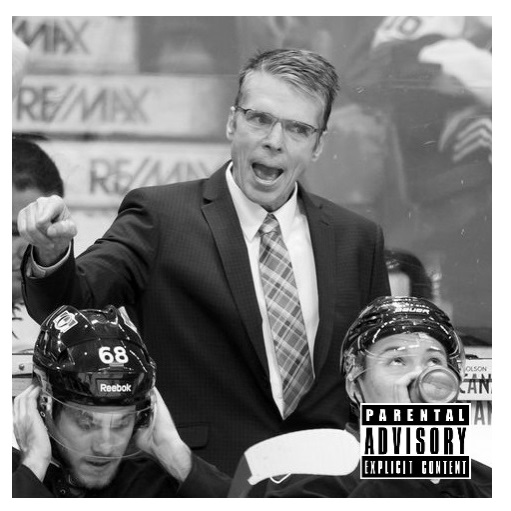
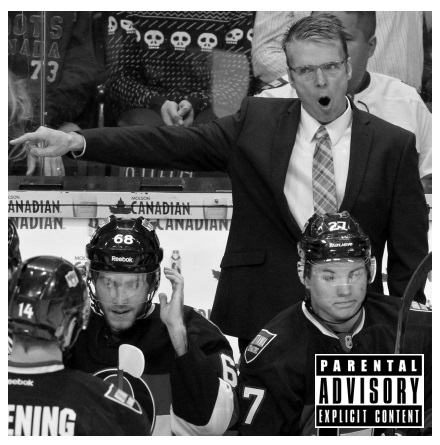
Me, dropping the rawest verse of 2016 (not pictured: you, starting a verse with your name followed by “and I’m here to say”)

Tuesday, February 23 – Senators @ Oilers

Whenever I hear my dear, beloved fellow Senators fans argue that the team should have committed harder to its sell-off a few years ago, tanked for multiple seasons, and stockpiled a series of high draft picks in order to contend sustainably, I think of our friends in Edmonton (motto: Any Farther North and You’re in the KHL). Can you even imagine? If the Senators had traded their moderate-ish success of the last five years – first-round-shellacking-of-the-Habs pennants hang forever, BTW – for a bunch of unsupervised kids that still hadn’t won anything? The calls from Ted in Greely that Ian Mendes would be enduring right now? “Well,” you might say, “the Senators would have developed those guys better than Edmonton did.” The same team that many argue hasn’t effectively developed Jared Cowen, Cody Ceci, and Curtis Lazar, yes?

The modern Oilers are like a cautionary driver’s ed film that GMs should be forced to watch before they’re allowed to start tanking. You want your license? Okay, but not until see how dangerous what you’re about to do can really be. Look at the wreckage. Look at the high-priced prospects, just strewn about; the shaken fans, staggering from the scene. It doesn’t matter how good you are behind the wheel, there are some situations you just can’t control. The thing is, Tim Murray probably watched this film and STILL thought he could beat the odds and get Connor McDavid. And where’d McDavid end up, after all that? Edmonton. God doesn’t play dice, my ass.

PREDICTION: Zack Smith is an investor in Eric Gryba’s duck call company, so look for him to stage an impromptu shareholder’s meeting at an Edmonton-area Milestones where he asks Gryba tough questions about the company’s direction, like, “So how you doin’, man?” and “You want another basket of garlic wings?” Then look for Smith to continue his recent goal-scoring ways against the Oilers the following night, and for him to call Gryba later this season to brag about how when he was traded, it was for a higher-round pick. Senators 5, Oilers 0.

Thursday, February 25 – Senators @ Canucks

We were talking about the sexy-but-dangerous unpredictability of tanking earlier, but the Vancouver Canucks have the opposite problem – their window is probably closed, but they refuse to accept reality and start over, trying desperately instead just to scrape into the playoffs every year through short-term, patchwork moves. Man, I wouldn’t want to be in that situation. The Canucks actually have it worse than the Senators ever did – do you remember all that loose, “trade Alfredsson” talk the last few years he was in Ottawa, supposedly to give him a shot at a Cup, but practically to reboot the team’s core and stop paying several million dollars a year to a guy whose almost-40-year-old body could crap out at any time? And the counter-argument from more sentimental fans who thought this would be the ultimate betrayal (uh, turns out not quite)? Imagine that situation in Vancouver, except there’s two of him.

How do you balance loyalty with long-term, sustainable success, though? Can you still build around veterans that have lost a step, hoping they’ll impart other values to your team, or do you have to turn over your roster every three years like you’re a Burger King night manager throwing out drunks? Do you attract players by fostering an environment that takes care of them, or do you attract players by winning consistently? Are there warning signs that you’re being too complacent? There are, actually; one is not making it either to or out of the first round of the playoffs four years in a row, as the Canucks have done recently. The other is probably Chris Phillips. Yo.

PREDICTION: You know who’s a big-body, hockey player-lookin’ guy that occasionally convinces GMs he might be a good pickup for a team that’s trying to stay relevant? Alex Chiasson. Don’t ask me how I know this. Look for Chiasson to have another good game on Thursday as he knows he’s playing for next year’s contract, and for the Canucks to immediately part with a few B-level prospects to make him like the seventh Alex on their roster. Never surrender, Canucks. Senators 5, Canucks 0.

Saturday, February 27 – Senators @ Flames

Okay, let’s review: don’t tank, but also don’t hang on to your core too long. So what’s left? Be good, make the right moves at the right time, and stay good forever. Not so hard, right? This lesson isn’t illustrated by the Flames, by the way; they just happen to be the third team the Senators play this week. No, it’s a lesson best illustrated by . . . I dunno, the Blackhawks? The Kings? Two long-term successful franchises who also happen to value winning so highly that they’re completely morally bankrupt when it comes to the character of their players, unless and until it conveniently suits their needs? Maybe that’s the key to long-term success: be morally bankrupt. Although a lot of fans don’t like that either? Basically just don’t be a hockey team, maybe.

What’s that? We’re supposed to be talking about the Flames? Snooze.

PREDICTION: Have you ever been to Calgary? Hang on, let me rephrase that. Have you been to Calgary, and then ever made a joke about Kanata? Because Calgary is basically Kanata if it stretched for forty miles in every direction. It’s a downtown core surrounded by new-money suburbs surrounded by the horizon. Yeah, congrats on scoring that three-car garage 90 minutes from work. No, I don’t know when the market’s going to turn around either. Senators 5, Flames 0.

Season prediction record: 28-26-6

Next week: The long-awaited Dion Phaneuf homecoming (ft. Chris Martin).

The Jail Phone: On Plans, Phaneuf, and a 2015-2016 Pre-Mortem

image

tfw ur thinking about bobby ryan and dion phaneuf’s 2021 cap hit

Once a month, James and Luke sit down separated only by a piece of plexiglas and talk shit for a few hours. The Jail Phone is a recurring segment containing the transcripts of those conversations.

Luke: Hi James.

I dunno if you’ve been outside today, but there’s so much white powder out there it looks like a Saturday Night Live after-party in 1979. As such, I thought you’d might like to grab a glass of your favourite winter beverage and we might have a little fireside chat about the State of the Sens Union.

Earlier this season, you looked around the mass of negativity around The Sensphere and said to me, “Imagine how bad this would be if the team didn’t just go on a historic run to the playoffs on the back of an ECHL journeyman goaltender.” Well, I think we’re about to find out how bad it can get.

For my part, I’m attempting to be as Zen as possible regarding the remaining games of this season. Some people might want to go Full Tank, but this team isn’t bad enough to go Full Tank. Toronto has that shit sewn up having cemented their place in Tank History by trading for Colin Greening and then putting him on the 2nd line. I don’t care how zesty Dave Cameron gets with the line combinations, we can’t beat that.

All this to say that I still want the Sens to win, but I’m no longer upset when they lose. I’m already looking ahead to next season. Can’t wait to see who we draft 12th overall.

Tell me about your feelings. What’s on your mind? What are you hoping to get out of the rest of this season? Why are you still here?

James: Maybe I’m comin out the gate WILD apologetic but my feelings are that the Sens sort of just had a shit season. IT HAPPENS. Remember how Columbus was talked about across the board that they were poised to make a deep run this year? Imagine as a Blue Jackets fan your most optimistic moment of the year was buying a jersey that said Saad on it? Damn.

What I’m saying is, it’s frustrating to sit through but DEEC teams miss the playoffs sometimes and don’t need to go into full out rebuilds to fix things. Yes I’m glassy eyed enough to vault the Sens into the lofty status of DEEC.

The Penguins missed last year. Washington missed a couple of seasons ago…they didn’t blow it up. They made some changes but realized they weren’t totally fucked. Sure, blowing it up is an option but let’s face it, it can be as risky a plan as they come. It’s not always the answer. Ayyyye Connor McDavid is really good! *looks at standings* WOW, Edmonton is starting to turn things around they’re only two points back of 28th place!

Peter Chiarelli: Bartender, ANOTHER round of Dalai Lama-level patience for the whole fanbase please!

Sam Malone: IIIIII think y’all have had enough.

Peter Chiarelli: Fuck. THAT. Another generational talent or two and we be battling for a wild card spot just hold tight. AGAIN.

Honestly, the negativity is such that it’s hit the point that the team gets roasted even when they win. I hate to say it but personally I don’t think Sens fans have the kind of patience to tough out a full rebuild. ESPECIALLY should aaaaaaaaaaanything not go according to plan in that time. I’m seeing a full meltdown over missing the playoffs. What would happen if we drafted another Daigle?

Luke: Alexandre Daigle? The 1st overall pick this fanbase is bitter towards 23 YEARS after we drafted him?

James: To me, Tampa Bay are one of the most annoying teams in the league because they had the good fortune of being a shit pile just a FEW times. Good the odd season, shite others. Some high end picks and a few good trades while avoiding ushering in a full on culture of losing. They picked up some key players while remaining DEEC. Because of this, they’re one of the better teams in the East, having not thrown the baby out with the bathwater (blech to that imagery).

Anyway, I’m not heartbroken if we have a high pick and a better team going into next year, which I believe we have. Why? Well, we were all experts on what was wrong with the Sens all season. “Get rid of Cowen, free up money to extend Mike Hoffman, make a big move and stop wasting Karlsson’s prime” AKA, “GET A TOP 4 DEFENSEMAN!”
Here we stand, mid-February Cowen gone, Greening gone, Milo’s money off the books (no disrespect but it’s a fair amount of money off the books), and all this for a top 4 defenseman with plenty of good years left ahead of him. This is …bad?

Luke: I’m gonna talk about the last thing you said and then bring it back around to the first thing you said because I’m the sort of writer who likes to flout the conventional rules of structure.

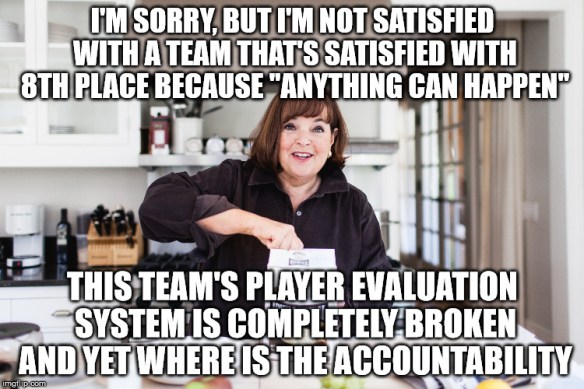
I feel like a lot of the negativity stems primarily from a few well-spoken, high-profile blogger/media figures who have been running with this narrative that the Ottawa Senators have no coherent plan. (Please see this James Gordon article entitled “The Ottawa Senators have no coherent plan”, and this 6th Sens article where Nichols writes of Ottawa’s “whimsical ‘get into the playoffs and anything can happen’ approach to team building.”). When you think that management is just spinning The Wheel of Moves at random, it becomes pretty easy to criticize everything management ever does, because every move is more proof there is no Plan.

People like Plans. Have you ever thought objectively about tanking? The Idea of Tanking is some Jedi Mind Trick shit. If you are a fan of the worst team in the league, the default reaction is usually extreme sadness or anger. Now if you’re a fan of the Leafs or Sabres, you love losing just because management has said “Don’t worry. We’re doing this on purpose.” It’s wild. That’s the power of A Plan, James. I don’t think fans want Ottawa to tank; I think fans want the comfort that comes with having A Plan. We are lost in a world of uncertainty otherwise.

I don’t really ascribe to the above narrative, because I think the Ottawa Senators DO have a plan and that plan is to get better one incremental improvement at a time. You know, building your team the old fashioned way. Witness these moves from the past year:

Move: Erik Condra out, Shane Prince in.
Hot Take: We all love some Erik Condra, but Shane Prince is like Erik Condra only with scoring touch so that’s an improvement.

Move: Eric Gryba out, Chris Wideman in.
Hot Take: Chris Wideman is better than Eric Gryba. That’s an improvement.

Move: David Legwand out, Curtis Lazar in.
Hot Take: Old, expensive veteran exchanged for cheap kid with (ALLEGED) upside. I don’t think this one has really worked out yet, but I understand the reasoning.

Move: Patrick Wiercioch out, Dion Phaneuf in.
Hot Take: I think this is an improvement, but let’s revisit this one in a few years. Again, I understand the reasoning.

So why does the team suck this year? If had to hazard a guess, I’d say it’s because injuries to Clarke MacArthur, Kyle Turris, and probably Marc Methot, in addition to major regressions in play from Alex Chiasson, Patrick Wiercioch, Mika Zibanejad, Craig Anderson, and Andrew Hammond have totally overshadowed whatever minor improvements the team made in personnel. This is part of the reason why I’m so hard on Patrick Wiercioch. I fully acknowledge Mark Borowiecki is not as good as Patrick Wiercioch, but Boro is the same as he’s ever been whereas PW is a major part of the reason why the team is worse this year. That dude had a ROLE to take on, and he was a total no-show this season. Brutal.

This all comes back to your point that “the Sens sort of just had a shit season”. Yes. Yes they did.

If we can treat this like one of those Tampa Bay anomalies, enjoy a nice-ish draft pick, refuse to panic, and then come back next year, I’ll be pleased with that.

James: I think the acquisition of Phaneuf is pretty big. Yes, it’s early but iz it ev-R 2 earl-E 4 HOTT-TAEKZ? The optics suck because the Sens haven’t managed to win since acquiring him (Ed note: #ACTUALLY), but I’m bold enough to say that so far Phaneuf has been an improvement over Wiercioch on the second pairing. (Cowen didn’t even get a sniff at the job he was so bad).

Not even a handful of games yet, but Phaneuf has looked pretty solid and in his role as a Senator. I think much of the trepidation regarding him does have to do with the contract, but also very much the fact that it’s Dion Phaneuf. This is a guy we have dragged mercilessly for years now as Sens fans. It’s going to take some adjustment…and time to believe in him. I mean hey, I feel weird even writing that. Most importantly, of course, is that he also has to earn our trust as fans. I still remember the handwringing over Marc “Regressed to the 3rd Pairing in shitty Columbus” Methot. Or how Sergei Gonchar in his late 30’s was overpaid no matter how he played. Maybe he was overpaid but I gotta say I miss the 27-37 points per year he’d put up and the wealth of experience he brought to the dressing room. In my opinion, another vet with a track record is better than rolling the dice on more than half of the D corps like the Sens were doing.

Whatever, it’s okay to be skeptical. Who knows how trades and FA signings are going to work out. I just can’t help but dwell on the fact that after a strong finish to last season, Wiercioch has been given ample opportunity to be a top 4 defender this year and hasn’t made a case for himself. At 25, is PW’s career over? I certainly don’t think so. But I think the organization realized they can’t continue down the current path by retaining him at a qualifying offer of $2.7 million. Instead they brought on Dion Phaneuf who, at age 30, has shown that in bad year (on a shite team) he puts up a higher output than Wiercioch’s career best. All this while being a guy who’s billed more as a stabilizing, physical minute muncher than a puck moving finesse player.

Basically, he’s not going to be worth his contract in blah di blah years. Okay. I thought the big criticism was the team wasn’t making any bold moves to improve the team in Karlssons prime. Well, here it goes nothing. It’s my feeling that (when healthy) the top 6 is fine, the top pairing is fine, the starting goaltender is fine. The big problem was bolstering the top 4 and a fun surprise has been a floundering bottom six. I don’t know about you, Eddie, but I’d much rather a GM on a budget tasked with improving the bottom 6 than the top.

This year might be a bit of a wrap but I think we go into next year stronger. Which is good as Imma need all that time to adjust to seeing DION PHANEUF in a Sens uniform.

Luke: I find it amazing that we, as a blog, put up nearly 3000 words of Dion Phaneuf takes and we’re still not done. At this point I’ve spent more time writing/talking about Dion Phaneuf than I’ve spent actually watching him play.

You’ve hit on something I believe though, which is that the bottom six is/has been the biggest problem this season. I’d have a lot more respect for “Sens don’t have a PLAN” takes if they were accompanied by some commentary that implied a Karlsson-Turris-Stone-Hoffman-Ryan-Zibanejad-Not Brain Damaged MacArthur core is insufficient to be competitive in the long term. That, at least, would display conviction that one truly disagrees with what The Bryan et al. have constructed over the past 4 years. However, to the best of my knowledge, most criticism of those players tends more towards something like “Kyle Turris only makes $3.5 Million a year, but he isn’t quite Anze Kopitar, is he?” or “Sure Bobby Ryan leads Sens forwards in points this year, but can he DRIVE POSSESSION?”, and outside of that, it is generally acknowledged that Ottawa’s good players are pretty damn good. (Four Senators are in the Top 35 in scoring this year TBH).

At the very least, a pessimist would have to say that Ottawa’s acquired some very good players BY ACCIDENT.

The big question for me is whether Ottawa can find some improvements over the Alex Chiassons of the team in the next six months? Honestly, I’m hopeful. If anything, being a seller at the deadline will make that easier. It’s not like Ottawa’s 2 points back of a wild card spot and has to keep Zack Smith around so as not to mess with locker room chemistry. If I’m reading these tea leaves correctly, Ryan Dzingel can easily step into that left winger role at a third of the cost. In addition, if Kyle Dubas has taught as anything, it’s that you can create a team consisting entirely of decent depth players in a single off-season. Surely finding a mere 3 or 4 of those guys shouldn’t really be that difficult, right? Then we just gotta sort out whatever it is Dave Cameron’s doing differently from last year. This off-season is gonna be EASY.

The Hater’s Guide to Week 20

This is a weekly feature that takes an uncharitable look at the Senators’ upcoming opponents.

z9lj8

Me, resplendent in chambray (not pictured: you, sweating through cheap polyester)

We’re going to preview this week’s games with a series of short, one-act plays.

Tuesday, February 16 – Senators vs. Sabres

“Tim Murray Orders Breakfast”

MURRAY: *into drive-through box* Small black coffee.

BOX: Will that be everything?

MURRAY: Yes.

BOX: Would you also-

MURRAY: No.

BOX: For an extra-

MURRAY: No.

BOX: Alright sir, that’ll be-

MURRAY: $1.35, coming around.

FIN

PREDICTION: If you’re a GM, there are two ways you can drink coffee during a hockey game. One is the Tim Murray way, which involves sitting perfectly still for three hours, fingers steepled against your lips, just staring at the cup through designer frames and waiting for it to spontaneously combust. The other is the Bryan Murray way, which involves cursing and arm-waving and screaming and is basically the exact opposite. Either way you never drink the coffee, because those guys down there just cannot break the puck out no matter how many drills we run, Jesus. But the Bryan Murray way is more fun to watch, at least. Senators 5, Sabres 0.

Thursday, February 18 – Senators vs. Hurricanes

“Tickets”

*SCENE: Outside the PNC Arena. Two scalpers stand on opposite corners trying to outdo each other.*

SCALPER 1: Tiiiiiiiickets. Get your Canes tiiiiickets. Tickets here.

SCALPER 2: Tickets.

SCALPER 1: Lots of tickets, still available. Tickets!

SCALPER 2: Good seats, good seats. Who needs ’em, I got tickets.

SCALPER 1: Tickets!

SCALPER 2: Canes tickets. Just selling, not buying.

SCALPER 1: Tickets here. Any section.

SCALPER 2: Tickettttttttttttttttts.

SCALPER 1: 10th anniversary Cup season, check it out, tickets.

SCALPER 2: Tickets, I got ’em.

SCALPER 1: Little Nathan Gerbe, come see him. Tickets!

SCALPER 2: Tiny little Nathan Gerbe! Tick! Ets! Here!

SCALPER 1: Come see a top 5 CF% team, if you’re holding a ticket!

SCALPER 2: Get ready to see a low-PDO team bounce back, name a seat, name a price, get a ticket!

SCALPER 2: TICKETS!

SCALPER 1: TICKKKKKKKKKETTTTTTTTTTTS!

*Silence, followed by a low, howling wind from the ghost dimension*

SCALPER 1: Come on, let’s get a beer. What is PDO?

SCALPER 2: No clue. I’ll say anything.

FIN

PREDICTION: You know how when you meet a friend at the game, and your friend has a real, printed ticket – and not one of the cheap red-and-white Capital Tickets ones; I’m talking about one of those season-ticket holder versions with a picture of a sweaty Marc Methot on it – and you bought yours on Stubhub and all you have is a crumpled printout? And you pull it out of your coat pocket, and somehow there’s mustard on it, and your friend is just staring at the ground awkwardly as the CTC usher tries to scan it and it doesn’t read, and it doesn’t read again, and you’re about ready to slink out of there and just wait at the bus loop for three hours when you finally hear the ticket reader chime? And the usher gives you a warm smile, letting you know you’re just as welcome as anyone else, and everything is okay for a minute? That’s exactly the kind of compassion we need more of in this world, and exactly the kind of compassion the Senators won’t be showing for the Hurricanes in this game. Your friend’s more of a prig than Frasier Crane, by the way. Senators 5, Hurricanes 0.

Saturday, February 20 – Senators vs. Red Wings

“THE FAMILY ALFREDSSON LEAVES DETROIT” (working title: “THE SOUND OF MELNYK”)

BIBI ALFREDSSON: Children, your father and I have decided to leave Detroit. But we have to hurry. Come along now, and be quiet.

*Fraulein Schmitt enters with two Red Wings in full uniform*

FRAULEIN SCHMITT: I tried to stop them.

DANIEL: That’s okay, Fraulein Schmitt.

ZETTERBERG: Going somewhere, “captain”?

DANIEL: We were just going for a walk, Herr Zetterberg.

DATSYUK: Convenient, you are supposed to report to Red Wings camp tomorrow.

DANIEL: Was I? I don’t remember receiving a telegram about that, Officer Datsyuk.

ZETTERBERG: You’ve received several and I’m here to take you directly myself.

BIBI: Well that’s impossible, gentlemen.

DATSYUK: Why is that?

BIBI: Because… the Family Alfredsson is singing at the Windsor Casino tonight. It’s all arranged. We should really get going.

DATSYUK: How convenient. Let’s go, captain. General Holland is waiting.

ZETTERBERG: Stop! You will sing! You will ALL sing! But only because I want it to be so. I want the people of Ontario to see that nothing has changed. I shall escort you myself.

*cut to Windsor Casino Theatre*

MC: Please welcome the Family Alfredsson!

ALFREDSSONS: There’s a sad sort of clanging from the clock in the hall
And the bells in the steeple too,
And up in Kanata an absurd little pub
Is selling its Big Rig Brew;
Ruutu, Cheechoo,
Remember those guys, P.U.,
But we don’t need much revenue,
To say goodbye to you.
So long, farewell, auf wiedersehen, adieu.

*curtain falls; applause*

MC: Let’s hear it one more time for the Family Alfredsson! Come on out! The Family Alfredsson! . . . The Family Alfredsson?

DATSYUK: They’re gone!

FIN

PREDICTION: It’s 2016 now, and the idea of a Saturday night game against Detroit being a premier matchup seems like a brief, odd historical phenomenon, like pogs, or Macklemore. Look for the TV broadcast to feature half a dozen shots of Daniel Alfredsson in a private suite, looking as Zen and unknowable as ever. Senators 5, Red Wings 0.

Season prediction record: 25-26-6

Next week: West coast Canadian road trip! So don’t worry, no playoff teams.

Hearing is Believing

There are plenty of valid theories on why the Sens have fallen flat since returning to action after the All-Star break. Not enough scoring punch, average goaltending, coaching failures, management issues, and of course, the generously porous defense. The Sens blockbuster trade with the Leafs for defenseman Dion Phaneuf has not yet brought a win.

But the true culprit of this slump has been ignored: Julia Robillard has forsaken us.[1]

Since February 2 (the date of the first Sens game post-ASG break), when a new Robillard Hearing Centres commercial that did not feature Julia aired, the Sens are 2-4. Ottawa surrendered 6 goals against Pittsburgh, was blown out by the hapless Oilers, mustered nothing against the Red Wings Petr Mrazek, and fell behind Colorado 3-0 before attempting a failed comeback last night. Yes, the Sens blew out Tampa and the Leafs since the ad aired, but even in these trying times, there are rules and Julia wouldn’t let us lose to teams wearing blue and white.

It seems like only yesterday[2] that we were celebrating the opening of the new Perth showroom with the Robillard clan. It marked the pinnacle achievement of Robillard ads. As the commercial explores the benefits of the new location, Julia, a mainstay in these ads is nowhere to be scene, until she triumphantly returns to close the commercial while confirming the worst-kept secret in capital region advertising: Julia is a diehard Sens fan. Resplendent in a Sens heritage jersey dress, she rightfully ascended to Sens celebrity royalty along with Anne Murray, Rihanna, and Zayn Malik (sorry not sorry Matt Perry).

Think how far we’d come: it was only a few short years ago we were being asked during play stoppages and intermission breaks the non-rhetorical question “do you like pizza?” as if the answer could possibly be anything other than “I like pizza”. Now, we had Julia proudly declaring her Sens fandom. Hearing truly was believing.

And yet there were signs of trouble. That glorious heritage dress ad featured the least screen time for Julia in an ad to that point. It was as if she was preparing us for the new, terrible reality we now find ourselves in. It’s not that the new ad is bad. On the contrary, the new ad features a Robillard customer telling viewers how Robillard products have changed his life. Hearing definitely is believing in this ad. It’s just without an appearance from their spokesperson, it’s nowhere near the same experience. Collectively, Sens fans are waiting for Julia’s return. We know in our hearts things won’t turn around for the team until she does.

Help us, Julia Robillard, you’re our only hope.


[1] If there’s a reason she’s no longer appearing in ads, we’re sorry Julia and the WTYKY gang is thinking of you.

[2] It was last month

Roundtable of Death: We Just Traded Our Worst Contracts to the Leafs Edition

change

Luke: People are out here like “WTYKY must speak on this”.

James: ____________________________!!!!!!!!!!!!!!!!!!!!!!!!!!!!!!!!!!!!!!!!!!!!!!!!!!!

Steph: I am so begrudgingly happy right now.

Andrew: I think it’s a deal that works well for both sides. Toronto will just buyout the players they don’t want (hint: all the guys being described by Bob McKenzie as NHL calibre) and get Lindberg and a 2nd rounder because I hear they want to have the most picks in the draft (that’s real winning) and GMBM got to trade another second rounder. But really Dion isn’t great, makes too much for too long, (the opposite of my financial situation btw), but instantly improves the blueline.

You all wanted an upgrade on D (yeah, you heard me) and this is what it looks like.

It’s also a way for the Sens to get out of nearly $10M in bad deals next season and for the rest of this season, so that mitigates the cost of Dion right now. The Sens love the deferred dollars in PW and Cowen’s deals, and this is a sort of creative interpretation of that.

Whatever, now we get a few months of hoping, beyond all odds, that Cowen will re-sign in Toronto. #DareToDream.

I don’t mind this trade. Defense was a need. We weren’t going to buy out those deals, they were just going to soak up more dollars next year. It will hurt later, but whatever. Sens are better because Cowen can never get back into the lineup.

Varada: “You all wanted an upgrade on D and this is what it looks like” is seriously perfect analysis. This is what it takes to trade for a defenseman who will actually play in this league.

Sens take on $22M in future salary for a bunch of players who currently aren’t contributing anything.

You know what would be an interesting point to look at: does the sens making deals that put a big financial burden on some future version of the team mean that Melnyk is selling?

Steph: Jared Cowen isn’t a Senator anymore. Sure, okay, we got another mediocre defenseman who misguidedly fights frequently and is overpaid but…your EB-Games-employee lookin ass ex-man Jared Cowen is GONE. This deal is not a thing I’m ever going to toast to, but it’s probably not going to be the cause of my drinking either. Contract wins and losses are being talked to death right now but we won’t know who “won” this deal for a long while (hint: Sens won, they’re winning the Cup, fuck the police).

Here’s what I know about the rest of the players we’re getting from extensive research in the last 5 minutes:

One time Matt Frattin autographed this kid’s face:

IMG_9630A6DFF7B3-114A-4F6D-8C58-BD69159806DA

Ryan Rupert is a twin and twins are the work of the devil. Casey Bailey is from Alaska and Alaska is the work of the devil. Cody Donaghey’s Twitter is the reason I had to look up what GOAT means.

Andrew: Steph, I love you. I am on board. Face autographs for all. EB-Games employees rejoice.

Chet: The Sens trading for the Maple Leafs’ captain reminds me of a Vulcan proverb: “Only Nixon could go to China.” But yes, this is what trading for a Top Four Defensiveman looks like. This is also Bryan Murray throwing Wideman and Wiercioch in a locked room with a shrimp fork and telling them that only one gets to come out, because you know Borowiecki is dug in like a tick on that third pairing.

And Clarke MacArthur helped convince Murray that Phaneuf was a good egg, right? But he still has a concussion? Vivid.

What I like about this trade is the number of different ways TSN 1200 listeners will be able to roast Phaneuf (which is Albertan French for “The Nine”) after some 6-5 loss to the Islanders:

a) That GUY Phaneuf used ta be the CAPTAIN in TORONNA. He was KING of the BUMS.
b) Phaneuf? Even TORONNA was smart enough to trade that BUM.
c) Bet that BUM Phaneuf is playin’ so bad ’cause he’s ticked off that he can’t find the fancy hair gel in Ottawa like he used ta buy in TORONNA.

I’ll hang up and listen. Although in the interests of hearing both sides (you gotta), any time you can improve your D by trading for the #1 guy from a team you just pasted 6-1, you gotta do it, even if it didn’t cost you $11M worth of guys, none of whom started for your team yesterday. At least the Leafs cleared enough cap room for Stamkos to use them as a stalking horse before signing somewhere else.

Andrew: Gotta say, the Stamkos Watch and subsequent disappointment is one of my favourite angles for this trade.

James: *Movie trailer narrator guy voice* “From the miiiiiiiiiiiiiiiiiiiind that made you fall in love with Clarke MacArthurrrr…”

Chet: I remember James describing his powerful emotions upon hearing that the Sens had signed Clarke MacArthur less than an hour after Daniel Alfredsson left for Detroit – and I’m paraphrasing, because at the time two cops had him in a headlock – as “Hey Sens fans, don’t worry, we just signed a guy you HATE.” Except nobody ever really hated Clarke MacArthur, did they? Did anybody even have an opinion on Clarke MacArthur until he came to town as something other than a blue jersey? After that it only took him five minutes to convince Sens fans he’d been a misused third-liner in Toronto, making him exactly the kind of “We Told You So, You Stupid Leafs” player that Ottawa could get behind. Phaneuf is . . . not that. Until today, Phaneuf was the overpaid, overrated, underwhelming captain of an overrated, overexposed, underperforming rival – with one of the NHL’s top 5 punchable faces – and flipping the switch completely on THOSE powerful emotions will take some time. But the Sens are a better team tomorrow, 36-year-old Dion Phaneuf is still five years away, and by the time Bobby Ryan TORCHES Jared Cowen on March 12 at the CTC, Phaneuf will officially be a member of the family. “That’s my son!” you’ll find yourself shouting despite yourself, as some drunk land-plankton in a Sundin jersey finally gets to shout “Suck it, Phaneuf!” before vomiting Carling Black Label into his sister’s purse.

What else? Karlsson is gonna use Phaneuf’s contract to ask for 700 kajillion dollars in a few years. Fine. Worth it. Milan Michalek took a lot of BS from Sens fans, but his teammates loved him, he was good on the PK, he scored 30 goals one time, he wanted to be here, and he wasn’t Dany Heatley (Heatley’s ears just perked up at that mention as his Bugatti idles at some German drive-through window). Colin Greening is a good dude with an Ivy League diploma who took all the money the Sens were willing to give him, even if his final NHL fate is being turned into Diet Nathan Horton by the Toronto Maple Leafs. Jared Cowen? You never know; what struggling players HAVEN’T turned their game around under the laid-back eye of the Toronto media? Mike Babcock has an arm around his shoulder right now, telling him, “Son, we’re going to give you every opportunity to get your game together,” as Kyle Dubas waves a “BUYOUT=650K=STAMKOS?” placard in the background. Good luck in Switzerland, you big western omelette.

I will miss Milan Michalek, actually. Yes, Michalek, the guy the Senators kept, at the same price, over Ales Hemsky, who literally only tried for 20 games – kudos to you, Bryan Murray, for not getting fooled, because Hemsky totally got ME on that one – after the Sens, barely in sight of a playoff spot, picked him up on an all-in move that ultimately failed. Is this more of the same? Yeah, maybe. But is it SOMETHING? Yes. Bryan Murray will be gone soon, but make no mistake, he’s not done writing the story Senators fans will tell about him. And I give the guy credit for that, no matter how this works out. See you in a week when he trades Wiercioch for Jonathan Drouin.

Luke: As of this morning I had resigned myself to spending the rest of the season evaluating interesting pending UFAs (Mikkel Boedker looks quite zesty! Jason Demers could be a satisfying acquisition on a number of levels!) and generally staying away from Twitter on account of my philosophy of devoting energy to things I enjoy. Then Andrew sent me a G-chat that read simply “GO ON TWITTER. NOW. TRADE.” and I was right back in.

I’m feeling very confused emotionally about this whole thing. On the one hand, there’s the joy of knowing that Ottawa has sent two of their worst players to a team I HAAAAAATE, although this joy has been somewhat lessened by every Leafs fan insisting “No, actually we want bad players!”, much in the same way I would make fun of myself in high school to discourage bullies from trodding that same ground.

There’s also a slight despair at having given up Tobias Lindberg, a prospect I really like, to a team I HAAAAAATE.

There’s also sadness at losing Milan Michalek, a consummate professional who did nothing other than whatever the org asked him to do, right down to waiving his No Trade Clause as his last official act as an Ottawa Senator.

And then there’s the uncertainty associated with acquiring a player who has mostly been an overpaid disappointment, yet could still be useful to the team given the right situation. Like James, I’ve certainly delighted in Phaneuf’s high-profile failings in the past, but even as I’ve mercilessly roasted the guy, I’ve also privately admitted that I thought Phaneuf was a victim of his role and expectations more than anything. “Dion Phaneuf: not as bad as you think!”, I would preach to my hapless friends, like a pretentious food connoisseur explaining how the shit sandwich they’d been served was actually considered a delicacy in some countries. Well now the shit is on the other baguette, and I’ll be damned if I’m not going to fake a smile as I dig in.

James: I think we all know what Toronto’s plan is for Greening and Cowen. They are using that “New, veinier leaf logo” merch money to buy them out, something Bryan Murray has consistently said was not an option for the Senators. Baring injuries to better players, Greening and Cowen couldn’t even get into the lineup anymore. On a .500 team. That…is awful. I cannot stress this enough: Jared Cowen was going to get a fucking $800,000.00 dollar raise next year. Yes, almost a million dollars for playing EVEN WORSE this year. Another angle: He was going to make $400K less than Marc Methot next season. You know, the guy who’s done nothing but hold down the top pairing for years. What a mess. Though I have spent years defending him I have to respect the money ball of getting Michalek of the books. Blessed is the player that can play in the top or bottom 6 without complaint but the hard truth is Milo though his contribution to the team can be under-appreciated, he does spend quite a lot of time injured these days. We all know deep down that the Senators aren’t really the type of team that can pay a bottom 6 penalty killer, good as he is, 4 million bananas a year. Besides what does Michalek really do at this point that Pageau doesnt? It was time.

As I attempt to scrub my internal hard drive of years and years of roasts, I cannot really say with confidence I know what Phaneuf’s play is like on a game to game basis. I’m sorry I have shit to do besides watch a terrible team that i loathe in my spare time. BUT i feel pretty good that the chances of him regressing below a second pairing defenceman are farrrrrrrrrrrr less likely than Jared Cowen progressing into a bottom pairing defender. Besides we have Hoffmans to re-sign.

Also, those in their feelings about Tobias Lindberg. He might make the Leafs yeah…THE REBUILDING LEAFS. Are we really thinking that guy had a chance of getting someone in the current top 6 out the paint? Shit, Shane Prince has twice the pedigree and is toiling on the 4th line trying to set up Chris Neil for one timers. Thumbs up to improving the defence which absolutely had to be done in exchange for shedding dead cash, giving up a prospect who had little chance here, a DEEC player and a second round pick.

Bryan Murray once traded a FIRST round pick for Chris Campoli btw.

Varada: I think I’d summarize this trade by saying, yes, it’s a blockbuster, in that trades don’t really happen anymore and this involved a lot of people. However, at the end of the day, it’s an often-injured top 6 forward, some dead cash, and some lottery tickets for a pretty ok top 3 D, some dead cash, and some lottery tickets. It’s hard for me to get worked up about it. We added a body we need now, and a player whose salary descends over the next five years who will be tradeable as the cap keeps going up. I’m a fan of the trade.

And to those who are writing that this is a terrible deal and we should be launching a BONAFIDE REBUILD™ – you know who you are, because you interpret every single occurrence through this lens – all I can say is that what was said when Phaneuf was signed to that deal remains true today: if you want to add a defenseman who can play 18-22 minutes for you every night, then you’re not getting him on the UFA market for anything less than a ridiculous number, and you’re not trading for him without giving up an amazing prospect. So you give him the term, and figure out the rest years from now. Ottawa got a player who literally could not be got any other way, and I don’t know what to say to those who are wishing we had to sit through 3-5 years of massive losing seasons instead. I’m a little tired of everything Ottawa tries being met with “Yeah, but this doesn’t fix everything the way the team being an entirely different team might fix things.”

Luke: One thing is certain, and that is that The Universe has set a course towards one of two possible realities – one reality in which Bryan Murray is hailed as an all-time genius for having managed to ship off Ottawa’s contractual dead weight to free up money for Mike Hoffman’s pending contract extension while simultaneously shoring up the Sens’ porous blue line simply by giving up a veteran 3rd line forward and Ottawa’s 3rd best prospect, or another reality in which Bryan Murray is remembered as having rid himself of two of his greatest mistakes by doubling down on an even bigger mistake and is subsequently forever ridiculed as an executive whose final year was mostly in service of our bitter provincial rival. Which reality we end up in hinges on one thing: Dion Phaneuf not playing like a pile of wet paper bags on Ottawa’s second pairing for the next 3 to 5 years.

Early predictions are mixed to say the least, but I have watched a lot of bad defensemen play for the Ottawa Senators this year, and I can confidently state that Dion Phaneuf will be an upgrade on no less than three of them.

“Phaneuf only looked good because he’s been playing against 2nd-tier competition!”, yell the braying masses. Well that’s good because that’s who Ottawa’s brought him to play against. “Phaneuf was being CARRIED by Jake Gardiner!”, goes another common criticism, as if Ottawa doesn’t have a defenseman as good as Jake Gardiner. This might be my inherent optimism talking, but it seems to me that if Dion Phaneuf can play well in certain situations on a team that is objectively terrible (Sorry, Rich Clune), he should be able to play well in certain situations on a team that is objectively slightly better than terrible. I don’t expect greatness, but I do expect an upgrade over what was there before by way of steady competence, and the peace of mind that steady competence brings is something you can’t really put a price tag on.

Well, I guess you can put a price tag on it. $33 million over 5 years would be the amount on that price tag.

Jared Cowen: A Retrospective

Jared Cowen and I have had some fun over the years. Let’s take a look back.

——————————

——————————

——————————

——————————

——————————

——————————

——————————

——————————

——————————

——————————

——————————

——————————

——————————

——————————

——————————

——————————

——————————

——————————

Goodbye, Gentle Giant.

The Hater’s Guide to Week 19

This is a weekly feature that takes an uncharitable look at the Senators’ upcoming opponents.

yrsf7

Me, putting cookies in a warm, toasty oven (not pictured: you, sharing another ice-cold take)

Hello! Did you have the weekend we had? With the kind of balmy weather that almost demanded a long, quiet walk at the bird sanctuary? And then you saw just the most superb owl, and celebrated with 12 pounds of hot wings and 77 beers? And woke up Monday, logy and covered in hot sauce, only to remember there were four games this week that needed previews?

It’s true, we’re running a little behind at the ol’ hater’s guide today, but don’t worry! We’re bringing back one of our most popular features, where we look at past players who left the Senators to play for one of this week’s opponents, only to endure poor performance, failure, and heartbreak. It’s the kind of feature you can feel good about. Let’s go!

Monday, February 8 – Senators vs. Lightning

109286249

Chris Phillips mentors Brian Lee on the importance of defensive positioning.

Senators: 167 GP, 5 G, 23 A
Lightning: 42 GP, 0 G, 8 A

PREDICTION: Look for a small subset of Twitter to continue to miss Erik Condra with the understated yet intense desperation of a late-70s Neil Diamond album, and for Erik Condra to continue not to score. Senators 5, Lightning 0.

Wednesday, February 10 – Senators @ Red Wings

chris-phillips-hockey-headshot-photo

Chris Phillips in an undated file photo.

Unfortunately, no Senators player has ever left Ottawa for Detroit. But that’s not bad, right?

PREDICTION: Look for a offensive outburst from Alex Chiasson, followed by a post-game revelation that Chiasson has been the latest struggling Senators forward to recently donate $50 to a member of Ottawa’s homeless community. Expect this to be covered as the kind of lightweight, feel-good story that does absolutely nothing for Ottawa’s homeless community. Senators 5, Red Wings 0.

Thursday, February 11 – Senators vs. Avalanche

96427152

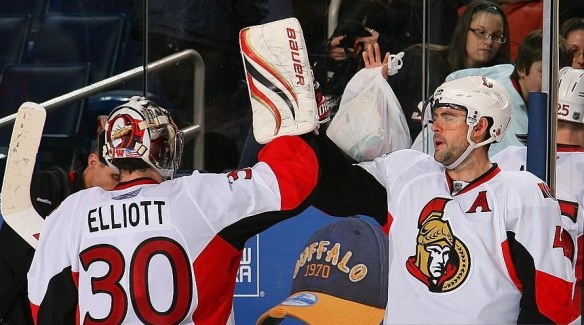
Chris Phillips congratulates Brian Elliott after a win in Buffalo.

Senators: 130 GP, 59-45, 2.80 GAA, .903 SV%
Avalanche: 12 GP, 2-8, 3.83 GAA, .891 SV%

PREDICTION: Erik Karlsson may be second in points in the entire league, but he’s still over 15 points behind league leader Patrick Kane. Look for him to make up most of the difference in this game, and for all the post-game questions to be about that pinch he was burned on in the third minute. Senators 5, Avalanche 0.

Saturday, February 13 – Senators @ Blue Jackets

98-99OttSen

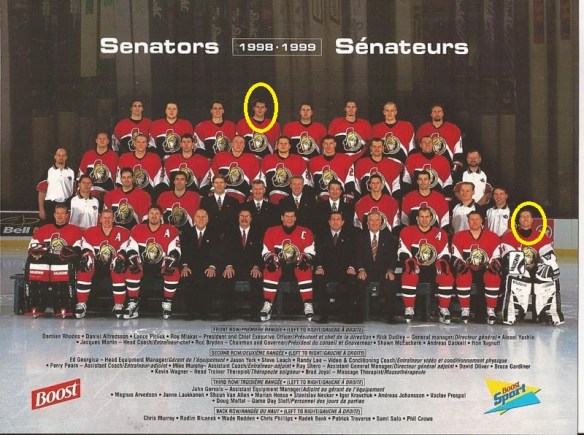
Chris Phillips and Ron Tugnutt pose for an intimate personal photo.

Senators: 166 GP, 72-53, 2.32 GAA, .906 SV%
Blue Jackets: 97 GP, 34-52, 2.62 GAA, .910 SV%

PREDICTION: A game against the Blue Jackets is the kind of low-pressure environment where Dave Cameron can try out new lines without worrying about Internet people firing off hurtful, charged phrases like “sub-optimal deployment”. So look for the debut of the Prince-Paul-Pageau line, which will be called the “Triple-P Line” by 99% of Sens fans and the “3 Feet High and Rising Line” by the rest. Senators 5, Blue Jackets 0.

Posted in Uncategorized | 1 Reply

Bobby Ryan, Coded Language, and Prejudice

(CW: prejudice and racism)

On the surface of things, Bobby Ryan’s answer to who he’s cheering for in Super Bowl 50 tomorrow might have seemed innocuous. He was just expressing a preference for one team, one set of players over another. He’s an NHLer with an understanding of what makes for a great professional. He just doesn’t like dabbing. It would be easy to read it this way.

Ryan’s been welcomed into the Ottawa community with open arms. In his three seasons with the team, he’s ingratiated himself to fans and the media alike, with his low key personality, honesty in interviews, and willingness to take responsibility for his and the team’s failings. He plays through injuries. He interacts with fans on social media and is willing to pose for pictures. He does a lot of things you want a player to do.

But he also has a pattern of racial prejudice expressed online and in the media that reflects the racist framework of North American pro sports like hockey. In today’s Ottawa Sun, a piece ran in which an informal poll of the dressing room asked which team the Sens players wanted to win tomorrow’s Super Bowl. Some expressed a desire for a Broncos win to see veteran Peyton Manning go out of top. However, a few players admitted to actively rooting against the Cam Newton-led Carolina Panthers. Clarke MacArthur commented that Carolina has “Just too much show after every play,” and Bobby Ryan echoed his teammate’s frustration. I don’t know if MacArthur’s comments are indicative of a professional conservatism often found in Canadian hockey players. They might be, as it’s certainly possible to dislike the Panthers and Newton for reasons other than race. But Ryan’s comments stand out because of how he pushed the issue and his personal history when it comes to topics of race. Here’s the relevant section from the Sun:

“I’m not a big Cam Newton fan,” Bobby Ryan said of the Carolina Panthers quarterback. “As a player, yes, I think he’s unbelievable. But I can’t stand the stuff he does.”

Over-the-top celebrating?

“Yeah, it’s idiotic,” said Ryan. “You’re up by 30 last week and you’re still doing it all over the field.”

Particularly annoying to Ryan (although apparently not to Mark Stone) is the dab, a dance move Newton has made even more popular that sees him stick both arms out to one side and bury his nose in the bent elbow.

“Guys do it around here now, which is really disappointing,” said Ryan. “It’s seeped its way into the NHL and I’m not a big fan.

“I don’t know the origin. I feel like it’s a song that’s been played, but you have to ask Stoner because he loves it.”

Prejudice and racism are easier to spot when people hurl slurs and are explicit in their language. It’s why it’s easier to denounce Donald Trump as racist but why we struggle to see why leaders in the Black Lives Matter movement take issue with many of Bernie Sanders policies.

Ryan doesn’t use slurs so many will just see these comments as a preference for the celebration style of Manning instead of Newton. Except it’s not. This is coded language, designed to obscure that race is the objection here. During the media frenzy that is the build up to the Super Bowl, Newton’s celebrations, pants, sandals, and general fashion sense has been interrogated in ways they never are for white athletes. Newton is just the latest in a long line of black quarterbacks who have been subjected to harsh criticisms their white counterparts never received. Interrogating personal choices such as fashion or on-field celebrations of black athletes is an attempt by mainstream media, professional leagues, and fans to control expressions of black masculinity, often perceived to be threatening. When white athletes, coaches, league officials, and media members talk about how to “act like a pro,” it is most often an attempt to discourage expressions of difference, whether it be sexuality, gender identity, religion, or in this case, race. “Act like a pro” more often means, “act like us” – white, cis, straight, and male.

It’s funny that in his concern for professional conduct, Ryan did not mention Manning’s longstanding misogyny, his documented sexual harassment, and his continued refusal to leave his victim alone. Peyton is viewed as professional; his substantial promotional work for pizza and insurance helps cement that image despite what we know about him. Another former NFL MVP, Aaron Rodgers, celebrates touchdowns with a wrestling title-belt gesture to cheers. Cam Newton is not granted similar leeway. Instead, Ryan attacked Newton’s ebullience after scoring plays, which as someone who has watched Bobby’s euphoric celebrations after each of his Ottawa goals, seems hypocritical. Bobby can fist pump, jump into the glass, shout, and hug teammates because his intensity is never viewed as threatening. He’s white. This also provides Ryan the protection to criticize a black athlete for a practice he himself engages in.

Ryan’s dismissal of dabbing is similarly coded and not a principled stance against appropriating black culture. Rather, his ignorance of dabbing’s roots in the hip-hop community and his refusal to acknowledge its current popularity are in some ways a rejection of black expression as valid, as culturally relevant. It’s a rejection of black culture’s influence on the professional sports landscape.

This isn’t a simple difference of opinion rooted in the respective distinctiveness of football as compared to hockey. Players of colour have been subjected to similar critiques in the NHL as well. P. K. Subban’s enthusiastic goal celebrations have been denounced by some Senators in the past and frequently by mainstream hockey media. When Ryan took ownership for his late slump last season by stating “I just suck right now,” it was seen as leadership. When Subban explicitly expressed his frustration at Montreal’s lengthy ongoing slump last month, it was a “profanity-laden tirade” and comments from his parents were sought. But when Erik Karlsson swears, the media doesn’t turn it’s focus to Sweden to consult his mom and dad. In both Subban’s and Newton’s cases what fellow players and media hope to contain is their expressions of individuality, what they hope to maintain is white privilege.

If you’re concerned that this examination of Ryan’s comments is a stretch or an overreaction, please note it fits a pattern of behaviour with the Sens winger. Last year when the Sens were visiting St. Louis, Black Lives Matter protests were in full swing. These activists and community members were protesting the murder of black teen Mike Brown by police in the St. Louis suburb of Ferguson. Ryan callously tweeted that the protests were interrupting his pregame nap. It showed disdain for both the protesters and their cause. It would have been a perfect metaphor for white privilege except it wasn’t a metaphor, it was real life.

Ryan’s prejudiced behaviour on twitter goes beyond his tweets. His “likes” are a dumpster fire of racism. They reveal a penchant for agreeing with the worst racists active in American politics right now. He’s liked tweets about Donald Trump preventing Muslims from entering the United States and racists tweets about Barack Obama. There are more examples. This is a pattern, this is prejudice. Like everyone, he’s entitled to his opinions. Like everyone, he’s not above criticism.

Bobby Ryan is polite. Bobby Ryan scored a goal and got a kid a puppy. Bobby Ryan was kind to you when he posed for a photo at the grocery store. Bobby Ryan has done all of those things.

But Bobby Ryan is prejudiced and he’s made that pretty clear too.

Nothing is served by ignoring this pattern in Ryan’s behaviour. Equally, nothing is gained from refusing to interrogate how Ryan’s actions fit within the larger racist framework of professional sports in Canada and the United States. When playing the game the right way is so often code for playing the game within acceptable white standards of behaviour, we will continue to have players like Ryan maintain those standards, and continue to attack players like Newton and Subban who challenge such arbitrary norms.


Your Model Sucks

20160125_151812

No Fancy Stats argument is actually about stats. A statistic is a number that (theoretically) represents reality, and you can’t argue about reality1. Mark Borowiecki has a 5-on-5 score-adjusted CF% of 44% this season. Can’t argue with that. Patrick Wiercioch has 3 points this season and Erik Karlsson’s got 51 points this season. Can’t argue with that.

Analytics arguments are actually (#ACTUALLY) dissecting what these numbers mean in terms of player evaluation and future performance. These are questions without easy answers2 and really more about one’s philosophy and biases than they are about actual mathematics. This is why participants in a #fancystats argument mostly end up sounding like 3rd year undergraduates trying to nail the 5% class participation mark. This isn’t math class, it’s philosophy class.3

All this to say I’m not here to talk about stats. I’m here to talk about models, which are like stats only worse. Let me explain…

Ed note: This post is about to get wild nerdy. I don’t know how to prevent this. Turns out one can’t talk about their personal philosophy of phenomenological modelling without sounding like a huge dork. So it goes.

In a perfect world, you would describe and make predictions about all physical phenomena by applying the prescribed laws. Physicists love doing this. Physicists write down some laws, solve some differential equations, and boom there’s General Relativity. Very few things ever work out this nicely. Most things worth studying contain too many moving parts to accommodate well-defined system behaviour. The real world is messy. This is where models come in.

A model takes inputs, does math to the inputs (to use the technical term), and then spits out an an output that looks hopefully looks like reality. A good model should help us make inferences about the relationship between Things. However, and this is very important to always bear in mind, just because a model looks like reality does not mean that it is necessarily a good stand-in for reality. This is the origin of the expression from the statistician George Box, “All models are wrong, some models are useful.

Which brings me back to the intentionally inflammatory title of this post: your model sucks. It does. It is in the very nature of modelling that a model is an imperfect representation of reality. Therefore, if a model is to be taken seriously, I believe that the ways in which it is imperfect must be both qualitatively and quantitatively stated (and if your default position is to say “It’s just because of variance”, I will personally wish for you to be haunted until the end of your days by the ghost of Ludwig Boltzmann.)

There is another philosophical question that must be answered, which is “What is this model for?”. Is it meant to be a descriptive model (and if so, why is it necessarily better than examining raw inputs?), or is it a predictive/evaluative model (and if so, just how predictive is it?). There’s a couple of models floating around out here, and it’s not always clear what supposed to be for.

Let’s look at the much-ballyhooed dCorsi. From Stephen Burtch’s post, “dCorsi represents the unexplained residual portion of Corsi results observed for a given skater in a given season.” which is to say it’s the difference between The Fancy Model and Reality. Even if dCorsi is repeatable (its year-over-year R-squared is about 0.15), all that would really mean is that the model is wrong in some consistent ways, which I would find worrying if it was my job to apply the model. I would rather just use dCorsi as a way to quantify the error bars on the model outputs. I think it’s difficult to properly use something like dCorsi as an evaluative tool when it is literally just an expression of what you don’t know.

Then there is this:

In general I feel like weird results such as this, where Brad Marchand has a Goals Above Replacement per 60 that is 50% higher than Patrick Kane, or where John Tavares and Jack Eichel have worse dCorsis than Zac Rinaldo really say much more about the model in question than they do about the player being modeled. It’s tough for me to read this post without coming away with the impression that the values from this Expected Goal model should have some big goddamn error bars on them. Merely posting something that basically says “Aaaaaaay, look how much better Brad Marchand is than Patrick Kane.” is slightly absurd because Brad Marchand is not a better hockey player than Patrick Kane. If anything, this tweet is best understood as an illustration of how much work on these types of models still need to be done4.

Not every deep truth about sports has to be couched in some sort of Gladwellian counter-intuition. Sometimes your model just sucks. I need to know why and by how much if I’m ever going to use it.

1. Ok just work with me on this one.

2. Don’t @ me.

3. Good example: Do secondary assists matter? Answer: it depends! Speaking of secondary assists, we here at Welcome to your Karlsson Years dot com would like to bestow the Lifetime Achievement Award in Petty Hating to Tyler Dellow for his 2012 piece (which sadly no longer exists on the internet) in which he examined every single one of Erik Karlsson’s assists in an attempt to de-legitimize EK’s point totals. You did it, boo! (You can read Travis Yost’s response here.)

4. I believe Zack Lowe’s amazing piece on the Toronto Raptors’ player tracking department is an excellent indication of how much more data (i.e. a ludicrous amount of data) modelers will need before useful models can be created for hockey. Until then, I’ll settle for some big ol’ error bars on this stuff.